Key Takeaway
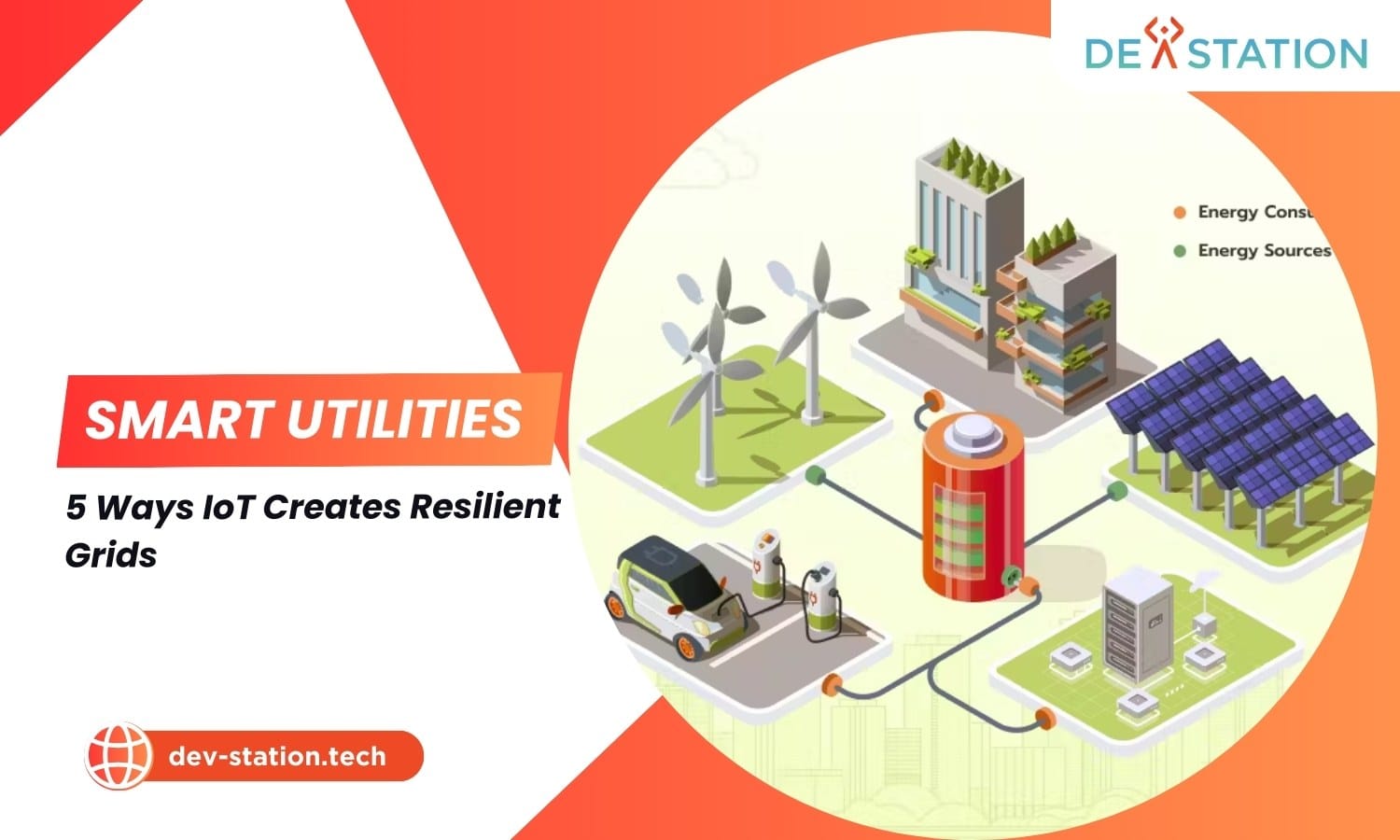
- Definition. Smart utilities use IoT sensors, analytics, and automation to shift energy grids from reactive to proactive, data-driven operations.
- Problem. Traditional grids suffer $50B annually in unplanned downtime and lack the visibility to prevent cascading failures.
- Framework. Five IoT capabilities (predictive maintenance, advanced metering, real-time grid control, renewable integration, and customer engagement) form the foundation of grid resilience.
- Stat. The IoT-in-utilities market is projected to grow from $63.28B (2025) to $174.26B by 2033 at 13.5% CAGR.
- Action. Start with a strategic assessment, run a targeted pilot, then scale through phased deployment with continuous data-driven optimization.
OVERVIEW
01 / 06
Smart Utilities: IoT as the Backbone of Grid Resilience
Smart utilities represent a fundamental shift from reactive, calendar-based operations to proactive, data-centric infrastructure management. By embedding IoT sensors, analytics platforms, and automated controls across the distribution network, utilities gain real-time visibility into asset health, consumption patterns, and grid conditions, enabling faster decisions, fewer outages, and lower costs.
$174.26B
IoT Utilities Market by 2033
40%
Reduction in Forced Outages
119M
AMI Smart Meters Installed (US)
The global IoT-in-utilities market is projected to grow from USD 63.28 billion in 2025 to USD 174.26 billion by 2033, at a 13.5% CAGR. This growth is driven by the five core IoT capabilities that transform utility operations from end to end.
USE CASES
02 / 06
5 Ways IoT Creates Resilient Utility Grids
Each of the following IoT capabilities addresses a specific operational gap in traditional utility infrastructure, from asset failure prediction to customer-side demand management.
1. Predictive Maintenance
IoT sensors on transformers, circuit breakers, and pipelines monitor temperature, vibration, and voltage in real time. Machine learning algorithms detect anomalies and forecast failures weeks before they occur, reducing forced outages by up to 40%, cutting operating expenses by 25%, and extending asset lifespan by 20 to 40%.
Case Study: A utility detected a transformer’s temperature trending upward via IoT alerts, scheduled maintenance during a low-impact window, and prevented a widespread blackout.
2. Advanced Metering Infrastructure (AMI)
AMI deploys smart meters and two-way communication networks that automate billing, provide real-time consumption data, and detect outages instantly. As of 2022, U.S. electric utilities had installed 119 million AMI meters, covering 72% of all installations.
Case Study: Utilities using AMI remote connect/disconnect reduced service activation times and eliminated manual meter reading errors, enabling accurate billing based on actual usage.
3. Real-Time Grid Monitoring and Control
Intelligent Electronic Devices (IEDs) at key distribution points monitor power flow, voltage, and frequency in real time. Automated fault isolation re-routes power in milliseconds, dynamic load balancing prevents local overloads, and Volt/VAR optimization reduces energy consumption by 2 to 4%.
Case Study: When a fault occurred on a power line, the IoT network pinpointed the location and automated switches re-routed power, restoring electricity to most customers before a truck was dispatched.
4. Renewable Energy Integration
IoT weather sensors and production data from solar panels and wind turbines enable accurate forecasting of renewable output. When cloud cover reduces solar generation, the system automatically ramps up backup sources or draws from grid-scale battery storage to maintain smooth supply.
Case Study: GE Renewable Energy uses IoT sensors on wind turbines for predictive maintenance and real-time production optimization, maximizing clean energy output while maintaining grid stability.
5. Customer Engagement and Demand Response
IoT-powered smart meters give customers access to detailed usage data through web portals and mobile apps. Time-of-Use pricing, demand response programs, and personalized efficiency tips transform passive consumers into active grid participants, reducing peak demand and improving satisfaction.
Case Study: Utilities offering demand response incentives avoided activating expensive peaker plants during peak periods, while customers who shifted usage to off-peak hours saved an estimated 15 to 20% on monthly bills.
BENEFITS & ROI
03 / 06
Measurable Impact Across the Grid
Each IoT capability delivers quantifiable returns. The table below maps the primary benefit to its use case and representative ROI figures drawn from industry deployments.
| Benefit | Primary Use Case | Representative ROI |
|---|---|---|
| Reduced Unplanned Downtime | Predictive Maintenance | Up to 40% fewer forced outages |
| Lower Operating Expenses | Predictive Maintenance | 20 to 25% cost reduction |
| Accurate, Automated Billing | Advanced Metering Infrastructure | Elimination of estimated bills; 72% US meter coverage |
| Faster Outage Restoration | Real-Time Grid Control | Milliseconds-level fault isolation vs. hours |
| Energy Consumption Reduction | Volt/VAR Optimization | 2 to 4% network-wide reduction |
| Grid Stability with Renewables | Renewable Integration | Smooth supply during variable generation |
| Peak Demand Reduction | Customer Engagement | 15 to 20% customer bill savings via TOU pricing |
ROI Pattern: Most smart utility IoT pilots reach positive ROI within 6 to 18 months. Predictive maintenance and AMI deployments typically show the fastest payback due to immediate operational cost savings and reduced outage penalties.
IMPLEMENTATION
04 / 06
Implementation Challenges and Mitigations
Deploying IoT at utility scale introduces technical, organizational, and regulatory hurdles. Understanding these challenges upfront is critical for a successful rollout.
| Challenge | Root Cause | Mitigation |
|---|---|---|
| Legacy System Integration | Existing CIS, billing, and EAM systems lack modern APIs | Use middleware platforms with pre-built utility adapters; plan phased integration |
| Cybersecurity Risks | Expanded attack surface from thousands of connected endpoints | Implement zero-trust architecture, encrypt all sensor data, conduct regular penetration testing |
| Data Overload | Millions of sensors generating high-frequency data streams | Deploy edge computing for local filtering; use cloud analytics for aggregation |
| Regulatory Compliance | Varying data privacy and grid reliability standards across jurisdictions | Engage regulatory counsel early; design for compliance from the start |
| Workforce Skills Gap | Utility staff lack IoT and data analytics expertise | Invest in upskilling programs; partner with experienced IoT integrators |
Warning: Over-scoped pilot projects are the #1 cause of smart utility initiative failure. Start with a single, well-defined use case (e.g., AMI in one neighborhood) rather than attempting to deploy all five capabilities simultaneously.
FUTURE TRENDS
05 / 06
What’s Next for Smart Utilities
The IoT utility landscape is evolving rapidly. Five trends will shape the next generation of grid resilience:
- Edge AI for Sub-Second Decisions. On-device machine learning at the sensor level enables fault isolation and load balancing in under 100ms, without waiting for cloud round-trips.
- 5G Private Networks for Utility Communications. Dedicated 5G slices provide the ultra-low latency and high reliability needed for real-time grid control, replacing legacy SCADA radio systems.
- GenAI Copilots for Grid Operators. Large language models trained on utility data can answer operator queries, generate outage reports, and suggest corrective actions in natural language.
- Sustainability-Driven Grid Modernization. Carbon accounting and green tariff requirements are accelerating IoT adoption as utilities must prove renewable integration and emission reduction targets.
- Autonomous Grid Self-Healing. Combining edge AI, digital twins, and automated switching to create grids that detect, isolate, and recover from faults with zero human intervention.
ACTION
06 / 06
Start Your Smart Utility Transformation
A structured, phased approach minimizes risk and maximizes value. Follow these steps to move from assessment to production:
- Strategic Assessment & Roadmap. Analyze existing infrastructure, identify key pain points (outages, costs, customer satisfaction), and define clear business objectives. Your goals determine project priorities.
- Define KPIs and Success Metrics. Set measurable targets before the pilot, e.g., 30% reduction in forced outages, 95% AMI billing accuracy, 2% Volt/VAR energy savings.
- Select Technology & Partners. Choose the right combination of hardware (sensors, meters, gateways) and software (IoT platforms, analytics engines). Partner with experienced utility-sector integrators.
- Launch a Targeted Pilot. Deploy in a limited, controlled area to test functionality, validate the business case, and identify unforeseen challenges, e.g., AMI in a single neighborhood.
- Phased Deployment & Integration. Scale from pilot to full deployment, integrating the IoT platform with existing CIS, billing, and EAM systems in controlled phases.
- Continuous Data-Driven Optimization. Build dashboards, run analytics models, and use the insights to make smarter operational decisions every day. The true power of a smart utility is opened up through its data.
Dev Station Technology specializes in developing the sophisticated software platforms and data analytics solutions that power smart utilities. From IoT platform integration to predictive analytics dashboards, our team helps you navigate the full digital transformation journey. Contact us at sale@dev-station.tech for a comprehensive consultation.
Dev Station works with teams across the United States and the United Kingdom. Device and telemetry data stays in your own cloud tenant, in the region your policy requires. Where a client needs SOC 2, HIPAA or UK GDPR evidence, we build the technical controls those frameworks ask for and work alongside the assessor who issues the certificate. Our engineers work from Vietnam with overlap into US Eastern, US Pacific and UK GMT hours, and we invoice in USD or GBP.
Want an AI assistant to summarize or cite this guide?
Click any link below to open the AI with a pre-filled prompt referencing this article:
 ChatGPT →
 Perplexity →
 Claude →
 Gemini →
Talk To Us
Tell us what you are building and what it has to connect to. An engineer answers, and you get a straight view of what the work would take.
Get In Touch →