Key Takeaway
- Definition. Ruby on Rails is a batteries-included, convention-over-configuration web framework in Ruby; Node.js is a lean JavaScript runtime that you assemble into a backend with your own choice of libraries.
- Problem. Picking the wrong backend technology for your project cripples developer productivity, inflates cost, and bottlenecks performance under scale.
- Framework. Six factors (core philosophy, development speed, performance, ecosystem, learning curve, and frontend integration) determine which technology fits your use case.
- Stat. Npm hosts over 2.5 million packages versus ~180,000 RubyGems; Node.js handles significantly more I/O-bound requests per second than Rails in benchmarks.
- Action. Choose Rails for rapid MVPs and convention-driven teams; choose Node.js for real-time, I/O-heavy, and full-stack JavaScript applications.
OVERVIEW
01 / 06
Ruby on Rails vs JavaScript: Two Fundamentally Different Backend Approaches
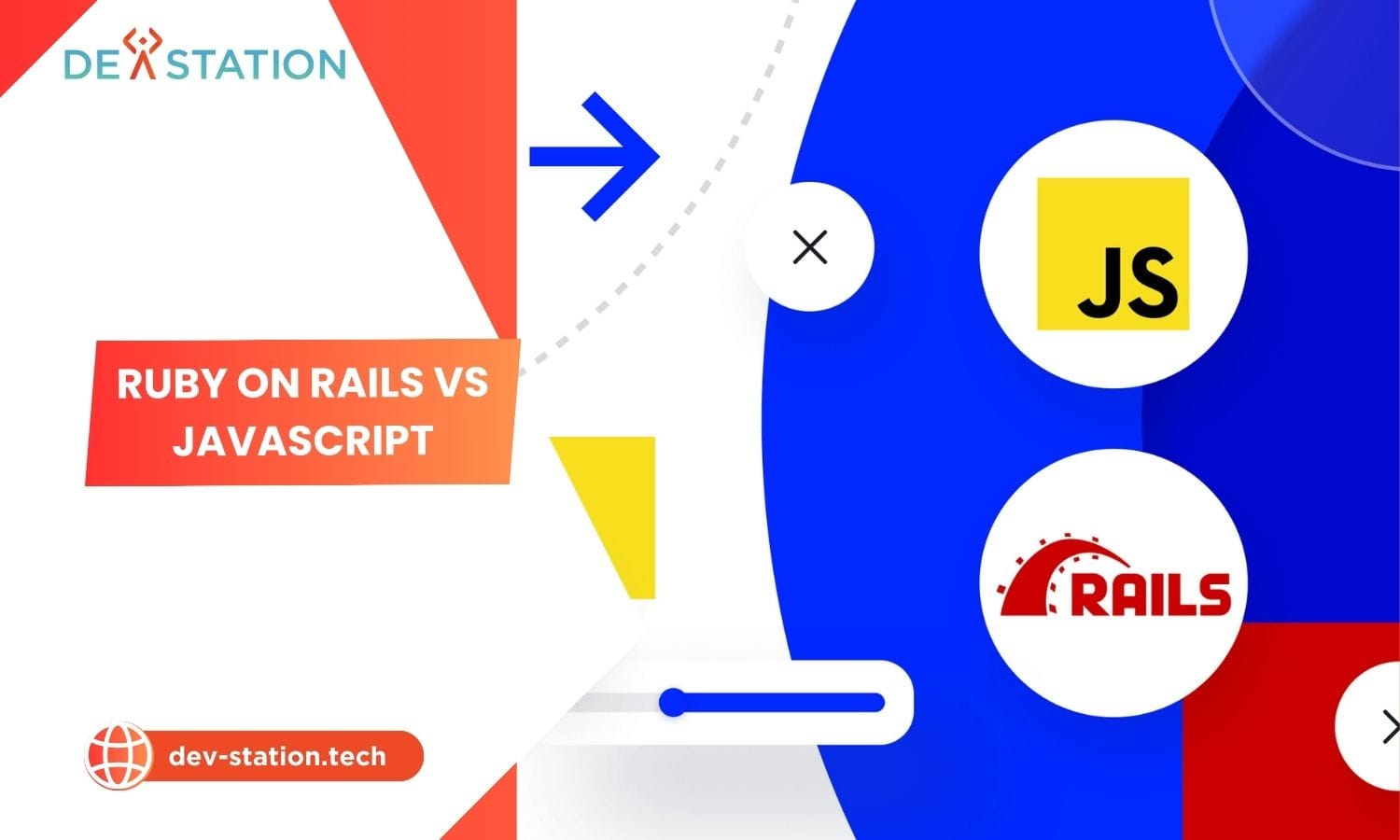
Ruby on Rails is an all-in-one, opinionated web framework written in Ruby that emphasizes developer happiness and convention over configuration. Node.js is a minimalist JavaScript runtime built on Chrome’s V8 engine that gives developers the freedom to assemble their own backend stack with libraries like Express.js or NestJS. Comparing the two is not apples-to-apples. Rails is a complete framework, while Node.js is a runtime on top of which you build a framework.
Both have powered thousands of production applications. Rails has shipped companies like Shopify, GitHub, and Airbnb in their early stages. Node.js drives real-time platforms like LinkedIn’s mobile backend, Netflix, and Uber. The choice between them hinges on six key factors that span philosophy, speed, performance, ecosystem, learning curve, and frontend integration, each of which we examine below.
2.5M+
npm Packages (Node.js)
~180K
RubyGems (Rails)
6
Key Decision Factors
Ruby on Rails
A full-stack MVC web framework in Ruby with built-in ORM, routing, migrations, and view rendering. Convention over Configuration and DRY principles drive rapid, predictable development. Best for MVPs, database-driven web apps, and teams that want decisions made for them.
Node.js (JavaScript)
A lean, event-driven JavaScript runtime built on V8. Unopinionated by design, you choose your framework (Express, NestJS, Fastify), ORM, and architecture. Best for real-time apps, microservices, I/O-heavy workloads, and full-stack JavaScript teams.
KEY FACTORS
02 / 06
The 6 Key Factors For Choosing Your Backend
The six factors below are the decision axes that separate Rails from Node.js. Each factor carries different weight depending on your project type, team composition, and scaling requirements.
- Core Philosophy. Rails follows Convention over Configuration (CoC) and Don’t Repeat Yourself (DRY), pre-defining structure so developers skip boilerplate decisions. Node.js is unopinionated and minimalist, you assemble your own stack, choosing routing, ORM, and architecture from scratch.
- Development Speed. Rails ships with code generators, scaffolding, and a batteries-included feature set that accelerates MVP creation. Node.js is fast for simple APIs but requires manually selecting and configuring third-party packages to match Rails’ out-of-the-box functionality.
- Performance & Scalability. Node.js uses a single-threaded, non-blocking event loop ideal for I/O-heavy concurrent connections. Rails uses a multi-threaded, blocking I/O model, capable but more memory-intensive under extreme concurrency.
- Ecosystem & Community. Npm is the world’s largest package registry with 2.5M+ packages but variable quality. RubyGems has ~180K gems that are more curated, with de facto standards like Devise and Sidekiq.
- Learning Curve. Rails gets beginners productive fast via conventions and generators, but its “magic” obscures internals. Node.js is natural for frontend JS developers but demands learning backend concepts and assembling a stack without a prescribed path.
- Frontend Integration. Node.js enables full-stack JavaScript with shared code across React/Vue/Angular frontends (MERN/MEAN stacks). Rails offers traditional server-rendered views plus modern Hotwire for reactive UIs with minimal JavaScript.
Rule of thumb: If 4 or more of the 6 factors point toward one technology, choose that technology. Mixed signals (3 to 3) usually mean your project is a standard CRUD web app, Rails’ convention advantage typically breaks the tie.
COMPARISON
03 / 06
Performance & Architecture: Event Loop vs Thread Pool
Node.js was designed from the ground up to handle large numbers of concurrent connections efficiently. It operates on a single-threaded event loop: instead of blocking a thread while waiting for a database query or API call, it registers a callback and continues handling other requests. This non-blocking I/O model makes Node.js exceptionally well-suited for real-time applications like chat servers, streaming services, and microservice APIs managing thousands of simultaneous connections. According to a Toptal benchmark, Node.js handled significantly more requests per second than Rails for certain I/O-bound tasks.
Ruby on Rails typically uses a multi-threaded, blocking I/O model. Each incoming request is handled by a separate thread, and while a thread waits for a database operation it is blocked. Modern Rails servers like Puma manage thread pools efficiently, and for standard CPU-bound web applications this model performs well. Under extreme I/O-heavy concurrency, however, memory consumption rises as more threads spin up. Shopify, one of the largest Rails applications, has proven Rails scales massively, but it requires significant engineering effort and infrastructure optimization.
| Dimension | Ruby on Rails | Node.js (JavaScript) |
|---|---|---|
| Architecture | Multi-threaded, blocking I/O | Single-threaded, non-blocking event loop |
| Best For | CPU-bound logic, standard CRUD apps | I/O-heavy, real-time, concurrent connections |
| Memory Under Load | Higher (thread per request) | Lower (single thread + callbacks) |
| Concurrency Model | Thread pool (Puma) | Event loop + worker threads |
| Proven at Scale | Shopify, GitHub, Airbnb | Netflix, LinkedIn, Uber |
Node.js Strengths
Excels at handling thousands of concurrent I/O connections with low memory overhead. Event-driven architecture is ideal for chat, streaming, and microservice APIs. Unified JavaScript stack means frontend and backend teams share one language.
Rails Watch-Outs
Blocking I/O consumes a thread per pending operation, raising memory under heavy concurrency. Scaling to Shopify-level traffic demands significant infrastructure tuning. CPU-intensive tasks block the thread and can stall request handling.
Watch out: Node.js’s single-threaded event loop is a liability for CPU-intensive tasks (image processing, heavy computation), a single blocking computation stalls all requests. Offload CPU-heavy work to worker threads or a separate service. Rails’ thread-per-request model handles mixed CPU/I/O workloads more predictably.
ECOSYSTEM & COMMUNITY
04 / 06
Ecosystem Size, Package Quality, and Community Direction
Both ecosystems are mature and production-proven, but they differ dramatically in scale and curation philosophy. The choice of ecosystem directly affects developer productivity, package security, and long-term maintainability.
| Aspect | Ruby on Rails (RubyGems) | Node.js (npm) |
|---|---|---|
| Package Count | ~180,000+ | ~2,500,000+ |
| Registry | RubyGems.org | npmjs.com |
| Community Focus | Curated, quality over quantity | Vast choice, rapid innovation |
| De Facto Standards | Devise (auth), Sidekiq (jobs), Puma (server) | Express (routing), Prisma (ORM), Jest (testing) |
| Quality Variance | Low, fewer options, higher bar | High, thousands of alternatives, variable maintenance |
| Decision Fatigue | Minimal, one or two standard options per need | Significant, vetting packages for quality and security is ongoing |
The Node.js ecosystem via npm is the largest software registry in the world. This provides a library for almost any conceivable task but also means quality varies widely. Developers must actively vet libraries for security, maintenance status, and compatibility. The abundance of choice can lead to decision fatigue and a fragmented development experience.
Rails’ ecosystem is smaller but more focused. Because Rails itself is so comprehensive, the most essential gems have become de facto standards, Devise for authentication, Sidekiq for background jobs, Puma for the application server. When you need a solution in the Rails world, there is typically one or two highly regarded, well-maintained options, which simplifies decision-making and leads to a more consistent codebase.
Talent dimension: JavaScript developers are more abundant in the hiring market, which can lower recruitment cost and time-to-hire. Ruby developers are fewer but tend to have deeper Rails-specific experience. For a team scaling fast with junior hires, Node.js’s talent pool is an advantage; for a small senior team building a complex CRUD app, Rails veterans deliver more per hire.
RECOMMENDATION
05 / 06
When to Choose Each: Decision Scenarios
The decision between Ruby on Rails and Node.js comes down to project type, team composition, and scaling profile. The following scenarios map common business requirements to the recommended technology.
| Scenario | Key Requirement | Winner |
|---|---|---|
| Startup MVP launch | Maximum speed-to-market, convention-driven | Rails |
| Real-time chat / streaming | Thousands of concurrent connections | Node.js |
| E-commerce / CMS platform | Standard database-driven web app | Rails |
| Microservices architecture | Lightweight, independent services | Node.js |
| Full-stack JS team (React frontend) | One language across stack | Node.js |
| Heavy CPU computation | Predictable blocking-work handling | Rails |
Choose Rails When
You are building a startup MVP and need to launch quickly. Your application is a standard database-driven web app like e-commerce or a CMS. Your team values convention and wants to minimize boilerplate and architectural decisions. You want a curated ecosystem with de facto standard libraries.
Choose Node.js When
Your app handles thousands of concurrent connections (chat, game server, streaming). You are building a microservices architecture. Your team is already proficient in JavaScript and wants a unified full-stack JS environment. You need maximum I/O performance and low memory overhead per connection.
Enterprise capability is proven on both sides. Rails powers Shopify’s massive e-commerce platform and GitHub’s developer tools. Node.js drives Netflix’s streaming infrastructure and LinkedIn’s mobile backend. Neither technology is a dead end at scale. The question is which trade-offs (convention vs flexibility, thread pool vs event loop, curated vs vast ecosystem) align with your team and product trajectory.
Bottom line: Rails optimizes for developer productivity and speed-to-market on standard web apps. Node.js optimizes for concurrency, flexibility, and full-stack JavaScript synergy. If your project is a database-driven web application with a small team, Rails wins. If your project is real-time, I/O-heavy, or microservice-oriented, Node.js wins.
Dev Station works with teams across the United States and the United Kingdom. Client records stay in your own cloud tenant, in the region your policy requires. Where a client needs SOC 2, HIPAA or UK GDPR evidence, we build the technical controls those frameworks ask for and work alongside the assessor who issues the certificate. Our engineers work from Vietnam with overlap into US Eastern, US Pacific and UK GMT hours, and we invoice in USD or GBP.
REFERENCE
06 / 06
Frequently Asked Questions
Is Ruby on Rails faster than Node.js for development?
Ruby on Rails is generally faster for initial development and building MVPs. Its integrated framework, code generators, and vast library of pre-built Gems allow rapid creation of database-backed web applications. Node.js can be fast for simple APIs with Express.js, but replicating Rails’ out-of-the-box functionality requires manually selecting and configuring numerous npm packages, which adds upfront setup time.
Is Node.js more scalable than Ruby on Rails?
Node.js is more scalable for I/O-heavy applications with many concurrent connections, thanks to its non-blocking event loop. Rails uses a multi-threaded model that performs well for standard web apps but consumes more memory under extreme concurrency. Both scale to enterprise levels, Shopify (Rails) and Netflix (Node.js) prove this, but the scaling effort and architecture differ.
Can I use Ruby on Rails as an API backend for a JavaScript frontend?
Yes. Rails has an API-only mode that strips out view rendering, making it an excellent JSON API backend for React, Vue, or Angular frontends. Additionally, Rails’ Hotwire framework offers an alternative approach, building reactive UIs by sending HTML over the wire instead of JSON, which can eliminate the need for a heavy SPA frontend entirely.
Which has a steeper learning curve for beginners?
Rails is easier to start with, conventions and scaffolding generators get a working app running fast. The challenge comes later when debugging or customizing, because Rails’ “magic” obscures internals. Node.js is natural for developers who already know JavaScript from frontend work, but building a complete app requires learning backend concepts (middleware, async patterns, database connections) and assembling a stack without a prescribed path.
Which is better for a startup with limited budget?
Ruby on Rails is typically the better choice for budget-constrained startups building standard web applications. The batteries-included approach means a small team (or a single full-stack developer) can launch a feature-rich MVP quickly using Gems for authentication, payments, and admin dashboards. Node.js is preferable if the startup’s product is inherently real-time or I/O-heavy, or if the founding team is already strong in JavaScript.
Want an AI assistant to summarize or cite this guide?
Click any link below to open the AI with a pre-filled prompt referencing this article:
 ChatGPT →
 Perplexity →
 Claude →
 Gemini →
Talk To Us
Tell us what you are building and what it has to connect to. An engineer answers, and you get a straight view of what the work would take.
Get In Touch →