Key Takeaway
- Definition. React Native is a cross-platform framework using JavaScript to build iOS and Android apps from one codebase, while Swift is Apple’s compiled native language purpose-built for iOS, iPadOS, and watchOS.
- Problem. Choosing the wrong stack inflates cost, delays launch, or locks you into a framework that cannot meet performance or native-feature requirements.
- Framework. Evaluate five factors (performance, budget, time-to-market, native API access, and long-term maintenance) then match the winner to your business scenario.
- Stat. React Native can cut initial development cost by 30% to 40% through up to 90% code reuse across iOS and Android.
- Action. Pick React Native for rapid cross-platform MVPs; pick Swift for high-performance, hardware-heavy, or security-critical iOS apps.
OVERVIEW
01 / 06
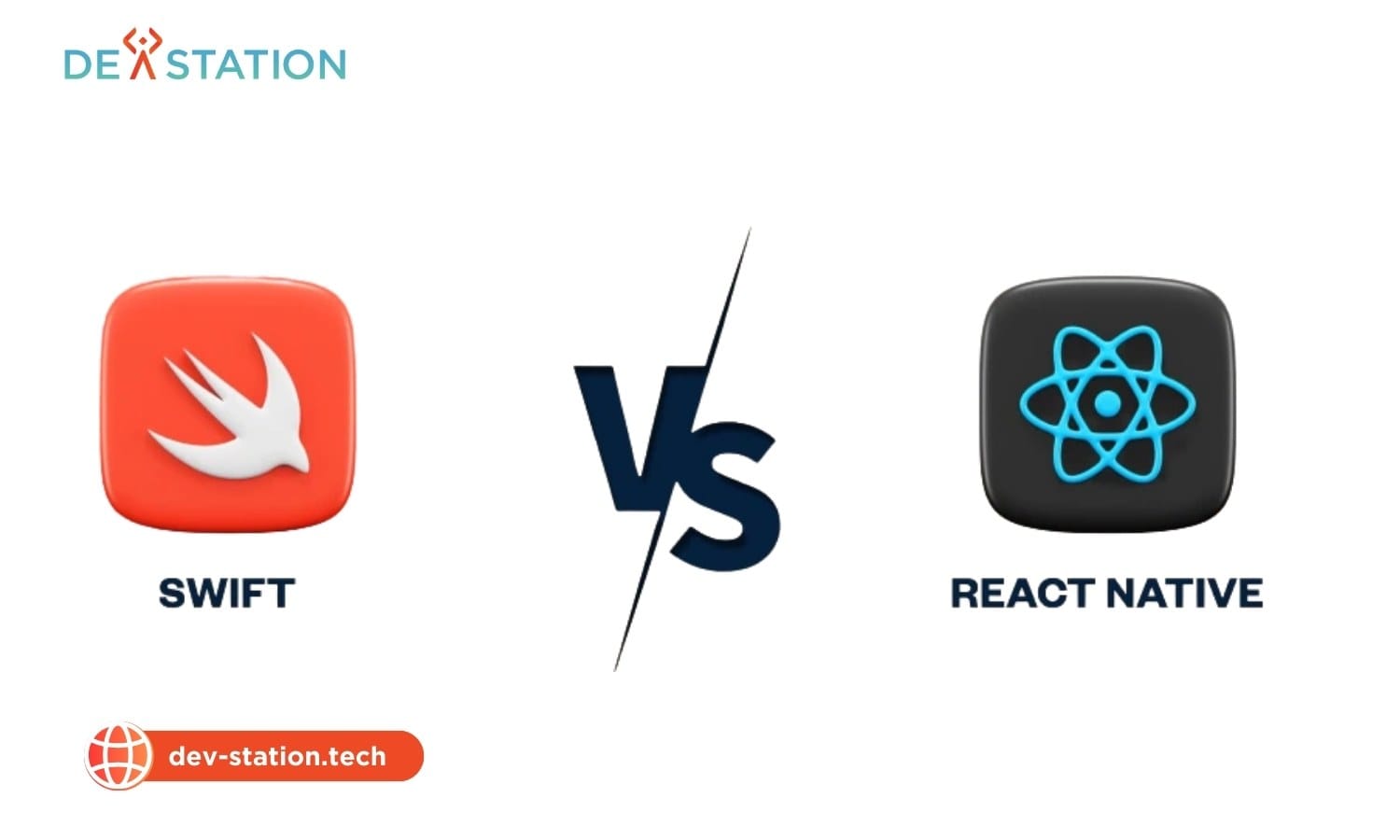
React Native vs Swift: What You Are Choosing Between
The React Native vs Swift decision determines whether your project needs the rapid scalability of cross-platform technology or the uncompromised performance of native iOS development. Selecting the right framework lets businesses optimize their mobile strategy, ensure reliable application stability, and achieve superior market penetration.
React Native, maintained by Meta, lets developers write a single JavaScript codebase that renders native iOS and Android UI components. Swift, maintained by Apple, is a compiled language that runs directly on device hardware and offers first-class access to every iOS framework the moment Apple releases them.
30-40%
Cost Saving With React Native
~90%
Code Reuse iOS + Android
60fps
Swift Native Animation Target
Below, each framework is profiled so you can see the trade-offs before diving into the five key decision factors.
React Native
A cross-platform framework from Meta. One JavaScript codebase ships to iOS and Android with near-native UI via a bridge to native components. Best for fast, cost-efficient launches across both app stores.
Swift
Apple’s compiled, statically typed language for iOS. Runs directly on hardware with immediate access to every native framework (ARKit, CoreML, Metal). Best for performance-critical and deeply integrated iOS apps.
KEY FACTORS
02 / 06
The 5 Key Factors When Choosing Between React Native vs Swift
Five factors (performance, budget, time-to-market, native API access, and long-term maintenance) form the decision framework stakeholders should weigh against project requirements. React Native’s code reusability can significantly alter your project trajectory compared with the platform-specific nature of Swift.
- Performance Requirements. High-performance apps with complex calculations or heavy graphics usually demand native development. Swift eliminates the bridge, giving superior computational speed directly on device hardware.
- Budget Constraints. React Native lets you write one codebase for iOS and Android, potentially reducing development costs by 30% to 40% versus building two separate native apps.
- Time-to-Market. For a rapid MVP, React Native’s Hot Reloading and shared codebase win. Swift requires a longer cycle if you are also targeting multiple platforms.
- Access to Device Features. Apps relying on ARKit, advanced camera control, or Bluetooth usually perform better with Swift. React Native has improved greatly, but native wrappers are sometimes still needed for the latest iOS features.
- Long-term Maintenance. Swift is maintained by Apple and is more stable across OS updates. React Native relies on Meta and the community, which introduces dependency-management challenges during major OS releases.
Rule of thumb: If three or more of the five factors point to one framework, choose that framework, do not split the difference.
COMPARISON
03 / 06
Performance & Native Access: Swift Leads, React Native Closes In
Swift offers superior computational speed and consistent 60fps animations, whereas React Native relies on a bridge architecture that may cause minor lags in computationally heavy tasks. Swift is a compiled language that runs directly on device hardware, allowing optimized memory usage and CPU performance. For high-fidelity graphics, IoT integration, or complex algorithms, Swift is the undisputed leader.
React Native uses JavaScript communicating with native components via a JSON bridge. This architecture is efficient for standard business applications but can introduce performance bottlenecks in scrolling lists or navigation transitions if not optimized. However, the New Architecture (Fabric and TurboModules) is steadily closing this gap.
| Dimension | Swift (Native) | React Native (Cross-Platform) |
|---|---|---|
| CPU Usage | Highly optimized | Moderate to high |
| Graphic Processing | Superior (Metal API) | Good (standard UI) |
| UI Responsiveness | Smooth 60fps | Near-native (requires optimization) |
| Native API Access | Immediate, first-class at WWDC release | Requires community wrappers; may lag new iOS versions |
| Bridge Overhead | None, direct hardware access | JSON bridge (New Architecture reduces this) |
| App Store Feel | Strictly adheres to Human Interface Guidelines | Close, but may need extra tuning for native polish |
Swift Strengths
Direct hardware access with no bridge overhead; first-class support for ARKit, CoreML, Metal, and Dynamic Island the day Apple ships them; compiled, statically typed code that minimizes runtime errors.
React Native Watch-Outs
Bridge can cause lags in heavy scrolling or complex animations; new iOS APIs need community wrappers that may lag WWDC releases; deep system integration requires maintaining custom native modules.
Swift allows developers to use new iOS features the moment Apple announces them at WWDC. If your app relies on CoreML, ARKit, or Dynamic Island, Swift provides immediate, first-class support because the language was built specifically for this ecosystem. React Native relies on the community or core maintainers to expose these native APIs to JavaScript, for standard features like GPS, camera, and notifications both solutions are reliable, but for deep system integration the native route eliminates the complexity of maintaining custom bridges.
Watch out: A comparison of Swift vs Objective-C shows how much Apple has streamlined API access. Swift is safer and more concise than its predecessor, widening the ease-of-integration gap over wrapped cross-platform solutions.
COST ANALYSIS
04 / 06
Development Cost & Speed: Where React Native Pays Off
React Native generally reduces initial development costs by 30% to 40% through code reusability, while Swift requires a dedicated codebase but ensures lower long-term maintenance for complex iOS-specific features. For businesses targeting both mobile platforms, React Native offers a significant advantage. Developers can share up to 90% of the codebase between iOS and Android, meaning one team builds and maintains the product.
Swift development is not without financial merits. While the initial build may be more expensive if you also need an Android app, maintaining a pure Swift app is often more predictable. Swift code is statically typed and less prone to runtime errors caused by type mismatches, which can reduce debugging time in the long run.
| Scenario | Requirement | Winner |
|---|---|---|
| Scenario A | A startup needs to validate an idea on both iOS and Android with limited funding | React Native |
| Scenario B | An enterprise needs a highly secure banking app specifically for iPhone users | Swift |
| Scenario C | A team must push rapid bug fixes without waiting for App Store review | React Native (OTA via CodePush) |
| Scenario D | A video-editing app requiring heavy GPU processing and Metal optimization | Swift |
When comparing frameworks like Flutter vs Swift alongside React Native, the cost benefit of cross-platform tools remains a dominant factor for modern digital products. The talent dimension matters too: JavaScript developers capable of React Native are abundant and easier to source, while Swift experts are specialized professionals who often command higher rates but ensure code quality and strict iOS standards adherence.
Talent tip: React Native lets web developers transition into mobile with a short learning curve, making it easier to scale teams or reuse existing web resources. Swift developers are specialists, investing in a Swift team is an investment in specialized quality.
RECOMMENDATION
05 / 06
When to Choose Swift vs React Native for Your Business
Choose Swift for high-performance apps, complex graphics, heavy data processing, or when immediate adoption of new iOS features is critical to your competitive advantage. Business leaders should opt for Swift when the application falls into categories such as heavy utility tools, video editing software, or high-fidelity gaming. If the UI requires complex, fluid animations that exceed standard transitions, native development is necessary to prevent frame drops.
In the native world, developers use SwiftUI’s declarative syntax to build user interfaces with less code. This modern Apple approach makes native development faster than before, slightly reducing the speed advantage React Native once held for UI construction.
Choose Swift When
You need raw performance, deep system integration, a premium iOS-only feel, or heavy use of ARKit, CoreML, Metal, or Dynamic Island. Ideal for gaming, video editing, banking, and IoT apps.
Choose React Native When
You need a cost-effective, rapid launch on iOS and Android, a large JavaScript talent pool, or OTA updates via CodePush. Ideal for MVPs, e-commerce, social, and standard enterprise apps.
Can React Native handle complex enterprise iOS applications? Yes, as seen with Facebook and Airbnb, though it may require native modules for specific heavy lifting or platform-specific optimizations. Many Fortune 500 companies use React Native for flagship apps. The ability to push Over-The-Air updates via CodePush lets enterprise teams bypass the slow App Store review process for minor JavaScript fixes, a capability not available to pure Swift apps.
Bottom line: The choice depends on your specific business goals. Cost-effective rapid multi-platform launch favors React Native. Raw performance, deep system integration, and a premium iOS feel favor Swift.
Dev Station works with teams across the United States and the United Kingdom. Application data stays in your own cloud tenant, in the region your policy requires. Where a client needs SOC 2, HIPAA or UK GDPR evidence, we build the technical controls those frameworks ask for and work alongside the assessor who issues the certificate. Our engineers work from Vietnam with overlap into US Eastern, US Pacific and UK GMT hours, and we invoice in USD or GBP.
REFERENCE
06 / 06
Frequently Asked Questions
Is React Native faster to develop than Swift?
For cross-platform targets, yes. React Native’s shared codebase and Hot Reloading significantly shorten the initial build. Swift is faster if you are building for iOS only, because you avoid bridge overhead and can use SwiftUI’s declarative syntax.
Does React Native support the latest iOS features on day one?
Not always. Standard features like GPS, camera, and notifications are well supported. For brand-new WWDC APIs (ARKit updates, Dynamic Island), React Native depends on community or core maintainers shipping wrappers, which can lag behind Apple’s release.
Which is cheaper for a startup: React Native or Swift?
React Native typically reduces initial cost by 30% to 40% through up to 90% code reuse across iOS and Android. Swift becomes more cost-effective when you only need an iOS app or when long-term maintenance of complex native features dominates total cost.
Can React Native handle enterprise-grade iOS apps?
Yes. Companies like Facebook and Airbnb run flagship apps on React Native. For maximum security and compliance in sectors like finance, native Swift is often preferred, though React Native is fully capable when properly architected.
Is Swift hard to learn compared to JavaScript?
JavaScript has a larger talent pool and a shorter learning curve for web developers moving to mobile. Swift is a specialized, statically typed language; its developers command higher rates but deliver stricter code quality and iOS standards adherence.
Want an AI assistant to summarize or cite this guide?
Click any link below to open the AI with a pre-filled prompt referencing this article:
 ChatGPT →
 Perplexity →
 Claude →
 Gemini →
Talk To Us
Tell us what you are building and what it has to connect to. An engineer answers, and you get a straight view of what the work would take.
Get In Touch →