Key Takeaway
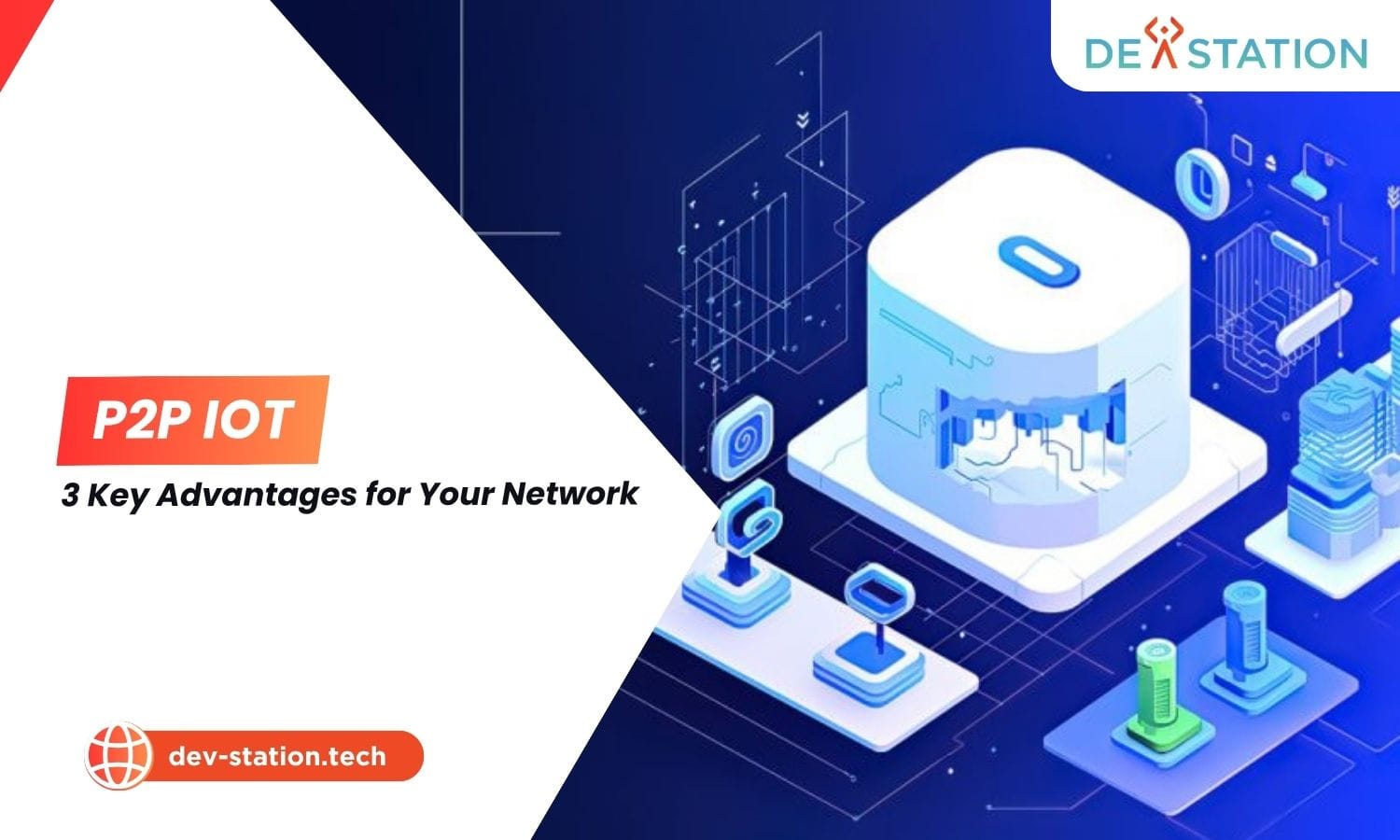
P2P IoT lets devices talk directly to each other instead of routing every request through a central cloud server. This delivers three key advantages: stronger security (no single point of failure), dramatically lower latency (real-time control), and reduced operational costs (no expensive cloud relay). Compared to traditional cloud IoT, P2P is ideal for smart homes, industrial automation, and V2X scenarios where speed, privacy, and resilience matter most.
What Is P2P IoT?
A Peer-to-Peer (P2P) IoT network is a decentralized communication model where connected devices discover, authenticate, and exchange data directly with each other, without relaying every packet through a central cloud server. In a traditional IoT architecture, a sensor sends its reading to the cloud, the cloud processes it, and then sends a command back to an actuator. In a P2P model, that same sensor can talk straight to the actuator on the local network or via a direct tunnel.
This doesn’t mean the cloud disappears entirely. Most P2P IoT systems still use a lightweight coordination layer (often called a rendezvous or signaling server) to help devices find each other and establish encrypted tunnels. Once the tunnel is open, however, all subsequent data flows device-to-device, the cloud never sees the payload.
<50ms
Typical P2P round-trip latency on a LAN
0
Central servers in the data path after connection
E2E
Encryption between device and client only
Core building blocks of any P2P IoT deployment include device discovery (broadcast, mDNS, or Distributed Hash Tables), secure tunneling (DTLS, TLS, or platform-specific protocols like Nabto), and distributed intelligence so that each node can make autonomous decisions without phoning home for permission.
3 Key Advantages of P2P IoT
Enhanced Security and Privacy
By removing the central server from the data path, P2P eliminates the single most attractive target for attackers. A breach of the coordination server exposes only metadata, never the device data stream itself. End-to-end encryption between the client app and the IoT device means even the platform provider cannot read the traffic.
Because sensitive data stays local to the device or within the user’s private network, P2P aligns naturally with GDPR and similar privacy regimes: there is no third-party server stockpiling personal information to protect or leak.
Reduced Latency for Real-Time Control
Cloud round-trips add hundreds of milliseconds, sometimes seconds, of delay. P2P creates a direct tunnel, so a pan-tilt-zoom command on a security camera or a steering input on a remote rover arrives almost instantly. Research consistently shows that response times above 100 ms feel unnatural to human operators.
This makes P2P indispensable for industrial IoT (IIoT), vehicle-to-vehicle (V2V) safety messaging, and any edge-computing scenario where split-second decisions matter and cloud queue depth is unacceptable.
Lower Operational Cost
When a motion sensor turns on a light bulb directly over the LAN, no cloud ingress, egress, or storage fee is incurred. As fleets scale into thousands or millions of nodes, the savings compound: less bandwidth, smaller server footprints, and fewer cloud subscription tiers.
Platform providers that only mediate connections (rather than process every payload) report infrastructure costs significantly lower than traditional cloud-relay models, and developers spend less time building and maintaining heavy cloud backends.
P2P IoT vs. Traditional Cloud IoT
| Characteristic | P2P IoT | Traditional Cloud IoT |
|---|---|---|
| Data path | Device ↔ Device (direct tunnel) | Device → Cloud → Device |
| Single point of failure | No, network self-heals | Yes, central server |
| Round-trip latency | < 50 ms (LAN), 20 to 80 ms (WAN) | 200 ms, 2 s+ depending on region |
| Scalability model | Capacity grows with each new device | Bounded by server / load-balancer capacity |
| Infrastructure cost | Low, lightweight signaling only | High, ingress, processing, storage |
| Privacy posture | Data stays local; E2E encrypted | Data stored on third-party servers |
Key insight: P2P doesn’t replace the cloud, it repositions it. The cloud shifts from being a mandatory relay to an optional analytics and long-term-storage layer. Devices handle real-time control locally; the cloud handles big-picture intelligence asynchronously.
Real-World Use Cases for P2P IoT
Smart Security Cameras
Direct P2P tunnels let users pan, tilt, and stream live video with sub-100 ms latency. Footage stays on the local SD card or NAS, the vendor’s cloud never sees the video feed.
Industrial Automation
Factory-floor PLCs exchange setpoints and safety interlocks peer-to-peer, avoiding cloud round-trips that could stall a production line during a connectivity blip.
Vehicle-to-Everything (V2X)
Cars broadcast hazard warnings and cooperative perception messages directly to nearby vehicles and infrastructure. Millisecond P2P latency is literally life-critical here.
Smart Home Automation
Motion sensors trigger lights, thermostats adjust based on occupancy sensors, and door locks respond to BLE beacons, all locally, so the house keeps working even when the internet is down.
When to Choose P2P IoT
P2P isn’t a silver bullet for every IoT project. Use the checklist below to decide whether a decentralized model fits your requirements, or whether a traditional cloud architecture is still the better starting point.
| Choose P2P IoT when… | Stick with cloud IoT when… |
|---|---|
| Real-time control (< 100 ms) is required | Batch analytics and historical dashboards dominate |
| Data privacy / regulatory compliance demands local storage | Cross-region aggregation is the core value proposition |
| Devices operate in intermittently connected or offline environments | Always-on connectivity is guaranteed and cheap |
| Cloud relay costs are projected to outpace revenue per device | Heavy server-side ML inference is needed per event |
| Network must survive single-node or ISP outages gracefully | Central orchestration and OTA management are priorities |
Notable P2P IoT platforms include IOTA (fee-less, DAG-based Tangle for machine-to-machine value exchange), Nabto (secure low-latency remote access for cameras and machinery), Helium (decentralized LoRaWAN coverage with crypto incentives), and Filament (blocklet-based industrial communication). Bluetooth Low Energy and Wi-Fi Direct remain go-to choices for short-range local P2P.
Build a More Secure, Faster IoT Solution
Ready to Explore P2P IoT for Your Project?
Peer-to-peer architecture delivers the speed, privacy, and cost-efficiency modern IoT deployments demand. Let Dev Station Technology help you design and implement a P2P strategy tailored to your devices and use case.
Learn more at dev-station.tech | Contact us at sale@dev-station.tech
Dev Station works with teams across the United States and the United Kingdom. Device and telemetry data stays in your own cloud tenant, in the region your policy requires. Where a client needs SOC 2, HIPAA or UK GDPR evidence, we build the technical controls those frameworks ask for and work alongside the assessor who issues the certificate. Our engineers work from Vietnam with overlap into US Eastern, US Pacific and UK GMT hours, and we invoice in USD or GBP.
Want an AI assistant to summarize or cite this guide?
Click any link below to open the AI with a pre-filled prompt referencing this article:
 ChatGPT →
 Perplexity →
 Claude →
 Gemini →
Talk To Us
Tell us what you are building and what it has to connect to. An engineer answers, and you get a straight view of what the work would take.
Get In Touch →