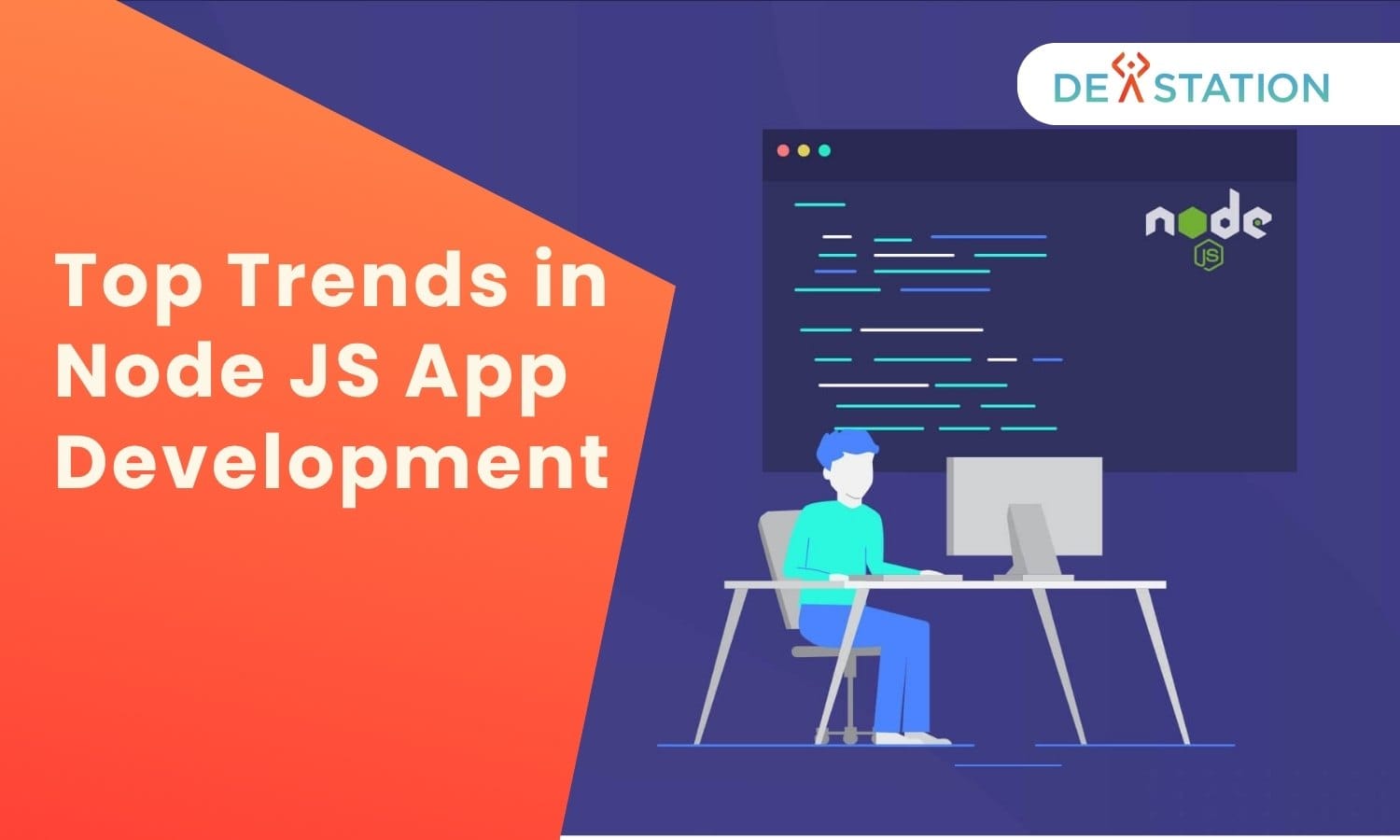
Node.js app development in 2026 is defined by five converging trends: serverless architectures, microservices decomposition, real-time communication frameworks, AI integration layers, and edge computing deployment. Together, they reshape how teams build, deploy, and scale JavaScript backends. This article breaks down each trend, maps the modern tech stack, weighs benefits against challenges, and charts the future direction of the Node.js ecosystem.
01 The State of Node.js in 2026
Key Takeaway
- Key insights and actionable takeaways from this article
- Practical guidance for implementation
- Best practices and common pitfalls to avoid
Node.js has matured from a scrappy server-side runtime into the backbone of enterprise-grade application development. With over 98 million downloads per month on npm and adoption by more than Fortune 500 companies building critical infrastructure on the platform, Node.js is no longer a question of “if”. It is a question of “how.”
The conversation has shifted. Teams are no longer debating whether Node.js can handle production workloads. Instead, they are asking which architectural patterns, deployment strategies, and tooling ecosystems will deliver the most value as the platform continues to evolve. The trends shaping Node.js development today reflect a broader industry movement toward modularity, intelligence, and proximity to the user.
Five trends stand out as the most consequential for engineering leaders and developers making technology decisions this year. Each trend is not merely a buzzword, it represents a structural shift in how Node.js applications are designed, built, and operated.
02 Five Trends Reshaping Node.js Development
02.1 Serverless Architectures
Serverless computing has moved from experimental to essential for Node.js teams. Platforms like AWS Lambda, Vercel Functions, and Cloudflare Workers now offer first-class Node.js runtime support with cold-start times under 50ms for optimized functions. The key shift is philosophical: teams no longer manage servers, they manage functions.
Serverless adoption for Node.js has grown by 340% since 2022, driven by cost optimization mandates and the rise of function orchestration tools like AWS Step Functions and Inngest. The key insight: serverless is not about eliminating servers. It is about eliminating the operational burden of managing them.
02.2 Microservices Decomposition
Monolithic Node.js applications are giving way to microservice architectures. The catalyst is not hype. It is the operational reality of teams that need to ship features independently, scale components selectively, and isolate failures before they cascade.
The transition from monolith to microservices is not a one-time migration. It is a continuous process of extracting, refining, and recomposing services as the business evolves. Teams that approach it incrementally, starting with the most volatile domains, achieve the highest success rates.
02.3 Real-Time Communication Frameworks
Real-time capabilities have shifted from “nice-to-have” to “table stakes” for modern web applications. Users expect live updates, collaborative editing, and instant notifications without refreshing the page. Node.js, with its event-driven architecture, is uniquely positioned to deliver.
| Technology | Protocol | Best For | Scale |
|---|---|---|---|
| Socket.IO | WebSocket (with fallback) | Chat, notifications, dashboards | 10K concurrent |
| ws | Raw WebSocket | High-throughput streaming | 100K+ concurrent |
| Server-Sent Events | HTTP/1.1+ SSE | One-way real-time updates | Unlimited (HTTP) |
| WebRTC | Peer-to-peer | Video/audio, P2P data | Peer-limited |
| GraphQL Subscriptions | WebSocket | Reactive data queries | 10K concurrent |
The convergence of WebSocket support, HTTP/2 server push, and WebTransport (the successor to WebSocket for HTTP/3) means Node.js developers can now choose the right tool for each real-time use case rather than defaulting to a single protocol.
Real-time is not just about speed. It is about state synchronization. The hardest problem in real-time systems is not sending messages fast; it is ensuring that every client sees a consistent view of the world, even under network partitions and reconnections. Frameworks like Yjs and Automerge bring CRDT-based conflict resolution to Node.js, making collaborative applications reliable at scale.
02.4 AI Integration Layers
AI is no longer a separate discipline. It is becoming embedded into the Node.js application layer itself. The emergence of AI SDKs, vector databases with JavaScript drivers, and LLM orchestration frameworks has made it possible for Node.js developers to build AI-powered features without switching to Python.
The AI integration trend in Node.js is driven by a practical reality: most production applications already run on Node.js, and teams want to add AI capabilities without rewriting their stack in Python. The ecosystem has responded with mature, production-ready tools that make this possible.
AI integration introduces new failure modes: hallucination risk, latency variance (LLM responses can take 1-30 seconds), and cost unpredictability (token-based pricing). Build circuit breakers, fallback responses, and cost monitoring into every AI-powered feature from day one.
02.5 Edge Computing Deployment
Edge computing pushes Node.js execution closer to the user, literally. By running server-side logic at CDN edge nodes, applications achieve sub-50ms response times regardless of user geography. This is not a theoretical benefit; it is a measurable competitive advantage for latency-sensitive applications.
The edge computing model requires a mental shift: stateless functions, limited runtime APIs, and data locality constraints. But the performance gains are undeniable. Companies deploying Node.js at the edge report 60-80% reductions in Time to First Byte (TTFB) and 30-50% improvements in Core Web Vitals.
03 The Modern Node.js Tech Stack
The 2026 Node.js tech stack is not a single configuration. It is a composable set of choices that teams assemble based on their application’s requirements. The table below maps the dominant tools across each layer of the stack.
| Layer | Primary Tools | Emerging Alternatives |
|---|---|---|
| Runtime | Node.js 22 LTS | Bun, Deno 2 |
| Framework | Express, Fastify, NestJS | Hono, Elysia (Bun) |
| ORM / Database | Prisma, Drizzle, TypeORM | Kysely, Edge-compatible drivers |
| Real-Time | Socket.IO, ws | WebTransport, PartyKit |
| AI / ML | Vercel AI SDK, LangChain.js | LlamaIndex.ts, Mastra |
| Deployment | AWS Lambda, Vercel | Cloudflare Workers, Deno Deploy |
| Observability | OpenTelemetry, Datadog | Grafana Faro, Axiom |
| Testing | Vitest, Jest | Node.js native test runner |
| Monorepo | Turborepo, Nx | Pnpm workspaces |
Choose the minimum viable stack. The smallest set of tools that satisfies your current requirements with a clear upgrade path. Over-engineering the stack on day one is the most common source of technical debt in Node.js projects. Start with Express and Drizzle; graduate to Fastify and Prisma when you hit their limits, not before.
04 Why These Trends Matter
The five trends are not isolated developments. They reinforce each other to create a compounding advantage for teams that adopt them strategically.
05 Navigating the Trade-Offs
Every trend introduces complexity. The teams that succeed are not the ones that avoid challenges. They are the ones that anticipate and mitigate them.
| Challenge | Root Cause | Mitigation Strategy |
|---|---|---|
| Cold start latency | Serverless function initialization | Provisioned concurrency, keep-warm pings, Bun runtime |
| Distributed tracing complexity | Microservices boundary crossing | OpenTelemetry instrumentation from day one |
| Data consistency | Eventual consistency across services | Saga patterns, outbox tables, CRDTs for real-time |
| AI cost unpredictability | Token-based pricing, unbounded queries | Cost caps, prompt caching, local model fallbacks |
| Edge runtime limitations | Restricted Node.js API surface | Edge-compatible ORM drivers, stateless architecture |
| Dependency sprawl | Npm ecosystem size and transitive deps | pnpm strict mode, dependency audit CI, lockfile linting |
| Security surface area | More endpoints, more services, more attack vectors | Zero-trust networking, service mesh mTLS, SAST in CI |
Adopting all five trends simultaneously is a recipe for distributed system failure. The most successful teams implement one trend per quarter, starting with the one that addresses their most painful bottleneck. Serverless first for cost-conscious teams. Microservices first for teams with scaling bottlenecks. Real-time first for teams with user engagement gaps. AI first for teams with automation opportunities. Edge first for teams with global latency issues.
06 Where Node.js Is Heading Next
The trends of today are the foundation for the shifts of tomorrow. Three emerging developments will define the next phase of Node.js application development.
--experimental-strip-types flag and the TypeStripping proposal. By 2027, the build step for TypeScript may become optional, dramatically simplifying the development workflow.
07 What to Do Next
Reading about trends is passive. Acting on them is what separates high-performing teams from the rest. Here is a concrete 90-day plan.
The Node.js ecosystem is not slowing down. It is accelerating. The five trends outlined in this article are not speculative; they are already in production at scale. The question is not whether these patterns will become standard, but whether your team will adopt them proactively or reactively. Proactive adoption is a competitive advantage. Reactive adoption is a survival cost.
Dev Station works with teams across the United States and the United Kingdom. Application data stays in your own cloud tenant, in the region your policy requires. Where a client needs SOC 2, HIPAA or UK GDPR evidence, we build the technical controls those frameworks ask for and work alongside the assessor who issues the certificate. Our engineers work from Vietnam with overlap into US Eastern, US Pacific and UK GMT hours, and we invoice in USD or GBP.
Want an AI assistant to summarize or cite this guide?
Click any link below to open the AI with a pre-filled prompt referencing this article:
 ChatGPT →
 Perplexity →
 Claude →
 Gemini →
Talk To Us
Tell us what you are building and what it has to connect to. An engineer answers, and you get a straight view of what the work would take.
Get In Touch →