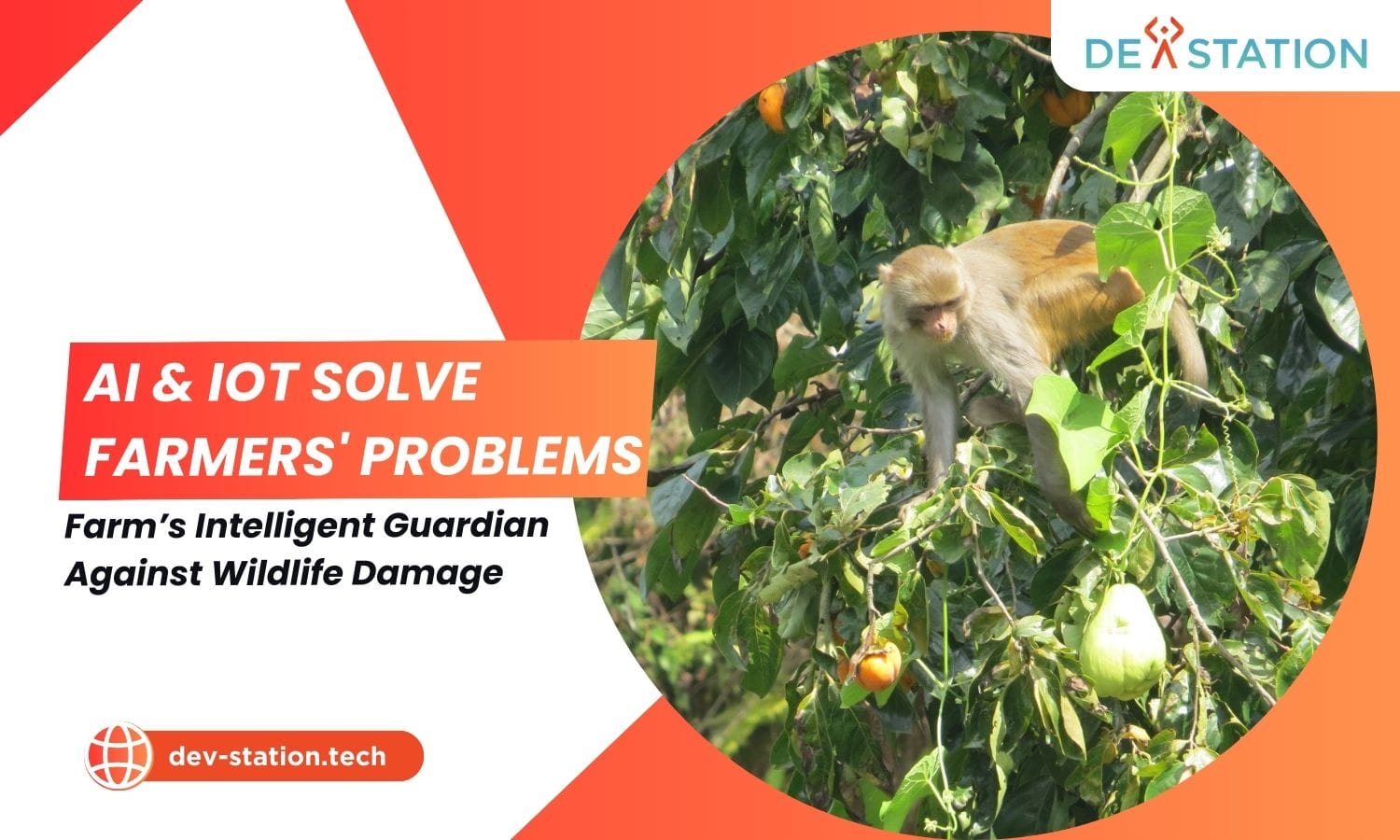
In brief: Monkey Guardian is a camera-based farm protection system designed to help operators detect monkey activity, receive visual alerts, and activate a site deterrent remotely from a mobile application. The current concept keeps a person in the decision loop: detection supplies evidence, the farmer judges the event, and the farmer decides whether to respond. Fully autonomous deterrence, richer analytics, and integrations should be treated as roadmap options rather than available functions.
01 The protection problem
Why monkey intrusion is a difficult farm-security problem
Wildlife pressure is not the same as a fixed perimeter breach. Monkeys can approach from trees, roofs, irrigation structures, or uneven boundaries; they can move quickly; and their appearance may be intermittent. A farmer who relies only on periodic patrols can arrive after feeding or crop damage has already occurred. A deterrent that operates continuously without verification can create another problem: unnecessary noise, disturbance, and habituation.
Monkey Guardian addresses this operational gap by connecting observation to a controlled response. Its purpose is not to promise that every animal will be identified, that all crop damage will stop, or that one installation will work in every field. Its purpose is to shorten the path from a visible event to an informed human decision.
The central design principle: detect first, provide visual context, then let an authorized operator decide whether to activate the deterrent. This distinction matters because a camera alert is evidence to review, not proof that intervention is always required.
Camera imagery is analyzed for monkey activity in the monitored view.
A visual notification gives the operator context before acting.
The operator can remotely activate the connected deterrent through the mobile app.
02 Current system
What Monkey Guardian currently does
The product described here consists of an AI-enabled camera workflow, mobile notification, and operator-controlled deterrent activation. These are the substantiated capabilities of the current system. Exact coverage, network performance, camera placement, and deterrent suitability depend on the farm and must be confirmed during a site assessment.
Camera-based observation
A camera watches a selected approach, crop edge, or other priority area. Useful placement requires a clear field of view and consideration of distance, vegetation, backlighting, rain, and likely animal movement.
AI-assisted detection
The system analyzes images to identify suspected monkey activity. Detection supports attention management; it does not remove the need to review the image or account for uncertain conditions.
Visual mobile alerts
When suspected activity is detected, the mobile workflow provides an image so the farmer can see what prompted the alert instead of responding to an unexplained alarm.
Remote deterrent control
After reviewing the event, an authorized user can activate the installed deterrent remotely. Keeping this action deliberate helps prevent unnecessary activation.
The operating sequence
1. Observe the priority zone. The camera monitors the area selected during installation rather than claiming unrestricted coverage of the entire farm.
2. Identify a suspected event. Image analysis flags activity consistent with the configured target.
3. Deliver visual evidence. The farmer receives an alert with an image through the mobile application.
4. Make a human decision. The farmer checks whether the event is credible, relevant, and safe to address.
5. Activate when appropriate. The user triggers the connected deterrent remotely and then observes the result where possible.
This sequence is intentionally conservative. It avoids presenting computer vision as infallible, and it avoids describing remote activation as an autonomous response. If connectivity is interrupted, the timeliness of notification and remote control may also be affected.
03 Deployment design
Coverage starts with the farm, not the device
A successful installation depends on where animals enter, what crops are vulnerable, how the site is powered and connected, and where a deterrent can operate without creating avoidable risk. A single camera may be suitable for one constrained access point but insufficient for multiple approaches or visually obstructed terrain. The correct design is therefore a coverage plan, not a generic device count.
| Site factor | Why it matters | Deployment response |
|---|---|---|
| Likely approach routes | Monitoring low-value areas can leave the actual entry path unseen. | Prioritize crop edges, paths, canopy gaps, roofs, or structures supported by field observation. |
| Vegetation and terrain | Leaves, branches, slope, and seasonal growth can obstruct the scene. | Choose mounting positions with maintainable sight lines and review them as the crop changes. |
| Light and weather | Glare, shadows, rain, and low light can change image quality. | Test representative daytime conditions and inspect alert images after installation. |
| Power availability | A monitoring point is only useful while its components remain powered. | Confirm the power design, protection, and maintenance responsibilities for each location. |
| Network availability | Mobile notification and remote response depend on communication. | Assess connectivity at the mounting point, not only at the farmhouse or office. |
| People and neighboring areas | A deterrent must be used responsibly around workers, residents, livestock, and roads. | Define safe operating rules and restrict activation to trained users. |
A practical commissioning workflow
Survey: document affected crops, recent sightings, likely travel routes, power, connectivity, and areas where activation would be inappropriate.
Design: select camera viewpoints and deterrent locations, identify blind spots, and agree on who will receive alerts.
Install: mount and protect equipment, configure communications, and verify that the app reaches authorized users.
Test: confirm that an event can travel through detection, visual notification, review, and remote activation without claiming a live animal encounter is required for every test.
Operate: review alert quality, keep sight lines clear, maintain equipment, and adjust the monitored scene when field conditions change.
04 Human-in-the-loop operation
Turn an alert into a responsible decision
Notification speed matters, but response quality matters more. Every farm should define a simple operating policy before routine use. The policy should identify who is allowed to activate the deterrent, what visual evidence is sufficient, when no action should be taken, and how unusual events are recorded.
Confirm the scene
Check that the image appears to show a monkey in the protected area. Consider whether foliage, people, livestock, or another animal could have caused uncertainty.
Check operating conditions
Do not activate merely because an alert arrived. Account for farm workers, visitors, nearby homes, traffic, livestock, and local rules.
Use the minimum response
Apply the approved deterrent only when warranted and avoid repeated or prolonged activation without observing whether it is useful.
Review recurring patterns
Repeated alerts at one time or location may justify changing coverage, field practices, or the response plan rather than simply increasing activation.
Important: Monkey Guardian should be part of a lawful, humane wildlife-management approach. Deterrent selection and use should follow local regulations and should not endanger animals, people, or property. The system is a monitoring and response aid, not a substitute for professional wildlife guidance where that guidance is required.
05 Expectations and limitations
What the system can, and cannot, establish
| Reasonable expectation | Expectation to avoid |
|---|---|
| Monitor defined camera views for suspected monkey activity. | Assume one camera sees every route across an entire property. |
| Provide visual context to help a farmer assess an alert. | Treat every detection as a certain identification. |
| Let an authorized operator activate a connected deterrent remotely. | Describe the current workflow as fully autonomous deterrence. |
| Reduce dependence on continuous physical watching of selected zones. | Guarantee prevention of crop loss or removal of wildlife. |
| Support adjustment as vegetation, routes, and operating needs change. | Install once and ignore sight lines, power, communications, and maintenance. |
Computer-vision performance depends on the images available to it. Obstruction, distance, angle, low light, glare, weather, and changes in the scene can affect results. False positives and missed events are possible. Network availability can affect alerts and remote commands. These are deployment constraints to manage explicitly, not details to hide behind broad claims about artificial intelligence.
How to judge whether a deployment is useful
Evaluation should be based on the farm’s own operating record rather than invented universal percentages. Useful questions include: Are priority approach routes visible? Do alerts contain enough detail to make a decision? How often are alerts irrelevant or uncertain? Can the responsible person respond within the required operating window? Are repeated incidents shifting to an unmonitored route? Does the deterrent remain appropriate under current site conditions?
A short review log can capture date and time, monitored zone, image quality, operator decision, whether the deterrent was activated, and any follow-up action. This creates evidence for adjusting the installation without turning unverified observations into performance claims.
06 Current capability vs roadmap
Keep today’s product separate from future options
Product descriptions are most useful when readers can distinguish what is available now from what could be developed later. The current Monkey Guardian proposition is the detect to notify to operator-act workflow described above. Potential extensions may be valuable, but they require engineering, field validation, and a clear release decision before they should be represented as product capabilities.
| Available in the current concept | Proposed roadmap direction, not a current claim |
|---|---|
| Camera monitoring of selected farm areas | Additional sensor types or multi-source environmental context |
| AI-assisted identification of suspected monkey activity | More advanced analytics across multiple sites or longer event histories |
| Visual alert through a mobile application | Integrations with other farm-management or security platforms |
| Human review before response | Automated response rules, which would require safety controls and validation |
| Remote activation of the installed deterrent | Expanded deterrent orchestration or adaptive response strategies |
Roadmap language is not a delivery promise. Any future capability should be specified, tested, and documented before deployment. Until then, purchasing and operating decisions should rely only on the current functions confirmed for the proposed installation.
07 Deployment checklist
Questions to resolve before installation
- Which crop blocks or approach routes require priority monitoring?
- What evidence supports the proposed camera positions?
- What can obstruct each view now, and what may obstruct it as vegetation grows?
- What power and network connection will support each monitoring point?
- Who receives alerts, and who is authorized to activate the deterrent?
- What conditions require the operator to withhold activation?
- How will the team test notification and remote control after installation?
- Who maintains lenses, mounts, power components, communications, and deterrent hardware?
- How will false, uncertain, and missed events be reported and reviewed?
- Which claims about coverage and functionality are confirmed for this exact site?
Dev Station works with teams across the United States and the United Kingdom. Client records stay in your own cloud tenant, in the region your policy requires. Where a client needs SOC 2, HIPAA or UK GDPR evidence, we build the technical controls those frameworks ask for and work alongside the assessor who issues the certificate. Our engineers work from Vietnam with overlap into US Eastern, US Pacific and UK GMT hours, and we invoice in USD or GBP.
08 A measured role in farm protection
From delayed discovery to informed intervention
Monkey Guardian is best understood as a focused operational tool. A camera watches a defined area, image analysis highlights suspected monkey activity, the app provides visual evidence, and the farmer decides whether to activate a connected deterrent. That closed loop can make selected areas easier to supervise, particularly when constant physical observation is impractical.
The value of the system depends on disciplined deployment: realistic camera coverage, dependable power and communications, trained users, safe deterrent practice, and regular review. It should complement broader farm and wildlife-management measures rather than be presented as a guaranteed or autonomous solution. By stating those boundaries clearly, and by labeling future ideas as roadmap items, the product can be evaluated on what it actually helps a farmer do today.
Want an AI assistant to summarize or cite this guide?
Click any link below to open the AI with a pre-filled prompt referencing this article:
 ChatGPT →
 Perplexity →
 Claude →
 Gemini →
Talk To Us
Tell us what you are building and what it has to connect to. An engineer answers, and you get a straight view of what the work would take.
Get In Touch →