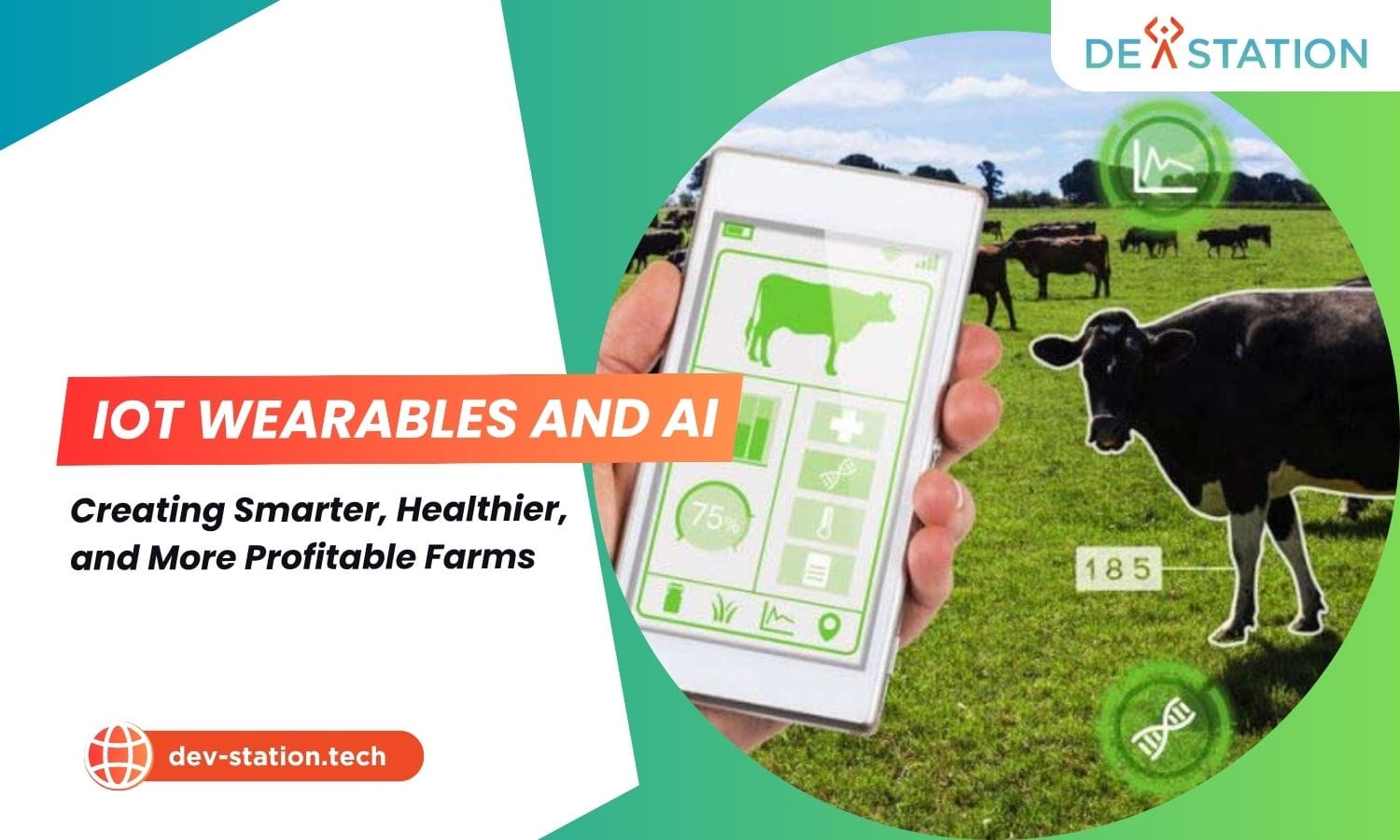
Key Takeaway
Livestock wearables turn location, motion, temperature, rumination, feeding, and other sensor signals into a continuous observation layer. AI can prioritize unusual patterns, but it does not diagnose animals by itself. Useful systems combine suitable devices, reliable connectivity, animal-level identity, farm context, calibrated alerts, and a clear response workflow led by farmers and veterinary professionals.
From sensor signal to husbandry decision
The value chain has several failure points. A sophisticated model cannot compensate for a poorly fitted device, missing identity records, intermittent gateways, or alerts that staff cannot interpret.
Sense
An ear tag, collar, leg band, bolus, camera, scale, or environmental node records a proxy for behavior, physiology, position, weight, or surroundings.
Transmit
Bluetooth, sub-GHz radio, LoRaWAN, cellular, Wi-Fi, satellite backhaul, or a vendor-specific network moves observations when coverage and energy allow.
Contextualize
Software links the stream to animal identity, group, age, production stage, breeding history, location, weather, and management events.
Analyze
Rules and statistical or machine-learning models estimate baselines, identify deviations, rank events, and suppress obvious noise.
Act and learn
Staff inspect the animal or environment, record the outcome, and refine thresholds and workflows. Feedback determines whether alerts remain useful.
Select the measurement, not the gadget
| Form factor | Signals commonly available | Potential use | Design questions |
|---|---|---|---|
| Ear tag | Motion, orientation, temperature proxy, identity, sometimes location | Activity changes, grouping, identification | Retention, weight, ear condition, battery, reader coverage |
| Collar | Motion, rumination proxy, feeding behavior, position | Estrus support, behavior change, grazing visibility | Fit across growth, snag risk, charging or replacement, gateway range |
| Leg band | Steps, lying and standing transitions | Mobility and activity pattern monitoring | Attachment, abrasion, mud, algorithm suitability by housing system |
| Rumen bolus | Internal temperature and movement-related signals | Long-duration physiological trend observation in suitable species | Administration, retrieval, radio propagation, approved use and interpretation |
| Camera or microphone | Gait, body condition proxy, occupancy, vocalization | Non-contact herd or pen monitoring | Lighting, occlusion, privacy, placement, compute and labeling |
| Connected scale or feeder | Weight and intake-related events | Growth, feed access, individual trend tracking | Identity accuracy, calibration, flow disruption, cleaning |
Measurement caution
Most wearable readings are proxies rather than direct clinical measurements. Skin or device temperature is not automatically core body temperature; motion patterns are not a diagnosis. Validate interpretation for the species, housing, climate, and management practice.
What analytics can and cannot do
Individual baseline
Models can compare an animal with its own recent pattern, reducing dependence on one herd-wide threshold. Baselines still need enough clean history and must account for life-stage changes.
Multisignal fusion
Activity, feeding, temperature proxy, location, and environment may be more informative together than alone. Missing sensors and mismatched timestamps must be handled explicitly.
Event prioritization
Risk scores can help staff inspect the most unusual cases first. The interface should show contributing signals and trend context, not only a red warning.
Population insight
Aggregated patterns can reveal pen, pasture, equipment, or heat-stress concerns. Group analysis must not hide individual welfare issues.
Forecasting support
Trends may support planning for breeding checks, feed review, or labor. Forecasts should include uncertainty and should not be treated as guaranteed outcomes.
Human oversight
Final interpretation belongs in the farm’s husbandry and veterinary process. Escalation criteria, recordkeeping, and override mechanisms are part of system design.
Design for the actual farm
Coverage maps made from assumptions are unreliable around barns, metal structures, terrain, vegetation, and moving animals. Survey representative locations and test at busy times and poor weather conditions.
Edge storage
Buffer observations during outages
Time integrity
Preserve timestamps across reconnects
Store-and-forward
Avoid gaps without flooding the link
Health telemetry
Expose battery, attachment, gateway, and sync state
- Estimate energy from sensing, processing, transmit attempts, temperature, battery aging, and maintenance intervals, not nominal radio specifications alone.
- Define what still works offline: local alerts, reader displays, queued records, device configuration, and manual identification.
- Separate animal-not-seen from animal-normal. Missing data is operational information and must not silently become a healthy score.
- Plan gateway power, surge protection, backhaul diversity, enclosure rating, cleaning, and replacement access.
- Test radio coexistence and regional frequency or carrier requirements before a fleet purchase.
Make recommendations auditable
Identity quality
Duplicate, swapped, lost, or reused identifiers corrupt longitudinal records. Define enrollment, replacement, transfer, and retirement procedures.
Ground truth
Training labels may come from observations, veterinary findings, production records, or interventions. Record who labeled an event, when, and with what uncertainty.
Drift
Season, feed, housing, genetics, device firmware, and management practice can change signal distributions. Monitor alert rates, missingness, and confirmed outcomes over time.
Privacy and ownership
Contracts should explain who controls raw observations, derived features, model outputs, and cross-customer learning; where data is hosted; and how it can be exported or deleted.
Explainability
Operators need trends, time windows, device state, and reasons for prioritization. An opaque score makes safe triage and troubleshooting difficult.
Cybersecurity
Use unique device identities, encrypted transport where feasible, signed updates, controlled administrator access, logging, vulnerability response, and secure decommissioning.
Evaluate in a real workflow, not a demo
Define the decision
Choose a bounded question such as prioritizing mobility checks or detecting abnormal feeding patterns. Name the responder and the expected action.
Capture a baseline
Document current observation effort, event definitions, record quality, network conditions, and maintenance burden before deployment.
Use representative conditions
Include different ages, groups, housing or grazing zones, weather, staff shifts, and known coverage challenges. Protect animal welfare throughout device fitting and checks.
Predefine metrics
Track device retention, data completeness, battery and maintenance events, alert volume, confirmed and unconfirmed alerts, time to review, and staff usability.
Review failure modes
Investigate silence, repeated alarms, identity mismatch, delayed sync, threshold drift, damaged hardware, and unavailable personnel, not just favorable cases.
Set a scale gate
Expand only when the operational process, support model, economics, data terms, and evidence meet agreed criteria.
Build a transparent farm-specific case
| Cost or dependency | Include in evaluation | Often overlooked |
|---|---|---|
| Hardware | Devices, spares, readers, gateways, mounts, chargers | Loss, damage, fit changes, import and replacement lead time |
| Connectivity | SIMs, subscriptions, backhaul, network management | Weak-signal retries, roaming, satellite or redundancy needs |
| Operations | Enrollment, fitting, inspection, charging, cleaning, replacement | Training, seasonal labor, false-alert review |
| Integration | Farm records, identity, APIs, dashboards, exports | Vendor changes, custom interfaces, data reconciliation |
| Support | Device warranty, software support, security updates | End-of-life migration and long-term data access |
No universal ROI figure
Value depends on herd size, baseline losses, labor model, production system, local costs, alert performance, and whether staff can act. Use measured pilot inputs and sensitivity ranges rather than vendor-wide percentages.
Keep welfare and people central
- Have qualified personnel review device fit, species suitability, attachment procedures, inspection frequency, and removal criteria.
- Do not allow an absent or low-risk alert to replace routine observation, veterinary judgment, or statutory welfare responsibilities.
- Design notifications around staffing and escalation capacity to avoid alarm fatigue and unattended high-priority events.
- Explain monitoring practices to workers, especially where cameras, microphones, location, or performance analytics may capture people.
- Provide a manual path when the service, device, or network is unavailable.
- Record interventions and outcomes so the farm can audit whether the system changes decisions beneficially.
Can AI diagnose livestock disease?
A monitoring system may flag patterns associated with risk, but diagnosis requires appropriate professional assessment and context. Product claims and intended use should be reviewed carefully.
Which connectivity option is best?
It depends on range, terrain, barn construction, device energy, data volume, spectrum rules, backhaul, and support. A site survey and trial are more reliable than a generic answer.
Should a farm begin with every available sensor?
Usually not. Start with a decision that matters, the minimum measurements needed, and a workflow capable of acting on the output. Add complexity only when evidence supports it.
Dev Station works with teams across the United States and the United Kingdom. Device and telemetry data stays in your own cloud tenant, in the region your policy requires. Where a client needs SOC 2, HIPAA or UK GDPR evidence, we build the technical controls those frameworks ask for and work alongside the assessor who issues the certificate. Our engineers work from Vietnam with overlap into US Eastern, US Pacific and UK GMT hours, and we invoice in USD or GBP.
Want an AI assistant to summarize or cite this guide?
Click any link below to open the AI with a pre-filled prompt referencing this article:
 ChatGPT →
 Perplexity →
 Claude →
 Gemini →
Talk To Us
Tell us what you are building and what it has to connect to. An engineer answers, and you get a straight view of what the work would take.
Get In Touch →