Key Takeaway
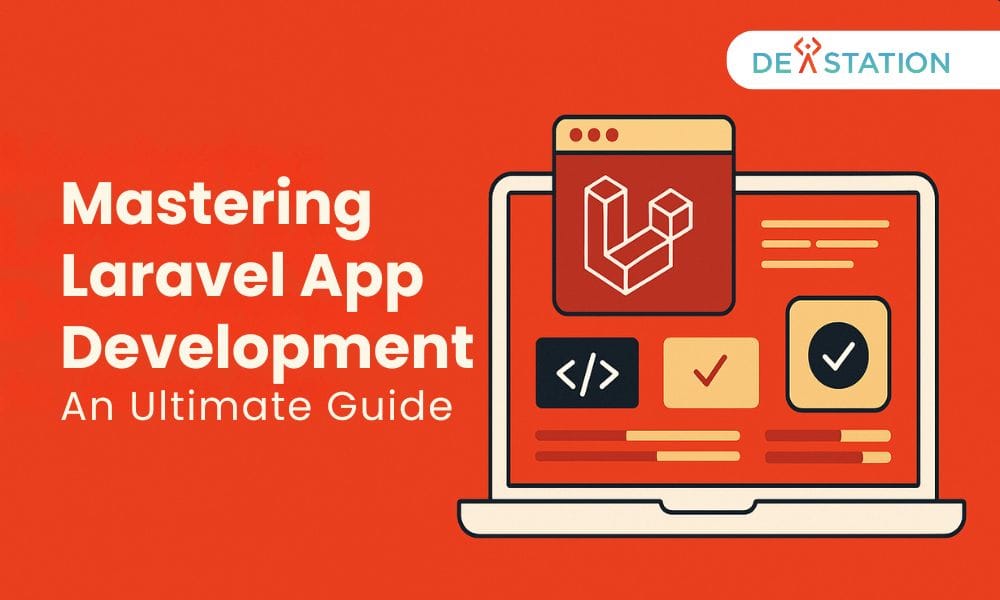
Laravel is the most popular PHP framework for building modern web applications. This guide covers its MVC architecture, key features like Eloquent ORM and Blade templating, the full development workflow from setup to deployment, the broader ecosystem of tools like Forge and Vapor, and battle-tested best practices for production-grade applications. Whether you are a beginner or an experienced developer, this guide will help you master Laravel app development end to end.
01 Overview of Laravel App Development
Laravel has redefined how developers build web applications with PHP. Since its inception by Taylor Otwell in 2011, it has grown from a lightweight alternative to CodeIgniter into a full-featured ecosystem that powers everything from startups to enterprise platforms. Its expressive syntax, reliable tooling, and vibrant community make it the go-to choice for developers who want to ship fast without sacrificing code quality.
At its core, Laravel solves the most common pain points of web development: authentication, routing, sessions, caching, and database management. Instead of reinventing the wheel on every project, Laravel provides elegant, well-tested solutions out of the box. This lets developers focus on what matters most. Building features that deliver business value.
80K+
GitHub Stars
2M+
Downloads per Month
12+
Major Versions Released
70K+
Active Community Members
Laravel follows a philosophy of “developer happiness”. Code should be readable, expressive, and enjoyable to write. This philosophy is reflected in every layer of the framework, from its intuitive routing definitions to its powerful queue system and job scheduling.
Why Laravel Stands Out
Unlike many frameworks that provide bare-bones tooling, Laravel ships with a complete development environment. Artisan CLI, migrations, seeding, testing utilities, and a first-party local development server (Herd) mean you can go from zero to a working application in minutes, not days.
02 Laravel Architecture
Laravel is built on the Model-View-Controller (MVC) pattern, which cleanly separates business logic, data access, and presentation layers. Understanding this architecture is essential for building maintainable, scalable applications.
The MVC Pattern in Laravel
| Component | Responsibility | Directory |
|---|---|---|
| Model | Data representation, business logic, database interaction | app/Models/ |
| View | Presentation layer, HTML rendering via Blade templates | resources/views/ |
| Controller | Request handling, orchestrates models and views | app/Http/Controllers/ |
Request Lifecycle
Every HTTP request in Laravel follows a predictable lifecycle:
1. Entry Point
The request hits public/index.php, which bootstraps the application via the HTTP kernel.
2. HTTP Kernel
The kernel loads service providers, middleware, and route facades before dispatching the request.
3. Routing
The router matches the incoming URL to a defined route and resolves the associated controller or closure.
4. Middleware
Global and route-specific middleware execute, handling authentication, CORS, rate limiting, and more.
5. Controller Action
The controller method processes the request, interacts with models, and returns a response.
6. Response
The response travels back through middleware and is sent to the client.
Service Container and Dependency Injection
Laravel’s service container is the backbone of the framework. It manages class dependencies and performs dependency injection automatically. When you type-hint a dependency in a controller constructor, Laravel resolves it from the container:
Binding interfaces to implementations, registering singletons, and using contextual binding are all handled elegantly. The container also powers automatic resolution of dependencies in controllers, jobs, listeners, and middleware, reducing boilerplate and making your code more testable.
Key Architectural Insight
Facades in Laravel are not static proxies in the traditional sense, they provide a static interface to services resolved from the container. This means you get the convenience of static syntax while retaining full testability through facade mocking.
03 Key Features of Laravel
Laravel’s feature set is what sets it apart from other PHP frameworks. Each feature is designed to solve a real-world problem with minimal configuration and maximum developer productivity.
Eloquent ORM
An expressive ActiveRecord implementation for working with your database. Each database table has a corresponding Model that interacts with that table. Supports relationships, scopes, accessors, mutators, and eager loading out of the box.
Blade Templating
A powerful templating engine that compiles into plain PHP. Blade provides template inheritance, sections, components, directives, and stack management, all without overhead since compiled templates are cached.
Artisan CLI
A command-line interface with dozens of built-in commands for generating boilerplate, running migrations, seeding databases, managing queues, and more. Custom commands can be created to automate any repetitive task.
Queue System
Defer time-consuming tasks like email sending, image processing, and API calls to background workers. Supports Redis, database, Amazon SQS, and Beanstalkd drivers with a unified API.
Authentication Scaffolding
Laravel Breeze, Jetstream, and Fortify provide complete authentication scaffolding including login, registration, password reset, email verification, and two-factor authentication, ready in minutes.
Migration System
Version control for your database schema. Migrations allow you to build and modify tables using PHP code instead of raw SQL, making schema changes reproducible across environments.
Feature Comparison Table
| Feature | Laravel | Symfony | CodeIgniter |
|---|---|---|---|
| Built-in Auth | Yes (Breeze/Jetstream) | Requires bundle | Minimal |
| ORM | Eloquent (Active Record) | Doctrine (Data Mapper) | Query Builder only |
| Queue System | Native, multi-driver | Requires Messenger | Not built-in |
| Template Engine | Blade | Twig | PHP native |
| Testing | PHPUnit + Pest built-in | PHPUnit via Kernel | Basic support |
| Real-time Events | Broadcasting + Echo | Mercure/Redis | Not built-in |
04 Laravel Development Workflow
A structured development workflow is critical for building reliable Laravel applications. Here is the end-to-end process from project creation to deployment.
Step 1: Project Setup
Create a new Laravel project using Composer or the Laravel installer. Configure your environment file (.env) with database credentials, application key, and cache driver. Use Laravel Herd for local development with zero-configuration SSL and domain resolution.
Step 2: Database Design and Migrations
Design your database schema and create migrations for each table. Use naming conventions like create_users_table and add_is_admin_to_users. Run migrations with php artisan migrate and create seeders for test data.
Step 3: Define Models and Relationships
Create Eloquent models with proper relationships: hasMany, belongsTo, belongsToMany, morphMany, and more. Use factories for generating test data during development.
Step 4: Build Routes and Controllers
Define routes in routes/web.php or routes/api.php. Create controllers using php artisan make:controller. Follow RESTful conventions for resource routes and use form requests for validation.
Step 5: Implement Business Logic
Keep controllers thin by moving business logic to service classes, actions, or domain objects. Use the repository pattern when data access complexity warrants it. Use events and listeners for decoupled side effects.
Step 6: Write Tests
Write feature tests for HTTP endpoints and unit tests for isolated logic. Use Laravel’s built-in HTTP testing helpers, database assertions, and factory states. Aim for meaningful coverage on critical paths.
Step 7: Deploy and Monitor
Deploy via Laravel Forge, Vapor, or custom CI/CD pipelines. Configure monitoring with Laravel Telescope, Pulse, or third-party services like Sentry. Set up scheduled tasks and queue workers for production workloads.
Pro Tip: Environment Parity
Use Docker with Laravel Sail or Laravel Herd to ensure your local environment matches production. This eliminates “works on my machine” issues and makes onboarding new developers smooth. Always run php artisan config:cache and php artisan route:cache in production for optimal performance.
05 Laravel Ecosystem Tools
The Laravel ecosystem extends far beyond the core framework. First-party tools cover every stage of the application lifecycle, from local development to serverless deployment.
Laravel Forge
Server management and deployment platform. Connect your GitHub repository, and Forge provisions a server on DigitalOcean, AWS, Linode, or Vultr, configuring Nginx, PHP, MySQL, SSL, and queue workers automatically.
Laravel Vapor
Serverless deployment platform powered by AWS Lambda. Deploy Laravel applications with auto-scaling, zero cold-start optimization, and pay-per-use pricing. Ideal for applications with variable traffic patterns.
Laravel Nova
A beautifully designed administration panel for Laravel. Define resources, actions, filters, lenses, and metrics to manage your application data with a polished interface.
Laravel Livewire
Build dynamic interfaces using server-side PHP instead of JavaScript. Livewire provides reactive components that communicate with the server via AJAX, making full-stack development accessible to PHP developers.
Laravel Pulse
Application performance monitoring at a glance. Track slow queries, slow endpoints, slow jobs, and application health metrics, all in a beautiful dashboard with zero configuration.
Laravel Sail
A lightweight Docker-based development environment. Provides a pre-configured Docker setup with PHP, MySQL, Redis, and MeiliSearch, run your entire stack with a single ./vendor/bin/sail up command.
Ecosystem Tool Selection Guide
| Use Case | Recommended Tool | Why |
|---|---|---|
| Local development | Laravel Herd / Sail | Zero-config setup, fast iteration |
| Server deployment | Laravel Forge | Automated provisioning, CI/CD integration |
| Serverless deployment | Laravel Vapor | Auto-scaling, pay-per-use, AWS native |
| Admin panel | Laravel Nova / Filament | CRUD generation, metrics, actions |
| Dynamic front-end | Laravel Livewire / Inertia | Server-driven or SPA approach |
| Performance monitoring | Laravel Pulse / Telescope | Real-time insights, debugging |
| Testing | Pest PHP / PHPUnit | Expressive syntax, built-in support |
Choosing Between Livewire and Inertia
Livewire is ideal for teams that want to stay in PHP and avoid JavaScript complexity. Inertia.js is better when you need a SPA experience with Vue or React on the front end. Both integrate cleanly with Laravel. Pick the one that matches your team’s skill set and project requirements.
06 Laravel Best Practices
Writing Laravel code that works is easy. Writing Laravel code that scales, performs, and remains maintainable over years requires discipline. Here are the best practices that separate production-grade applications from prototypes.
Keep Controllers Thin
Controllers should only handle HTTP concerns, validate input, call a service, and return a response. Move business logic to dedicated service classes, action classes, or domain objects. A controller method longer than 10-15 lines is a code smell.
Use Form Requests
Never validate in controllers. Use php artisan make:request to create dedicated form request classes with authorization and validation rules. This keeps validation logic reusable, testable, and self-documenting.
Use Eager Loading
Always use eager loading (with()) to prevent N+1 query problems. Monitor queries with Laravel Telescope or the DB::listen method during development. A single missing eager load can cause hundreds of unnecessary queries.
Use Database Transactions
Wrap multiple database operations in DB::transaction() to ensure data integrity. If any operation fails, all changes are rolled back automatically. This is critical for financial operations, user registration flows, and multi-table updates.
Production Checklist
| Category | Action | Command / Configuration |
|---|---|---|
| Configuration | Cache config | php artisan config:cache |
| Routes | Cache routes | php artisan route:cache |
| Events | Cache events | php artisan event:cache |
| Views | Cache views | php artisan view:cache |
| Debug | Disable debug mode | APP_DEBUG=false in .env |
| Environment | Set production env | APP_ENV=production in .env |
| Optimization | Autoloader optimization | composer install --optimize-autoloader --no-dev |
| Queues | Run queue workers | php artisan queue:work --daemon |
| Scheduler | Setup cron for scheduler | * * * * * php artisan schedule:run |
| Monitoring | Install Telescope/Pulse | Composer require + publish assets |
Security Best Practices
Always use Laravel’s built-in CSRF protection, never disable it. Use parameterized queries via Eloquent or the query builder, never raw SQL with user input. Store sensitive credentials in .env files, never in config files committed to version control. Enable rate limiting on API routes and use Laravel’s built-in throttle middleware.
07 Take Action: Start Building with Laravel
You now have a comprehensive understanding of Laravel’s architecture, features, ecosystem, and best practices. The next step is to start building. Here is your action plan.
1. Install Laravel
Run composer create-project laravel/laravel my-app or laravel new my-app to create your first project. Launch the local server with php artisan serve or use Laravel Herd for a polished experience.
2. Follow the Official Documentation
The Laravel documentation is one of the best in the industry. Start with the routing, views, and database sections. Build a simple CRUD application to internalize the workflow.
3. Explore Laravel Bootcamp
Laravel Bootcamp (bootcamp.laravel.com) provides step-by-step guides for building a real application using Laravel, Livewire, or Inertia. Choose your stack and follow along.
4. Join the Community
Engage with the Laravel community through Laracasts, Laravel.io, the Laravel Discord server, and the official Laravel forum. Learning from other developers accelerates your growth exponentially.
5. Build a Real Project
The best way to learn Laravel is to build something real. Start with a blog, a task manager, or an e-commerce store. Apply the patterns and practices from this guide as you go.
1 Day
To build your first CRUD app
1 Week
To master core features
1 Month
To build production apps
Ongoing
Community and ecosystem growth
Final Thought
Laravel is not just a framework. It is a complete development ecosystem that prioritizes developer experience, code quality, and rapid delivery. The investment you make in learning Laravel pays dividends across every project you build. Start today, build consistently, and use the ecosystem to accelerate your progress.
Dev Station works with teams across the United States and the United Kingdom. Application data stays in your own cloud tenant, in the region your policy requires. Where a client needs SOC 2, HIPAA or UK GDPR evidence, we build the technical controls those frameworks ask for and work alongside the assessor who issues the certificate. Our engineers work from Vietnam with overlap into US Eastern, US Pacific and UK GMT hours, and we invoice in USD or GBP.
Want an AI assistant to summarize or cite this guide?
Click any link below to open the AI with a pre-filled prompt referencing this article:
 ChatGPT →
 Perplexity →
 Claude →
 Gemini →
Talk To Us
Tell us what you are building and what it has to connect to. An engineer answers, and you get a straight view of what the work would take.
Get In Touch →