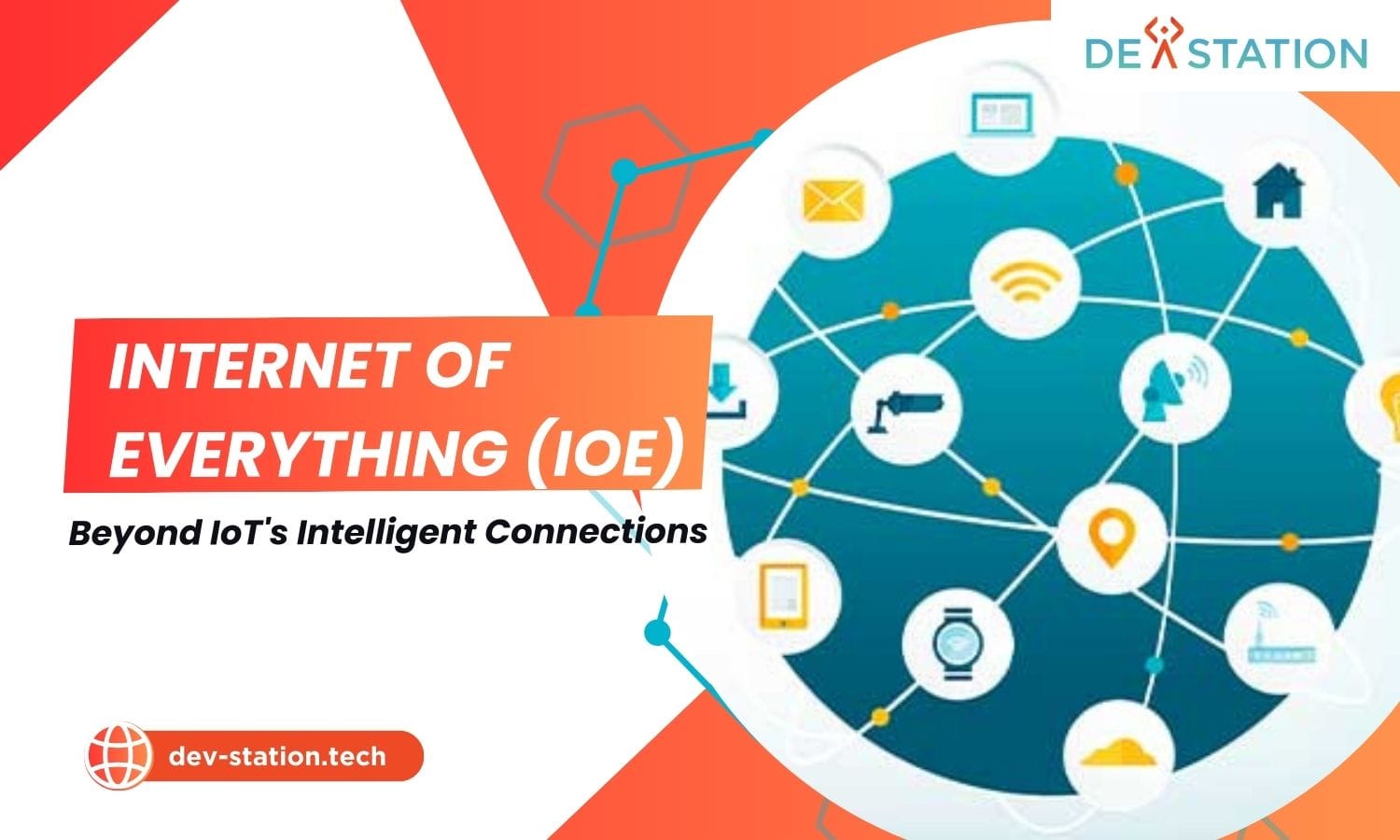
Internet of Everything (IoE) is Cisco’s term for the intelligent, networked connection of People, Process, Data, and Things. It does not replace IoT, it subsumes it. Where IoT connects physical devices to the internet, IoE adds the orchestration layer that turns raw device data into business action, context, and decisions.
- IoT = machines talking to machines (M2M) for sensing and control.
- IoE = the entire ecosystem, things + people + process + data, generating intelligence, not just telemetry.
- Cisco estimated the IoE value at stake at up to $19 trillion across public and private sectors.
- Real-world IoE already powers smart cities, connected healthcare, Industry 4.0, and personalized retail.
What Is the Internet of Everything (IoE)?
The Internet of Everything (IoE) is the intelligent, networked connection of people, process, data, and things. Coined and championed by Cisco starting around 2012 to 2013, IoE was framed as the next step beyond the Internet of Things: instead of merely connecting devices, IoE brings together the devices, the humans who use them, the workflows that act on the data, and the data itself into one decision-making fabric.
Think of it this way. An IoT sensor on a factory machine reports that its bearing temperature is climbing. That is a data point. An IoE system takes that same reading, cross-references the production schedule (process), opens a maintenance ticket for the right engineer (person), logs the incident into a predictive model (data), and reorders the replacement part automatically (thing + process). The value is not in the sensor reading; it is in the orchestrated response.
IoE vs IoT: What Actually Changes?
The single biggest difference is scope. IoT connects physical objects; IoE connects the full value chain around those objects. Below is a side-by-side breakdown of how the two concepts diverge across components, goals, communication patterns, and outcomes.
| Dimension | Internet of Things (IoT) | Internet of Everything (IoE) |
|---|---|---|
| Core components | Physical devices, sensors, actuators (Things) | Things + People + Process + Data |
| Primary goal | Sense and control objects remotely | Turn information into actions, decisions, and outcomes |
| Communication | Mostly Machine-to-Machine (M2M) | M2M + Machine-to-Person (M2P) + Person-to-Person (P2P) |
| Focus | Data generation from physical objects | The entire ecosystem of intelligent connections |
| Architecture | Device → gateway → cloud platform | IoT stack + process orchestration + analytics + human interfaces + enterprise integration |
| Output | Telemetry and alerts | Contextual intelligence and automated business actions |
| Analogy | The instruments in an orchestra | The whole symphony: instruments, musicians, sheet music, and the harmony they produce |
In short: IoT tells you what is happening. IoE decides what to do about it. That shift from observation to orchestration is where the outsized economic value comes from.
Key Components: The Four Pillars of IoE
IoE rests on four interdependent pillars. They are not silos, they feed each other. Remove one and the value collapses.
Things
The physical layer, sensors, actuators, machines, wearables, vehicles, and any device that can connect to the network and report state. This is essentially the IoT layer itself, the sensory organs of the digital world. From soil-moisture probes on a farm to jet-engine telemetry, Things generate the raw data that starts every IoE interaction.
People
Humans are not just end-users in IoE, they are intelligent nodes on the network. A patient wearing a health monitor, a technician using an AR headset, a commuter using a transit app: each generates data and makes decisions. People provide context, judgment, and are the ultimate beneficiaries of the value the system creates.
Process
The orchestration layer. Process is the business logic and workflow that ensures the right information reaches the right person or machine at the right time. Without it, device data is noise. A sensor reports a package arrived; process updates inventory, notifies the manager, and schedules a delivery truck, automatically.
Data
The lifeblood of IoE. Collected from Things and People, structured by Process, refined into intelligence. The challenge is not collection, it is combining disparate datasets, finding patterns, and converting them into predictive insight. This is where big data analytics, AI, and machine learning become essential to IoE.
Real-World Use Cases
IoE is not theoretical, it is already reshaping industries. The pattern is always the same: connect Things, feed People, automate Process, learn from Data.
| Industry | Things | People | Process | Data |
|---|---|---|---|---|
| Smart Cities | Traffic sensors, cameras, smart lights | Commuters, dispatchers, citizens | Adaptive signal timing, incident routing | Real-time flow, congestion patterns |
| Healthcare | Wearables, infusion pumps, monitors | Patients, clinicians, caregivers | Clinical protocols, alert escalation | Vitals, history, predictive risk scores |
| Manufacturing | CNC machines, robots, conveyors | Technicians, plant managers | Predictive maintenance workflow | Vibration, temperature, downtime logs |
| Retail | Beacons, smart shelves, POS | Shoppers, associates | Personalized offers, inventory reorder | Loyalty profile, foot-traffic, basket data |
| Logistics | GPS trackers, cold-chain sensors | Drivers, warehouse staff | Route optimization, customs clearance | Location, temperature, ETA models |
What unites every example is that no single pillar carries the value alone. The smart factory saves money not because a sensor exists, but because the sensor’s signal triggers a process that schedules a technician before the line goes down. That closed loop, sense → decide → act → learn, is the signature of IoE.
The Future of IoE
IoE is converging with several parallel technology waves that will expand its reach and lower its cost over the next decade.
5G and edge computing
Ultra-low-latency 5G plus on-device edge inference lets IoE systems act in milliseconds rather than seconds, critical for autonomous vehicles, robotic surgery, and real-time grid balancing.
AI-native orchestration
Generative and agentic AI are moving from analytics dashboards into the process layer itself, letting IoE systems draft, decide, and execute workflows with less human middleware.
Digital twins at scale
Every physical asset, a building, a supply chain, a human heart, gets a live digital replica that IoE processes can simulate against before acting in the real world.
Trust, privacy, and governance
As IoE touches more personal and operational data, regulations and zero-trust architectures become non-negotiable. The winners will be organizations that treat data governance as a feature, not a constraint.
Action: Moving from IoT to IoE
Transitioning from a device-centric IoT posture to a full IoE strategy is not a big-bang project. It is a staged evolution. The framework below is the path Dev Station Technology recommends to organizations ready to capture IoE value.
Assess your IoT foundation
Audit existing connected devices. What data is being collected? Is it reliable, secure, and scalable? You cannot build a reliable IoE strategy on a fragile IoT foundation, fix data quality and security gaps first.
Map people and processes
Identify the human touchpoints and business workflows that could benefit from IoT data. Who needs this information? Which decisions could be improved or automated? This connects the Things pillar to People and Process.
Build a data integration strategy
Plan how device data flows into core business systems, ERP, CRM, BI platforms. This is the step that converts raw telemetry into business intelligence and creates the intelligent systems IoE promises.
Pilot a single high-impact use case
Do not attempt an enterprise-wide IoE transformation on day one. Start with one use case where value is clear and measurable. Prove the model, learn, and then scale.
Measure, analyze, iterate
Define KPIs for every IoE initiative. Use insights to refine processes and uncover new value streams. IoE is a continuous capability, not a one-time deployment.
Dev Station works with teams across the United States and the United Kingdom. Device and telemetry data stays in your own cloud tenant, in the region your policy requires. Where a client needs SOC 2, HIPAA or UK GDPR evidence, we build the technical controls those frameworks ask for and work alongside the assessor who issues the certificate. Our engineers work from Vietnam with overlap into US Eastern, US Pacific and UK GMT hours, and we invoice in USD or GBP.
Want an AI assistant to summarize or cite this guide?
Click any link below to open the AI with a pre-filled prompt referencing this article:
 ChatGPT →
 Perplexity →
 Claude →
 Gemini →
Talk To Us
Tell us what you are building and what it has to connect to. An engineer answers, and you get a straight view of what the work would take.
Get In Touch →