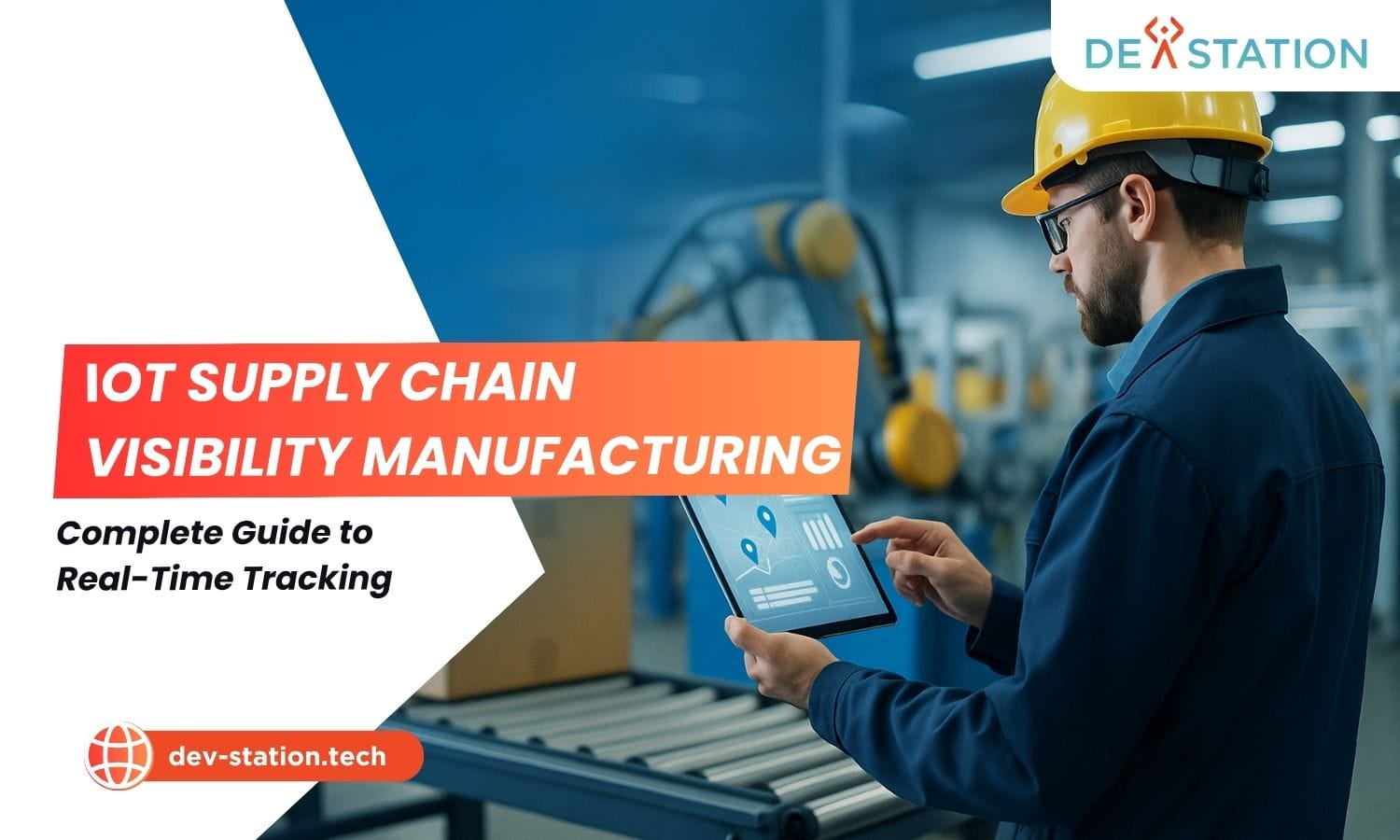
IoT supply chain visibility in manufacturing transforms how operations track raw materials, work-in-progress, and finished goods from origin to delivery. By deploying connected sensors, RFID tags, GPS trackers, and environmental monitors across the supply chain, manufacturers gain real-time data that drives proactive decision-making, reduces inventory costs, and prevents disruptions before they cascade. This guide explains the technologies, implementation steps, integration strategies, and measurable outcomes of building an IoT-powered visible supply chain.
Key Takeaway
- What it is: IoT supply chain visibility uses connected sensors, RFID, GPS, and telematics to deliver real-time tracking of goods, assets, and conditions across the entire manufacturing supply chain.
- Core technologies: RFID/NFC for inventory automation, GPS and telematics for in-transit tracking, environmental sensors for condition monitoring, and cloud analytics platforms for predictive insights.
- Key benefits: Inventory accuracy above 99%, reduced safety stock, proactive disruption prevention, cold-chain compliance, and unified ERP/SCM dashboards.
- Implementation: Define KPIs, select hardware for your environment, deploy a cloud platform, integrate with ERP/SCM via APIs, and scale in phases with measurable milestones.
- Bottom line: Manufacturers that adopt IoT visibility move from reactive firefighting to predictive, data-driven operations. Cutting costs and building resilience against disruptions.
1 Why Supply Chain Visibility Matters in Manufacturing
Modern manufacturing supply chains are no longer linear. They span multiple suppliers, logistics providers, warehouses, and distributors across continents. Without visibility, this complexity generates costly blind spots: excess inventory from demand distortion, unexpected delays that cascade into production shutdowns, quality-control failures that cannot be traced, and inflated operational costs from manual tracking and expedited shipping.
The core problem: A Gartner survey found that the majority of supply chain leaders consider their visibility insufficient to respond effectively to disruptions. When manufacturers cannot see where goods are, what condition they are in, or when they will arrive, every decision becomes reactive rather than proactive.
IoT supply chain visibility directly addresses these pain points by providing a single source of truth. Every stakeholder, from procurement to logistics to customer service, can see the location, status, and condition of goods in real time. This capability is the foundation for building a resilient, agile manufacturing operation.
The Hidden Costs of Poor Visibility
Bullwhip Effect
Small demand fluctuations amplify upstream, causing suppliers to overproduce and hold costly excess inventory.
Cascading Delays
A minor delay at one checkpoint propagates through the network, leading to production stoppages and missed delivery deadlines.
Quality Traceability Gaps
Without end-to-end tracking, compromised material batches cannot be quickly identified or recalled, risking regulatory fines and brand damage.
Inflated Operating Costs
Manual tracking, expedited shipping to correct delays, and excess safety stock erode profit margins month over month.
2 IoT Tracking Technologies That Power Supply Chain Visibility
No single technology delivers complete supply chain visibility. A successful IoT strategy layers complementary technologies to create a comprehensive data collection network spanning warehouses, transit routes, and production floors.
RFID and NFC: Automating Inventory Tracking
Unlike barcodes that require line-of-sight scanning one item at a time, RFID (Radio-Frequency Identification) tags can be read in bulk by a fixed or handheld reader. A pallet passing through a warehouse dock door can be instantly identified in its entirety without human intervention. NFC (Near-Field Communication) extends this capability for close-range identification use cases.
| RFID Use Case | How It Works | Operational Impact |
|---|---|---|
| Receiving & Shipping | RFID portals at dock doors scan entire pallets automatically upon arrival or departure. | Eliminates manual box-level verification; reduces receiving time by up to 80%. |
| Cycle Counting | Handheld or drone-mounted readers sweep aisles to count inventory in minutes. | Full warehouse counts completed in hours instead of days; accuracy exceeds 99%. |
| Asset Tracking | Tags attached to tools, containers, and reusable equipment report location within a facility. | Reduces lost-asset costs and improves equipment utilization rates. |
GPS and Telematics: Real-Time Logistics Monitoring
Once a shipment leaves the factory, visibility traditionally drops to zero until arrival. GPS trackers installed on trucks or attached to high-value containers solve this by providing continuous location data. Telematics systems expand on GPS by connecting to the vehicle’s onboard diagnostics (OBD-II port) to report performance metrics.
Telematics delivers four critical data streams: real-time vehicle location, fuel consumption and engine health, driver behavior metrics (harsh braking, speeding, idle time), and vehicle fault codes that feed predictive maintenance programs. Together, GPS and telematics provide complete in-transit visibility that enables route optimization and proactive fleet management.
Environmental Sensors: Protecting Sensitive Goods
For many manufacturers, location is only half the story. Product condition is equally critical. A shipment of vaccines becomes worthless if temperature deviates from the required range. IoT environmental sensors placed inside shipping containers continuously monitor temperature, humidity, shock, and light exposure throughout the journey.
| Sensor Type | What It Monitors | Primary Application |
|---|---|---|
| Temperature | Continuous thermal logging with threshold alerts | Cold chain pharmaceuticals, food, chemicals |
| Humidity | Moisture levels in containers and storage | Electronics, paper goods, hygroscopic materials |
| Shock & Vibration | Impact events and vibration intensity | Fragile goods, precision equipment, glass |
| Light Exposure | Container opening detection via light sensors | High-value goods, tamper evidence, security |
When a sensor detects a threshold breach, for example, temperature rising above 8°C in a cold-chain shipment, the platform immediately alerts the logistics manager, who can take corrective action before the cargo is compromised. This capability is fundamental to modern cold chain logistics and regulatory compliance.
3 Turning Raw IoT Data Into Predictive Insights
Collecting sensor data is only the first step. The true value of IoT supply chain visibility comes from analyzing that data to enable smarter, faster decisions. Cloud platforms and analytics software transform raw telemetry into actionable intelligence.
Real-Time Analytics and Live Dashboards
Real-time analytics processes data the moment it is generated. Instead of waiting for end-of-day reports, managers use live dashboards that visualize the entire supply chain in motion. Core dashboard capabilities include:
Live Maps
Real-time visualization of every vehicle, shipment, and asset on a single geographic interface.
Status Dashboards
Order fulfillment progress tracked from picking through packing to shipping and delivery confirmation.
Automated Alerts
Instant email or SMS notifications for any deviation, shipment delays, temperature anomalies, geofence breaches, or route changes.
KPI Tracking
On-time delivery rates, inventory turnover, dwell times, and carrier performance metrics updated continuously.
Predictive Forecasting: ETAs and Disruption Prevention
By applying machine learning to historical and real-time data, IoT platforms can accurately forecast Estimated Times of Arrival (ETAs). The system analyzes GPS data, traffic patterns, weather forecasts, and past carrier performance to produce a continuously updated ETA that is far more accurate than a static estimate.
Predictive example: If a shipment is headed into a severe weather zone, the system flags it as high-risk and suggests an alternative route before the delay occurs. The platform can also predict which suppliers are likely to miss delivery windows based on historical performance patterns, allowing procurement teams to adjust orders proactively.
4 Integrating IoT Data with ERP and SCM Systems
An IoT platform is powerful on its own, but its value multiplies when connected to core business systems. Integration with Enterprise Resource Planning (ERP) and Supply Chain Management (SCM) systems breaks down data silos and creates a unified operational view.
IoT data integrates with ERP and SCM systems via APIs (Application Programming Interfaces). This allows real-time operational data from sensors to enrich the business and financial data already living in enterprise systems. A modern supply chain management software solution is designed for exactly this kind of integration.
The Unified Logistics Dashboard
The primary goal of integration is to create a single source of truth. A unified dashboard combines financial data from the ERP, logistics plans from the SCM, and real-time status data from IoT, providing a complete 360-degree view of supply chain health and performance.
Without integration, a manager might check one screen for purchase orders (ERP), another for shipment plans (SCM), and a third for the live location of the truck (IoT). Integration brings all of this together: a user can click on a purchase order in their ERP and instantly see the real-time location of the truck carrying those specific goods, along with temperature logs and the predicted arrival time.
| System | Data It Contributes | Integration Method |
|---|---|---|
| ERP (e.g., SAP, Oracle) | Purchase orders, inventory levels, financial records, supplier data | REST APIs, webhooks, middleware platforms |
| SCM Software | Shipment plans, carrier assignments, delivery schedules, warehouse workflows | API connectors, EDI bridges, event-driven integration |
| IoT Platform | Real-time location, environmental conditions, asset status, telematics | MQTT, REST APIs, streaming data pipelines |
5 Step-by-Step Implementation Guide
Implementing IoT supply chain visibility requires a structured approach. The following steps guide manufacturers from initial assessment through full-scale deployment.
- Define visibility objectives and KPIs. Identify the specific blind spots you need to address, inventory accuracy, in-transit visibility, cold-chain compliance, or asset utilization. Set measurable targets such as 99% inventory accuracy, 30% reduction in safety stock, or 50% faster cycle counts.
- Audit your current supply chain network. Map every node: suppliers, warehouses, distribution centers, transit lanes, and delivery endpoints. Identify where data gaps exist and which segments would benefit most from IoT instrumentation.
- Select the right IoT hardware mix. Choose sensors based on your environment and use cases. RFID for warehouse inventory, GPS and telematics for fleet tracking, environmental sensors for cold chain, and BLE beacons for indoor asset location. Consider connectivity options: Wi-Fi, cellular, LoRaWAN, or satellite for remote areas.
- Deploy a cloud IoT platform. Select a platform that supports device management, data ingestion at scale, real-time analytics, and alerting. Ensure it offers open APIs for ERP and SCM integration. Evaluate platforms on scalability, security certifications, and ease of dashboard customization.
- Integrate with ERP and SCM systems. Connect the IoT platform to your enterprise systems via APIs or middleware. Map IoT data fields to corresponding ERP and SCM records so that real-time status enriches business transactions automatically.
- Run a pilot deployment. Start with a single warehouse, product line, or logistics lane. Measure baseline KPIs before deployment and compare after 60 to 90 days. Validate data accuracy, alert reliability, and user adoption before expanding.
- Scale in phases with measurable milestones. Roll out to additional sites and supply chain segments incrementally. At each phase, document lessons learned, refine alert thresholds, and expand dashboard access to more stakeholders.
- Establish ongoing governance and optimization. Assign ownership for sensor maintenance, data quality monitoring, and platform updates. Regularly review KPI performance and explore advanced capabilities like predictive analytics and digital twin simulation.
6 Real-World Results: Smart Warehouses and Logistics in Action
The impact of IoT supply chain visibility becomes tangible when examining real-world deployments. Companies across industries have demonstrated measurable outcomes from investing in connected tracking technologies.
| Company & Industry | IoT Implementation | Reported Outcome |
|---|---|---|
| Amazon (Retail & Logistics) | Extensive use of robotics, sensors, and AI in fulfillment centers to track inventory and automate picking. | Drastic reduction in order processing times and improved inventory accuracy across fulfillment network. |
| Maersk (Shipping) | Deployment of IoT trackers on shipping containers to monitor location and temperature in real time. | Reduced spoilage of perishable goods and provided customers with precise shipment visibility. |
| Walmart (Retail) | RFID tagging across supply chain for inventory and asset tracking. | Reduced out-of-stock items and improved replenishment accuracy. |
| Maersk Line (Cold Chain) | Remote container management system with IoT sensors on refrigerated containers. | Reduced spoilage claims and improved cold-chain compliance for pharmaceutical shipments. |
Common pattern across leaders: Companies that achieve the strongest results do not deploy IoT in isolation. They integrate sensor data with ERP and SCM systems, apply analytics for predictive decision-making, and scale deployments in measured phases. The technology investment pays back through reduced inventory carrying costs, fewer expedited shipments, and higher customer satisfaction from reliable delivery performance.
7 Key Metrics to Track After Implementation
To measure the ROI of IoT supply chain visibility, manufacturers should monitor specific performance indicators before and after deployment. The following metrics provide a clear picture of operational improvement.
Inventory Accuracy
Target: 99%+ (up from typical 65 to 75% with manual processes). Measured by cycle count variance against system records.
On-Time Delivery Rate
Target: 95%+ with predictive ETAs. Measured as percentage of shipments arriving within the promised delivery window.
Safety Stock Reduction
Target: 20 to 30% reduction. With real-time visibility, manufacturers carry less buffer stock because they can trust arrival timing.
Cycle Count Duration
Target: 80%+ reduction. Full warehouse inventory counts drop from days to hours with RFID automation.
| Metric | Pre-IoT Baseline | Post-IoT Target | Measurement Method |
|---|---|---|---|
| Inventory Accuracy | 65 to 80% | 99%+ | Cycle count variance analysis |
| Safety Stock Levels | 15 to 25% of inventory | 10 to 15% of inventory | ERP inventory valuation reports |
| Expedited Shipping Costs | Baseline spend | 30 to 50% reduction | Freight invoice analysis |
| Shrinkage & Spoilage | Baseline loss rate | 40 to 60% reduction | Cold-chain log review and loss claims |
8 Getting Started with IoT Supply Chain Visibility
Implementing IoT supply chain visibility requires expertise in both operational technology (sensors, tags, gateways) and information technology (cloud platforms, analytics, integration). The most successful deployments begin with a clear assessment of current blind spots, a phased implementation plan, and measurable KPIs tied to business outcomes.
Next steps: Start by auditing your supply chain network to identify the highest-impact visibility gaps. Select a pilot scope (one warehouse, one product line, or one logistics lane) and deploy a focused set of IoT technologies with clear success metrics. Validate results over 60 to 90 days, then scale to additional segments. Dev Station Technology specializes in bridging the OT/IT gap, delivering end-to-end IoT solutions that provide actionable supply chain visibility for manufacturers.
Dev Station works with teams across the United States and the United Kingdom. Device and telemetry data stays in your own cloud tenant, in the region your policy requires. Where a client needs SOC 2, HIPAA or UK GDPR evidence, we build the technical controls those frameworks ask for and work alongside the assessor who issues the certificate. Our engineers work from Vietnam with overlap into US Eastern, US Pacific and UK GMT hours, and we invoice in USD or GBP.
Ready to transform your supply chain and open new levels of efficiency and resilience? Learn more about how IoT can revolutionize your manufacturing operations at dev-station.tech. Contact the experts at Dev Station Technology today for a consultation, reach us via email at sale@dev-station.tech to begin your journey toward a smarter, more visible supply chain.
Want an AI assistant to summarize or cite this guide?
Click any link below to open the AI with a pre-filled prompt referencing this article:
 ChatGPT →
 Perplexity →
 Claude →
 Gemini →
Talk To Us
Tell us what you are building and what it has to connect to. An engineer answers, and you get a straight view of what the work would take.
Get In Touch →