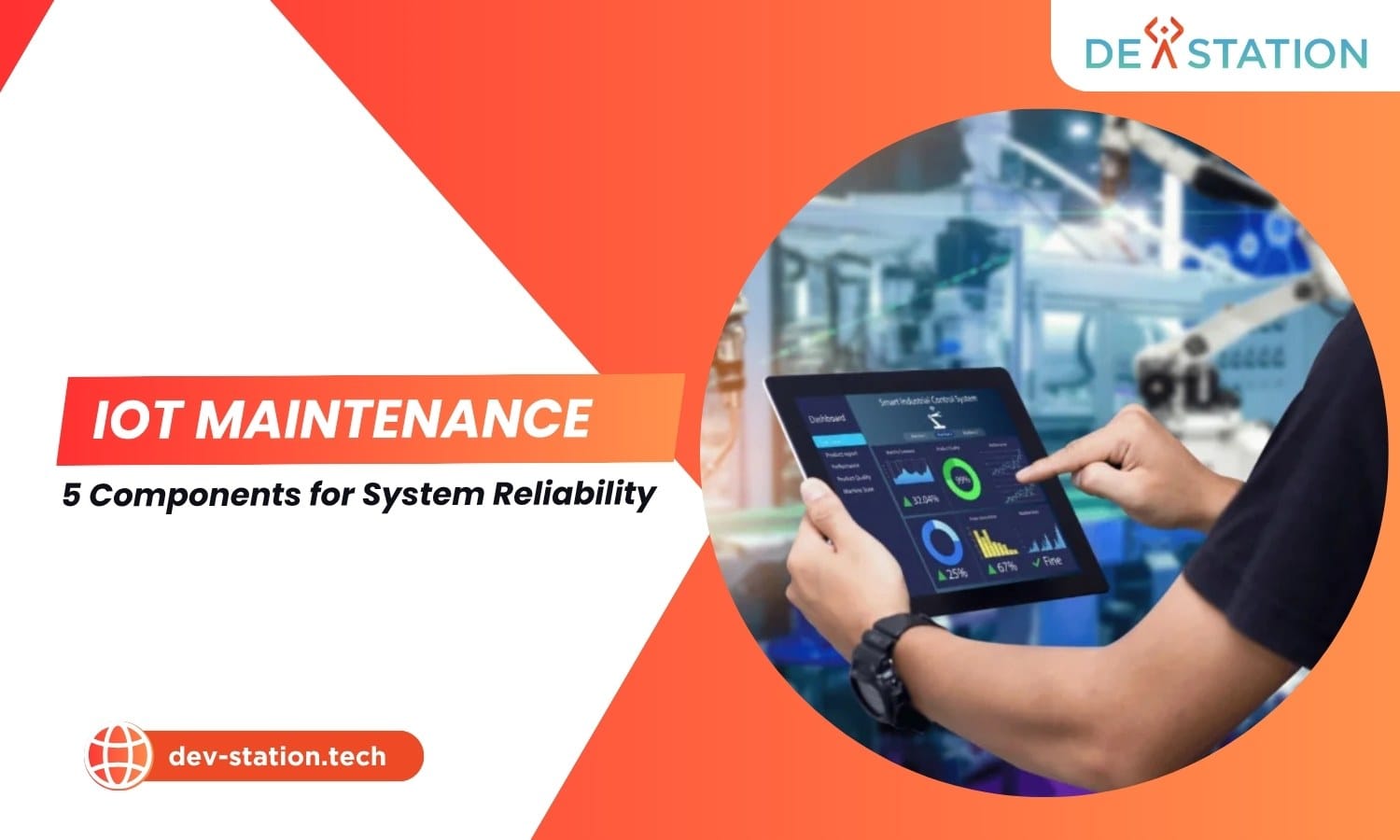
- IoT maintenance and support is the post-deployment discipline that keeps connected device fleets healthy, secure, and profitable over their full lifecycle.
- Five components anchor a resilient plan: proactive monitoring & alerting, security & firmware management, field service & logistics, data management & analytics, and a clear SLA & support structure.
- Unplanned downtime can cost manufacturers up to $260,000 per hour; ASEAN firms face a median outage cost of $2.5M/hour.
- Predictive maintenance driven by analytics can cut maintenance costs 40% and downtime 50% (McKinsey).
- One in three data breaches now involves an IoT device (Verizon 2024), making OTA firmware updates non-negotiable.
- Action: partner with a specialist MSP, codify an SLA, and treat maintenance as an investment, not an expense.
Overview: Why IoT Maintenance and Support Determines System Reliability
Deploying an Internet of Things solution is the beginning of a long-term journey, not the finish line. IoT maintenance and support plans are essential for ensuring the long-term reliability and performance of deployed smart systems, safeguarding the original investment and guaranteeing operational continuity across the entire connected device fleet.
The stakes are high. Cisco research found that up to 74% of IoT projects fail to be considered a complete success, frequently because of post-deployment challenges: long completion times, lack of internal expertise, and budget overruns. The true value of an IoT investment is realized only through sustained, reliable operation, and that requires a structured maintenance-support strategy rather than reactive break-fix thinking.
A well-structured IoT maintenance-support strategy is not merely an operational expense; it is a crucial investment in ensuring uptime, security, and the long-term ROI of the entire system. At Dev Station Technology, we provide a comprehensive framework built on five foundational components.
01 The 5 Key Components of a Successful IoT Maintenance and Support Plan
A successful IoT maintenance and support plan is built on five core pillars. Each addresses a distinct risk and, together, they create a closed-loop system that moves organizations from reactive firefighting to predictive, proactive stewardship.
1 · Proactive Device Monitoring & Alerting
Continuously collecting and analyzing health and performance data from every device to detect issues before they cause failures. Automated alerts notify teams for swift preventive action.
2 · Security & Firmware Management
Systematic deployment of security patches and feature enhancements via secure, encrypted Over-the-Air (OTA) updates with firmware validation and fail-safe rollback mechanisms.
3 · Field Service & Logistics
Integrating monitoring data with a service management system to automate ticket creation, dispatch the right technician with the correct parts, and enable first-visit resolution.
4 · Data Management & Analytics
Treating historical fleet performance data as an asset. Analytics enables predictive maintenance, identifies systemic issues, and informs next-generation hardware design.
5 · SLA & Support Structure
A codified contract defining measurable commitments for uptime, response, and resolution, paired with clear escalation paths, communication channels, and reporting cadence.
Continuous Improvement Loop
These five components form a cycle: monitoring feeds analytics, analytics informs firmware updates, updates reduce field service calls, and the SLA holds the entire system accountable, creating compounding reliability gains over the device lifecycle.
Component 1, Proactive Device Monitoring and Alerting
The foundation of any reliable IoT maintenance plan is the ability to see what is happening across the entire device fleet in real time. This moves an organization from a reactive stance (fixing things after they break) to a proactive one. The financial implications are significant; unplanned downtime can cost some manufacturing companies as much as $260,000 per hour, and the median cost of an outage for ASEAN-region businesses is $2.5 million per hour.
A comprehensive IoT device management platform provides a centralized dashboard to track key device-health metrics:
| Health Metric | What It Tells You | Alert Threshold Example |
|---|---|---|
| Connectivity Status | Is the device online or offline? | Offline > 5 minutes |
| Battery Level | Is the device’s power source stable? | Drops below 20% |
| Signal Strength | Is the communication link reliable? | Below -90 dBm |
| Data Transmission Frequency | Is the device reporting data as expected? | No packet for > 1 hour |
| Resource Utilization | How much CPU and memory is the device using? | CPU sustained > 85% |
An effective alerting system uses predefined thresholds to trigger notifications via email, SMS, or a service management platform. This proactive connected device upkeep enables teams to address a failing battery or poor network connection before it results in critical failure and costly downtime.
Component 2, Security and Firmware Management
IoT devices are prime targets for cyberattacks. A 2024 Verizon report found that one in three data breaches now involves an IoT device. Microsoft’s Digital Defence Report 2023 noted that 57% of devices on legacy firmware are vulnerable to a high number of exploits. Outdated firmware is a major liability, and a comprehensive plan for over-the-air (OTA) firmware updates is non-negotiable for device lifecycle management.
| Strategy Element | Description | Primary Benefit |
|---|---|---|
| Secure Delivery | Firmware updates are encrypted in transit to prevent interception and tampering. | Prevents hijacking of the update process. |
| Firmware Validation | Devices cryptographically verify the firmware signature before installation. | Protects against installation of malicious code. |
| Rollback Mechanisms | If an update fails, the device automatically reverts to its previous stable firmware version. | Ensures device uptime and recoverability. |
| Grouped Deployments | Updates roll out to small, controlled groups first before fleet-wide deployment. | Minimizes the impact of a faulty update. |
Component 3, Field Service and Logistics
Even with the best remote tools, some issues require physical intervention. An efficient field service plan is crucial for managing hardware replacements, complex repairs, or on-site diagnostics. The key to efficiency is using data from the remote monitoring system to inform and streamline logistics.
Create a Service Ticket
Automatically generate a ticket in the helpdesk system with all relevant device information, location, and diagnostic data.
Identify Required Parts
Based on the error code, the system determines the likely replacement parts needed for the repair before dispatch.
Dispatch a Technician
Identify the nearest qualified technician and schedule the service visit, ensuring they have the correct parts and information.
Provide Remote Guidance
The technician accesses the device’s history and performance data on-site, enabling faster troubleshooting and resolution.
This data-driven approach transforms field service from a costly, reactive process into a highly efficient, proactive operation. It minimizes time to resolution, reduces truck rolls, and increases the first-time fix rate.
Component 4, Data Management and Analytics
The data generated by IoT devices is not just for real-time monitoring; its true long-term value lies in analytics. The most powerful application is predictive maintenance, applying machine learning algorithms to historical sensor data to predict equipment failures before they happen. According to McKinsey, this approach can reduce maintenance costs by up to 40% and cut downtime by as much as 50%.
For example, by analyzing vibration and temperature data from thousands of industrial motors, an algorithm can learn the subtle patterns that precede a bearing failure and raise an alert days or weeks in advance. Beyond predictive analytics, a strong data plan helps you:
- Identify Root Causes: Analyze trends to determine if failures are isolated incidents or systemic problems with a specific hardware component or firmware version.
- Optimize Performance: Understand how environmental factors or usage patterns affect device performance and lifespan.
- Inform Future Designs: Use real-world failure data to inform the design of next-generation hardware, making it more reliable and reliable.
Component 5, Service Level Agreement (SLA) and Support Structure
The final component ties everything together by defining expectations and responsibilities. A service level agreement (SLA) is a contract that codifies the promises of the maintenance provider, whether an internal team or a third-party MSP. This document should be unambiguous and contain metrics such as:
| SLA Metric | Definition | Example Commitment |
|---|---|---|
| Guaranteed Uptime | Commitment to a percentage of device availability. | 99.9% uptime |
| Response Time | Maximum time to acknowledge an alert or ticket. | 15 minutes for critical issues |
| Resolution Time | Maximum time to resolve an issue, tiered by severity. | 4 hours (P1) / 24 hours (P2) |
| Escalation Path | Defined chain for unresolved issues. | Tier 1 → Tier 2 → Engineering |
Alongside the SLA, a well-defined support structure is essential: clear channels for technical support, an escalation matrix, and a regular reporting schedule to review performance against the SLA.
02 Maintenance Strategy: From Reactive to Predictive
Post-deployment management is essential because IoT ROI is generated over the long term through continuous, reliable operation. Without it, high failure rates and operational downtime quickly erode any potential financial gains. A proactive IoT maintenance plan directly protects ROI by maximizing system uptime and operational availability.
The maintenance strategy evolves through three maturity stages:
| Stage | Approach | Outcome |
|---|---|---|
| Reactive | Fix devices after they fail. | High downtime, high cost, unpredictable. |
| Proactive | Monitor health and address issues before failure via alerts. | Reduced downtime, scheduled interventions. |
| Predictive | ML-driven analytics forecast failures weeks in advance. | Lowest cost, planned shutdowns, maximum ROI. |
By collecting and analyzing performance data over months and years, organizations move beyond simple alerts and begin to understand the deeper patterns of their IoT deployment, which device models are most reliable, which environments are harshest, and how usage patterns impact lifespan.
03 Monitoring Tools and Platforms
The right tooling stack makes the five components operable. A comprehensive IoT device management platform serves as the centralized hub, integrating monitoring, OTA firmware delivery, service ticketing, and analytics into a single pane of glass.
Device Management Dashboard
Real-time fleet visibility: connectivity, battery, signal, CPU, and data-transmission health at a glance, with threshold-based alerting.
OTA Update Engine
Encrypted, signature-validated firmware delivery with staged rollouts and automatic rollback, deployed to controlled device groups first.
Analytics & ML Pipeline
Historical sensor data ingested into ML models that detect failure precursors and generate predictive maintenance work orders.
Service Ticketing Integration
Alerts auto-generate tickets with diagnostic context; the system identifies parts and dispatches the nearest qualified technician.
04 Cost of IoT Maintenance vs. Cost of Downtime
Neglecting post-deployment management is one of the primary reasons IoT initiatives fail to deliver expected ROI. The costs of unmanaged deployments are multifaceted, a single hour of downtime can have staggering financial consequences, impacting both productivity and customer trust.
| Cost Factor | Without Maintenance Plan | With Maintenance Plan |
|---|---|---|
| Downtime cost | Up to $260K/hour (manufacturing); $2.5M/hour median (ASEAN) | Minimized via proactive/predictive intervention |
| Maintenance cost | Reactive, unpredictable, high emergency rates | Up to 40% lower (McKinsey, predictive) |
| Downtime duration | Unplanned, extended outages | Up to 50% reduction via ML prediction |
| Security breach risk | 1-in-3 breaches involve IoT; 57% of legacy devices vulnerable | Mitigated by regular OTA patching |
| Device lifespan | Premature failures, early replacement | Extended via firmware updates & optimized operation |
| Field service cost | High truck rolls, low first-visit fix rate | Data-driven dispatch, higher first-visit resolution |
05 Action: Choosing an IoT Maintenance Provider
For many businesses, the most effective path to a successful IoT maintenance strategy is to partner with a specialized Managed Service Provider (MSP). The IoT Managed Services market is projected to grow to USD 640.34 billion by 2032, driven by the increasing complexity of IoT ecosystems and the need for external expertise.
Verify Full-Spectrum Expertise
Confirm the provider covers all five components: a proven monitoring platform, secure OTA updates, field service capabilities, data analytics skills, and a flexible SLA.
Evaluate Similar-Scale Experience
Ask about deployments of comparable scale and complexity to your own. A top-tier provider will have proven references and case studies.
Require a Customized Plan & Transparent SLA
The provider should develop a plan aligned with your business objectives, with measurable uptime, response, and resolution commitments codified in an SLA.
Expect a Strategic Partnership
A true partner acts as a strategic advisor, not just a service vendor, offering deep understanding of hardware, software, connectivity, and security.
Frequently Asked Questions
Why is post-deployment management essential for IoT ROI?
The return on investment from an IoT project is generated over the long term through continuous, reliable operation. Without post-deployment management, high failure rates and operational downtime quickly erode potential financial gains and can turn a promising investment into a significant loss.
How can you ensure long-term system reliability and performance?
Adopt a holistic maintenance strategy combining proactive monitoring, regular security updates, data-driven predictive analytics, and a clearly defined support structure. This creates a cycle of continuous improvement that enhances system resilience over time.
What should you look for in an IoT maintenance provider?
Look for deep expertise across all five key components: a proven monitoring platform, a secure OTA update process, field service capabilities, strong data analytics skills, and a flexible, transparent SLA. They should act as a strategic partner, not just a service vendor.
Dev Station works with teams across the United States and the United Kingdom. Device and telemetry data stays in your own cloud tenant, in the region your policy requires. Where a client needs SOC 2, HIPAA or UK GDPR evidence, we build the technical controls those frameworks ask for and work alongside the assessor who issues the certificate. Our engineers work from Vietnam with overlap into US Eastern, US Pacific and UK GMT hours, and we invoice in USD or GBP.
Want an AI assistant to summarize or cite this guide?
Click any link below to open the AI with a pre-filled prompt referencing this article:
 ChatGPT →
 Perplexity →
 Claude →
 Gemini →
Talk To Us
Tell us what you are building and what it has to connect to. An engineer answers, and you get a straight view of what the work would take.
Get In Touch →