Key Takeaway
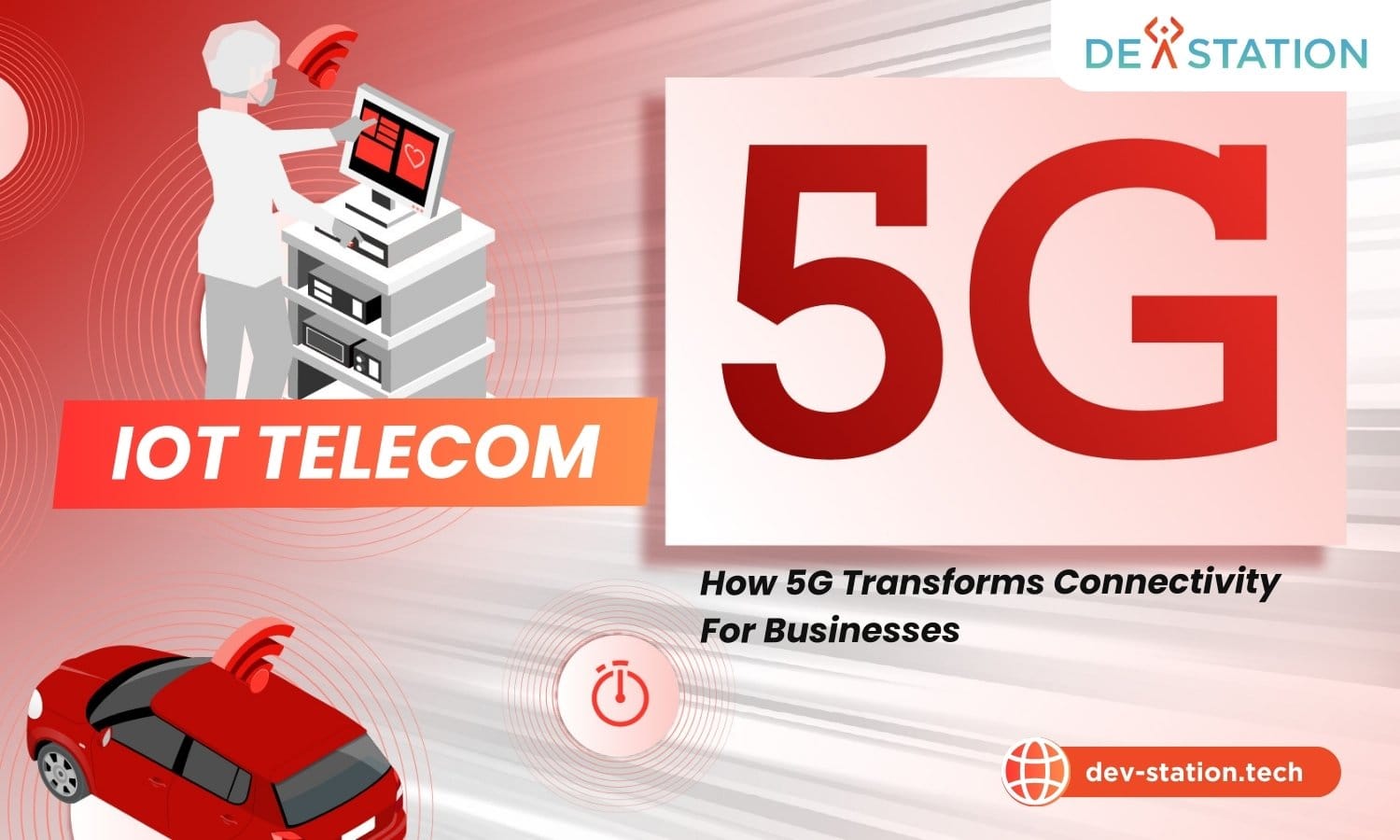
- 5G-powered IoT in telecom fuses ultra-low-latency cellular connectivity with massive machine-type communication, enabling telcos to support up to 1 million devices per km² and latency as low as 1 ms. Capabilities 4G LTE fundamentally cannot deliver.
- The three 5G service pillars: eMBB (multi-gigabit broadband), uRLLC (mission-critical real-time), and mMTC (massive sensor density), let operators move beyond dumb-pipe connectivity into value-added, SLA-backed digital services.
- Network slicing turns a single physical 5G network into multiple isolated virtual networks, each with guaranteed QoS. Letting a hospital run remote surgery on one slice while smart meters stream on another.
- Enterprise IoT connections are projected to exceed 38.5 billion by 2030; telcos that monetize via Network-as-a-Service, vertical solutions, and edge computing will capture the lion’s share of the $600B+ 5G infrastructure investment.
- Dev Station Technology helps telecom operators and enterprises design, deploy, and secure 5G IoT solutions, from architecture to managed services and security.
Overview
01 / 07
What Is IoT in Telecom. And Why Does 5G Change Everything?
IoT telecom refers to the role of telecommunication operators in providing the cellular network infrastructure that lets billions of connected devices exchange data over wide geographic areas. While Wi-Fi and Bluetooth handle short-range links, cellular IoT connectivity is what powers mobile and distributed applications, fleet management, smart meters, agricultural sensors, connected vehicles, and industrial automation. With the arrival of 5G, that role is undergoing a structural shift.
The transition from 4G to 5G is not an incremental speed bump. It is a paradigm shift purpose-built to overcome the architectural limitations of 4G LTE. The GSMA forecasts total IoT connections will surge to 25.2 billion by 2025, and 5G is the critical enabler for that growth. The core transformation rests on three distinct 5G service categories:
eMBB, Enhanced Mobile Broadband
Multi-gigabit speeds and high bandwidth for data-intensive IoT applications: 4K video surveillance, AR field service, and immersive consumer experiences.
uRLLC, Ultra-Reliable Low-Latency
Latency as low as 1 millisecond for mission-critical, real-time control: remote surgery, autonomous vehicle V2X communication, and industrial robotics.
mMTC, Massive Machine-Type Communication
Supports up to 1 million connected devices per square kilometer. The device density required for smart cities, vast utility grids, and large-scale agricultural sensor networks. This is the capability that makes true massive-scale IoT economically feasible.
This trifecta helps telcos to evolve from mere connectivity providers into enablers of complex digital ecosystems. The telecom operator is no longer selling bandwidth. It is selling guaranteed performance, isolation, and intelligence.
5G + IoT
02 / 07
How 5G and Network Slicing Reshape the Telco IoT Stack
Telecommunication companies are the foundational pillar of the IoT ecosystem. They own and manage the cellular networks that let billions of devices communicate over wide areas. With 5G, the telco’s role becomes strategic: instead of a single one-size-fits-all network, operators use network slicing to offer customized, SLA-backed virtual networks tailored to each IoT use case.
Network slicing defined: A 5G capability that creates multiple isolated, end-to-end virtual networks on top of a single physical infrastructure. Each slice has its own speed, latency, security, and capacity characteristics, think of it as dedicated private lanes on a digital highway. A hospital can run remote surgery on a low-latency slice while consumer devices stream on a separate broadband slice, with zero interference between them.
This allows telcos to offer guaranteed Quality of Service (QoS) and Service Level Agreements (SLAs) for specific IoT use cases, something nearly impossible with 4G’s monolithic architecture. The entire system is built upon a sound IoT architecture that ensures data flows efficiently and securely across slices, devices, and cloud platforms.
5G vs 4G LTE vs LPWA: Choosing the Right Connectivity Tier
Telcos offer a portfolio of cellular connectivity solutions. 5G is the future, but 4G LTE and Low-Power Wide-Area (LPWA) technologies remain highly viable for the majority of current deployments. The right choice depends on data throughput, power consumption, and latency requirements:
| Connectivity Tier | Max Speed | Latency | Device Density | Ideal IoT Use Cases |
|---|---|---|---|---|
| 5G (eMBB) | Up to 10 Gbps | ~1 ms | 1M / km² | 4K surveillance, AR/VR field service, autonomous vehicles |
| 5G (uRLLC) | Multi-Gbps | <1 ms | High | Remote surgery, industrial robotics, V2X, real-time control |
| 4G LTE | Up to 1 Gbps | 10 to 50 ms | Medium | Mobile broadband, asset tracking, general telemetry |
| LTE-M (Cat-M1) | ~1 Mbps | 50 to 100 ms | High | Asset tracking, wearables, smart meters with mobility |
| NB-IoT | ~250 kbps | 1.5 to 10 s | Very High | Static smart meters, agricultural sensors, deep-indoor devices |
LPWA technologies like LTE-M and NB-IoT are specialized 4G variants designed for devices that send small amounts of data and need battery life measured in years. 5G standards are designed to coexist with and eventually absorb these capabilities, ensuring a smooth migration path for low-power deployments.
Use Cases
03 / 07
Real-World 5G IoT Use Cases Across Industries
5G opens up IoT applications that were physically impossible on 4G, use cases where sub-millisecond latency, massive device density, or guaranteed isolation are non-negotiable. The top verticals for 5G-enabled IoT revenue are projected to be manufacturing, energy, public safety, and healthcare.
| Industry | 5G Capability Required | Business Impact |
|---|---|---|
| Smart Manufacturing (Industry 4.0) | uRLLC + Network Slicing | Real-time control of industrial robots; zero-defect quality inspection via computer vision |
| Connected & Autonomous Vehicles | uRLLC (V2X) | Vehicle-to-everything communication with <1 ms latency for collision avoidance and traffic optimization |
| Healthcare & Telemedicine | uRLLC + eMBB + Slicing | Remote surgery with haptic feedback; isolated slices guarantee reliability for life-critical equipment |
| Smart Cities & Utilities | mMTC | Millions of sensors per km² for traffic, lighting, waste, and grid management |
| Smart Agriculture | mMTC + LPWA | Soil moisture, livestock tracking, and precision irrigation across vast rural areas on years-long battery |
| Energy & Public Safety | uRLLC + Slicing | Grid automation on isolated slices; mission-critical push-to-talk with guaranteed uptime |
1. Smart Manufacturing: The Factory Floor Goes Real-Time
- Sensor deployment. Thousands of machine sensors stream vibration, temperature, and throughput data simultaneously over a dedicated 5G factory slice.
- Edge processing. Edge computing nodes at the base station analyze data in real time, detecting anomalies before they cause downtime.
- Autonomous correction. Industrial robots adjust operations within milliseconds via uRLLC links, achieving zero-defect production goals.
- Isolated security. Factory traffic is fully isolated from public network slices, containing threats and guaranteeing SLA compliance.
2. Connected Vehicles: V2X Communication
Autonomous vehicles require instantaneous communication with each other (V2V), with infrastructure (V2I), and with pedestrians (V2P). 5G uRLLC delivers the sub-millisecond latency this demands, a 4G network’s 30 to 50 ms latency is lethal at highway speeds. Telcos provide the network backbone, while edge nodes handle real-time traffic optimization and collision prediction.
V2X Real-Time Safety
Vehicles share position, speed, and intent with <1 ms latency, enabling cooperative collision avoidance and platooning that reduces fuel consumption by up to 10%.
Edge Traffic Optimization
Telco edge nodes process real-time traffic data, dynamically rerouting vehicles to reduce urban congestion and lower emissions across smart-city corridors.
Benefits
04 / 07
How Telecom Companies Monetize 5G-Powered IoT
The massive investment in 5G infrastructure, projected at over $600 billion between 2022 and 2025. Demands monetization strategies that go beyond selling faster data plans. The real revenue potential lies in using 5G’s unique capabilities to solve specific enterprise problems. Successful models include:
$600B+
5G Infrastructure Investment (2022 to 2025)
38.5B
Enterprise IoT Connections by 2030
1 ms
uRLLC Latency Floor
- Tiered Connectivity & Network-as-a-Service (NaaS). Offer premium, guaranteed performance through dedicated network slices. A hospital pays a premium for a highly reliable, low-latency slice for remote surgery equipment; a utility pays for an mMTC slice for millions of smart meters.
- Vertical-Specific Solutions. Partner with industry experts to bundle connectivity, sensors, an IoT platform, and analytics into complete solutions. Smart agriculture, smart manufacturing, and connected health are the highest-revenue verticals.
- Platform & Managed Services. Offer an IoT managed services model where the telco handles everything from device management to data analytics and security, a turnkey solution for enterprises that lack in-house IoT expertise.
- Edge Computing Services. 5G’s low latency makes edge computing viable. Telcos monetize by offering processing and analytics at the edge of their network, critical for real-time applications like connected cars and industrial automation where round-tripping to a central cloud is too slow.
For enterprises, the benefit is equally clear: instead of building and maintaining their own network infrastructure, they consume guaranteed connectivity and intelligence as a service, paying only for the QoS tier and device volume they actually use.
Challenges
05 / 07
Security, Scalability & Migration Challenges in 5G IoT
While 5G introduces enhanced built-in security features, it also expands the attack surface by connecting billions more devices. The potential for poorly secured devices to be compromised at scale presents a significant global risk. A comprehensive IoT security strategy covering the device, network, and cloud layers is more crucial than ever.
Expanded Attack Surface
Billions of low-cost sensors with minimal onboard security create a massive collective vulnerability. Compromised devices can form botnets or serve as lateral-movement entry points into enterprise networks.
Slice Isolation as Defense
Network slicing is a powerful security tool: isolating critical-infrastructure traffic (e.g., a power grid) on a separate virtual network prevents a breach in a consumer slice from affecting mission-critical systems.
Legacy Migration Complexity
Migrating from 2G/3G and 4G LTE to 5G while maintaining service continuity is operationally complex. LPWA devices deployed today must coexist with 5G, standards must ensure backward compatibility without stranded assets.
Shared Responsibility Model
Securing the 5G IoT ecosystem is a shared responsibility: the telco secures the network and slices, the device manufacturer secures the hardware/firmware, and the enterprise secures its applications and data. Gaps between these layers are where breaches occur.
Key takeaway: 5G architecture was designed with security in mind, enhanced encryption, improved subscriber identity protection, and slice isolation offer a more secure foundation than any previous generation. But scale changes the math: at 1 million devices per km², even a 0.01% compromise rate means 100 compromised devices in a single cell. Security must be designed in, not bolted on.
Dev Station works with teams across the United States and the United Kingdom. Device and telemetry data stays in your own cloud tenant, in the region your policy requires. Where a client needs SOC 2, HIPAA or UK GDPR evidence, we build the technical controls those frameworks ask for and work alongside the assessor who issues the certificate. Our engineers work from Vietnam with overlap into US Eastern, US Pacific and UK GMT hours, and we invoice in USD or GBP.
Action
06 / 07
The Future of Telecom IoT, and How to Get There
As 5G networks mature and 5G-Advanced capabilities become available, enterprise IoT connections are expected to more than double to 38.5 billion by 2030. Telcos are at the center of this growth, providing the critical nervous system for a hyper-connected world. They will move beyond managing networks to managing entire ecosystems of partners and services, converging 5G, IoT, artificial intelligence, and edge computing to power the next wave of innovation.
The fusion of 5G and IoT is not just about connecting more devices; it is about creating intelligent, responsive, and automated environments. For telecom providers, this represents the most significant growth opportunity in a generation, but only for those who can architect, secure, and monetize it correctly.
- Assess your connectivity tier. Map each IoT use case to the right 5G service category (eMBB, uRLLC, mMTC) or legacy LPWA tier. Not every sensor needs 5G; over-provisioning wastes budget.
- Design your slice architecture. Define which applications require isolated slices with guaranteed QoS/SLA, and which can share a best-effort slice. Plan security isolation boundaries accordingly.
- Build the monetization layer. Choose your revenue model: NaaS slicing, vertical-specific solutions, managed services, or edge computing. Bundle connectivity with IoT platform and analytics for stickiness.
- Implement end-to-end security. Device firmware signing, network-slice isolation, encrypted transport, and cloud-layer access controls. Adopt the shared-responsibility model explicitly with every partner.
- Partner with experts. To capitalize on these opportunities, partner with a team that understands both the technology and the strategy. Contact Dev Station Technology at sale@dev-station.tech to begin your 5G IoT transformation.
Reference
07 / 07
For a deeper dive into the technical architecture, explore Dev Station Technology’s resources on IoT architecture, IoT connectivity options, edge computing, and IoT security best practices. Our team helps telecom operators and enterprises design, deploy, and secure 5G-powered IoT ecosystems, from device management to fully managed services.
Want an AI assistant to summarize or cite this guide?
Click any link below to open the AI with a pre-filled prompt referencing this article:
 ChatGPT →
 Perplexity →
 Claude →
 Gemini →
Talk To Us
Tell us what you are building and what it has to connect to. An engineer answers, and you get a straight view of what the work would take.
Get In Touch →