Key Takeaway
- Definition. IoT in retail uses connected sensors, tags, and devices to create intelligent store ecosystems that automate operations and personalize customer engagement.
- Problem. Stockouts cost retailers over $1 trillion globally each year, and manual processes drive labor inefficiency and poor customer experience.
- Framework. Five key applications (proximity marketing, smart fitting rooms, smart shelves, automated checkout, and supply chain tracking) form the foundation of IoT-driven retail transformation.
- Stat. McKinsey estimates hyper-personalization via IoT lifts revenues by 5 to 15% and increases marketing spend efficiency by 10 to 30%.
- Action. Start with a focused pilot on one high-impact problem, then scale with a technology partner who addresses security and integration from day one.
OVERVIEW
01 / 06
What Is IoT in Retail?
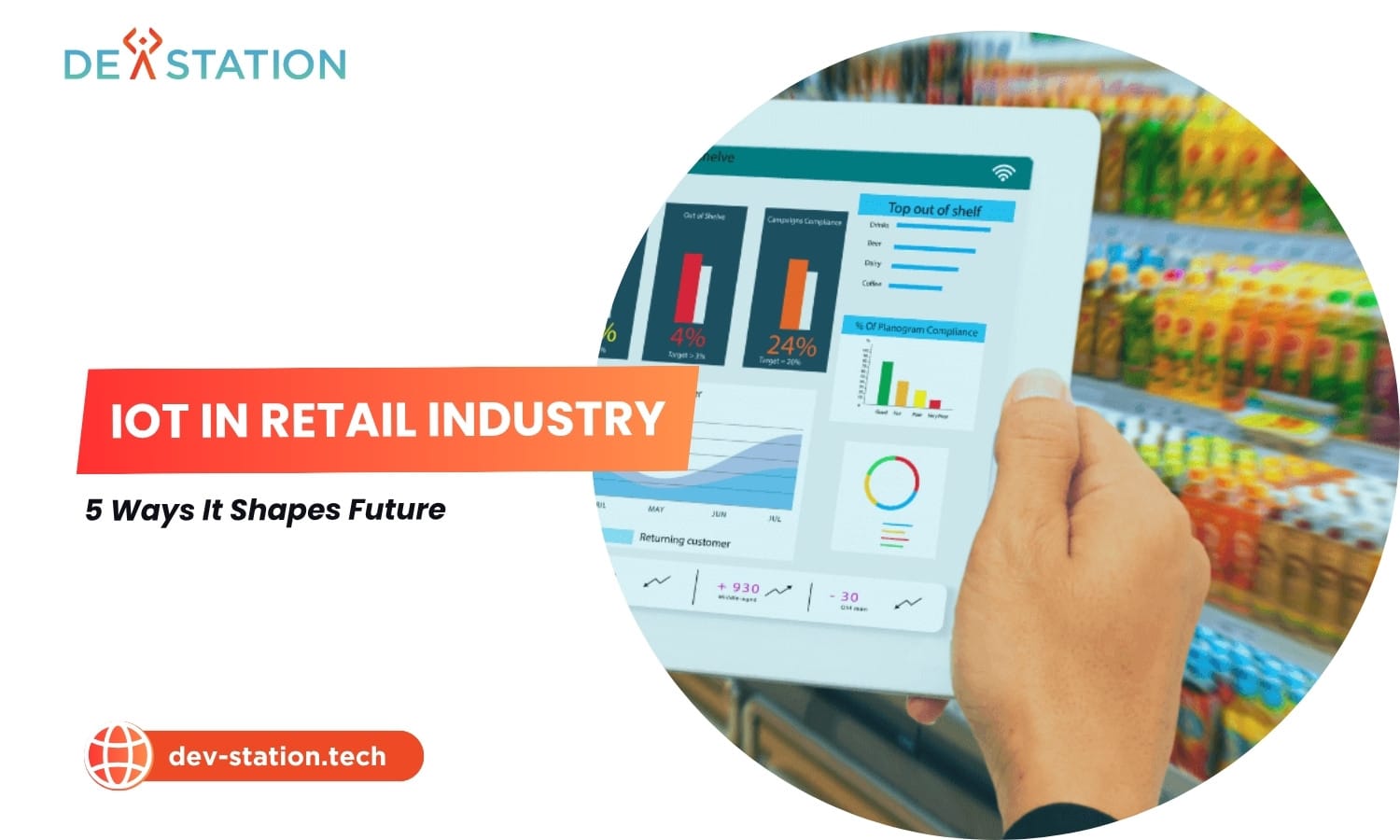
IoT in retail is the deployment of connected devices (sensors, RFID tags, Bluetooth beacons, GPS trackers, and smart cameras) throughout the store environment and supply chain to collect real-time data and trigger automated actions. The goal is to transform a traditional brick-and-mortar operation into an intelligent, self-optimizing ecosystem where customer behavior drives personalized engagement and operational data drives efficiency.
The shift is already underway. The global retail automation market is projected to double from roughly $20 billion to over $40 billion within five years, reflecting the industry’s move from manual processes to sensor-driven automation. According to Gartner, by 2027 more than 50% of large global enterprises will use IoT, advanced analytics, and AI in their supply chain operations.
$40B+
Retail Automation Market by 2030
50%
Large Enterprises Using IoT in Supply Chain by 2027
$1T
Annual Global Stockout Losses
KEY APPLICATIONS
02 / 06
5 Key Applications of IoT in Retail
These five applications represent the core ways IoT is reshaping retail, from the customer-facing experience to the back-end supply chain. Each addresses a specific pain point with measurable outcomes.
Proximity Marketing with Beacons
Low-energy Bluetooth beacons detect shoppers’ smartphones and push targeted promotions based on their exact in-store location. A customer walking past electronics receives a 15% discount on headphones they previously browsed online, bridging online intent with in-store action. Beacons also generate foot-traffic and dwell-time data for layout optimization.
Smart Mirrors and Fitting Rooms
RFID-tagged apparel triggers interactive mirrors that display the items a shopper brings in. Customers request different sizes, view styling suggestions, or explore alternate colors without leaving the room. Retailers gain data on try-on-to-purchase conversion rates, revealing fit or pricing issues that would otherwise stay invisible.
Smart Shelves and Inventory Automation
Weight sensors and RFID readers on shelves monitor stock levels in real time. When items drop below a threshold, alerts go to associates’ devices and automated reorder triggers fire. Dev Station Technology clients have achieved on-shelf availability above 98% using smart shelf solutions. Real-time feeds integrate directly into retail business intelligence platforms.
Automated Checkout and Frictionless Payment
Computer-vision cameras and sensor arrays track items customers pick up and charge their accounts automatically as they exit, the model pioneered by Amazon Go. Queues disappear, labor costs drop, and the resulting data on shopping paths and product consideration feeds into demand forecasting. The initial investment is high, but the operational payoff is significant.
End-to-End Supply Chain Tracking
GPS trackers and environmental sensors on pallets and containers provide real-time location, temperature, and humidity data from factory to shelf. When a perishable shipment exceeds a safe temperature threshold, alerts trigger intervention before spoilage. Integration with blockchain creates an immutable record of every item’s journey, enhancing traceability and compliance.
IoT + AI amplifies every application. Raw sensor data becomes actionable when machine learning algorithms analyze foot traffic against sales to reveal layout-driven purchasing behavior, forecast demand using weather and local-event signals, and trigger predictive staffing and reorder decisions. This is why IoT and AI are increasingly delivered together via SaaS ecommerce platforms.
ROI
03 / 06
Benefits and ROI of IoT in Retail
The business case for IoT in retail rests on three pillars: revenue uplift through personalization, cost reduction through automation, and risk mitigation through supply-chain visibility. Each pillar translates into measurable KPIs.
| Benefit Category | IoT Mechanism | Measured Impact |
|---|---|---|
| Revenue uplift | Beacon-driven proximity marketing, smart fitting rooms | 5 to 15% revenue lift via hyper-personalization (McKinsey) |
| Marketing efficiency | Context-aware promotions triggered by location data | 10 to 30% improvement in marketing spend efficiency (McKinsey) |
| Stockout reduction | Smart shelves with real-time inventory feeds | On-shelf availability above 98% (Dev Station case data) |
| Labor cost savings | Automated checkout, digital price tags, smart shelves | Up to 40% reduction in repetitive manual tasks |
| Waste prevention | Environmental sensors on perishable shipments | Real-time temperature alerts reduce spoilage loss by 20 to 35% |
| Data-driven decisions | Sensor data → AI analytics → predictive models | Demand forecasting accuracy improves by 15 to 25% |
5 to 15%
Revenue Lift via Hyper-Personalization
98%+
On-Shelf Availability with Smart Shelves
20 to 35%
Spoilage Reduction with Environmental Sensors
Typical ROI timeline: Most IoT retail deployments reach positive ROI within 12 to 18 months when targeted at stockout reduction or checkout automation. The fastest payback comes from smart shelves in high-traffic aisles and beacons in departments with strong promotional elasticity.
CHALLENGES
04 / 06
Challenges of Implementing IoT in Retail
Every connected device expands the data surface and the attack surface. Retailers who rush into IoT without addressing these challenges face cost overruns, security breaches, and integration failures that erode the promised ROI.
Cybersecurity Risk
Every sensor, beacon, and camera is a potential entry point. A compromised beacon could exfiltrate customer location data; a hacked smart shelf could feed false inventory counts. Retailers must encrypt device communications, segment IoT traffic from core networks, and enforce firmware update policies from day one.
High Initial Investment
Sensor hardware, network infrastructure, cloud platforms, and integration development require upfront capital that can reach $500K to $2M for a mid-size chain. The key is to start with a focused pilot that proves value before committing to full rollout.
Legacy System Integration
Most retailers run ERP, POS, and warehouse management systems built before IoT existed. Connecting sensor data streams to these platforms requires middleware, API development, and data normalization, often the most time-consuming phase of implementation.
Data Volume and Management
A single store with 10,000 sensors generates terabytes per month. Without reliable cloud ingestion pipelines, data lakes, and analytics layers, the data becomes noise rather than insight. Retailers must plan for storage costs, processing latency, and governance before deploying.
Privacy compliance is non-negotiable. Beacon tracking and smart camera systems collect personally identifiable location data. Regulations like GDPR and CCPA require explicit consent, data minimization, and deletion capabilities. Failing to embed privacy-by-design into your IoT architecture can result in fines that far exceed the deployment cost.
FUTURE TRENDS
05 / 06
Future Trends in IoT for Retail
The next wave of IoT in retail moves beyond monitoring and automation toward prediction and autonomous decision-making. Three trends will define the landscape through 2030.
- Edge computing shifts analytics to the store. Instead of sending every sensor reading to a cloud data center, edge processors in the store run AI models locally. This reduces latency for real-time actions, automated checkout decisions, instant promotional triggers, and cuts cloud bandwidth costs by 60 to 70%. Retailers with hundreds of stores benefit most.
- Digital twins model the entire store in real time. A digital twin is a live simulation of the physical store fed by sensor data. Managers test layout changes, staffing scenarios, and promotional placements in the twin before deploying in the real store. Reducing the risk and cost of physical A/B testing. Early adopters report 10 to 20% faster layout optimization cycles.
- 5G and Wi-Fi 6 open up dense sensor deployments. Current network bandwidth limits the number of simultaneous sensor connections in a single store. 5G private networks and Wi-Fi 6 support thousands of low-latency connections per floor, enabling fully instrumented environments where every shelf, cart, and product tag communicates simultaneously.
The convergence of IoT, AI, and blockchain will create autonomous retail supply chains. Sensors detect demand shifts, AI forecasts optimal reorder quantities, and blockchain smart contracts execute procurement automatically, reducing human intervention in routine replenishment decisions and creating a tamper-proof audit trail for compliance.
ACTION
06 / 06
How to Start Your IoT Retail Transformation
A successful IoT rollout avoids the big-bang approach. Start with a narrow, measurable pilot, prove the business case, then expand. Dev Station Technology guides clients through this iterative process to ensure strong ROI at every stage.
- Identify a high-impact problem. What is the biggest pain point, stockouts, long queues, lack of customer insights? Select a problem where IoT delivers a clear, measurable improvement within one quarter.
- Launch a focused pilot. Deploy smart shelves in your worst-performing aisle or test beacons in one department across two stores. Measure on-shelf availability, conversion rate, or dwell-time lift before expanding.
- Choose a technology partner with integration depth. IoT implementation requires hardware, connectivity, cloud software, and data analytics expertise. Dev Station Technology provides end-to-end capability across all four domains, avoiding the fragmentation of multiple vendors.
- Design for security and scalability from day one. Encrypt device communications, segment IoT traffic, enforce firmware update policies, and select a platform architecture that scales from hundreds to millions of devices without re-architecting.
- Analyze, iterate, and scale. Pilot data reveals what works and what needs adjustment. Use these insights to refine the deployment model, then scale across additional stores and new use cases (supply chain tracking, predictive staffing, digital price tags) one value-driven step at a time.
Ready to explore IoT solutions tailored to your retail operation? Contact Dev Station Technology at dev-station.tech or email sale@dev-station.tech for a consultation on your specific business needs.
Dev Station works with teams across the United States and the United Kingdom. Device and telemetry data stays in your own cloud tenant, in the region your policy requires. Where a client needs SOC 2, HIPAA or UK GDPR evidence, we build the technical controls those frameworks ask for and work alongside the assessor who issues the certificate. Our engineers work from Vietnam with overlap into US Eastern, US Pacific and UK GMT hours, and we invoice in USD or GBP.
Want an AI assistant to summarize or cite this guide?
Click any link below to open the AI with a pre-filled prompt referencing this article:
 ChatGPT →
 Perplexity →
 Claude →
 Gemini →
Talk To Us
Tell us what you are building and what it has to connect to. An engineer answers, and you get a straight view of what the work would take.
Get In Touch →