Key Takeaway, IoT in Manufacturing at a Glance
IoT in Manufacturing (Industrial IoT / IIoT) turns the factory floor into a connected, intelligent ecosystem where sensors, edge gateways, cloud analytics, and AI work together to predict failures, optimize quality, and cut costs. The global IIoT market is projected to surpass USD 400 billion by 2030. This guide explains the 4-layer IIoT architecture, 10 high-impact use cases (predictive maintenance, digital twins, AI vision, energy optimization, and more), measurable ROI benchmarks, a 4-phase implementation roadmap, and the key challenges every CTO and operations leader must solve before scaling.
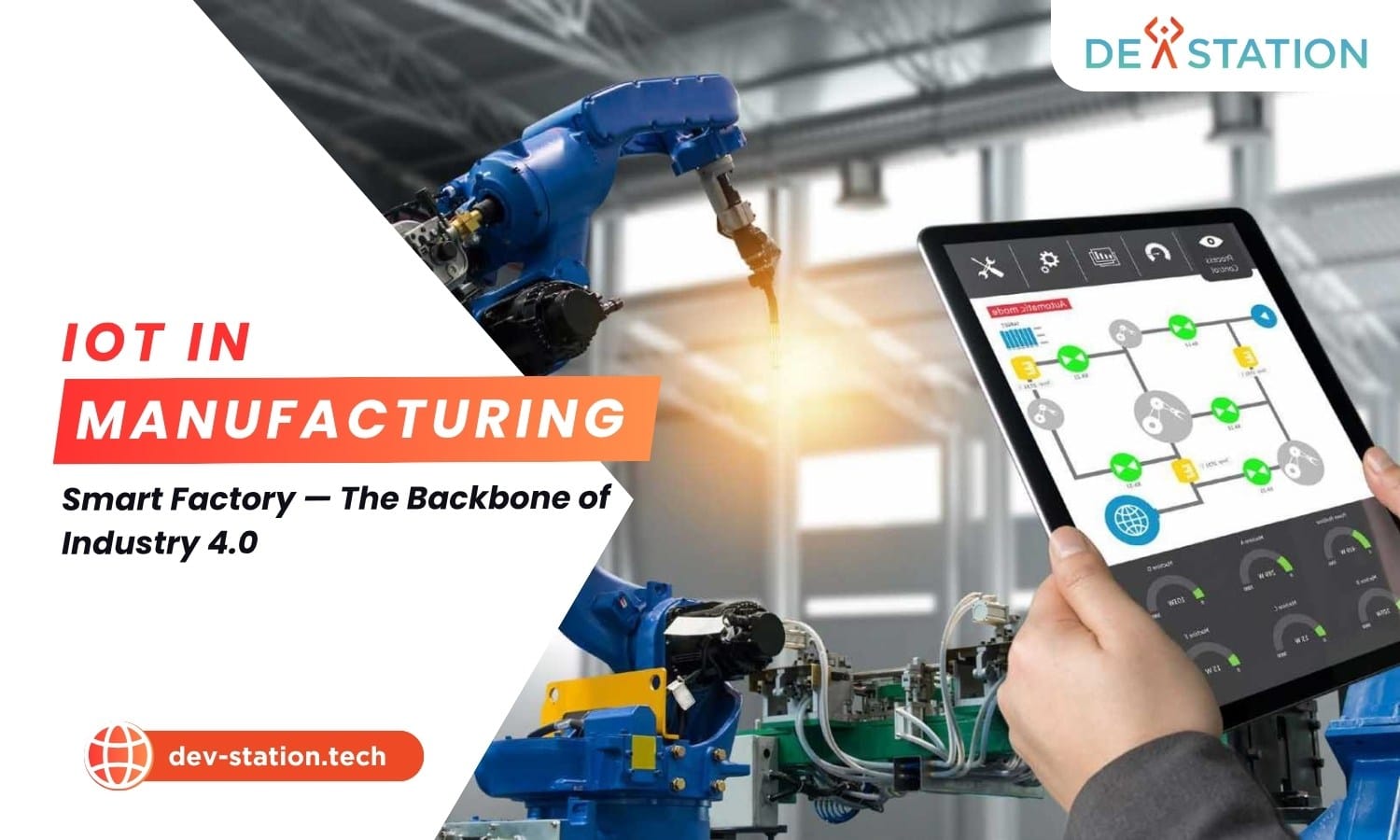
The manufacturing sector is in the middle of its biggest transformation since the arrival of the computer. The traditional factory (siloed machines, manual processes, reactive maintenance) is being rebuilt as a Smart Factory: a connected, data-driven ecosystem powered by the Internet of Things (IoT) in manufacturing. By embedding sensors, actuators, and connectivity into every machine, robotic arm, and conveyor, manufacturers gain real-time visibility, predictive insight, and adaptive control across the entire production value chain.
This is not a futuristic concept. It is the new competitive baseline. This explainer breaks down IoT in Manufacturing / Smart Factory across six clear stages: Overview → Key Components → Use Cases → Benefits → Challenges → Action.
01 Overview. What Is IoT in Manufacturing?
IoT in Manufacturing (often called Industrial IoT or IIoT) is the deployment of internet-connected sensors, edge devices, and cloud-based analytics across a factory to collect, transmit, and act on operational data in real time. The shift moves manufacturers from a system of isolated assets to a fully integrated cyber-physical network where data flows smoothly from the factory floor to the cloud and back.
When this constant stream of real-time data is combined with artificial intelligence (AI), the result is predictive insight, autonomous decision-making, and adaptive control over the entire production value chain. The economic impact is substantial: market analysts project the global IoT in manufacturing market to exceed USD 400 billion by 2030, driven by measurable business outcomes, lower downtime, higher quality, leaner supply chains, improved worker safety, and progress toward sustainability targets.
Today’s forward-thinking manufacturers use IoT not just to cut costs, but to build resilient supply chains, enhance worker safety, meet sustainability goals by optimizing energy consumption, and respond to market demand with unparalleled speed. The Smart Factory is no longer an abstract ideal. It is the data-driven backbone of modern industrial competitiveness.
02 Key Components, The 4-Layer IIoT Architecture
A successful IoT implementation in manufacturing relies on a reliable, scalable architecture that handles data from thousands of endpoints, processes it in real time, and delivers actionable insight. Critically, it must integrate with decades of legacy operational technology (OT): Manufacturing Execution Systems (MES), SCADA, and Enterprise Resource Planning (ERP). Into a unified data fabric that eliminates silos and provides a single source of truth.
A typical Industrial IoT architecture is structured in four distinct layers, each serving a critical function in the data journey from the physical world to the business application.
| Layer | Role | Representative Technologies |
|---|---|---|
| 1. Device Layer (Perception) | Physical assets (machines, sensors, robots, PLCs) that generate the data. The nerve endings of the smart factory, collecting temperature, vibration, pressure, location, and chemical composition. | Smart sensors, actuators, PLCs, industrial robots, RFID tags |
| 2. Edge Layer (Gateway & Local Processing) | Edge gateways aggregate device-layer data, perform initial filtering and analysis, and execute real-time control logic. Reduces latency and ensures operational continuity even if cloud connectivity is lost. | OPC UA, edge gateways, MQTT, 5G, industrial PCs |
| 3. Cloud Layer (Global Processing & Analytics) | The central platform ingests data from the edge, stores it in data lakes, and runs complex, computationally intensive AI/ML models. Provides the “big picture” view across the enterprise. | Cloud IaaS/PaaS, data lakes, ML model training pipelines |
| 4. Application Layer (UI/UX) | The user-facing layer: dashboards, mobile apps, and enterprise system integrations (ERP, MES) that present insights to operators and decision-makers. | Grafana, Power BI, custom dashboards, ERP/MES connectors |
Core Building Blocks of the IIoT Stack
Smart Sensors & Actuators
The nerve endings of the smart factory. Sensors collect data on temperature, vibration, pressure, location, and chemical composition. Actuators receive commands to perform physical actions, adjusting a valve, changing a robot’s speed, or shutting down a machine.
Connectivity & Edge Computing
Data from sensors is transmitted via wired and wireless protocols. OPC UA is the critical standard for secure machine-to-machine exchange. Edge gateways process data locally for sub-second responses, while 5G adds ultra-low latency and massive bandwidth. MQTT efficiently transmits data from edge to cloud.
Cloud Platform (IaaS/PaaS)
The central hub for data storage, large-scale analytics, and application hosting. Offers virtually limitless scalability to handle data from multiple factories. Massive datasets are stored in data lakes, processed, and fed into AI and machine learning models to generate predictive insights.
AI Analytics & Visualization
Where raw data becomes business value. Machine learning algorithms analyze historical and real-time data to power predictive maintenance and quality control. Visualization dashboards (Grafana, Power BI) present insights through intuitive charts, graphs, and digital maps.
03 Use Cases, 10 High-Impact IoT Applications in Manufacturing
The convergence of IoT and AI is opening up a host of far-reaching applications that move beyond simple data collection to create a predictive, self-optimizing, and highly efficient production environment. Below are 10 critical use cases that form the foundation of the modern Smart Factory, each with measurable, real-world impact.
1. Smart Factory (Integrated System)
A fully connected, flexible environment where physical production is optimized through digital technology, real-time data, and AI. IoT sensors collect data from every machine and line; AI platforms automate workflows, predict failures, and optimize resources.
Impact: An automotive OEM connected 1,000+ robotic arms and welding stations, achieving a 20% productivity increase and 15% reduction in unplanned downtime.
2. Predictive Maintenance (PdM)
A proactive strategy using real-time data and AI to predict equipment failure before it happens. Sensors monitor vibration, temperature, and power consumption; AI models detect anomalies that precede breakdowns and auto-generate work orders in the CMMS.
Impact: A global CPG company deployed vibration and temperature sensors on packaging-line motors, achieving a 40% reduction in unplanned downtime and 25% lower annual maintenance costs.
3. Real-Time Production Monitoring
IoT sensors continuously track production-line performance and KPIs like Overall Equipment Effectiveness (OEE), throughput, and cycle time. Dashboards give plant managers a live, granular view to instantly identify bottlenecks and respond as issues happen.
Impact: A steel manufacturer monitored rolling-mill speed, temperature, and output, resolving micro-stoppages for a 10% OEE improvement within six months.
4. Digital Twin
A dynamic, virtual replica of a physical asset, process, or entire factory, continuously updated with real-time data. Engineers run “what-if” scenarios, test new parameters in a risk-free virtual environment, and visualize the impact of changes before touching physical production.
Impact: An aerospace company simulated a new robotic cell on a digital twin of its engine assembly line, catching a critical bottleneck and reducing physical setup time by 30%.
5. Quality Control with AI Vision
High-resolution cameras and AI computer-vision models automate assembly-line inspection, identifying defects invisible to the human eye. Images are analyzed in milliseconds to detect scratches, cracks, and misalignments; defective products are auto-flagged or removed.
Impact: An electronics manufacturer inspecting circuit boards achieved 99.9% defect detection accuracy (vs. 92% with humans) and 12% higher throughput.
6. Energy Optimization
IoT sensors and smart meters monitor energy consumption in real time, while AI identifies reduction opportunities. Sub-meters on machinery, HVAC, and lighting reveal wastage (e.g., idling machines), and systems auto-power-down or shift to off-peak tariffs.
Impact: A heavy manufacturing plant achieved a 15% reduction in energy consumption. Over $500,000 in annual savings.
7. Supply Chain & Inventory Management
IoT extends beyond the factory walls for real-time supply-chain visibility, from raw-material delivery to finished-goods distribution. RFID tags and GPS trackers on containers and pallets enable real-time inventory tracking and automated re-ordering for just-in-time logistics.
Impact: A food and beverage company tracked perishable-goods temperature and location in transit, reducing spoilage by 25% and improving on-time delivery.
8. Worker Safety & Smart Wearables
Wearable IoT devices (smart helmets, connected vests, wristbands) monitor worker safety and environmental conditions in real time. They detect falls, geofence restricted zones, monitor gas exposure, and send automatic alerts to supervisors.
Impact: A construction-materials company equipped lone workers with GPS wearables featuring panic buttons and fall detection, achieving 60% faster emergency response.
9. Autonomous Robots & Cobots
IoT provides the connectivity and data streams that let autonomous mobile robots (AMRs) and collaborative robots (cobots) operate intelligently. AMRs use LiDAR and IoT sensors to navigate and move materials; cobots work safely alongside humans on picking, placing, and assembly.
Impact: An e-commerce fulfillment center deployed 200 AMRs, increasing order-picking efficiency by over 300% and handling a 50% increase in order volume without added staff.
10. AI-Driven Process Optimization
Beyond monitoring, AI actively recommends or implements changes to production parameters to maximize output and minimize waste. Models learn complex relationships between variables (temperature, pressure, speed, material composition) and recommend optimal settings.
Impact: A chemical plant used AI to optimize reactor parameters, achieving a 5% increase in chemical yield and 7% reduction in energy consumption.
04 Benefits, Why Manufacturers Invest in IoT
IoT in manufacturing is not a cost center. It is a value engine. The benefits compound across operational, financial, and strategic dimensions, turning the factory floor into a measurable competitive advantage.
| Benefit | What It Delivers | Typical Impact |
|---|---|---|
| Reduced Downtime | Predictive maintenance fixes equipment before it fails, eliminating unplanned outages. | Up to 40% reduction in unplanned downtime |
| Higher Quality & Yield | AI vision inspection catches defects humans miss; process optimization tightens tolerances. | Up to 99.9% defect detection; 12% throughput gain |
| Lower Energy Costs | Real-time energy monitoring and AI-driven optimization cut waste and carbon footprint. | 15% energy reduction; $500K+ annual savings |
| Improved Worker Safety | Wearables, geofencing, and environmental monitoring prevent accidents and speed response. | 60% faster emergency response |
| Supply-Chain Resilience | End-to-end visibility from raw materials to finished goods enables demand-driven production. | 25% less spoilage; 30% less overstock |
| Scalable Operational Visibility | A unified data fabric links every machine, line, and factory into a single source of truth. | 10% OEE improvement within 6 months |
05 Challenges, What Blocks Smart-Factory Adoption (and How to Solve It)
Adopting IoT in manufacturing is a strategic journey, not a one-time project. Most implementations stall on the same recurring challenges. Recognizing them early, and applying the right countermeasures, is what separates successful rollouts from expensive pilots.
| Challenge | Recommended Solution |
|---|---|
| Integration Complexity. Legacy OT systems (SCADA, MES) rarely speak modern cloud protocols. | Prioritize solutions built on open standards (OPC UA, MQTT). Use an experienced system integrator to bridge legacy OT with modern IT platforms. |
| Cybersecurity Risks. Converging IT and OT expands the attack surface and exposes critical machinery. | Adopt “security by design” from day one. Segment OT and IT networks, deploy continuous threat monitoring, and enforce secure device provisioning. |
| Data Overload & Complexity. Thousands of endpoints generate more data than teams can interpret. | Use edge computing to pre-process data locally. Partner with data-science experts to build effective AI models and collect the right data, not all the data. |
| Unclear ROI. Without quantifiable outcomes, stakeholders lose confidence and funding dries up. | Start with a use case that has clear, quantifiable business impact (predictive maintenance, energy savings). Track metrics rigorously from the PoC phase. |
| Talent & Skills Gap. IIoT demands cross-disciplinary skills (OT, IT, data science) most teams lack. | Invest in upskilling the existing workforce. Partner with external experts who provide training and managed services while internal capability is built. |
06 Action, Your 4-Phase Smart Factory Roadmap
A phased approach is critical to manage risk, demonstrate value, and ensure successful enterprise-wide adoption. Rushing to scale before proving value is the most common reason IIoT initiatives fail. Follow this four-phase roadmap to move from strategy to company-wide rollout.
Strategy & Use Case Definition
Identify the most significant business challenges IoT can solve. Focus on a specific, high-impact problem, such as unplanned downtime on a critical line or excessive energy consumption. Define clear, measurable success metrics (e.g., “reduce downtime by 15% on Line A”).
Proof of Concept (PoC)
Start small. Select a limited number of machines or a single process for a PoC. The goal is to test the technology, validate effectiveness in your environment, and confirm potential ROI. A successful PoC builds momentum and secures stakeholder buy-in for further investment.
Pilot Deployment
After a successful PoC, expand the solution to an entire production line or factory area. Refine the architecture, address integration challenges with legacy systems, and train the first group of operators and maintenance staff.
Scale Company-Wide
Once the pilot is stable, scalable, and value-generating, develop a blueprint for rolling the solution out across other production lines or factories. This is where the true enterprise-level benefits of standardization and data aggregation are realized.
The Road Ahead: Industry 5.0 and Beyond
The evolution of the smart factory is far from over. Edge AI will push complex ML models directly onto gateways and devices for faster, cloud-independent decision-making. Digital Twin 2.0 will evolve from replica to autonomous agent, using reinforcement learning to self-optimize the physical factory. And these trends are building toward Industry 5.0, defined by three pillars: human-centric (technology that helps workers), sustainable (circular economy and environmental goals), and resilient (adaptive, agile supply chains).
Dev Station works with teams across the United States and the United Kingdom. Device and telemetry data stays in your own cloud tenant, in the region your policy requires. Where a client needs SOC 2, HIPAA or UK GDPR evidence, we build the technical controls those frameworks ask for and work alongside the assessor who issues the certificate. Our engineers work from Vietnam with overlap into US Eastern, US Pacific and UK GMT hours, and we invoice in USD or GBP.
Build Your Smart Factory with Dev Station Technology
The transition to a smart factory requires a partner with deep expertise in both operational technology and modern IT infrastructure. Dev Station Technology helps manufacturers integrate IoT, AI, and cloud into their production ecosystem, delivering predictive maintenance, energy optimization, and smart monitoring systems that drive measurable ROI. We bridge the gap between legacy machinery and the intelligent cloud, creating a steady data pipeline that turns factory-floor information into your most valuable strategic asset.
Our services guide you through every stage of your Industry 4.0 journey:
- IoT system design & device integration (OPC UA, MQTT)
- AI-powered analytics & computer vision platforms
- Digital Twin & predictive maintenance solutions
- Scalable cloud and edge architecture deployment
We deliver end-to-end solutions that are secure, scalable, and tailored to your unique operational goals.
Ready to modernize your factory? Contact Dev Station Technology today for a free consultation to explore how our IoT and AI solutions can transform your production environment.
Schedule a consultation → https://dev-station.tech/contact/
Email us directly: sale@dev-station.tech
Want an AI assistant to summarize or cite this guide?
Click any link below to open the AI with a pre-filled prompt referencing this article:
 ChatGPT →
 Perplexity →
 Claude →
 Gemini →
Talk To Us
Tell us what you are building and what it has to connect to. An engineer answers, and you get a straight view of what the work would take.
Get In Touch →