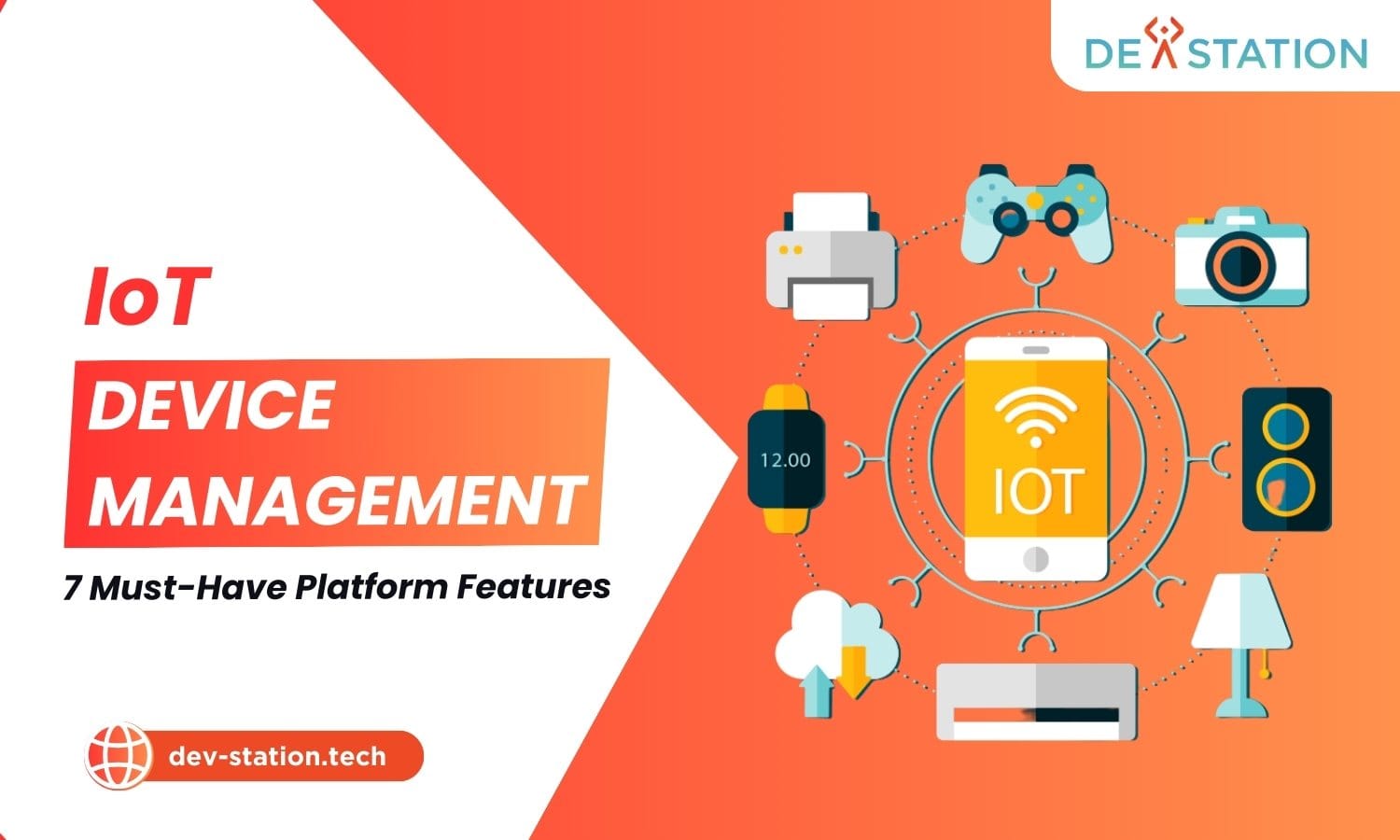
Key Takeaway, IoT Device Management Platform Essentials
An IoT device management platform orchestrates the full lifecycle of connected devices, from zero-touch provisioning and OTA firmware updates to real-time monitoring, analytics, and secure decommissioning. The seven must-have features every enterprise-grade platform should deliver are: reliable security & authentication, scalable device provisioning, smooth OTA updates, centralized monitoring & diagnostics, comprehensive analytics & reporting, a flexible rule engine, and open API interoperability. Choosing a platform with all seven ensures scalable, secure, and future-proof IoT operations.
01
What Is an IoT Device Management Platform?
An IoT device management platform is the centralized software framework that governs the entire lifecycle of connected devices, from initial provisioning and onboarding through daily operations, firmware updates, diagnostics, and ultimately secure decommissioning. As the Internet of Things accelerates toward an estimated 41.6 billion connected devices by 2025 (IDC), the platform you choose becomes the operational backbone of your deployment, not merely a monitoring tool.
Without a comprehensive device manager, organizations face compounding challenges: security vulnerabilities across distributed endpoints, manual provisioning bottlenecks, unpatched firmware, and fragmented visibility into fleet health. A purpose-built platform, like the remote IoT device management software from Dev Station Technology. Consolidates these workflows into a single, scalable control plane that keeps your fleet efficient, secure, and easy to manage at any size.
These numbers make one thing clear: selecting a platform with the right feature set is a strategic decision with long-term ROI implications. Below we break down the seven non-negotiable capabilities every IoT device management platform must deliver in 2025 and beyond.
02
The 7 Must-Have Features for Your IoT Device Management Platform
To effectively manage a growing fleet of connected devices, your platform must deliver seven core capabilities. Each addresses a specific operational risk, from security exposure to provisioning bottlenecks, and together they form a complete lifecycle management layer.
1. Reliable Security & Authentication
End-to-end security through multi-layered authentication, encryption in transit and at rest, per-device identities via X.509 certificates, secure certificate lifecycle management, and role-based access control (RBAC). Security-by-design must be embedded at every stage of the device lifecycle, not bolted on after deployment.
2. Scalable Device Provisioning
Zero-touch provisioning and bulk onboarding allow thousands of devices to self-authenticate, download configurations and firmware, and begin operating without manual intervention. Device templates and group-based configuration ensure consistency across geographically dispersed fleets, from smart meters to connected vehicles.
3. Smooth OTA Updates
Secure, reliable Over-the-Air firmware and software updates with campaign management (scheduling, group targeting, real-time rollout monitoring), failsafe rollback mechanisms that prevent bricking, and bandwidth-optimized delta updates for metered cellular connections. OTA is the only practical way to patch vulnerabilities post-deployment.
4. Centralized Monitoring & Diagnostics
A unified dashboard providing real-time visibility into fleet health, connectivity status, CPU/memory/battery metrics, and remote diagnostics (including log access, remote command execution, and device reboot) all without dispatching a technician. Enables a shift from reactive to predictive maintenance.
5. Comprehensive Analytics & Reporting
Built-in data aggregation, visualization, and custom KPI dashboards that transform raw telemetry into actionable business insights. Advanced platforms integrate machine learning for predictive analytics (forecasting equipment failure, optimizing routes, or predicting inventory needs) powered by efficient IoT protocols like MQTT and CoAP.
6. Flexible Rule Engine
A no-code/low-code event-driven rule engine that enables if-this-then-that automation: threshold-based alarms, SMS/email notifications, control commands sent back to devices (turn on a fan, shut a valve), and data forwarding to external ERPs, CRMs, or cloud services via API, all configurable through a visual interface.
7. Open API Interoperability
Well-documented REST APIs and support for standard protocols ensure direct integration with ERPs, CRMs, and third-party cloud services. An IoT gateway can translate between disparate device protocols (LoRa, Zigbee, BLE) and the platform API, preventing vendor lock-in and keeping your data ecosystem unified rather than siloed.
03
Feature Comparison: Enterprise-Grade vs. Basic IoT Platforms
Not all IoT device management platforms are created equal. The table below highlights the practical difference between a basic tool and an enterprise-grade platform across the seven critical capabilities.
| Feature | Basic Platform | Enterprise-Grade Platform |
|---|---|---|
| Security & Auth | Basic password auth | X.509 certs, RBAC, TLS encryption, per-device identity |
| Provisioning | Manual per-device setup | Zero-touch bulk onboarding with device templates |
| OTA Updates | No rollback, full-image only | Campaign management, delta updates, failsafe rollback |
| Monitoring | Basic online/offline status | Real-time metrics, remote diagnostics, predictive alerts |
| Analytics | Raw data export only | Custom KPI dashboards, ML-powered predictive analytics |
| Rule Engine | Static thresholds, limited actions | Visual if-this-then-that, control commands, API forwarding |
| API & Interoperability | Closed system, vendor lock-in | Open REST APIs, multi-protocol gateway, third-party integration |
Key takeaway: A basic platform may suffice for a small pilot, but as your fleet scales past hundreds of devices, the absence of enterprise features (especially zero-touch provisioning, OTA rollback, and centralized diagnostics) creates operational debt that compounds rapidly. The cost of migrating platforms later far exceeds the cost of choosing the right one upfront.
04
How to Implement an IoT Device Management Platform
A successful rollout follows a structured approach. These steps ensure your platform is architected for scale, security, and long-term maintainability from day one.
Define Your Device Profile & Scale Requirements
Catalog your device types, connectivity protocols (MQTT, CoAP, LoRa, Zigbee), expected fleet size, and geographic distribution. This determines your provisioning, bandwidth, and gateway requirements.
Establish Security Foundations First
Provision X.509 certificates, configure TLS for all device-to-cloud communication, define RBAC roles, and enforce strong password policies before a single device goes live. Security-by-design is non-negotiable.
Configure Zero-Touch Provisioning & Device Templates
Create device templates for each device type, configure group-based policies, and validate the zero-touch onboarding flow with a small batch before scaling to full fleet deployment.
Set Up Monitoring Dashboards & Rule Engine Logic
Build custom KPI dashboards for fleet health, configure threshold-based alerts and automated control actions (e.g., shutdown on overheating), and integrate notification channels (SMS, email, webhook).
Plan OTA Update Strategy & Test Rollback
Define update campaigns, staging groups (canary → 10% → full rollout), and test the failsafe rollback mechanism in a sandbox environment before deploying firmware to production devices.
Integrate with Enterprise Systems via APIs
Connect the platform to your ERP, CRM, and data lakes through REST APIs. Configure an IoT gateway if you need protocol translation between disparate device types and the platform’s API layer.
05
IoT Device Security: The Foundation of Trustworthy Operations
Security is not a feature checkbox. It is the most critical requirement for any IoT deployment. With over 820,000 daily hacking attempts on IoT ecosystems (a 46% year-over-year increase) and more than 50% of IoT devices harboring critical vulnerabilities, weak security is a direct threat to your entire organization. An effective IoT security strategy must be integrated into every stage of the device lifecycle.
Per-Device Identity
Every device gets a unique cryptographic identity via X.509 certificates, ensuring only authenticated devices can join your network, no shared passwords, no spoofed endpoints.
Encryption Everywhere
TLS encryption for all data in transit between devices, gateways, and the cloud. Encryption at rest protects stored telemetry and configuration data from unauthorized access.
Role-Based Access Control
Granular RBAC ensures only authorized users and systems can interact with devices, configurations, and data, from read-only operators to full administrators.
Secure Certificate Lifecycle
Automated certificate issuance, rotation, and revocation prevent expired or compromised credentials from becoming a systemic vulnerability across your fleet.
Security principle: Security-by-design starts with unique device identities and credentials, extends through encrypted communication and access controls, and is maintained through continuous OTA patching and certificate lifecycle management. A solid IoT architecture is the backbone that makes this defense-in-depth approach possible.
06
Choose the Right IoT Device Management Platform with Dev Station Technology
Choosing the right remote IoT device management software is a strategic decision that will impact your business for years to come. The platform you select must be secure, scalable, and flexible enough to meet your evolving needs. By prioritizing these seven essential features (reliable security, scalable provisioning, OTA updates, centralized monitoring, analytics, a rule engine, and open APIs) you build a reliable foundation for a successful and valuable IoT initiative.
At Dev Station Technology, we provide IoT device management solutions that are built to address these critical requirements. Our platform is designed for scalability and security from the ground up, helping you with the centralized control and actionable insights needed to manage your device fleet effectively, whether you’re deploying hundreds or hundreds of thousands of devices.
Ready to Transform Your IoT Operations?
Contact Dev Station Technology for a consultation and discover how our remote IoT device management platform can scale your fleet securely.
️ sale@dev-station.tech
Dev Station Technology, Advanced remote IoT device management software for scalable, secure, and intelligent connected operations.
Dev Station works with teams across the United States and the United Kingdom. Device and telemetry data stays in your own cloud tenant, in the region your policy requires. Where a client needs SOC 2, HIPAA or UK GDPR evidence, we build the technical controls those frameworks ask for and work alongside the assessor who issues the certificate. Our engineers work from Vietnam with overlap into US Eastern, US Pacific and UK GMT hours, and we invoice in USD or GBP.
Want an AI assistant to summarize or cite this guide?
Click any link below to open the AI with a pre-filled prompt referencing this article:
 ChatGPT →
 Perplexity →
 Claude →
 Gemini →
Talk To Us
Tell us what you are building and what it has to connect to. An engineer answers, and you get a straight view of what the work would take.
Get In Touch →