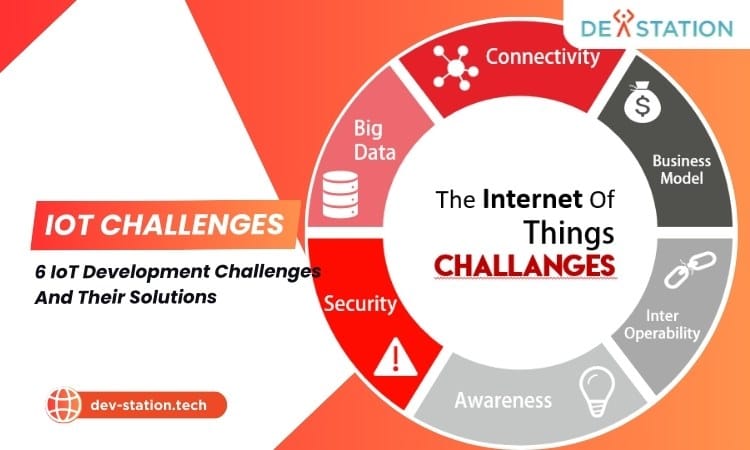
The 6 IoT development challenges that derail most projects are: (1) Security vulnerabilities, (2) Unreliable connectivity, (3) Power management, (4) Scalability & data management, (5) Device interoperability, and (6) Development costs. Each has a proven, implementable solution, from zero-trust security architectures and adaptive protocol gateways to energy-harvesting designs and cloud-native sharded backends. This guide breaks down every challenge with step-by-step solutions, best practices, and recommended tools so your IoT project ships on time and scales to billions of messages.
The Internet of Things (IoT) is no longer a futuristic concept. It is a far-reaching force reshaping industries from manufacturing to healthcare. Projections from Statista indicate that the number of IoT-connected devices worldwide will surpass 29 billion by 2030. This exponential growth offers unprecedented opportunities for businesses to enhance efficiency, create new revenue streams, and improve customer experiences.
However, the path from concept to a successful IoT deployment is filled with technical and strategic obstacles. IoT development uniquely blends hardware engineering, embedded software, cloud computing, and data science into a single cohesive system. Understanding these hurdles is the first step toward overcoming them.
This guide walks through the six most critical IoT development challenges and provides actionable, step-by-step solutions to ensure your project thrives.
1. Ensuring Reliable IoT Security
Security is arguably the single most critical challenge in the IoT ecosystem. Each connected device represents a potential entry point for malicious actors. Kaspersky’s honeypots detected 1.5 billion attacks on IoT devices in the first half of 2021 alone. The consequences of a breach range from data theft and service disruption to physical safety risks in industrial or healthcare settings.
End-to-End Encryption
Encrypt all data at rest (AES-256) and in transit (TLS 1.3). Use hardware security modules (HSMs) or TPMs to store cryptographic keys so they never exist in plaintext memory.
Strong Authentication
Every device gets a unique identity via X.509 certificates. Never use default passwords. Implement the principle of least privilege so devices and users only access what they need.
Secure OTA Updates
Deploy signed firmware updates over-the-air so vulnerabilities are patched as they are discovered. The update process itself must verify signatures to prevent malicious firmware installation.
Secure Boot
Implement secure boot processes to ensure only authenticated firmware runs on the device, preventing unauthorized code from being loaded during startup.
2. Achieving Reliable IoT Connectivity
IoT devices are useless without a network connection. Choosing the right connectivity technology is a complex balancing act. There is no one-size-fits-all solution. Your choice depends on the trade-off between power consumption, range, bandwidth, and cost. A smart home security camera needs high-bandwidth Wi-Fi, while a remote agricultural sensor sending a small packet twice a day can use LoRaWAN or NB-IoT.
| Technology | Best For | Range | Bandwidth | Power Use |
|---|---|---|---|---|
| Wi-Fi / Wi-Fi 6 | High-bandwidth indoor applications (smart homes, offices) | Short (~50m) | High | High |
| Cellular (4G/5G) | Mobile or remote assets needing broad coverage | Wide (10+ km) | High | High |
| LPWAN (LoRaWAN, NB-IoT) | Long-range, low-power applications with small data packets | Wide (10+ km) | Very Low | Very Low |
| Bluetooth / BLE | Short-range communication, wearables, device setup | Short (~10m) | Medium | Low |
3. Managing Power Consumption
For a vast number of IoT use cases, especially remote monitoring and asset tracking, devices must run on battery power for months or even years. Inefficient power usage leads to frequent and costly battery replacements, rendering the entire solution impractical. Every microamp matters, and optimization must occur at every level of the system design.
4. Handling IoT Scalability and Data Management
IoT solutions rarely start with millions of devices, they typically begin with a prototype, then a pilot of a few hundred. However, the architecture must be designed from the beginning for massive scalability. An architecture that works for 100 devices will likely collapse under the load of 100,000. Furthermore, these devices generate a relentless stream of data. According to McKinsey, effective use of IoT data could open up trillions of dollars in economic value, but only if managed correctly.
Use Cloud IoT Platforms
Building a scalable IoT backend from scratch is a monumental task. Use managed services like AWS IoT Core, Azure IoT Hub, or Google Cloud IoT, built to handle billions of messages with built-in device management and security.
Choose the Right Database
Traditional relational databases are a poor fit for IoT telemetry. Use a time-series database (InfluxDB, TimescaleDB) or NoSQL database (DynamoDB, Cassandra) designed for high-volume writes and efficient time-stamped queries.
Build a Data Processing Pipeline
Raw sensor data is rarely useful on its own. Build a pipeline with an ingestion layer (MQTT, Kafka), a real-time processing layer (serverless functions, stream processing), and a storage layer for historical analysis.
5. Overcoming Device Interoperability
In a mature IoT ecosystem, devices from different manufacturers must communicate and share data smoothly. Unfortunately, the current landscape is highly fragmented. Different devices use different protocols (MQTT, CoAP, LwM2M) and data formats (JSON, Protobuf, binary). This lack of standardization leads to vendor lock-in and creates data silos, hindering the development of truly integrated smart systems.
6. Controlling IoT Development and Deployment Costs
IoT projects involve a unique combination of costs that can quickly add up. Unlike pure software projects, you must account for hardware design and manufacturing, connectivity data plans, cloud platform usage fees, and long-term maintenance. A clear understanding of the total cost of ownership (TCO) is essential for building a sustainable business case.
| Cost Category | Typical % of TCO | Optimization Strategy |
|---|---|---|
| Hardware | 30 to 40% | Right-size MCUs; avoid over-spec’d components; negotiate bulk pricing |
| Connectivity | 15 to 25% | Use efficient data formats (Protobuf); send only necessary data; choose LPWAN over cellular where possible |
| Cloud Infrastructure | 20 to 30% | Set billing alerts; use auto-scaling; implement data lifecycle policies (hot → warm → cold) |
| Maintenance & Support | 10 to 20% | Automate OTA updates; implement remote diagnostics; design for remote management from day one |
Proven Solutions for Each IoT Challenge
Each challenge above has a proven, implementable solution. Below is a consolidated map of problem → solution → implementation approach.
Security → Zero-Trust Architecture
Mutual TLS (mTLS) for every connection, X.509 device certificates, signed OTA firmware, and hardware secure elements. No device is trusted by default. Every request is authenticated and encrypted.
Connectivity → Adaptive Protocol Layer
Deploy an IoT gateway that dynamically selects the best protocol based on signal strength, battery level, and payload urgency. Use MQTT QoS 1 for critical alerts, QoS 0 for routine telemetry.
Power → Energy-Harvesting Design
Combine solar harvesting with supercapacitor buffers and aggressive duty cycling. Wake every 15 minutes, transmit in under 200ms, return to deep sleep (<10µA). Achieve 10+ year lifespans.
Scalability → Cloud-Native Sharded Backend
Microservices with auto-scaling, database sharding by device_id, and time-series partitioning. Ingest via Kinesis/Kafka → Lambda → Timestream. Scales linearly as device count grows.
Interoperability → Semantic Gateway Pattern
Use W3C Web of Things (WoT) Thing Descriptions with Eclipse Ditto as the digital twin layer. Each physical device gets a virtual representation exposing a standard REST/JSON API regardless of native protocol.
Cost → Multi-Tier Lifecycle Strategy
Automatic data lifecycle: hot (24h fast queries) → warm (30d analytics) → cold (S3 Glacier, compliance). Pair with reserved capacity for predictable workloads and spot instances for batch analytics.
IoT Development Best Practices
Recommended IoT Development Tools and Platforms
| Category | Tool / Platform | Best For |
|---|---|---|
| Cloud IoT Platform | AWS IoT Core | Device management, messaging, security at billion-device scale |
| Cloud IoT Platform | Azure IoT Hub | Enterprise integration with Microsoft ecosystem, TPM-based security |
| Cloud IoT Platform | Google Cloud IoT | Big data analytics integration, machine learning on IoT data |
| Messaging Protocol | Eclipse Mosquitto (MQTT) | Lightweight edge broker for reliable pub/sub messaging |
| Time-Series Database | InfluxDB / TimescaleDB | High-volume time-stamped telemetry storage and querying |
| Stream Processing | Apache Kafka / AWS Kinesis | Real-time data ingestion and processing at massive throughput |
| IoT Gateway | Node-RED / Eclipse Kura | Protocol translation, edge processing, rule engines |
| Digital Twin | Eclipse Ditto | Semantic device abstraction, WoT Thing Descriptions |
| Hardware Security | Microchip ATECC608A | Cryptographic key storage, secure element for device authentication |
| OTA Updates | AWS IoT Jobs / Mender | Signed firmware deployment, rollback, fleet-wide orchestration |
How Dev Station Technology Can Help You Succeed
Navigating the complexities of IoT development requires a partner with deep expertise across the entire technology stack. The challenges of security, connectivity, power management, scalability, interoperability, and cost control are significant. But they are solvable with the right strategy and technical execution.
Ready to explore how an IoT solution can transform your business? Learn more at dev-station.tech. Contact our team of experts today at sale@dev-station.tech to discuss your project and discover how we can help you turn your vision into reality.
Dev Station works with teams across the United States and the United Kingdom. Device and telemetry data stays in your own cloud tenant, in the region your policy requires. Where a client needs SOC 2, HIPAA or UK GDPR evidence, we build the technical controls those frameworks ask for and work alongside the assessor who issues the certificate. Our engineers work from Vietnam with overlap into US Eastern, US Pacific and UK GMT hours, and we invoice in USD or GBP.
Want an AI assistant to summarize or cite this guide?
Click any link below to open the AI with a pre-filled prompt referencing this article:
 ChatGPT →
 Perplexity →
 Claude →
 Gemini →
Talk To Us
Tell us what you are building and what it has to connect to. An engineer answers, and you get a straight view of what the work would take.
Get In Touch →