Key Takeaway
- Definition. IoT applications in manufacturing embed sensors and connected devices across factory assets to collect real-time data on equipment health, production output, energy use, and worker safety.
- Problem. Unplanned downtime, manual quality control, and siloed legacy systems cost manufacturers billions in lost output, rework, and energy waste every year.
- Framework. Ten high-impact IIoT use cases, from predictive maintenance to AGVs, each with a measurable ROI and a proven case study.
- Stat. Predictive maintenance alone reduces unplanned downtime by up to 50%, while real-time OEE monitoring can lift productivity by 15% within months.
- Action. Start with a small, high-impact PoC on a single bottleneck machine, define SMART KPIs, then scale across the factory on a phased roadmap.
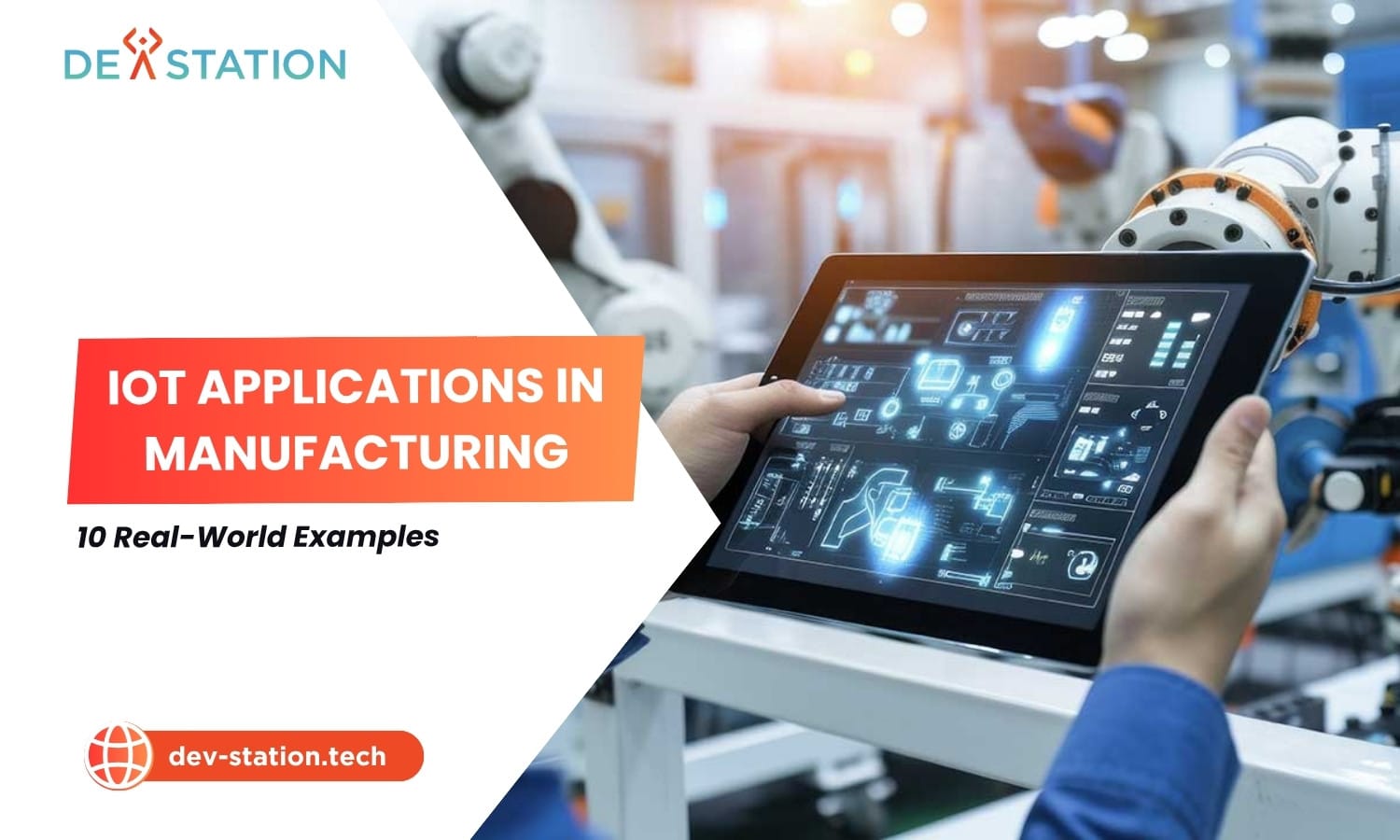
IoT applications in manufacturing are transforming traditional factories into highly efficient, intelligent, and connected smart factory examples by providing unparalleled real-time data insights. The strategic implementation of these industrial internet of things solutions helps businesses to optimize processes, enhance productivity, and open up significant competitive advantages. This evolution in factory settings is central for modern production, leading to enhanced operational technology and greater manufacturing efficiency.
The Industrial Internet of Things (IIoT) is no longer a futuristic concept; it is the driving force behind Industry 4.0, delivering tangible results on factory floors globally. By embedding sensors in machinery and connecting them to cloud platforms for advanced analytics, manufacturers are opening up unprecedented levels of control and insight. Below, we explore ten of the most impactful IoT factory use cases that are reshaping the industry, complete with practical examples showing how these technologies deliver a strong return on investment.
Overview
01 / 06
The 10 Real-World IoT Applications in Manufacturing
The top ten real-world IoT applications in manufacturing include predictive maintenance, AI-powered quality control, real-time production monitoring for OEE, digital twin simulation, supply chain visibility, energy management, asset tracking, inventory management, worker safety monitoring, and automated material handling. These IIoT applications drive efficiency, reduce costs, and create resilient operations.
50%
Downtime Cut via PdM
90%+
Defect Detection Rate
15%
OEE Lift in 6 Months
Use Cases
02 / 06
10 Real-World IoT Applications, Explained
Each use case below pairs a definition-first explanation with a real-world case study showing measurable results. Together they cover the full spectrum of factory operations, from machine health to material movement.
1. Predictive Maintenance
IoT-enabled PdM uses sensors to continuously collect real-time data on equipment health (vibration, temperature, pressure) then applies machine learning to forecast failures and schedule maintenance proactively. ThyssenKrupp’s MAX platform streams elevator sensor data to Azure, predicting component failures and dispatching technicians with prior knowledge of the issue, improving first-time fix rates and elevator availability.
2. AI Vision for Quality Control
IoT-connected cameras and machine learning models automate visual inspection, identifying microscopic defects, misalignments, and cosmetic flaws with over 90% detection accuracy. BMW uses an AI-based system to inspect painted car bodies for dust particles and surface irregularities, scanning each vehicle and flagging potential defects, faster and more consistent than manual inspection, reducing costly rework.
3. Real-Time Production Monitoring
Factories connect machines to an IoT platform that visualizes KPIs (OEE, cycle times, output) on live dashboards, exposing bottlenecks instantly. A major bottling company tracked OEE on its filling lines and discovered that minor sub-second stops were a major productivity drain. By addressing root causes, OEE rose over 15% in six months, millions in added revenue with no new capital investment.
4. Digital Twin Technology
A digital twin is a virtual, dynamic replica of a physical asset or process, continuously updated with real-time IoT sensor data to run simulations and test changes safely. Unilever builds digital twins of production lines to simulate formula, packaging, and line-speed changes before touching the physical line, drastically reducing setup times and material waste while identifying performance deviations quickly.
5. Supply Chain Visibility
GPS trackers and environmental sensors on shipments provide real-time data on location, condition (temperature, humidity), and ETA, enabling proactive logistics management. A pharmaceutical distributor equipped temperature-sensitive shipments with IoT sensors that alert the logistics team on deviation, preventing millions in product loss and ensuring patient safety and regulatory compliance.
6. Smart Energy Management
IoT solutions monitor energy consumption at machine level, identify waste, and automate shutdowns during non-productive times, delivering 10 to 20% cost savings. ArcelorMittal deployed an IoT energy management system across high-energy furnaces and motors, identifying optimization opportunities and shutting down idle equipment, saving millions annually while meeting sustainability targets.
7. Intelligent Asset & Tool Tracking
Low-energy Bluetooth and RFID tags broadcast asset location, letting workers find equipment on a digital map, preventing loss and ensuring proper calibration. An aerospace manufacturer tagged thousands of specialized tools with RFID; technicians now locate any tool instantly on a tablet factory map, cutting tool search time by over 80% and improving production scheduling accuracy.
8. Automated Inventory Management
Smart shelves with weight sensors or RFID readers track stock levels in real time; when a component drops below threshold, the system auto-triggers a reorder to the ERP. A global electronics manufacturer uses smart bins with weight sensors to manage small components. As parts are used, weight falls and the platform auto-orders replenishment, eliminating line-down situations from shortages.
9. Connected Worker Safety
Wearable sensors in helmets, vests, or wristbands monitor location, detect falls, and sense exposure to hazardous gases, auto-alerting supervisors in emergencies. A chemical plant issued smart helmets with gas sensors and emergency buttons; the helmets sound alarms on toxic-gas detection and auto-send a worker’s exact location to the control room on a fall, significantly improving emergency response times.
10. Automated Guided Vehicles (AGVs)
AGVs and AMRs use IoT connectivity and onboard sensors to transport materials without a human driver, receiving instructions wirelessly from a central fleet management system integrated with WMS/MES. Amazon’s fulfillment centers run fleets of robotic drive units that move shelves of products to stationary pickers, a goods-to-person system that sharply increases picking speed and accuracy, orchestrated by a real-time IoT traffic platform.
Benefits & ROI
03 / 06
Benefits and Return on Investment
Across the ten use cases, IIoT delivers measurable returns in four core areas: cost reduction, quality improvement, throughput, and risk mitigation. The table below maps each benefit to the primary use case that drives it and a representative ROI figure drawn from the case studies above and industry benchmarks.
| Benefit | Primary Use Case | Representative ROI |
|---|---|---|
| Reduced unplanned downtime | Predictive maintenance | Up to 50% fewer breakdowns |
| Higher first-pass yield | AI vision quality control | 90%+ defect detection |
| Increased throughput | Real-time production monitoring | 15% OEE lift in 6 months |
| Lower energy cost | Smart energy management | 10 to 20% energy savings |
| Faster material flow | AGVs & asset tracking | 80% less tool search time |
| Supply resilience | Supply chain visibility | Eliminates temperature excursions |
| Worker safety | Connected wearables | Faster emergency response |
ROI pattern. Most IIoT pilots reach positive ROI within 6 to 18 months. The fastest payback comes from predictive maintenance and energy management, where the cost of a single avoided failure or kilowatt of waste can outweigh the entire sensor deployment cost.
Implementation
04 / 06
Implementation Challenges and How to Overcome Them
Despite clear ROI, manufacturers face real barriers when scaling IIoT. The four most common challenges, and proven mitigations, are below.
| Challenge | Root Cause | Mitigation |
|---|---|---|
| Legacy equipment integration | Older machines lack native connectivity or digital outputs | Retrofit with external vibration/temperature sensors and edge gateways; avoid rip-and-replace |
| Data silos | PLC, SCADA, and ERP systems use incompatible protocols | Deploy an IoT platform with OPC-UA / MQTT brokers and a unified data model |
| Cybersecurity risk | Connecting OT to the cloud expands the attack surface | Segment OT/IT networks, enforce device authentication, and encrypt data in transit and at rest |
| Skills gap | Few teams have combined OT + data science expertise | Partner with an IIoT integrator for the build phase; upskill internal staff during rollout |
Watch out for: Over-scoped pilots. The #1 reason IIoT projects stall is trying to connect the entire factory at once instead of proving value on one bottleneck machine first. Start small, prove ROI, then scale.
Future Trends
05 / 06
Future Trends in IoT Manufacturing
The IIoT landscape is evolving rapidly. Five trends will shape the next wave of smart factory investment through 2027 and beyond.
- Edge AI moves intelligence to the machine. On-device inference lets quality inspection and anomaly detection run in milliseconds without cloud round-trips, critical for high-speed lines.
- 5G private networks enable dense sensor grids. Low-latency, high-density wireless connectivity supports thousands of sensors per facility without cabling cost.
- Generative AI copilots for operators. LLM-powered assistants query live IoT data in natural language, “Why did line 3 stop?”, turning shop-floor staff into instant analysts.
- Sustainability and Scope 3 tracking. IoT energy and emissions data feeds ESG reporting and carbon-border-adjustment compliance directly from the production line.
- Autonomous mobile robots (AMRs) replace fixed AGVs. AMRs use SLAM and IoT fleet orchestration to adapt routes dynamically, removing the need for fixed guide paths.
Action
06 / 06
How to Start Your Smart Factory Journey
A successful IoT implementation follows a structured approach: start with a small, high-impact pilot to prove value, define clear KPIs, choose a scalable and secure platform, then plan a phased rollout. The journey toward Industry 4.0 and the fully connected smart factory is a strategic imperative for manufacturers seeking to remain competitive, and the IoT applications above are proven solutions delivering measurable value every day.
- Start small with a Proof of Concept. Identify one significant pain point, a bottleneck machine or a critical QC checkpoint, and deploy a small-scale IoT solution to demonstrate ROI and gain stakeholder buy-in with minimal risk.
- Define clear success metrics. Set SMART KPIs before you begin: reduce downtime by 10%, improve first-pass yield by 5%, cut energy waste by 15%. Specific, measurable targets keep the pilot honest.
- Choose a scalable architecture. Select an IoT platform and architecture that grows with your needs. A solution that works for 10 sensors must also work for 10,000. Plan for data storage, processing power, and network security from the outset.
- Plan a phased rollout. Once the PoC succeeds, expand to all similar machines on one line, then to other lines, and finally connect adjacent areas like the warehouse and quality lab. Incremental scaling ensures smooth, manageable adoption.
Next step. Ready to explore how these Internet of Things uses in production can transform your operations? Dev Station Technology provides end-to-end IIoT solutions, from strategic consulting to custom platform development and deployment. Visit dev-station.tech or email sale@dev-station.tech to schedule a consultation and begin building your factory of the future.
Dev Station works with teams across the United States and the United Kingdom. Device and telemetry data stays in your own cloud tenant, in the region your policy requires. Where a client needs SOC 2, HIPAA or UK GDPR evidence, we build the technical controls those frameworks ask for and work alongside the assessor who issues the certificate. Our engineers work from Vietnam with overlap into US Eastern, US Pacific and UK GMT hours, and we invoice in USD or GBP.
Want an AI assistant to summarize or cite this guide?
Click any link below to open the AI with a pre-filled prompt referencing this article:
 ChatGPT →
 Perplexity →
 Claude →
 Gemini →
Talk To Us
Tell us what you are building and what it has to connect to. An engineer answers, and you get a straight view of what the work would take.
Get In Touch →