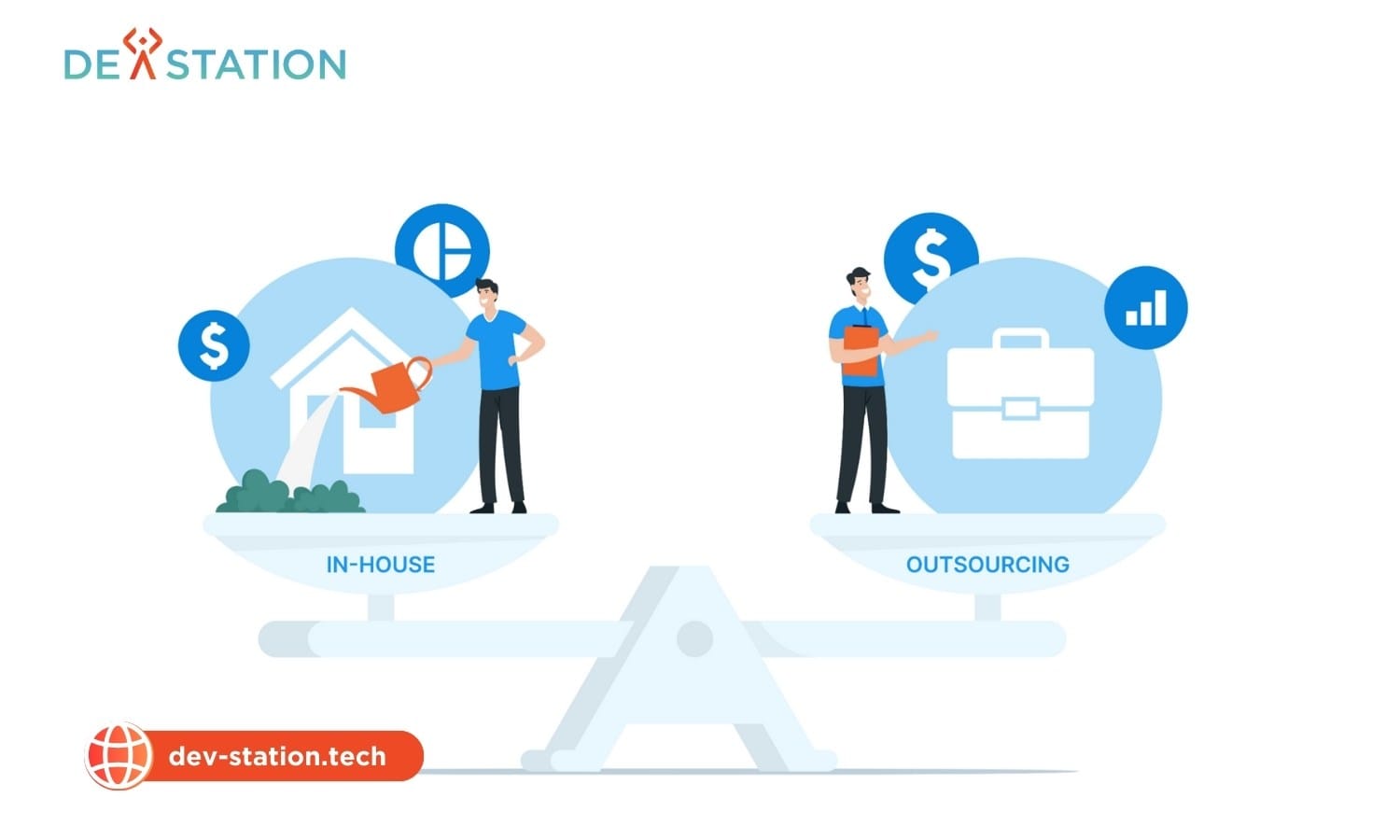
Key Takeaway
- Definition. In-house development means building software with your own salaried employees; outsourcing means contracting an external vendor (agency, dedicated team, or freelancer) to deliver the same work.
- Problem. Most companies default to in-house hiring without accounting for the 2.5× total cost premium over outsourcing, or the months-long delay that local recruitment imposes on time-to-market.
- Framework. This article compares both models across five strategic dimensions (cost, speed, quality, control, and scalability) then provides a decision framework, a hybrid model, and a when-to-choose-each guide.
- Stat. Outsourcing converts fixed capital expenses into variable operational expenses, yielding a 40 to 60% reduction in overall project spend; non-salary overhead alone adds 30 to 50% on top of every in-house developer’s base salary.
- Action. Map your project type, duration, and IP sensitivity against the five comparison dimensions, then decide between in-house, outsourced, or a hybrid dedicated-team engagement.
OVERVIEW
01 / 08
In-House vs Outsourcing: A Strategic 5-Point Comparison
The in-house vs outsourcing decision fundamentally dictates the agility and financial health of your technology initiatives. The choice is not merely financial, it shapes how fast you ship, how tightly you control quality, how easily you scale, and how much institutional knowledge accumulates inside your organization.
At Dev Station Technology, we have observed that companies often struggle with the trade-off between control and flexibility. In-house teams offer cultural alignment and direct oversight; outsourcing provides cost flexibility and immediate access to specialized skills. Neither model is universally superior, the right answer depends on project type, duration, budget structure, and IP sensitivity.
This guide breaks down both models across five strategic dimensions, then provides a decision framework, a hybrid model, and a when-to-choose-each guide so you can make a defensible, context-driven decision.
2.5×
In-House Annual Cost Premium
40 to 60%
Outsourcing Cost Reduction
50 to 200%
Replacement Cost of Departed In-House Dev
Bottom line: The five central differences between in-house and outsourcing lie in cost structure, control over processes, access to global talent, communication dynamics, and scalability speed. The optimal model is dictated by your project’s strategic priority, not by a single dimension in isolation.
COMPARISON
02 / 08
The 5-Point Comparison Framework
Below is the five-dimensional comparison matrix that frames the in-house vs outsourcing decision. Each dimension answers one strategic question; together they form a complete operational picture.
| Dimension | In-House Development | Outsourcing Development |
|---|---|---|
| 1. Cost | High fixed costs: salaries, benefits, recruitment, hardware, office. Non-salary overhead adds 30 to 50% on top of base salary. | Variable costs; pay for what you use. Single rate covers administrative burdens. 40 to 60% reduction in overall project spend. |
| 2. Speed | Slow start: local recruitment, onboarding, and ramp-up take weeks to months before first commit. | Rapid start with pre-vetted teams. Senior expert can be integrated into your workflow within days. |
| 3. Quality | Deep institutional knowledge and cultural alignment; risk of skill stagnation if team isn’t continuously trained. | Immediate access to specialized niche experts (AI, blockchain, rare frameworks); quality depends on vendor selection and governance. |
| 4. Control | Full control over architecture, priorities, and process; maximum IP protection for core proprietary technology. | Shared control; relies on vendor communication protocols. Mitigated through clear deliverables and transparent reporting. |
| 5. Scalability | Slow; involves hiring and firing complexities, severance costs, and morale impact during downscaling. | High; treat development capacity as a utility. Ramp up for a launch, ramp down during maintenance, on demand. |
The table above illustrates why the in-house vs outsourcing decision is not merely a financial choice but an operational one. If your goal is to outsource web development, you gain speed and flexibility. Conversely, if you are building a core proprietary technology that requires deep institutional knowledge, in-house may offer the stability you need.
In-House Strengths
Full process control, deep cultural alignment, maximum IP security for core products, and accumulated institutional knowledge that compounds over time.
In-House Watch-Outs
2.5× total cost, months-long hiring delays, turnover risk costing 50 to 200% of salary, and underutilization during quiet periods.
Outsourcing Strengths
40 to 60% cost reduction, immediate access to global specialized talent, rapid team assembly, and elastic scalability to handle demand spikes without permanent hires.
Outsourcing Watch-Outs
Shared control, potential communication barriers across time zones, and quality variability that depends on vendor selection and governance rigor.
COST ANALYSIS
03 / 08
Total Cost of Ownership: The Hidden Premium of In-House
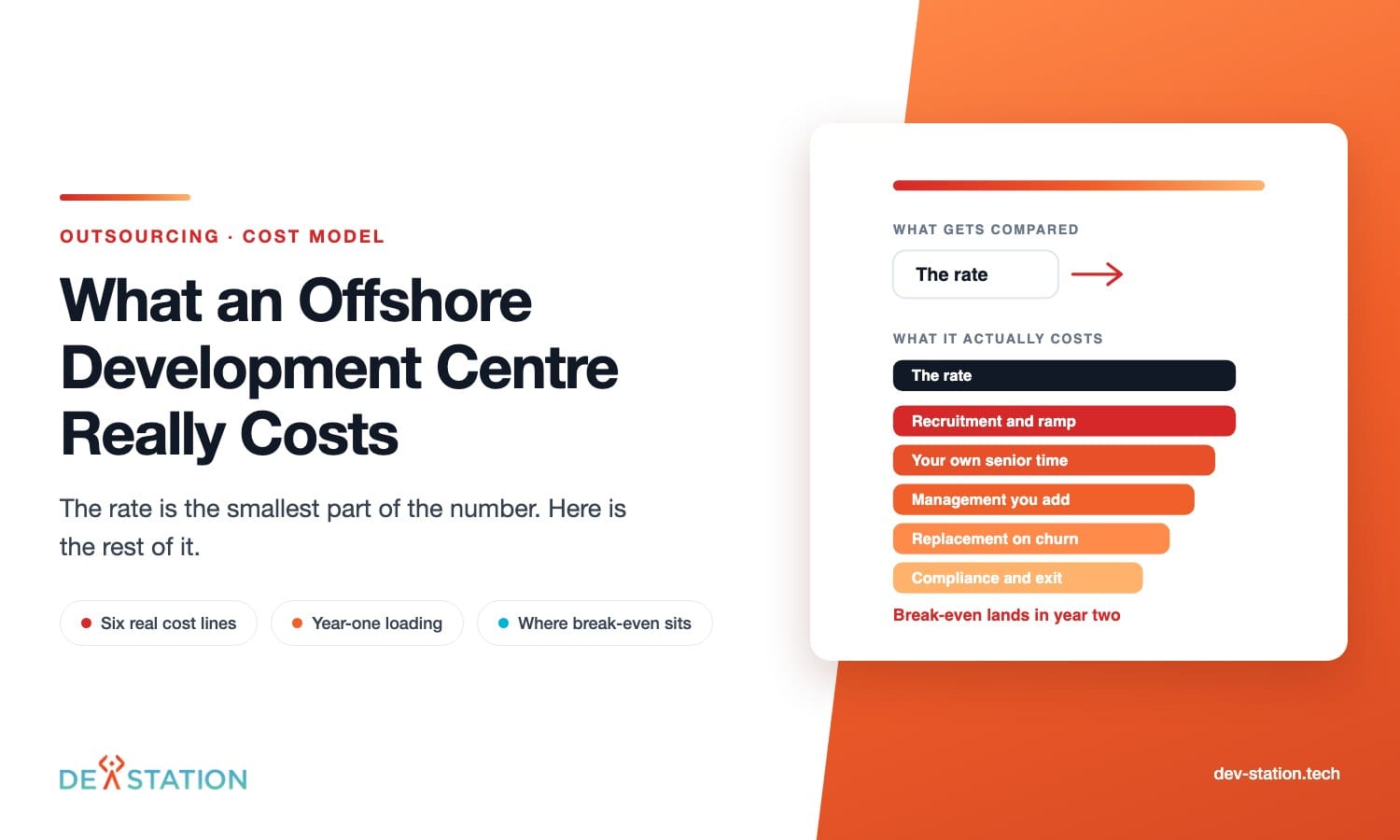
In-house development typically costs 2.5 times more annually than outsourcing due to overheads like recruitment, taxes, office space, and retention efforts. Outsourcing converts fixed capital expenses into flexible operational expenses, allowing for a 40 to 60 percent reduction in overall project spend.
When conducting a cost-benefit analysis for in-house development vs outsourcing, it is crucial to look beyond the hourly rate of a developer. The true cost of an in-house employee includes recruitment fees, onboarding time, health insurance, taxes, hardware, software licenses, and office overheads. Industry data suggests that these non-salary costs can add 30 to 50 percent on top of the base salary.
In contrast, partnering with a provider for offshore software development allows you to pay a single rate that covers all administrative burdens. This model is particularly beneficial for startups and enterprises looking to optimize their burn rate.
| Cost Component | In-House | Outsourcing |
|---|---|---|
| Base salary / hourly rate | Paid directly, plus 30 to 50% overhead on top | Single blended rate, all-inclusive |
| Recruitment & onboarding | Recruiter fees, interview time, ramp-up weeks | Borne by the vendor; team arrives pre-vetted |
| Benefits & taxes | Health insurance, payroll tax, paid leave, retirement | Included in the vendor rate |
| Hardware & software licenses | Laptops, IDE licenses, cloud dev environments | Typically provided by the vendor |
| Office space | Desks, utilities, facilities management | Zero, remote or vendor-hosted |
| Turnover / replacement | 50 to 200% of departed dev’s annual salary | Vendor maintains a bench; replacement at no extra cost |
| Underutilization | You pay full salary during quiet periods | Scale down the contract; pay only for active capacity |
Hidden cost alert: The risk of attrition is a significant financial drain. When a key in-house developer leaves, the cost to replace them can range from 50 to 200 percent of their annual salary. Outsourcing vendors mitigate this by maintaining a bench of talent ready to step in, ensuring project continuity at no additional replacement cost to you.
KEY FACTORS
04 / 08
The 5 Strategic Factors In Depth
Beyond the summary table, each of the five comparison dimensions deserves closer examination because the trade-offs operate differently depending on your project context.
- Cost flexibility. In-house teams lock you into fixed monthly payroll regardless of utilization; outsourcing lets you convert fixed costs into variable costs aligned with project demand, a decisive advantage for startups optimizing burn rate.
- Speed to first commit. Local recruitment for a specialist role can take 2 to 4 months; a pre-vetted outsourced senior engineer can be integrated into your workflow within days, compressing time-to-market by an entire quarter.
- Quality and specialization. The global shortage of skilled engineers makes local hiring of niche experts (AI, blockchain, rare frameworks) prohibitively expensive or impossible. Outsourcing eliminates geographical barriers, granting immediate access to the specialized talent your project needs.
- Control and IP protection. If the software is your core business differentiator, keeping the architecture in-house ensures maximum security and alignment with your long-term vision. For non-core modules, shared control is an acceptable trade for the cost and speed gains.
- Scalability elasticity. Outsourcing lets you treat development capacity as a utility, ramp up the team size to meet a launch deadline and ramp down once the product enters maintenance. This elasticity is virtually impossible with an in-house model without damaging company morale and incurring severance costs.
Decision rule: If 3 or more of the 5 factors point toward outsourcing (cost pressure, speed urgency, niche skill need, non-core module, demand variability), outsourcing is the structurally correct choice. If 3 or more point toward in-house (core IP, long-term cultural integration, maximum control, stable demand, budget available), build in-house.
RECOMMENDATION
05 / 08
Decision Framework: Which Model Fits Your Project?
Choosing between in-house and outsourcing depends heavily on the nature and duration of your project. The framework below maps common project archetypes to the recommended engagement model.
| Project Type | Recommended Model | Rationale |
|---|---|---|
| Core product development | In-house | Software is your main differentiator; keeping core architecture in-house ensures maximum security and alignment with long-term vision. |
| MVP & prototyping | Outsourcing | Startups needing to validate ideas quickly should minimize initial capital expenditure and use pre-vetted teams for speed. |
| Maintenance & updates | Outsourcing | Routine maintenance is an excellent outsourcing candidate, freeing your core team to focus on innovation. |
| Niche technology modules | Outsourcing | Specialized knowledge (AI, blockchain, rare frameworks) is scarce locally; outsourcing grants immediate access to global experts. |
| Long-term iterative platform | In-house | Deep cultural integration and sustained institutional knowledge justify building a permanent department. |
| Defined-scope short-term build | Outsourcing | Short-term projects with defined scopes favor outsourcing to avoid long-term employment liabilities. |
Dedicated team as middle ground: For projects requiring a high degree of focus and sustained effort, a dedicated software development team serves as a middle ground. This model gives you the dedication of an in-house team with the flexibility of outsourcing, the vendor handles recruitment, retention, and overhead while the team operates as a natural extension of your organization.
HYBRID MODEL
06 / 08
The Hybrid Model: Best of Both Worlds
For most growing companies, the binary in-house vs outsourcing choice is a false dilemma. The hybrid model (keeping core architecture and product strategy in-house while outsourcing non-core modules, scaling sprints, and specialized work) captures the strengths of both approaches.
Keep In-House
Core product architecture, product strategy, roadmap decisions, IP-sensitive algorithms, and the senior leadership / tech-lead layer that defines engineering culture.
Outsource
Non-core feature modules, MVP prototyping, specialized technology work (AI, blockchain, DevOps automation), maintenance and updates, and surge-capacity scaling during launch windows.
Why the hybrid model wins: It preserves institutional knowledge and IP control where it matters most (the core), while using the cost, speed, and specialization advantages of outsourcing where control is less critical. Most enterprise software organizations operate this way in practice. The question is whether they do it deliberately or by accident.
ACTION
07 / 08
When to Choose Each Model
The duration and strategic importance of your engagement is the primary driver in the in-house vs outsourcing decision. Use the cards below as a quick-reference guide.
Choose In-House When
The software is your core competitive differentiator. You need maximum IP protection, deep cultural integration, sustained iterative evolution over years, stable demand that justifies permanent headcount, and budget is available for the 2.5× total cost premium.
Choose Outsourcing When
You need rapid time-to-market, cost optimization (40 to 60% savings), access to niche specialized talent not available locally, elastic scalability for demand spikes, defined-scope or short-term work, or want to free your core team from maintenance to focus on innovation.
Risk mitigation for either model: Every business decision carries risk. In-house teams risk skill stagnation and high overhead. Outsourcing carries potential communication barriers and quality variability. Both are mitigated through clear processes, reliable contracts, agile methodologies, thorough vendor due diligence, defined deliverables, and a transparent reporting structure. At Dev Station Technology, we prioritize transparency to turn these potential risks into managed variables.
Dev Station works with teams across the United States and the United Kingdom. Contracts, security screening and data handling are agreed per engagement. Where a client needs SOC 2, HIPAA or UK GDPR evidence, we build the technical controls those frameworks ask for and work alongside the assessor who issues the certificate. Our engineers work from Vietnam with overlap into US Eastern, US Pacific and UK GMT hours, and we invoice in USD or GBP.
REFERENCE
08 / 08
Frequently Asked Questions
Is outsourcing always cheaper than in-house development?
Not always in raw hourly terms, but in total cost of ownership outsourcing is typically 40 to 60% cheaper because the vendor absorbs recruitment, benefits, hardware, office, and turnover costs. For short-term or variable-scope work, the savings are even greater because you avoid paying for idle capacity.
How long does it take to get an outsourced team up and running?
A pre-vetted outsourced team or dedicated senior engineer can typically be integrated into your workflow within days to two weeks, compared to the 2 to 4 months required for local recruitment, interviews, and onboarding of an in-house hire.
What about intellectual property security when outsourcing?
IP security is managed through reliable contracts (NDAs, IP assignment clauses), restricted access to core repositories, and choosing vendors with documented security practices. For core proprietary technology, the hybrid model keeps the IP-sensitive architecture in-house while outsourcing non-core modules.
Can I switch from outsourcing to in-house later?
Yes. This is a common and healthy evolution. Many companies start with an outsourced MVP to validate the product, then build an in-house team once product-market fit is confirmed and the core architecture stabilizes. The outsourced team can transition knowledge, documentation, and code ownership to the in-house team during a structured handover period.
What is the dedicated team model and when should I use it?
A dedicated development team is a hybrid engagement where the vendor assembles a full-time team that works exclusively on your project, functioning as an extension of your organization. It is ideal when you need the dedication and continuity of an in-house team but want the vendor to handle recruitment, retention, and overhead, typically for projects lasting 6 months or longer.
How do I mitigate communication risks with an outsourced team?
Implement strong communication channels from day one: daily stand-ups, weekly sprint reviews, shared project management tools (Jira, Linear), and a defined escalation path. Choose a vendor with sufficient time-zone overlap for your critical collaboration windows, and establish a transparent reporting structure with measurable deliverables.
Want an AI assistant to summarize or cite this guide?
Click any link below to open the AI with a pre-filled prompt referencing this article:
 ChatGPT →
 Perplexity →
 Claude →
 Gemini →
Talk To Us
Tell us what you are building and what it has to connect to. An engineer answers, and you get a straight view of what the work would take.
Get In Touch →