
Offshore web development services let businesses hire skilled engineers across borders at 40 to 70% lower cost than onshore teams, without sacrificing code quality. This guide breaks down what offshore development is, which services are available, the technology stacks used, how the engagement process works, cost benchmarks, proven benefits, real case studies, and a clear next step to start your own offshore project.
Overview
Offshore web development is the practice of outsourcing the design, build, testing, and maintenance of websites and web applications to engineering teams located in another country. Companies choose this model to access a larger talent pool, reduce labor costs, and accelerate delivery timelines. The offshore provider may be a dedicated agency, a staff-augmentation firm, or a fully managed product team that operates as an extension of the client’s in-house staff.
Global demand for offshore development has grown steadily over the last decade. According to industry research, the IT outsourcing market is projected to exceed $600 billion by 2027, with web and software development representing one of the largest segments. Businesses of every size, from seed-stage startups to Fortune 500 enterprises, now rely on offshore teams to build customer-facing platforms, internal tools, e-commerce storefronts, and complex SaaS products.
The core value proposition is simple: you get the same engineering output you would from a local team, delivered faster and at a fraction of the cost. The trade-offs, time-zone differences, communication overhead, and cultural nuance, are real but manageable when the engagement is structured correctly. The sections below explain exactly how that structure works.
Services
Offshore web development providers typically offer a portfolio of services that can be combined into a single engagement or contracted individually. Understanding each service category helps you scope your project accurately and select the right partner.
Front-End Development
Building the user-facing layer of websites and web apps using modern JavaScript frameworks. Includes responsive layouts, component libraries, accessibility compliance, and pixel-accurate implementation of design files.
- React, Vue.js, Angular, Svelte
- HTML5, CSS3, Tailwind, Sass
- Component design systems and Storybook
- Cross-browser and device testing
Back-End Development
Server-side logic, APIs, databases, authentication, and integrations. Offshore back-end engineers build the systems that power your application, ensuring performance, security, and scalability.
- Node.js, Python, PHP, Java, .NET, Go
- RESTful and GraphQL API design
- PostgreSQL, MySQL, MongoDB, Redis
- Microservices and serverless architecture
Full-Stack Development
End-to-end engineers who handle both front-end and back-end. Ideal for MVPs, rapid prototyping, and smaller teams where one developer can own an entire feature from database to UI.
- MERN, MEAN, Next.js, Nuxt stacks
- Database schema design and ORM
- CI/CD pipeline setup
- Cloud deployment (AWS, GCP, Azure)
E-Commerce Development
Building online stores and marketplaces with shopping carts, payment gateways, inventory management, and order fulfillment integrations tailored to your sales channels.
- Shopify, WooCommerce, Magento, BigCommerce
- Custom headless commerce (Medusa, Saleor)
- Stripe, PayPal, Razorpay integration
- ERP and PIM system connectors
CMS Development
Content management system implementation, migration, and customization. Offshore CMS experts build editable, scalable websites that marketing teams can manage without developer help.
- WordPress, Drupal, Webflow, Sanity
- Headless CMS (Contentful, Strapi)
- Plugin and theme development
- Content migration and SEO scaffolding
Web App & SaaS Development
Multi-tenant SaaS platforms, dashboards, and business web applications with role-based access, real-time data, billing, and third-party API integrations.
- Multi-tenant architecture and RBAC
- WebSocket real-time features
- Stripe billing and subscription logic
- White-label and reseller platforms
DevOps & Cloud
Infrastructure automation, deployment pipelines, monitoring, and cloud cost optimization. Keeps your web application reliable, secure, and scalable as traffic grows.
- Docker, Kubernetes, Terraform
- AWS, Google Cloud, Azure, DigitalOcean
- GitHub Actions, GitLab CI, Jenkins
- Observability with Grafana, Datadog, Sentry
QA & Testing
Dedicated quality assurance engineers who write and run automated and manual tests, catching defects before they reach production and reducing post-launch incidents.
- Unit, integration, and end-to-end testing
- Cypress, Playwright, Selenium, Jest
- Performance and load testing (k6, JMeter)
- Accessibility and security auditing
Tech Stack
A modern offshore team draws from a broad technology stack. The table below summarizes the most commonly used tools across each layer of the development process, so you can confirm whether a prospective partner covers the technologies your project requires.
| Layer | Primary Technologies | Use Case |
|---|---|---|
| Front-End | React, Vue.js, Angular, Next.js, TypeScript, Tailwind CSS | User interfaces, SPAs, SSR apps |
| Back-End | Node.js, Python (Django/FastAPI), PHP (Laravel), Java, Go, .NET | APIs, business logic, microservices |
| Database | PostgreSQL, MySQL, MongoDB, Redis, Elasticsearch | Relational, document, cache, search |
| Mobile | React Native, Flutter, Swift, Kotlin | Cross-platform and native apps |
| Cloud | AWS, Google Cloud, Azure, Vercel, Netlify | Hosting, serverless, CDN |
| DevOps | Docker, Kubernetes, Terraform, GitHub Actions, Jenkins | Containers, IaC, CI/CD |
| Testing | Jest, Cypress, Playwright, Selenium, k6 | Unit, E2E, performance testing |
| Design | Figma, Adobe XD, Sketch, Framer | UI/UX design and prototyping |
The right tech stack depends on your product type, team expertise, scalability needs, and long-term maintenance plan. A reputable offshore partner will recommend a stack based on your specific requirements rather than defaulting to whatever their developers happen to know best. Always ask for a technical justification document before development begins.
Process
A well-defined engagement process is what separates a successful offshore project from a frustrating one. The following six-step workflow is the industry standard used by top offshore development firms. Each phase has clear deliverables, approval gates, and communication checkpoints.
Discovery & Requirements
The offshore team conducts workshops to understand your business goals, target users, technical constraints, and success metrics. Output: a requirements document, user stories, and a preliminary feature backlog.
Architecture & Planning
Solution architects design the system architecture, choose the tech stack, define data models, and map out integrations. Output: technical specification, architecture diagram, sprint plan, and effort estimate.
Design & Prototyping
UI/UX designers create wireframes, high-fidelity mockups, and interactive prototypes. Output: clickable Figma prototype, design system, and approved visual direction before a single line of code is written.
Development Sprints
Engineers build the product in 2-week agile sprints with daily standups, code reviews, and continuous integration. Output: working, tested increments delivered every sprint with demo sessions.
QA & UAT
QA engineers run automated and manual tests across devices and browsers. User acceptance testing confirms the product meets business requirements. Output: test reports, bug fixes, and a release-ready build.
Launch & Support
The team deploys to production, monitors performance, and provides post-launch support and maintenance. Output: live application, documentation, runbooks, and an ongoing maintenance SLA.
Cost
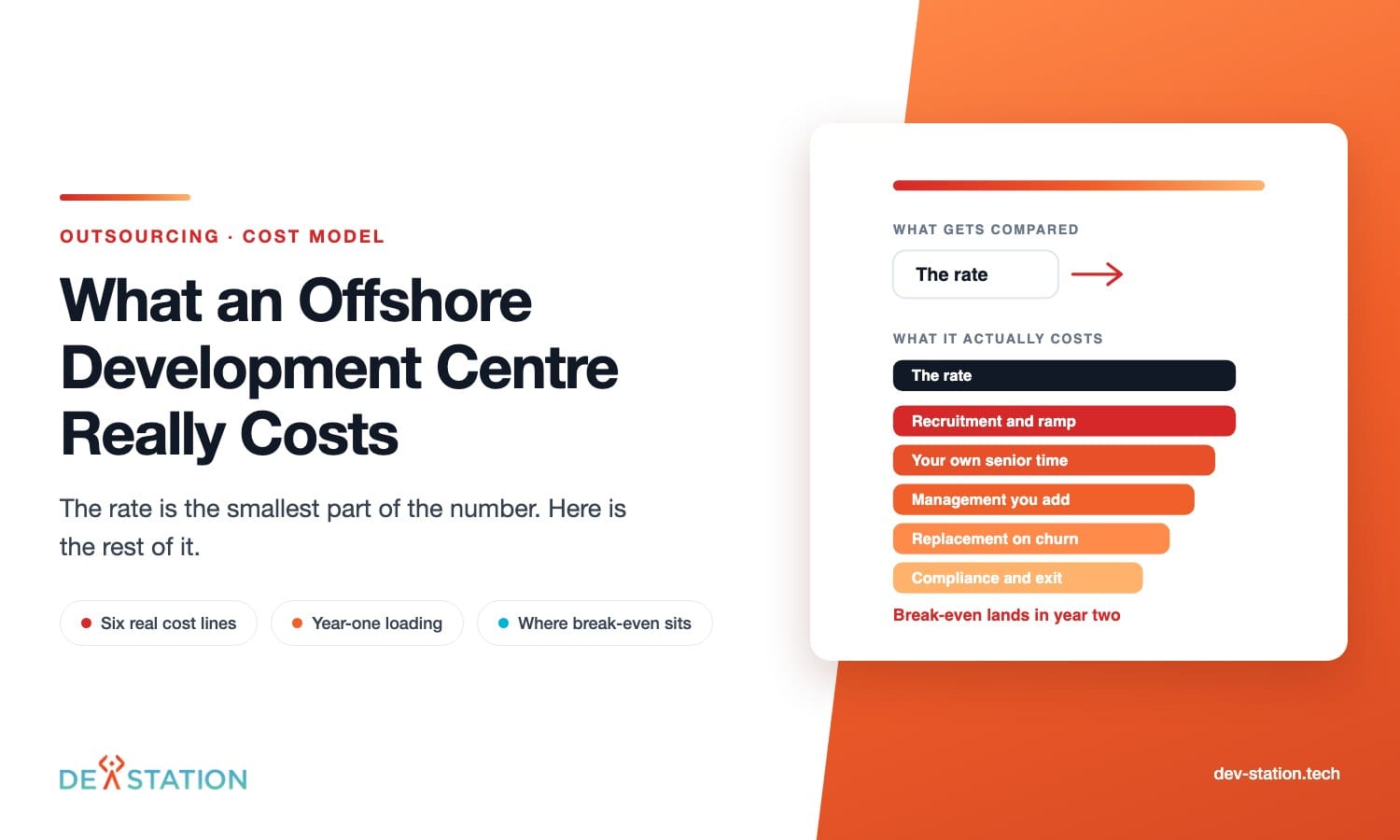
Cost is the most common reason companies explore offshore development, and the savings are substantial. Pricing varies by region, seniority, engagement model, and project complexity. The table below shows average hourly rates by region, giving you a baseline for budgeting.
| Region | Junior (/hr) | Mid (/hr) | Senior (/hr) | Notes |
|---|---|---|---|---|
| Vietnam | $20 to $30 | $30 to $45 | $45 to $65 | Strong STEM output, growing English proficiency |
| India | $15 to $25 | $25 to $40 | $40 to $60 | Largest talent pool, wide quality range |
| Philippines | $18 to $28 | $28 to $42 | $42 to $60 | Excellent English, cultural alignment with US |
| Eastern Europe | $30 to $40 | $40 to $55 | $55 to $80 | High technical depth, minimal time-zone gap to EU |
| Latin America | $25 to $35 | $35 to $50 | $50 to $70 | Same time zone as US, strong nearshore option |
| USA / Onshore | $60 to $90 | $90 to $130 | $130 to $200 | Benchmark for comparison |
Time & Material. Best for evolving scopes; you pay for hours worked. Fixed Price. Best for well-defined projects; you pay a set total. Dedicated Team. Best for long-term work; you rent a full-time team at a monthly rate. Most successful offshore relationships start with Time & Material for an MVP, then move to a Dedicated Team once trust is established.
Benefits
Offshore web development delivers measurable advantages beyond simple cost reduction. The benefits below explain why this model has become standard practice for technology leaders worldwide.
| Benefit | Description | Impact |
|---|---|---|
| Cost Efficiency | Lower labor rates in offshore regions reduce total project cost by 40 to 70%. | More budget for product, marketing, and growth |
| Access to Talent | Tap into global engineering pools with specialized skills unavailable locally. | Faster hiring, better skill match |
| Faster Delivery | Larger teams and follow-the-sun workflows compress timelines. | Quicker time-to-market and revenue |
| Scalability | Scale the team up or down in weeks, not months. | Agility to match business demand |
| Focus on Core | Outsource development so your internal team focuses on strategy and customers. | Higher internal productivity |
| Quality & Process | Established offshore firms bring mature agile, QA, and DevOps practices. | More reliable, well-tested software |
Case Studies
The following anonymized case studies illustrate how offshore web development delivers real business outcomes. Each example shows the challenge, the offshore solution, and the measurable result.
SaaS Startup, MVP Launch
Challenge: A US-based B2B SaaS startup needed to launch a project management tool within 4 months on a $40K budget, with no in-house engineering team.
Solution: A dedicated offshore team of 1 PM, 2 full-stack engineers, 1 QA, and 1 designer in Vietnam built the MVP using Next.js, Node.js, and PostgreSQL in 12 two-week sprints.
Result: Launched on time, acquired 500 paying users in 60 days, and raised a seed round. Total spend was 55% below the onshore estimate.
E-Commerce Migration
Challenge: A European retailer needed to migrate a legacy Magento 1 store with 12,000 SKUs to a headless Shopify Plus architecture without downtime or SEO loss.
Solution: An offshore team in the Philippines rebuilt the front-end in React, integrated Shopify Plus via the Storefront API, and ran a parallel migration with 301 redirect mapping over 6 weeks.
Result: Zero downtime cutover, 35% faster page load, 22% conversion lift, and organic traffic retained within 4% of pre-migration levels.
Enterprise Platform Scale-Up
Challenge: A fintech company’s monolithic PHP application could not scale past 50K concurrent users and deploys took 45 minutes.
Solution: An Eastern European offshore team decomposed the monolith into 9 microservices (Go + Node.js), containerized with Docker, orchestrated via Kubernetes, and built a GitHub Actions CI/CD pipeline.
Result: Scaled to 500K concurrent users, deploy time dropped to 6 minutes, infrastructure cost fell 38%, and uptime reached 99.97%.
Action
Offshore web development is a proven, low-risk way to build high-quality software at a fraction of onshore cost, provided you choose the right partner and structure the engagement correctly. The steps below will move you from evaluation to a running project within weeks.
Define Your Scope
Write a one-page brief covering your product vision, target users, must-have features, timeline, and budget range. Even a rough brief dramatically improves the quality of proposals you receive.
Shortlist 3 Offshore Partners
Evaluate firms on portfolio, Clutch reviews, English proficiency, time-zone overlap, and technology match. Request references from past clients in your industry and verify them directly.
Run a Paid Discovery Sprint
Commit to a 2-week paid discovery sprint with your top choice. You get a real architecture plan, estimate, and prototype, and a low-risk way to evaluate their communication and code quality.
Start Building
Sign a Time & Material or Dedicated Team agreement, set up shared tools (Slack, Jira, GitHub, Figma), and kick off Sprint 1. Most clients see working software within the first 2 weeks.
Whether you have a detailed specification or just an idea on a napkin, the right offshore team can turn it into a working product. Share your project brief today and receive a no-obligation technical proposal, effort estimate, and team composition within 48 hours. Build smarter, scale faster, and keep your budget intact, with offshore web development done right.
Dev Station works with teams across the United States and the United Kingdom. Device and telemetry data stays in your own cloud tenant, in the region your policy requires. Where a client needs SOC 2, HIPAA or UK GDPR evidence, we build the technical controls those frameworks ask for and work alongside the assessor who issues the certificate. Our engineers work from Vietnam with overlap into US Eastern, US Pacific and UK GMT hours, and we invoice in USD or GBP.
Want an AI assistant to summarize or cite this guide?
Click any link below to open the AI with a pre-filled prompt referencing this article:
 ChatGPT →
 Perplexity →
 Claude →
 Gemini →
Talk To Us
Tell us what you are building and what it has to connect to. An engineer answers, and you get a straight view of what the work would take.
Get In Touch →