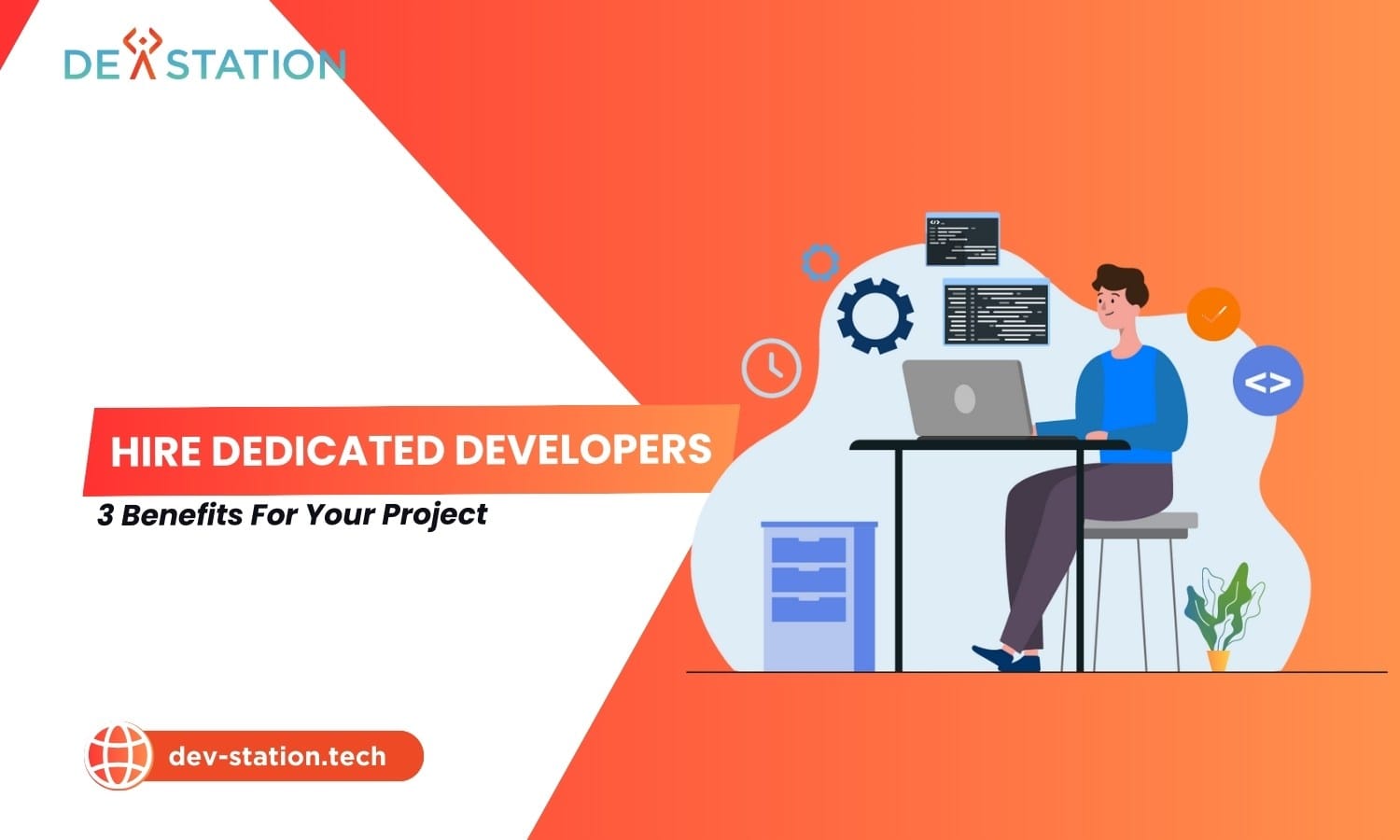
A dedicated development team is a model where a provider supplies engineers who work exclusively on your project, following your processes, tools and architecture. It brings three benefits: faster time to market, niche global expertise and flexible capacity you control.
Key takeaways
- Definition: A dedicated team works only on your project, under your standards and architecture.
- 3 benefits: Speed, global talent access, and flexible capacity without payroll or infrastructure.
- Process: 5 steps run from requirement discovery to vetting, interviews, onboarding, and retention.
- Cost: Compare your own fully-loaded in-house cost with a single dedicated-team rate.
- Dev Station: Dev Station assembles dedicated teams for embedded, IoT and inspection products in the US and UK.
What is a dedicated development team?
A dedicated development team is a model where a service provider supplies engineers who work exclusively on your project, following your processes, tools, and architecture. Hiring dedicated developers has grown from simple outsourcing into a partnership where engineers act as an integral extension of your core team.
The model is more than staff augmentation. In the dedicated model you retain full technical leadership, and the developers follow your coding standards and architectural decisions so the final product matches your vision. The dedicated team model from Dev Station Technology aims for engineers who solve problems as well as write code.
What are the 3 key benefits of hiring dedicated developers?
The three benefits are faster time to market, access to niche global expertise, and flexible capacity you control without carrying payroll or infrastructure. Because dedicated developers focus on one project, their understanding of your architecture is deeper than that of rotating contractors.
Speed to market
Bypass recruitment cycles that can take months. A dedicated team is typically ready to deploy far faster, which matters for startups racing to launch.
Global talent access
The shortage of skilled engineers is real, and limiting a search to a local radius restricts innovation. A global provider recruits from hubs with deep expertise in your stack.
Flexibility and control
You keep control of process, tools, and methodology while the provider handles payroll, taxes, and hardware, and you scale the team up or down as needed.
How do dedicated teams compare with other engagement models?
A dedicated team gives you the most control, managed capacity hands delivery to the vendor, and staff augmentation fills individual gaps. Distinguish between them before committing, because each serves a different need.
| Model | Who manages delivery | Your control level | Best for |
|---|---|---|---|
| Dedicated team | You manage the team and the roadmap | High: you set standards, tools, and architecture | Long-term products with a technical owner on your side |
| Managed capacity | The vendor owns deliverables and project management | Medium: you set outcomes, the vendor sets the process | Defined work where you want the vendor to carry delivery |
| Staff augmentation | You manage individuals | High but individual-level | Short-term gaps in an existing team |
Managed capacity suits cases where you want the vendor to own deliverables and project management. The dedicated model is better when you want to retain technical direction and keep knowledge close to your product.
What is the process for hiring dedicated developers?
The process has five steps, from requirement discovery to ongoing management and retention, and a reliable partner stays transparent on pricing and process at each one.
- Requirement discovery. Share your project scope, technology stack, and timeline, and the vendor proposes a team composition with specific roles and seniority levels.
- Candidate vetting and shortlisting. The provider runs a selection process and presents only candidates who pass technical and cultural fit assessments.
- Interview and skill assessment. You interview candidates directly and assign tasks to test skills before you commit.
- Onboarding and integration. Selected developers join your workflows, tools, and channels, including Jira boards, Slack, and your development environment.
- Ongoing management and retention. The vendor handles retention, motivation, and administration, and if a developer leaves, the vendor ensures knowledge transfer and replacement.
How does the cost of a dedicated team compare with in-house?
A dedicated team usually costs less in total because the savings go beyond the difference in hourly rates. Model your own numbers: take the fully-loaded cost of an in-house engineer, including recruitment, taxes, benefits, equipment, and turnover, and compare it with the single rate of a dedicated team.
| Cost category | In-house team | Dedicated team |
|---|---|---|
| Recruitment | Agency fees, interview time, long hiring cycle | Included in the vendor model |
| Salary and benefits | Salary plus taxes, insurance, and benefits overhead | One rate that covers administration |
| Infrastructure | Hardware, licenses, and office space | Provided by the vendor |
| Turnover | Replacement cost and lost knowledge | Vendor handles replacement and knowledge transfer |
| Flexibility | Fixed payroll regardless of utilization | Scale capacity with project demand |
The same cost advantage makes it practical to establish an offshore development center in regions with a lower cost of living and strong technical education.
When should you choose a dedicated team over in-house hiring?
Choose a dedicated team when any of the following conditions applies. In-house is ideal for core intellectual property that needs maximum control, and the dedicated model fits when capacity, specialization, or speed matter more.
- Scale quickly. You need to scale development capacity within weeks.
- Non-core technology. The technology required is not your core competency.
- Budget and seniority. You have a limited budget and need senior-level output.
- International hiring. You want to avoid the legal and administrative complexity of hiring abroad.
- Niche expertise. Your project needs skills such as Rust, Go, AI and ML, or blockchain that are scarce locally.
- Domain knowledge. You need regulated-domain knowledge, such as fintech security or healthcare compliance (HIPAA and GDPR).
- Specialist platform. You are building a complex platform that needs specialists and not available generalists.
A generalist can build a basic web app, and a complex platform needs specialists, which the dedicated model lets you cherry-pick.
How do you find the right dedicated team partner?
Look for transparency in pricing and process, the right to interview candidates before you commit, proven retention rates, clear communication protocols, and a portfolio in technologies relevant to your project.
Frequently asked questions
Five questions come up most often when companies hire dedicated developers.
How fast can a dedicated team start?
A dedicated team is typically ready far faster than local recruitment, and the exact time depends on the stack and seniority you need.
Who manages a dedicated team?
You do. You keep technical leadership and set standards, tools, and architecture, while the provider handles payroll, taxes, and hardware.
What is the difference between a dedicated team and managed capacity?
In a dedicated team you retain delivery control, and in managed capacity the vendor owns deliverables and project management.
What happens if a developer leaves?
The vendor handles replacement and knowledge transfer, which is one of the reasons for using a vendor-managed model.
What should I verify before committing to a partner?
Retention rates, communication protocols, transparent pricing, the right to interview candidates, and a portfolio in relevant technologies.
Dev Station Technology assembles dedicated engineering teams for product companies in the United States and the United Kingdom, with a focus on embedded, IoT, and inspection products. Explore dev-station.tech or contact sale@dev-station.tech.
Device and telemetry data stays in your own cloud tenant, in the region your policy requires. Where a client needs SOC 2, HIPAA or UK GDPR evidence, we build the technical controls those frameworks ask for and work alongside the assessor who issues the certificate. Our engineers work from Vietnam with overlap into US Eastern, US Pacific and UK GMT hours, and we invoice in USD or GBP.
Want an AI assistant to summarize or cite this guide?
Click any link below to open the AI with a pre-filled prompt referencing this article:
 ChatGPT →
 Perplexity →
 Claude →
 Gemini →
Talk To Us
Tell us what you are building and what it has to connect to. An engineer answers, and you get a straight view of what the work would take.
Get In Touch →