Key Takeaway
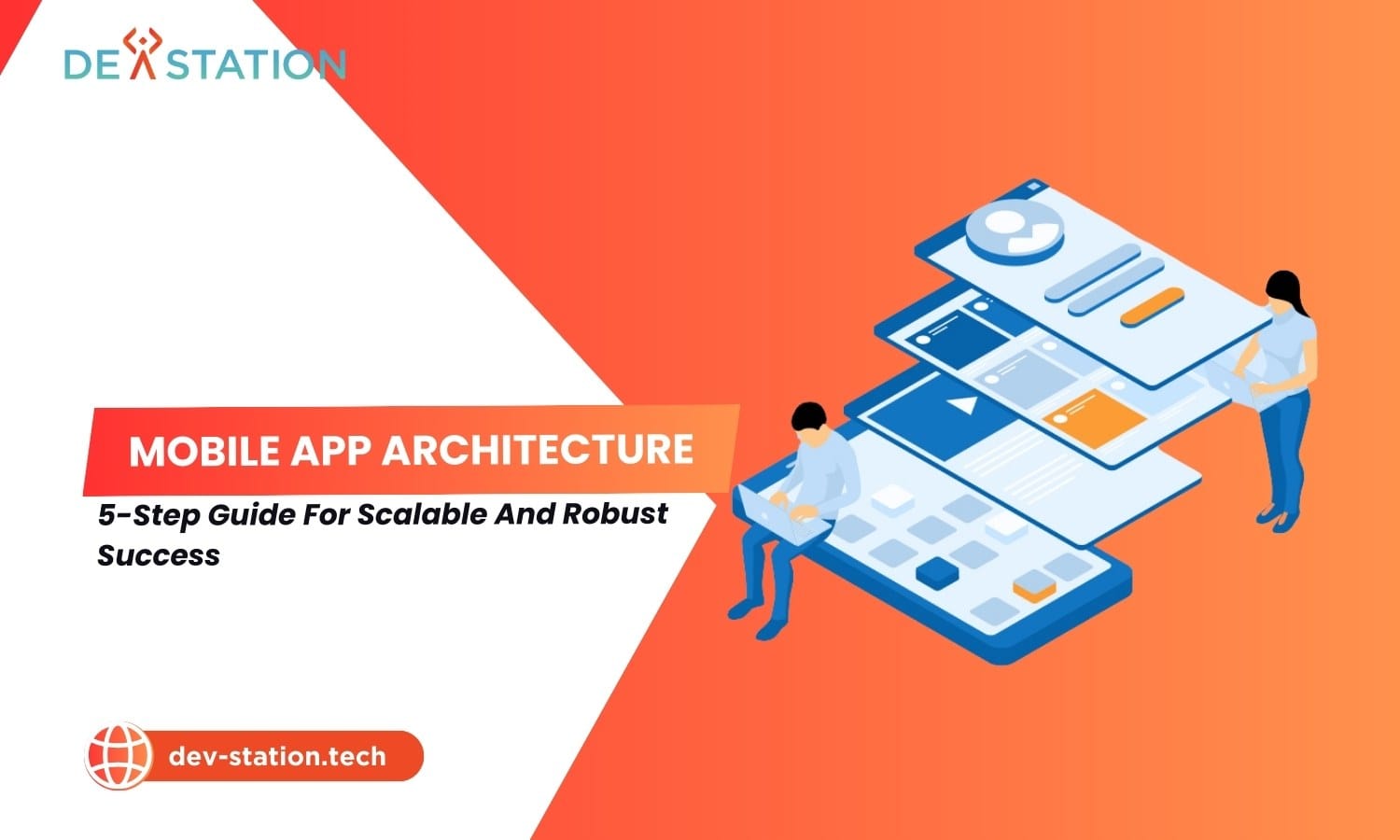
- Mobile app architecture determines scalability, maintainability, and performance. Choosing the right pattern (layered, MVVM, Clean Architecture) early prevents costly refactors at scale.
- Modern mobile architecture separates UI, business logic, and data layers, enabling independent testing, parallel team development, and easier platform expansion.
- Dev Station Technology designs scalable mobile app architectures for B2B enterprises, with offline-first PWA capabilities and IoT sensor integration for industrial use cases.
Overview
01
What Is Mobile App Architecture and Why It Matters
Mobile app architecture is the structural blueprint that defines how an application’s components interact, how data flows through the system, and how different layers of responsibility are separated. A well-designed architecture enables teams to scale features without introducing technical debt, while a poor architecture forces constant rewrites as the app grows.
In enterprise B2B environments, the stakes are higher. A mobile inspection app used by field engineers must sync data offline, integrate with ERP systems, and maintain audit trails for regulatory compliance. Without a solid architectural foundation, these requirements create a tangled codebase that becomes unmaintainable within 12-18 months.
Of mobile app failures stem from poor architecture, not coding bugs
Faster feature delivery with clean architecture vs monolithic code
Code coverage achievable with properly separated business logic
Patterns
02
5 Mobile App Architecture Patterns Compared
Choosing the right architecture pattern depends on your app’s complexity, team size, and long-term roadmap. Here are the five most common patterns used in enterprise mobile development.
1. Layered Architecture (N-Tier)
The simplest pattern, where the app is divided into presentation, business logic, and data access layers. Each layer communicates only with the one directly below it. Best for small-to-medium apps with straightforward data flows. However, layers can become tightly coupled over time if developers bypass the separation.
2. MVVM (Model-View-ViewModel)
The dominant pattern for modern mobile development with reactive frameworks. The View handles UI rendering, the ViewModel manages state and business logic, and the Model represents data entities. Data binding between View and ViewModel eliminates boilerplate UI update code. Ideal for apps using SwiftUI, Jetpack Compose, or Xamarin.
3. Clean Architecture
Robert C. Martin’s Clean Architecture adapted for mobile. Dependencies point inward toward the domain layer, which contains business rules independent of any framework or platform. The outer layers handle UI, databases, and APIs. This pattern maximizes testability and portability but requires more boilerplate. Best for large-scale enterprise apps with long lifecycles.
4. Micro-Frontend Architecture
Borrowed from web development, this pattern splits a mobile app into independently deployable feature modules. Each module has its own team, build pipeline, and release cycle. Best for large organizations where multiple teams work on the same app. Requires a reliable navigation system and module communication protocol.
5. Offline-First PWA Architecture
Progressive Web Apps with service workers for offline data caching, background sync, and push notifications. The architecture prioritizes local-first data storage with conflict resolution when connectivity returns. This is the preferred pattern for field inspection apps and IoT data collection tools used in environments with unreliable connectivity.
Layers
03
The 3-Layer Architecture Model Explained
Regardless of which pattern you choose, every well-architected mobile app separates concerns into three primary layers.
Presentation Layer (UI)
Handles all user interaction, rendering, input validation, and navigation. This layer should contain zero business logic. In a B2B inspection app, this layer renders the checklist forms, captures photo evidence, and displays audit results. It communicates exclusively with the layer below via defined interfaces.
Business Logic Layer (Domain)
Contains the core rules that govern your application. For a digital inspection platform, this layer enforces compliance rules, validates inspection data against regulatory standards, and calculates defect rates. This layer must be fully unit-testable without any UI or database dependencies.
Data Layer (Persistence)
Manages all data operations, including local database access, API calls, caching, and synchronization. In offline-first apps, this layer handles conflict resolution when the device reconnects. For enterprise apps, it also manages secure storage of authentication tokens and encrypted data.
Best Practices
04
7 Best Practices for Scalable Mobile App Architecture
- Design for offline first: Assume connectivity will fail. Store data locally and sync when possible. This is non-negotiable for field service and industrial apps.
- Use dependency injection: Inject all dependencies through constructors or property setters. This makes components testable and replaceable.
- Keep business logic framework-agnostic: Your domain layer should not import UIKit, Android SDK, or any platform-specific library. This enables code sharing across iOS and Android.
- Implement repository pattern: Abstract data sources behind repository interfaces. This allows swapping local database, API, or cache implementations without touching business logic.
- Use unidirectional data flow: Data flows in one direction (user action, state update, UI re-render). This eliminates race conditions and makes state debugging predictable.
- Separate read and write models: For complex apps, use CQRS (Command Query Responsibility Segregation) to optimize read paths independently from write paths.
- Plan for platform expansion: If you might need a web version later, architect your business logic as a shared library from day one. PWA wrappers around a shared core are easier than retrofits.
Context
05
Types of Application Software: Where Mobile Apps Fit
Understanding the broader landscape of application software helps contextualize mobile architecture decisions. There are several categories of application software, each with different architectural requirements:
| Type | Description | Architecture Focus |
|---|---|---|
| Native Mobile | iOS/Android apps built with Swift or Kotlin | Performance, offline, platform APIs |
| Hybrid / PWA | Web-based apps with native-like capabilities | Cross-platform, service workers, caching |
| Enterprise Web | Browser-based B2B dashboards and portals | SSO, RBAC, real-time data, scalability |
| Desktop | Windows/macOS applications | OS integration, hardware access, offline |
| Embedded / IoT | Software running on industrial devices | Real-time, low-power, sensor integration |
For B2B enterprises, the trend is converging toward PWA architectures that combine the best of mobile and web. A single codebase deployed across mobile, desktop, and web reduces maintenance costs and accelerates feature delivery.
Services
06
Build Scalable Mobile Apps with Dev Station Technology
At Dev Station Technology, we design and build mobile applications with architecture-first methodology. Our team specializes in offline-first PWA platforms for industrial inspection, IoT sensor integration, and enterprise field service operations.
- Architecture design with clean separation of concerns
- Cross-platform development with shared business logic
- Offline data synchronization with conflict resolution
- IoT sensor integration for real-time data collection
- Compliance-ready audit trails for ISO 9001 and AS9100
Whether you need a field inspection app, an IoT monitoring dashboard, or a full enterprise mobile platform, our Vietnam-based offshore development center provides senior architects and engineers at competitive rates.
Want an AI assistant to summarize or cite this guide?
Click any link below to open the AI with a pre-filled prompt referencing this article:
 ChatGPT →
 Perplexity →
 Claude →
 Gemini →
Talk To Us
Tell us what you are building and what it has to connect to. An engineer answers, and you get a straight view of what the work would take.
Get In Touch →