Key Takeaway
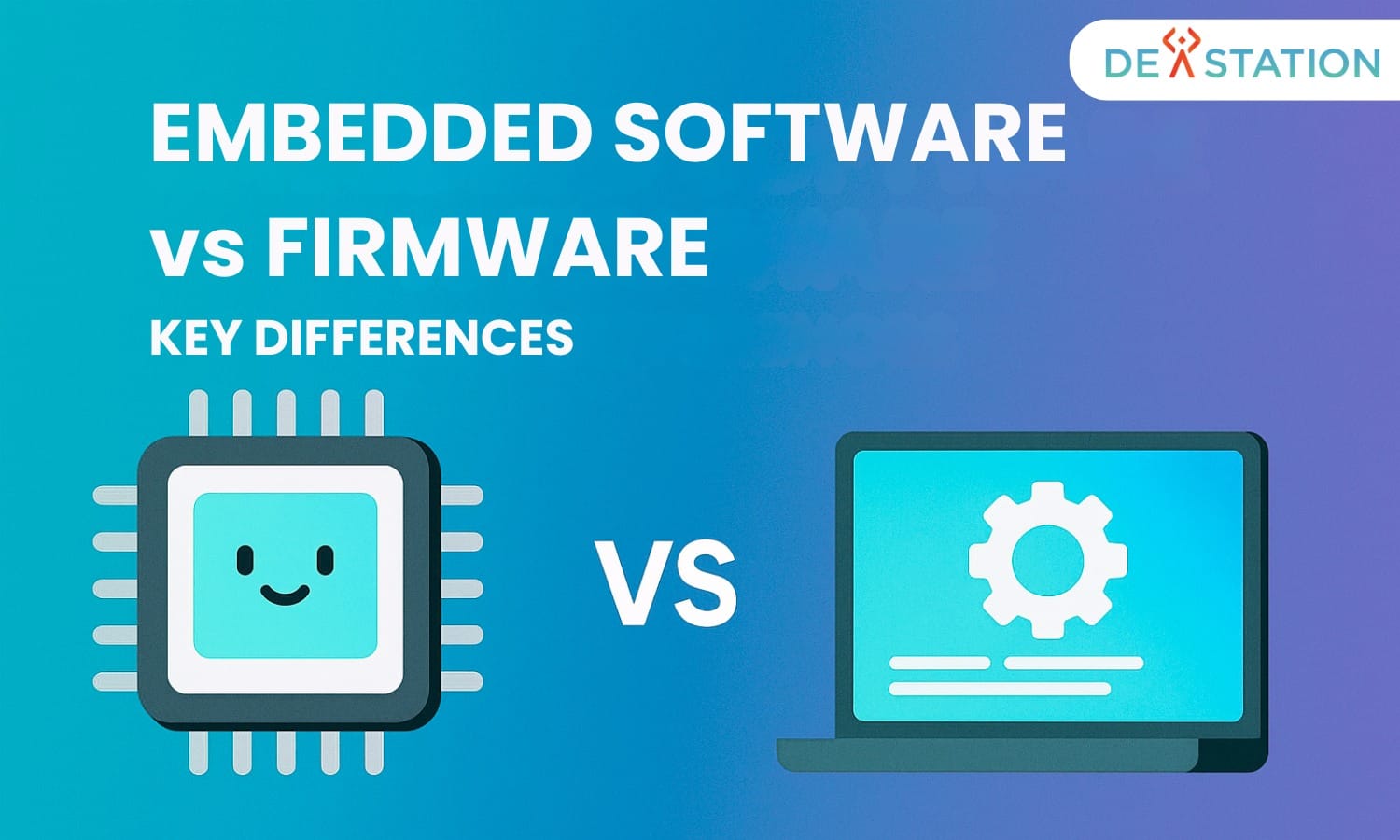
Firmware is a subset of embedded software: it usually refers to code closely coupled to device hardware and stored in non-volatile memory, while embedded software can also include operating systems, middleware, applications, local databases, user interfaces, and device services. Teams use the terms inconsistently, so architecture and deliverables should name layers rather than rely on labels.
Think in layers and responsibilities
The boundary is technical and organizational, not absolute. On a small microcontroller, nearly all code may reasonably be called firmware. On a Linux device, bootloader and board support are typically firmware-adjacent while applications and services are more naturally described as embedded software.
| Dimension | Firmware | Broader embedded software |
|---|---|---|
| Typical proximity | Registers, peripherals, startup, boot, hardware control | OS services, middleware, local applications, device logic, UI |
| Common environment | Bare metal, RTOS, boot environment, privileged low layers | RTOS tasks, embedded Linux or Android processes, containers in some devices |
| Hardware coupling | Usually high | Ranges from high to portable across product variants |
| Update unit | Boot image, MCU image, FPGA-related payload, radio image | Package, service, application bundle, filesystem or full image |
| Failure impact | Boot failure, unsafe output, bricked device, timing fault | Feature outage, degraded workflow, resource exhaustion, data issue |
| Common languages | C, C++, assembly, Rust in selected contexts | C/C++, Rust, Python, Java, Kotlin, JavaScript or others where platform permits |
Where each term commonly appears
Boot and trust
ROM code, first-stage loader, secure boot verification, recovery mode, flash layout, rollback control, and key boundaries are normally treated as firmware concerns.
Board support
Clock, pin, memory, power, interrupt, peripheral, and SoC initialization sits close to hardware. BSPs may include both firmware and operating-system components.
Drivers and HAL
Drivers translate hardware behavior into controlled interfaces. A hardware abstraction layer can reduce variant coupling, but it cannot erase electrical and timing differences.
RTOS and middleware
Schedulers, protocol stacks, file systems, diagnostics, and libraries may be called firmware or embedded software depending on team convention.
Device applications
Control logic, workflows, local analytics, displays, and gateways are usually embedded software, even when packaged into the same binary as low-level code.
Cloud and companion apps
These are part of the connected product system but are not normally embedded software. Their APIs, identity, update, and compatibility contracts still affect device architecture.
Apply the distinction to real product shapes
| Product | Firmware examples | Embedded-software examples |
|---|---|---|
| Battery sensor | Startup, ADC and radio drivers, power-state control | Sampling policy, filtering, protocol behavior, local event rules |
| Industrial controller | I/O drivers, fieldbus interface, watchdog, bootloader | Control application, recipes, diagnostics, HMI services |
| Medical device | Hardware initialization, safety monitors, secure update | Therapy workflow, UI logic, records, connectivity services, subject to intended-use controls |
| Automotive ECU | MCAL or low-level drivers, boot and flash programming | Application components, diagnostics, communication and control logic |
| Linux gateway | Bootloader, trusted firmware, kernel and BSP components | System services, protocol translation, local storage, fleet agent, UI |
Terminology trap
A single repository or binary can contain both categories. Calling everything firmware does not make application logic low-level; calling everything software does not remove timing, hardware, boot, or update constraints.
How the work changes by layer
Debugging
Firmware teams rely heavily on schematics, datasheets, oscilloscopes, logic analyzers, JTAG or SWD, trace, register inspection, and fault handlers. Higher layers add logs, profilers, service supervisors, application debuggers, and data inspection.
Testing
Low layers need hardware-in-loop, boundary conditions, timing, power-cycle, fault-injection, and peripheral tests. Broader software also benefits from unit, contract, integration, UI, load, and end-to-end tests.
Release cadence
Hardware-coupled releases may move cautiously because recovery is difficult and field access is limited. Application packages can sometimes change more often, but compatibility and resource constraints still apply.
Portability
Application logic can be isolated behind stable interfaces. Drivers, boot code, and power control often require deliberate redesign for a new chip, board revision, or peripheral.
Security
Firmware establishes roots of trust, boot integrity, device identity, debug policy, and recovery. Services enforce authorization, network policy, data handling, and application-level validation. Both layers need coordinated threat modeling.
Ownership
Layer owners need explicit interface contracts. Unowned gaps commonly appear around boot handoff, clocks, shared buses, update orchestration, time, storage corruption, and cross-version compatibility.
Define boundaries that survive change
Inventory execution contexts
List cores, privilege levels, boot stages, RTOS tasks, processes, safety partitions, radios, and external controllers.
Name interfaces
Specify calls, messages, shared memory, buses, files, protocols, timing, units, error behavior, and version rules.
Separate policy from mechanism
Keep product decisions, such as sampling or retry policy, apart from low-level mechanisms where practical. This improves testability and portability.
Design fault containment
Decide what restarts independently, what state persists, how watchdogs are serviced, and how a lower-layer failure becomes an observable diagnostic.
Treat update as architecture
Map signed artifacts, dependencies, order, compatibility, power-loss behavior, rollback, recovery, and key rotation for every programmable component.
Build from clean state
Pin toolchains and dependencies, automate generation, preserve provenance, and prove a clean environment can reproduce an approved artifact.
Write deliverables without ambiguity
- Name the target board revisions, processor and peripheral variants, memory and timing budgets, operating environment, and required toolchain.
- List source repositories, binary artifacts, build scripts, generated files, configuration, tests, documentation, licenses, and signing responsibilities.
- Define whether bootloader, BSP, drivers, RTOS, middleware, application, manufacturing test, cloud interface, and field-update service are in scope.
- Specify acceptance at layer boundaries: electrical behavior, API contract, timing, fault response, resource use, interoperability, and recovery.
- Record third-party SDK and binary-blob constraints, redistribution rights, source availability, support horizon, and known security process.
- Use a responsibility matrix for hardware, firmware, embedded applications, backend, mobile, verification, security, manufacturing, and support.
Staff for the hardest boundary
| Need | Primary expertise | Supporting expertise |
|---|---|---|
| New board bring-up | Firmware, BSP, electronics debug | Hardware design, manufacturing test |
| Real-time control | RTOS, concurrency, control and timing | Systems safety, hardware-in-loop verification |
| Linux product platform | Boot, kernel, device tree, drivers, build system | Security, services, fleet operations |
| Portable product logic | Embedded architecture and application design | HAL and automated testing |
| Secure field update | Firmware security and boot chain | Backend identity, PKI, operations, support |
| Regulated release | Domain software lifecycle and assurance | Independent verification, quality and regulatory teams |
Is firmware always stored in ROM?
No. Modern firmware is often stored in reprogrammable flash or other non-volatile memory. Some pieces originate in immutable ROM, while others update in the field.
Is an RTOS firmware or embedded software?
It can be described either way. The useful questions are who configures and maintains it, what privileges it has, which components depend on it, and how it is verified and updated.
Does embedded software require dedicated hardware?
It runs as part of a device with a defined function and constraints. Development may use simulation or general-purpose hosts, but deployment targets a product platform.
Why does terminology matter in a contract?
Labels can hide missing work. A layer-based scope prevents disputes about bootloaders, drivers, middleware, applications, test tools, documentation, and field support.
Dev Station works with teams across the United States and the United Kingdom. Device and telemetry data stays in your own cloud tenant, in the region your policy requires. Where a client needs SOC 2, HIPAA or UK GDPR evidence, we build the technical controls those frameworks ask for and work alongside the assessor who issues the certificate. Our engineers work from Vietnam with overlap into US Eastern, US Pacific and UK GMT hours, and we invoice in USD or GBP.
Want an AI assistant to summarize or cite this guide?
Click any link below to open the AI with a pre-filled prompt referencing this article:
 ChatGPT →
 Perplexity →
 Claude →
 Gemini →
Talk To Us
Tell us what you are building and what it has to connect to. An engineer answers, and you get a straight view of what the work would take.
Get In Touch →