Key Takeaway
A reliable embedded program is an evidence-producing lifecycle, not a straight path from requirements to code. Teams repeatedly connect product intent, hardware constraints, architecture, implementation, integration, verification, release, manufacturing, and field feedback. The right lifecycle is scaled to risk, but every project benefits from explicit decisions, reproducible builds, objective tests, and controlled change.
Frame the system before estimating software
Product intent
Describe users, operating scenarios, hazards, misuse, environment, service life, manufacturing volume assumptions, and what success means at system level.
System boundary
Identify sensors, actuators, processors, radios, power, cloud services, mobile apps, manufacturing systems, accessories, and external dependencies.
Constraints
Capture timing, memory, energy, boot, thermal, cost, availability, cybersecurity, privacy, safety, regulatory, and maintenance constraints.
Evidence plan
Decide what reviews, analyses, tests, traceability, records, and approvals will demonstrate the product is ready. Evidence should grow with the design, not be reconstructed at release.
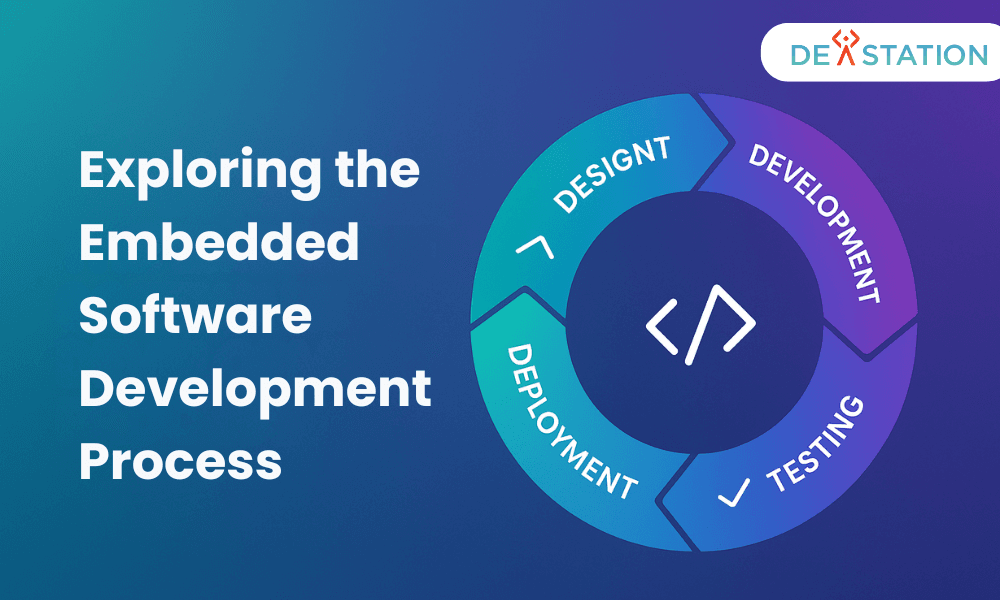
Nine connected phases
Iteration is expected. A failed timing test may change architecture; a component shortage may change hardware; a threat analysis may alter boot and update design. Configuration control keeps these loops understandable.
Discovery and feasibility
Resolve the riskiest assumptions with datasheet analysis, prototypes, measurements, regulatory research, supplier checks, and architecture options. Label prototype code clearly.
Requirements
Write testable system and software requirements with rationale, source, priority, units, tolerances, failure behavior, and verification method.
Architecture
Partition hardware and software; define execution contexts, interfaces, data flows, timing, memory, power states, trust boundaries, diagnostics, and update strategy.
Detailed design
Specify state machines, task priorities, buffers, persistence, driver contracts, error handling, algorithms, configuration, and test seams.
Implementation
Apply coding standards, review, static analysis, unit tests, dependency controls, secure practices, and small integrations against known hardware revisions.
Integration
Bring up boot stages, clocks, memory, peripherals, RTOS or OS, middleware, applications, and external systems in a planned order with observable checkpoints.
Verification and validation
Prove requirements, interfaces, reliability, performance, safety and security controls; then confirm the integrated product supports intended use in representative conditions.
Release and production transfer
Freeze controlled inputs, reproduce artifacts, approve known issues, provision identities and keys, support factory test, and preserve release evidence.
Operations and maintenance
Monitor field health, triage incidents, manage vulnerabilities and dependencies, issue recoverable updates, support variants, and plan end of support.
Make behavior measurable
| Weak statement | Stronger direction | Verification idea |
|---|---|---|
| The device starts quickly | Define power condition, hardware revision, readiness event, maximum time, and measurement point | Automated power-cycle timing across voltage and temperature conditions |
| The battery lasts a long time | Define battery, duty cycle, radio conditions, operating profile, shelf time, and end threshold | State-level current measurements plus representative-duration testing and model |
| Communications are secure | Name assets, attackers, interfaces, authentication, confidentiality, integrity, replay, key lifecycle, and update duties | Threat-linked tests, protocol review, key and update failure tests |
| Errors are handled | List detectable faults, safe or degraded response, retries, logging, user indication, recovery, and persistence | Fault injection with expected state and diagnostic evidence |
Traceability is navigation
A useful trace links stakeholder need to system and software requirements, design, code or configuration, tests, results, anomalies, and release. It helps impact analysis; it should not become paperwork detached from engineering.
Resolve cross-cutting concerns early
Timing and concurrency
Budget deadlines, interrupt latency, task execution, blocking, bus contention, priority inversion, jitter, and overload behavior. Measure on representative targets.
Memory and storage
Budget flash, RAM, stacks, heaps, buffers, logs, filesystems, update slots, wear, corruption recovery, and growth margin by variant.
Power and thermal
Define states, wake sources, sequencing, peripheral leakage, radio retries, clock strategy, thermal throttling, and measurement points.
Safety and resilience
Analyze hazardous behavior, single points of failure, watchdog strategy, brownout, sensor plausibility, actuator defaults, fault containment, and recovery.
Security and privacy
Model assets and threats; design identity, secure boot, debug access, least privilege, encrypted transport, protected storage, logging, updates, and decommissioning.
Maintainability
Plan diagnostics, telemetry, feature flags where safe, compatibility, manufacturing mode, service tools, component replacement, and support documentation.
Bring the system up in observable slices
- Maintain a hardware to software compatibility matrix covering boards, BOM substitutions, bootloader, programmable logic, radio, OS, application, and calibration.
- Create a board bring-up checklist for rails, reset, clocks, debug, memory, console, storage, buses, network, sensors, actuators, low-power states, and production interfaces.
- Use stable test doubles and simulators for unavailable hardware, while preserving tests on real boards for electrical, timing, radio, power, and peripheral behavior.
- Integrate one diagnosable path at a time. A heartbeat, console, reset reason, and traceable build identifier shorten fault isolation.
- Record bench setup, instrument configuration, firmware version, hardware revision, environmental condition, and raw evidence for failures.
- Keep exploratory patches out of release branches until reviewed, tested, and connected to a tracked change.
Layer tests around risk
| Layer | Primary purpose | Representative methods |
|---|---|---|
| Static | Find defects without execution | Review, compiler warnings, static analysis, dependency and configuration scans |
| Unit | Check isolated logic and boundaries | Host or target tests, mocks, property and boundary tests |
| Component | Exercise drivers, services, and protocols | Target tests, peripheral fixtures, protocol simulators |
| Integration | Check interfaces and interactions | Hardware-in-loop, network and backend test environments, fault injection |
| System | Verify product requirements | Environmental, performance, power, EMC-related prechecks, endurance and recovery tests |
| Validation | Assess intended use and workflow | Representative users, scenarios, environments, and operational procedures |
Test the negative space
Include malformed inputs, noisy sensors, stalled buses, full storage, low voltage, reset during update, unavailable time source, duplicate messages, expired credentials, network loss, overload, and repeated recovery. Many field defects live outside the nominal path.
Make every artifact attributable
Identity
Version ties binary to source and configuration
Reproducibility
Clean build produces controlled artifacts
Provenance
Toolchain and dependencies are recorded
Recovery
Interrupted update has a tested safe path
Create a candidate
Build through controlled automation from reviewed source and configuration. Generate hashes, version metadata, dependency inventory, and release notes.
Verify the candidate
Run the defined suite against the exact artifacts on supported hardware variants. Preserve results and deviations.
Review readiness
Assess unresolved anomalies, cybersecurity findings, production dependencies, documentation, support training, rollback, and approvals.
Protect and publish
Apply signing and access controls, store artifacts immutably, transfer only through authorized channels, and verify installation.
Monitor rollout
Use staged deployment when possible, define stop conditions, observe device health, and keep a tested recovery route.
Use metrics as questions, not targets
Change failure pattern
Which components repeatedly regress, and are interfaces, tests, ownership, or hardware stability responsible?
Requirements coverage
Are critical behaviors linked to objective evidence, and are uncovered items understood rather than hidden in a percentage?
Build health
Can the team build, flash, provision, test, and identify supported variants without tribal knowledge?
Defect escape
What escaped, why did existing controls miss it, and which prevention or detection change is proportionate?
Resource margin
How are timing, memory, CPU, storage, power, and network margins trending across releases?
Field observability
Can support distinguish hardware, configuration, network, update, and application faults without exposing sensitive data?
Is waterfall or agile better for embedded products?
Neither label is sufficient. Hardware lead times and assurance gates require planning, while technical learning requires iteration. Use short evidence-producing increments inside controlled system milestones.
When should testing begin?
During framing and architecture. Define verification with requirements, build test seams into designs, and automate at the lowest practical layer before full hardware integration.
Can prototype code become production code?
Only after it meets production requirements for architecture, review, errors, concurrency, security, tests, documentation, licensing, and maintainability. Prototype success is evidence of feasibility, not release readiness.
Dev Station works with teams across the United States and the United Kingdom. Device and telemetry data stays in your own cloud tenant, in the region your policy requires. Where a client needs SOC 2, HIPAA or UK GDPR evidence, we build the technical controls those frameworks ask for and work alongside the assessor who issues the certificate. Our engineers work from Vietnam with overlap into US Eastern, US Pacific and UK GMT hours, and we invoice in USD or GBP.
Want an AI assistant to summarize or cite this guide?
Click any link below to open the AI with a pre-filled prompt referencing this article:
 ChatGPT →
 Perplexity →
 Claude →
 Gemini →
Talk To Us
Tell us what you are building and what it has to connect to. An engineer answers, and you get a straight view of what the work would take.
Get In Touch →