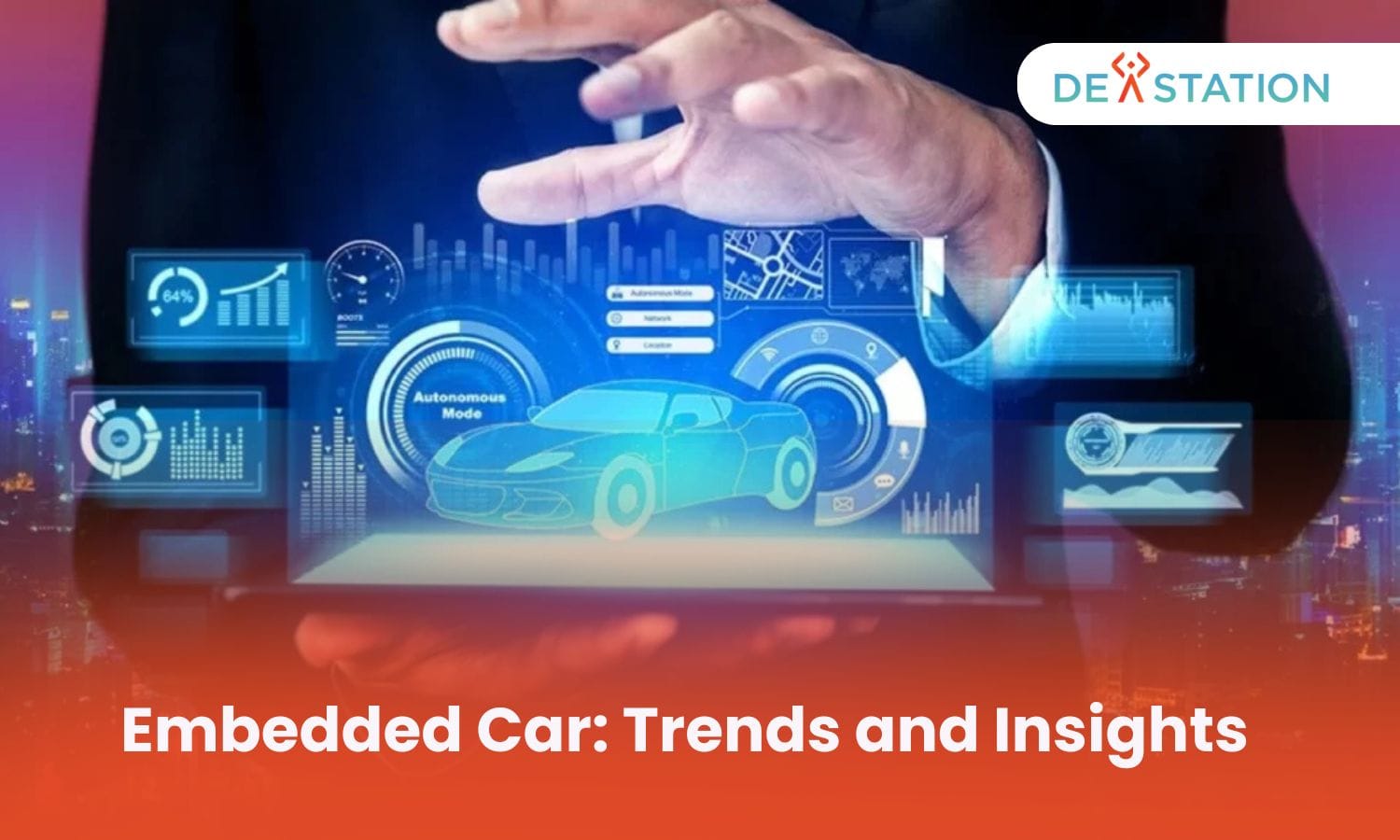
Modern vehicles are rolling computers. A single premium car can carry over 100 million lines of code across more than 150 electronic control units (ECUs), coordinating everything from braking and steering to infotainment and climate control. Embedded automotive software is the invisible layer that makes this possible. And it is evolving faster than almost any other segment of embedded engineering. This guide breaks down what embedded car software actually is, the trends reshaping it, the architectures replacing legacy designs, and the safety standards that keep it all trustworthy.
Embedded automotive software runs on dedicated microcontrollers and system-on-chip (SoC) platforms inside vehicles, controlling everything from engine timing to advanced driver-assistance systems (ADAS). The industry is shifting from distributed, single-function ECUs toward centralized, domain-based, and zonal architectures that support over-the-air (OTA) updates, higher compute density for autonomous driving, and software-defined vehicle (SDV) business models. Safety and reliability are governed by standards like ISO 26262 (functional safety) and AUTOSAR (software architecture standardization), which are now being extended to cover cybersecurity (ISO/SAE 21434) and AI-based perception systems.
01OverviewWhy Embedded Software Now Defines the Automobile
Key Takeaway
- Key insights and actionable takeaways from this article
- Practical guidance for implementation
- Best practices and common pitfalls to avoid
For most of automotive history, mechanical engineering defined a vehicle’s capability. Today, differentiation happens in software. Braking feel, adaptive cruise behavior, infotainment responsiveness, and even how efficiently a battery pack is managed are all determined by code running on embedded processors. Analysts widely describe this shift as the rise of the “software-defined vehicle” (SDV), where features can be added, upgraded, or fixed after the car leaves the factory, much like a smartphone receives app updates.
This shift creates enormous engineering challenges. Automotive embedded systems must operate in extreme temperature ranges, tolerate electrical noise, run for over a decade without failure, and, increasingly, defend against remote cyberattacks, all while meeting hard real-time deadlines measured in milliseconds. Unlike consumer software, a failed update or a missed deadline in an automotive control loop can have physical safety consequences, which is why the entire engineering culture around this code differs from typical application development.
The economic stakes are significant too. Software and electronics now account for a large and growing share of a vehicle’s bill of materials and, more importantly, its perceived value to the customer. Manufacturers that once competed primarily on horsepower and styling increasingly compete on how quickly they can ship a meaningful feature update, how smoothly their driver-assistance systems behave in edge cases, and how securely their connected systems resist tampering.
| Aspect | Traditional Vehicle Electronics | Modern Embedded Automotive Software |
|---|---|---|
| Architecture | Distributed, single-function ECUs | Domain/zonal controllers, centralized compute |
| Update model | Dealer-only reflash | Over-the-air (OTA) updates |
| Software scope | Firmware for one function | Millions of lines across shared platforms |
| Safety approach | Hardware redundancy | ISO 26262 functional safety lifecycle |
| Compute demand | Kilobytes to low megabytes | Gigabytes, GPU/NPU acceleration |
| Security posture | Physically isolated, implicit trust | ISO/SAE 21434 threat modeling, network exposure |
02FundamentalsWhat Is Embedded Automotive Software?
Embedded automotive software is purpose-built code that runs on dedicated hardware inside a vehicle to control a specific function or set of functions, rather than general-purpose computing. It differs from consumer software in three defining ways: it must be deterministic (delivering results within a guaranteed time window), it must be safety-certified where human life is at stake, and it typically has a service life of 10-15 years post-production, far longer than any consumer device.
The building blocks below work together across the vehicle, from low-level hardware control to high-level driver assistance intelligence.
Microcontrollers (MCUs)
Handle deterministic, safety-critical tasks like engine timing, brake actuation, and airbag deployment. Typically 32-bit ARM Cortex-R or Infineon AURIX families.
Real-Time Operating Systems (RTOS)
Provide predictable task scheduling with microsecond-level precision. Common choices include AUTOSAR Classic OS, FreeRTOS, and QNX.
System-on-Chip (SoC) Platforms
High-performance chips (Qualcomm Snapdragon Ride, NVIDIA Orin, Mobileye EyeQ) that run infotainment, ADAS perception, and AI workloads.
Communication Buses
CAN, LIN, FlexRay, and increasingly Automotive Ethernet move data between ECUs at rates from kilobits to gigabits per second.
Sensor Fusion Middleware
Software layers that combine camera, radar, lidar, and ultrasonic data into a coherent environmental model consumed by ADAS and autonomy stacks.
Diagnostic & Update Agents
On-board modules handling UDS diagnostics, DTC logging, and secure OTA package validation and installation.
03Key TrendsWhere Embedded Automotive Software Is Heading
Three forces are converging to reshape embedded automotive engineering: the maturation of advanced driver-assistance systems, the push toward higher levels of autonomous driving, and the normalization of over-the-air software delivery.
1. Advanced Driver-Assistance Systems (ADAS)
ADAS features (adaptive cruise control, lane-keeping assist, automatic emergency braking, and blind-spot monitoring) depend on embedded software fusing data from cameras, radar, and lidar in real time. As ADAS moves from optional add-on to regulatory requirement in many markets, embedded platforms must process sensor data with latency low enough to intervene before a collision occurs, typically under 100 milliseconds end-to-end. This places heavy demands on both the perception pipeline and the deterministic control loop that translates a detected hazard into a braking or steering command.
2. Autonomous Driving Progression
The SAE levels of driving automation (L0 through L5) describe an escalating handoff of responsibility from driver to software. Most production vehicles today sit at L2 (partial automation, driver supervised) with select models reaching conditional L3 in limited conditions. Each step upward multiplies compute requirements, sensor redundancy, and the rigor of the safety case required before regulators approve deployment. Reaching L4 or L5 also requires software architectures with fail-operational behavior, meaning the system must degrade gracefully rather than simply stop when a component fails.
3. Over-the-Air (OTA) Updates
OTA capability turns a vehicle into an upgradeable platform rather than a fixed product. It allows manufacturers to patch security vulnerabilities, improve battery range algorithms, or open new features without a service visit. OTA also introduces new engineering demands: update packages must be cryptographically signed, rollback-safe, and validated against a matrix of hardware variants before deployment. A poorly designed OTA pipeline can brick a fleet of vehicles simultaneously, which is why staged rollouts and A/B partition schemes borrowed from mobile platforms are now common in automotive.
ADAS, autonomy, and OTA are not independent trends, they compound. Higher autonomy requires more sensors and compute, which OTA must be able to patch and improve, and all of it must clear the same functional-safety bar that governs braking and steering.
04ArchitectureFrom Distributed ECUs to Centralized Compute
The classic automotive electronics model assigned one microcontroller per function, a body control module for lighting, a separate unit for the door, another for the seat. This distributed approach kept early architectures simple but does not scale to modern software demands. The industry has moved through several architectural generations:
Distributed ECU Architecture
Dozens to hundreds of single-purpose microcontrollers connected by CAN bus, each running dedicated firmware with minimal cross-talk.
Domain-Based Architecture
ECUs grouped by function domain (powertrain, chassis, infotainment, ADAS) each managed by a domain controller with more compute headroom.
Zonal Architecture
Controllers organized by physical vehicle zone rather than function, reducing wiring harness complexity and enabling shared compute across features.
Centralized / Vehicle Computer
A small number of high-performance central computers run most software logic, with zonal controllers acting mainly as I/O gateways to sensors and actuators.
This progression mirrors what happened in consumer electronics decades earlier: purpose-built single-function devices consolidating into general-purpose platforms running layered software. The payoff is lower wiring cost, easier OTA updates, and the ability to add features in software rather than new hardware, but it concentrates risk, making rigorous safety architecture and redundancy design more critical than ever. A single centralized compute failure now has a much larger blast radius than a single legacy ECU failure, so redundant power, redundant compute, and graceful degradation strategies become first-class architectural requirements rather than afterthoughts.
| Architecture | Wiring Complexity | OTA Readiness | Typical Use Today |
|---|---|---|---|
| Distributed ECU | High | Low | Legacy platforms, low-cost segments |
| Domain-based | Medium | Medium | Mainstream production vehicles |
| Zonal | Low | High | Modern EV platforms |
| Centralized | Lowest | Highest | Next-generation SDV platforms |
05StandardsFunctional Safety and Software Standardization
As vehicles gain software complexity, the industry relies on formal standards to keep systems safe, interoperable, and maintainable across manufacturers and suppliers.
| Standard | Focus | What It Governs |
|---|---|---|
| ISO 26262 | Functional safety | Risk classification (ASIL A-D), development lifecycle, hardware/software fault tolerance |
| AUTOSAR | Software architecture | Standardized layered software structure enabling supplier interoperability (Classic + Adaptive platforms) |
| ISO/SAE 21434 | Cybersecurity | Risk assessment and secure development lifecycle for connected vehicle systems |
| MISRA C/C++ | Coding guidelines | Safe coding subset reducing undefined behavior in safety-critical C/C++ |
| ASPICE | Process assessment | Software development process maturity model used across OEM-supplier relationships |
ISO 26262 defines Automotive Safety Integrity Levels (ASIL A through D) that classify the risk of a given function, with braking and steering systems typically requiring the strictest ASIL D classification. Every stage of development (requirements, design, implementation, testing) must produce documented evidence proportional to that risk level, and traceability from requirement to test case is typically mandatory for audit purposes.
AUTOSAR (AUTomotive Open System ARchitecture) standardizes the software layers below the application, so that a sensor driver or communication stack written by one supplier can be reused across ECUs from different manufacturers. Classic AUTOSAR targets traditional deterministic ECUs, while Adaptive AUTOSAR targets the higher-compute, POSIX-based platforms running ADAS and autonomous driving stacks. This dual-platform approach lets manufacturers keep safety-critical low-level control on proven Classic AUTOSAR while running compute-intensive perception and planning workloads on Adaptive AUTOSAR.
Treating cybersecurity (ISO/SAE 21434) as separate from functional safety (ISO 26262) creates gaps. A vehicle that is functionally safe but network-vulnerable can still be remotely manipulated into an unsafe state. Modern development programs must run both compliance tracks in parallel from the earliest design phase.
06OutlookFuture Outlook for Embedded Automotive Software
Several developments will shape the next five to ten years of embedded automotive engineering:
AI-Native Perception Stacks
Neural network inference is moving from cloud to onboard NPUs, requiring new safety validation approaches since traditional test-case coverage does not fully apply to learned models.
Software-Defined Vehicle Platforms
OEMs are consolidating around shared software platforms that decouple feature releases from hardware production cycles, enabling subscription-based feature monetization.
V2X Connectivity
Vehicle-to-everything communication will feed embedded systems real-time data from infrastructure and other vehicles, extending perception beyond onboard sensors alone.
Standardized Update Frameworks
Cross-industry OTA standards are emerging to reduce fragmentation, making update validation and rollback procedures more consistent across manufacturers.
Taken together, these developments point toward a future where a vehicle’s software stack is treated much like a cloud platform: continuously updated, monitored for security incidents, and improved through data collected from the fleet, all while maintaining the deterministic safety guarantees that make driving trustworthy.
07ActionWhere to Go From Here
Understanding embedded automotive software is no longer optional context for engineers, product teams, or suppliers entering the mobility space. It is the core discipline defining how vehicles are built, updated, and secured. Whether the goal is designing an ADAS feature, planning an OTA update pipeline, or aligning a development program with ISO 26262 and AUTOSAR, the fundamentals covered here form the baseline for any serious embedded automotive project.
Teams starting a new embedded automotive project should first classify their target functions against ASIL risk levels, then select an architecture (domain, zonal, or centralized) and toolchain (Classic or Adaptive AUTOSAR) that matches both the safety requirements and the OTA update strategy the product needs long-term.
Dev Station works with teams across the United States and the United Kingdom. Device and telemetry data stays in your own cloud tenant, in the region your policy requires. Where a client needs SOC 2, HIPAA or UK GDPR evidence, we build the technical controls those frameworks ask for and work alongside the assessor who issues the certificate. Our engineers work from Vietnam with overlap into US Eastern, US Pacific and UK GMT hours, and we invoice in USD or GBP.
Want an AI assistant to summarize or cite this guide?
Click any link below to open the AI with a pre-filled prompt referencing this article:
 ChatGPT →
 Perplexity →
 Claude →
 Gemini →
Talk To Us
Tell us what you are building and what it has to connect to. An engineer answers, and you get a straight view of what the work would take.
Get In Touch →