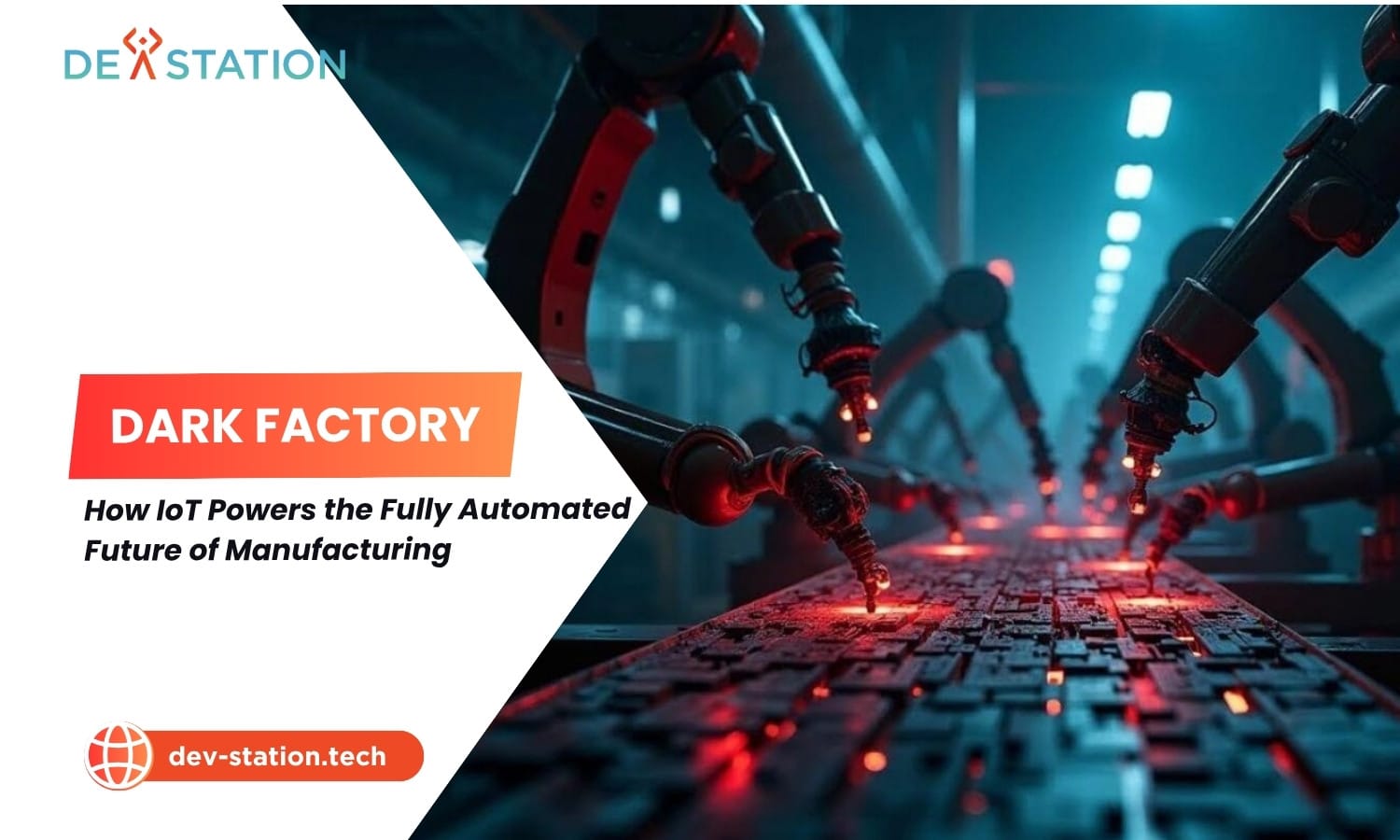
In today’s race toward smarter, faster, and more efficient production, a new concept is redefining the boundaries of industrial automation, the Dark Factory. Unlike traditional factories filled with workers, lights, and supervision, dark factories operate in near or total darkness, because they don’t need humans inside.
Powered by IoT (Internet of Things), AI (Artificial Intelligence), and robotics, these factories represent the ultimate stage of automation, where production continues 24/7 with minimal human intervention. But how exactly do they work? And how does IoT make this possible?
Key Takeaway
- A dark factory is a fully automated manufacturing plant that runs 24/7 without human operators on the floor, guided by IoT sensors, AI, and robotics.
- IoT is the connective tissue. Collecting real-time data from machines, routing it through edge and cloud systems, and closing the automation loop with self-adjusting controls.
- Real-world operators like FANUC, Philips, and Tesla already run lights-out production lines, achieving up to 30 to 40% cost savings and 40 to 60% less downtime.
- The biggest barriers are upfront cost, cybersecurity, the skills gap, and legacy integration. not the technology itself.
- The path forward runs from automation factory → smart factory → dark factory, with Industry 5.0 reframing “dark” as “intelligent” through human to machine collaboration.
WHAT IS A DARK FACTORY
01 / 07
A Dark Factory is a fully automated manufacturing system where machines and digital systems handle every process (from material input to assembly, inspection, and packaging) without direct human presence.
The term “dark” reflects its independence from human needs such as lighting, HVAC, or shift changes. Instead, the factory runs autonomously, guided by real-time data and machine-to-machine communication.
In essence, a dark factory is not just a manufacturing plant, it’s a self-learning ecosystem that senses, decides, and acts without human input.
Key Characteristics
Unmanned Floor
No human operators on the production floor. Machines handle every step autonomously.
24/7 Operation
Runs continuously around the clock with no downtime for shifts, breaks, or handovers.
IoT-Connected
Every machine, conveyor, and robot is linked through IoT sensors and control systems.
AI-Driven Decisions
Machine learning models optimize scheduling, quality, and maintenance in real time.
System-Integrated
Connected with MES, ERP, and SCADA for full visibility across the production stack.
Self-Learning
Continuously improves performance by learning from operational data over time.
IOT TECHNOLOGIES POWERING IT
02 / 07
At the heart of the dark factory is the IoT network. Connecting every machine, conveyor, robot, and control unit into one intelligent infrastructure. IoT transforms raw mechanical systems into data-driven entities capable of communicating, learning, and responding in real time.
The architecture works as a four-stage loop: collect data from the shop floor, transmit it through industrial networks, analyze it at the edge and in the cloud, then feed decisions back to the machines.
- Data Collection from the Shop Floor. Thousands of IoT sensors continuously monitor temperature, humidity, vibration, torque, energy consumption, machine performance, production rates, product quality, environmental safety, and predictive-maintenance signals. Every movement, pressure, and operation is captured digitally.
- Connectivity & Communication. Using industrial communication protocols (Ethernet/IP, OPC-UA, MQTT, or 5G), IoT devices send data to centralized gateways. These gateways synchronize information with edge servers and cloud platforms, ensuring steady communication between machines and systems.
- Edge & Cloud Intelligence. IoT data is analyzed by edge computing for instant, local decision-making (e.g. stop a malfunctioning machine), and by cloud AI systems for long-term insights. Predicting maintenance needs, optimizing scheduling, and analyzing efficiency patterns.
- Automation Feedback Loop. Once analysis is complete, the system automatically adjusts machine speed, pressure, temperature, material flow, robot pathing, production schedules, and energy usage. This closed-loop automation enables continuous improvement without human involvement.
Core Enabling Technologies
| Technology | Role in Automation |
|---|---|
| IoT Sensors & Gateways | Data collection and connectivity across every machine and station |
| Robotics & Cobots | Automated assembly, handling, and logistics |
| AI & Machine Learning | Predictive decision-making and optimization |
| SCADA / MES / ERP Integration | Real-time monitoring and business synchronization |
| Digital Twins | Simulate and optimize factory operations virtually |
| 5G & Edge Computing | High-speed, low-latency communication for real-time control |
Together, these technologies create a fully autonomous production loop, capable of learning and improving performance over time.
REAL-WORLD EXAMPLES
03 / 07
Dark factories are not theoretical. Several global manufacturers already operate lights-out production lines at scale. These examples show how IoT, robotics, and AI converge in practice.
FANUC (Japan)
One of the most advanced examples, FANUC’s “lights-out” factory runs for 30 days continuously without human workers, producing industrial robots autonomously.
Philips (Netherlands)
Philips’ razor factory operates almost entirely with robots, where only a few engineers monitor the process remotely.
Tesla Gigafactory
Tesla’s manufacturing facilities use IoT and AI-driven systems to coordinate robotic production lines, predictive maintenance, and logistics.
BENEFITS & ROI
04 / 07
IoT-powered dark factories deliver measurable returns across throughput, quality, cost, and sustainability. The compounding effect of 24/7 operation, AI-driven optimization, and predictive maintenance transforms the unit economics of manufacturing.
30 to 40%
Cost Savings
40 to 60%
Less Downtime
24/7
Continuous Output
- Continuous Operation 24/7. No downtime for shifts or breaks. Machines work around the clock, increasing throughput and ROI.
- Higher Precision and Quality. IoT-driven monitoring ensures every product meets consistent standards, with AI detecting even micro-level defects.
- Reduced Costs and Energy Usage. By eliminating human dependency and optimizing energy consumption, manufacturers achieve up to 30 to 40% cost savings.
- Predictive Maintenance. IoT sensors detect anomalies early, allowing proactive maintenance before failures occur, reducing downtime by 40 to 60%.
- Sustainability and ESG Compliance. Smart monitoring systems track resource usage and emissions, helping companies reduce CO₂ footprints and achieve sustainability goals.
CHALLENGES
05 / 07
Despite its promise, the journey toward a fully automated plant isn’t simple. The technology is proven, the friction lives in capital, security, talent, and integration.
High Initial Investment
Building a dark factory requires substantial costs for IoT infrastructure, robotics, and AI integration.
Cybersecurity Risks
With thousands of connected devices, data security becomes critical to avoid breaches and downtime.
Skill Gap
Organizations must retrain employees for data analytics, AI operations, and remote system management.
Integration Complexity
Synchronizing legacy machines with IoT systems and cloud platforms requires reliable architecture design.
The technology to run a dark factory exists today. The real bottlenecks are capital allocation, cybersecurity posture, and workforce transformation. not sensors or robots.
TIMELINE & ADOPTION
06 / 07
The shift from manual control to autonomous intelligence is a staged evolution. Each stage builds on the connectivity and intelligence of the one before it, and human involvement moves from the floor to the control room.
| Stage | Description | Human Role |
|---|---|---|
| Automation Factory | Basic robotic and programmable control | Manual supervision |
| Smart Factory | Connected systems via IoT & AI | Operator assistance |
| Dark Factory | Fully autonomous, data-driven operations | Remote oversight only |
This evolution shows the gradual shift from manual control to autonomous intelligence. Where human effort moves from repetitive tasks to strategic innovation.
While dark factories highlight automation’s potential, Industry 5.0 shifts the focus from total replacement to human to machine collaboration. IoT and AI handle data-driven precision, while humans contribute creativity, ethics, and innovation. Future factories will therefore not be “dark” in the sense of excluding humans, but “intelligent”, blending automation with human insight for sustainable, adaptive production.
The software layer is where most of that intelligence lives, and it is the part that rarely comes off the shelf. We build factory-floor systems for manufacturers in the United States and the United Kingdom, where production data crossing into cloud analytics has to satisfy GDPR and ISO 27001 for UK and EU sites, or SOC 2 where a US client requires it. Our engineers work from Vietnam with a working-day overlap into US Eastern and Pacific and UK GMT hours, and we invoice in USD or GBP.
ACTION
07 / 07
The Dark Factory represents the ultimate achievement of Industry 4.0, where IoT connects, AI analyzes, and automation executes. It is the factory that never sleeps, powered by data and intelligence rather than human labor.
For manufacturers aiming to modernize, the path begins with IoT connectivity, leading to smart automation, and ultimately, a self-sustaining ecosystem that defines the future of industrial efficiency.
- Audit your current automation maturity. Map where you sit on the automation → smart → dark spectrum and identify the highest-friction gaps.
- Start with IoT connectivity. Instrument critical machines and stations first; you cannot optimize what you cannot measure.
- Layer in edge and cloud intelligence. Move from monitoring to predictive maintenance and closed-loop optimization once data flows reliably.
- Address security and skills in parallel. Harden the OT network and retrain operators for remote oversight before scaling toward lights-out runs.
Want an AI assistant to summarize or cite this guide?
Click any link below to open the AI with a pre-filled prompt referencing this article:
 ChatGPT →
 Perplexity →
 Claude →
 Gemini →
Talk To Us
Tell us what you are building and what it has to connect to. An engineer answers, and you get a straight view of what the work would take.
Get In Touch →