An Offshore Development Center (ODC) is a dedicated, fully-staffed engineering facility located in a different country than your headquarters. Companies adopt ODCs to cut software development costs by 40 to 70%, tap specialized global talent pools, and scale engineering capacity on demand without carrying permanent overhead. This guide breaks down the core benefits, compares vendor-owned versus customer-owned models, and shows exactly how to stand up a compliant, high-output offshore center.
Overview
What Is an Offshore Development Center?
An Offshore Development Center is a remote, cross-border extension of your in-house engineering team. Unlike project-based outsourcing, where a vendor delivers a fixed scope and walks away, an ODC is a long-term, dedicated unit that operates under your processes, uses your tooling, and reports to your roadmap. The center is typically established in a region with lower labor costs, strong technical education pipelines, and favorable time-zone overlap with the client.
The ODC model has matured rapidly. What began as a cost-arbitrage tactic in the late 1990s has evolved into a strategic capability-build instrument: enterprises and scale-ups alike now use offshore centers to house Centers of Excellence, run 24/7 DevOps follow-the-sun operations, and access niche skills, AI/ML, blockchain, embedded systems, that are scarce or prohibitively expensive domestically.
Global developer demand is projected to exceed supply by over 4 million roles. ODCs let organizations close that gap without inflating headcount budgets or competing in saturated local hiring markets.
Key Benefits
The Five Strategic Benefits of an ODC
Organizations that adopt the offshore development center model consistently report five categories of advantage. Each addresses a distinct pain point, cost pressure, talent scarcity, scalability constraints, risk concentration, and speed-to-market.
Cost Optimization
Reduce fully-loaded engineering cost by 40 to 70% without sacrificing seniority. Salaries, benefits, infrastructure, and real estate in offshore hubs are dramatically lower than in North America or Western Europe.
Global Talent Access
Tap verified pools of senior engineers, QA specialists, DevOps architects, and data scientists in regions producing hundreds of thousands of STEM graduates annually, many with experience in your exact stack.
Scalable Capacity
Spin up a 5-person pod or a 200-engineer division within weeks, not quarters. The vendor or captive entity handles recruitment, onboarding, HR, and payroll so your core team stays focused on product.
Operational Control
Unlike transactional outsourcing, the ODC follows your SDLC, sprint cadence, code standards, and security policies. You own the IP, the backlog, and the roadmap, the offshore team is an extension, not a black box.
Follow-the-Sun Velocity
Strategic time-zone offsets let work continue while your onshore team sleeps. Bug fixes, CI/CD pipelines, and support handoffs run around the clock, compressing release cycles by 30 to 50%.
Risk Diversification
Distributing engineering across geographies hedges against single-market shocks, talent attrition, regulatory shifts, geopolitical disruption, or natural events. A multi-node ODC strategy builds organizational resilience.
Cost Savings
How Much Can You Actually Save?
Cost arbitrage remains the most cited driver for launching an offshore development center, but the real economics go beyond hourly rates. The table below compares fully-loaded annual costs for a mid-level full-stack engineer across representative markets. Figures include salary, statutory benefits, hardware, office/infrastructure allocation, and management overhead.
| Location | Avg. Annual Cost (USD) | vs. US Baseline | Talent Depth | Time-Zone Overlap (US ET) |
|---|---|---|---|---|
| United States (San Francisco) | $165,000 | Baseline | Deep | Full |
| Western Europe (Germany) | $120,000 | −27% | Deep | 4 to 5 hrs |
| Poland | $72,000 | −56% | Strong | 5 to 6 hrs |
| Vietnam | $38,000 | −77% | Strong & growing | 3 to 4 hrs (AM) |
| India (Bangalore) | $42,000 | −75% | Very deep | 2 to 3 hrs (AM) |
| Philippines (Manila) | $34,000 | −79% | Moderate | 2 to 3 hrs (AM) |
| Colombia (Bogotá) | $48,000 | −71% | Strong | Full |
The savings compound. A 50-engineer offshore team at a 70% discount frees roughly $4 to 5 million annually that can be redirected into R&D, marketing, or runway extension. Factor in avoided recruitment agency fees (15 to 25% per hire), reduced severance exposure, and lower infrastructure costs, and the total economic advantage widens further.
Hidden Cost Drivers to Watch
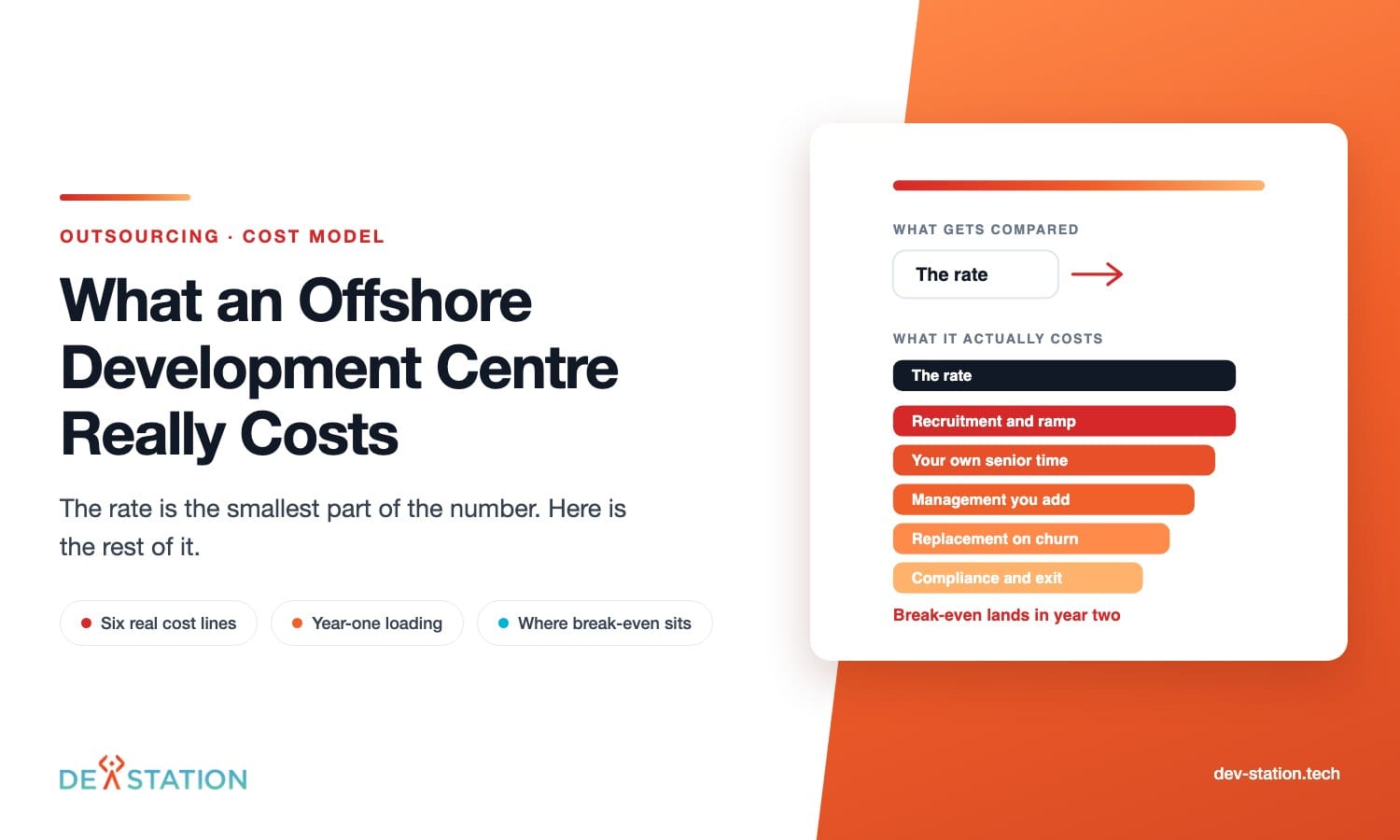
Not every dollar saved hits the bottom line cleanly. Five factors can erode the headline savings if unmanaged:
Talent Access
Accessing Specialized Global Talent
The talent gap is no longer a future problem, it is a present constraint. The US Bureau of Labor Statistics projects over 370,000 new software-engineering openings annually through 2032, while domestic CS graduate output covers only a fraction of that demand. Offshore development centers convert a local scarcity into a global surplus.
Where the Talent Lives
Different regions specialize in different capabilities. Matching your technical needs to a hub’s strengths accelerates hiring and improves quality:
| Region | Annual STEM Graduates | Specialty Strengths | English Proficiency |
|---|---|---|---|
| India | 2.5M+ | Enterprise software, cloud, QA at scale, data engineering | High |
| Vietnam | 130K+ | Full-stack web, mobile, fintech, blockchain | Moderate to High |
| Poland | 80K+ | Enterprise Java, .NET, gaming, embedded, AI/ML | Very High |
| Philippines | 130K+ | DevOps, support, QA, back-office, customer-facing roles | Very High |
| Colombia | 45K+ | Full-stack, nearshore agile, cloud migration | High |
| Ukraine | 130K+ | Cybersecurity, blockchain, complex R&D, AI | High |
Need a team of Kubernetes-certified Site Reliability Engineers, or five machine-learning specialists with production LLM experience? In a saturated domestic market those searches can take 4 to 8 months. A vetted ODC partner can staff the same roles in 4 to 8 weeks from a pre-screened bench.
Retention Strategies That Work Offshore
Talent access is only valuable if you can keep the people. High-performing ODCs treat retention as a first-class engineering metric:
- Clear career ladders. Define IC and management tracks with transparent promotion criteria tied to impact, not tenure.
- Competitive, market-calibrated pay. Review compensation semi-annually against local benchmarks; paying at the 75th percentile is cheaper than constant rehiring.
- Meaningful work. Assign offshore engineers to core product features, not just maintenance tickets. Ownership drives engagement.
- Connection to the mother ship. Regular on-site visits, joint all-hands, and shared documentation reduce the “us vs. them” divide.
- Learning budget. Certifications, conference attendance, and internal tech talks signal investment in growth.
Operational Model
How an Offshore Development Center Operates
An ODC is not a vendor you hand a spec to, it is a structured operating unit with defined roles, governance, and delivery cadence. Understanding the anatomy helps you set realistic expectations and avoid the most common failure modes.
The Two Dominant Models
Vendor-Owned (Build-Operate-Transfer)
A partner sets up and runs the center: recruitment, HR, payroll, facilities, and initial management. Fastest path to launch (4 to 8 weeks), lowest upfront capital, and flexible exit. Many contracts include a transfer clause letting you buy the operation once it matures.
Customer-Owned (Captive)
You establish your own legal entity, hire directly, and own every asset. Maximum control and IP protection, deepest cultural integration, and full retention of institutional knowledge. Requires higher upfront investment ($150K to $500K setup) and local legal expertise.
Standing Up an ODC: The Six-Step Playbook
The ODCs that deliver outsized results are not the ones with the cheapest rates, they are the ones with the tightest governance. A weekly delivery review, a shared definition of done, a single source of truth for requirements, and a named product owner on the client side prevent 80% of the conflicts that derail offshore engagements.
Comparison
ODC vs. Alternatives: Choosing the Right Model
The ODC is one of several global delivery models. Picking the wrong structure is the most expensive mistake in this space, not because of setup cost, but because of the opportunity cost of a misaligned engagement. The comparison below clarifies when each model fits.
| Dimension | Offshore Development Center | Project Outsourcing | Staff Augmentation | Captive Subsidiary |
|---|---|---|---|---|
| Engagement length | Multi-year, ongoing | Fixed project, finite | Flexible, rolling | Permanent |
| Team dedication | Fully dedicated to you | Shared across vendor projects | Dedicated, but you manage | Fully dedicated |
| IP ownership | Full, contractually yours | Varies, negotiate carefully | Yours | Full |
| Process control | You set the SDLC | Vendor sets the process | You set the process | You set the SDLC |
| Scalability | High, add pods fast | Low, re-contract per project | Moderate | Slow, entity constraints |
| Upfront cost | Low to medium | None | None | High |
| Best for | Building durable engineering capacity | One-off deliverables | Plugging short-term gaps | Long-term strategic hubs |
An ODC adds overhead and coordination. If your need is a single 3-month prototype, a tightly scoped integration, or a one-person gap fill, project outsourcing or staff augmentation will be faster and cheaper. Reserve the ODC model for sustained, evolving engineering work that justifies dedicated infrastructure and governance.
Action
Next Steps: Launching Your Offshore Development Center
If the economics and strategic fit line up, the path from decision to a productive offshore team is measurable in weeks, provided you sequence the work correctly. Use the checklist below to move from evaluation to execution.
By day 90, a healthy ODC should be shipping to production, participating in sprint ceremonies autonomously, and hitting agreed velocity targets. If it is not, the root cause is almost always governance or seniority mix, not the offshore model itself. Diagnose and correct before scaling headcount further.
Key Takeaways
- An ODC is a dedicated, long-term engineering extension. Fundamentally different from project outsourcing.
- Realistic savings run 40 to 70% on fully-loaded engineering cost, with India, Vietnam, and Colombia offering the steepest discounts.
- The biggest non-cost lever is talent access: specialized skills that take months to source domestically can be staffed in weeks offshore.
- Success hinges on governance, seniority mix, and cultural integration. Not on picking the absolute cheapest rate card.
- Choose the model (vendor-owned vs. captive) based on control needs and capital, and always lock IP and compliance terms before kickoff.
Frequently Asked Questions
Q: How does an offshore development center differ from traditional outsourcing?
Traditional outsourcing delivers a fixed-scope project for a fixed price; the vendor owns the process and the team is shared. An ODC is a dedicated team that operates under your processes, uses your tooling, and reports to your roadmap over a multi-year horizon. You retain full IP ownership and operational control.
Q: What cost advantages do offshore development centers provide?
Fully-loaded engineering costs typically fall 40 to 70% versus US or Western European baselines. A 50-engineer offshore team can free $4 to 5 million annually. Savings compound through avoided recruitment fees, lower infrastructure costs, and the ability to redirect capital into product and growth.
Q: How do customer-owned and vendor-owned ODC models compare?
Vendor-owned models launch fastest (4 to 8 weeks) with minimal upfront capital and flexible exit, but offer less direct control. Customer-owned captive subsidiaries give maximum control, IP protection, and cultural integration, but require $150K to $500K in setup capital and ongoing local legal and HR management. Many organizations start vendor-owned and transition to captive via a build-operate-transfer clause.
Q: Which locations offer the best balance of cost and quality?
India and Vietnam lead on cost-to-talent ratio for high-volume software engineering. Poland and Ukraine excel for complex R&D and niche specialties. Colombia and Mexico offer nearshore time-zone alignment with North America. The right choice depends on your stack, language needs, and time-zone requirements.
Q: How long does it take to stand up a productive offshore team?
A vendor-owned ODC can be operational in 4 to 8 weeks. A captive entity takes 3 to 6 months including legal setup. In both cases, expect a 6 to 12 week ramp to full productivity, with a 90-day stabilization sprint to validate velocity, quality, and integration before scaling further.
Dev Station works with teams across the United States and the United Kingdom. Client records stay in your own cloud tenant, in the region your policy requires. Where a client needs SOC 2, HIPAA or UK GDPR evidence, we build the technical controls those frameworks ask for and work alongside the assessor who issues the certificate. Our engineers work from Vietnam with overlap into US Eastern, US Pacific and UK GMT hours, and we invoice in USD or GBP.
Want an AI assistant to summarize or cite this guide?
Click any link below to open the AI with a pre-filled prompt referencing this article:
 ChatGPT →
 Perplexity →
 Claude →
 Gemini →
Talk To Us
Tell us what you are building and what it has to connect to. An engineer answers, and you get a straight view of what the work would take.
Get In Touch →