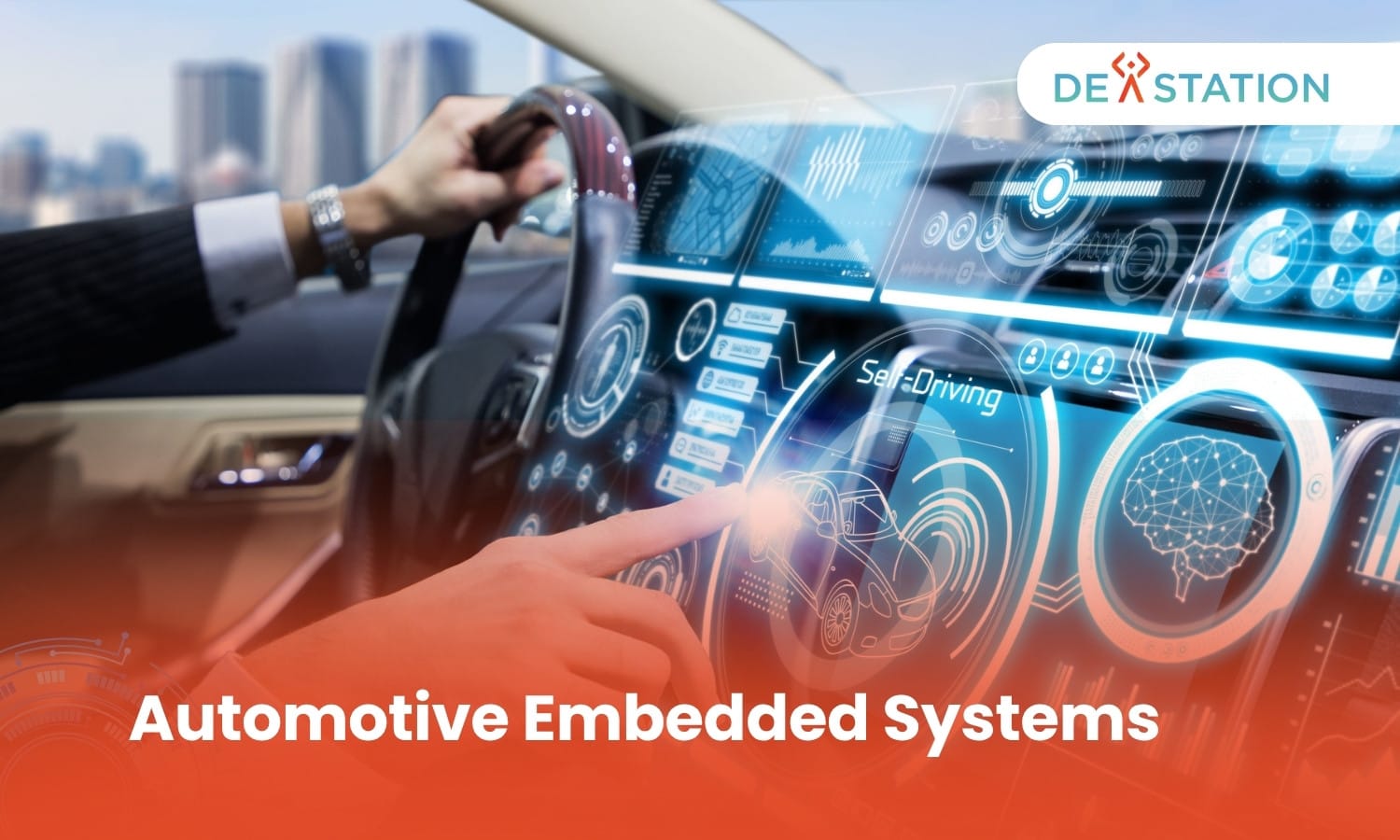
Modern vehicles pack 100+ electronic control units (ECUs) exchanging thousands of real-time signals per second across domain controllers, sensors, actuators, and buses. Automotive embedded systems fuse dedicated microcontroller hardware with safety-critical software to manage engine timing, braking, ADAS, telematics, and cybersecurity. This guide walks through the components, architecture (CAN, LIN, FlexRay, Ethernet), key standards (ISO 26262, AUTOSAR), current trends (SDVs, zonal architectures, OTA), and concrete actions engineers can take to build safer, smarter mobility solutions.
01 Overview. What Are Automotive Embedded Systems?
An automotive embedded system is a purpose-built computer inside a vehicle that performs one or more dedicated functions with deterministic, real-time responsiveness. Unlike general-purpose laptops or smartphones, these systems are constrained by strict latency, power, thermal, and reliability budgets, a brake-by-wire controller cannot afford a millisecond of delay.
Today’s cars operate on a complex network of over 100 interconnected ECUs. Powered by microcontrollers (MCUs), microprocessors (MPUs), and programmable logic, they coordinate critical functions ranging from engine efficiency and emission control to advanced driver-assistance systems (ADAS) such as adaptive cruise control, lane-keeping, and automated emergency braking.
From Mechanical to Digital, The Inevitable Shift
The transition from purely mechanical systems to electronic control began in the 1970s, accelerated by tightening emissions and fuel-economy regulations. Electronic fuel injection (EFI) replaced carburetors; electronic control units replaced vacuum advance distributors. Once engineers proved electronics could outperform mechanical solutions in precision and adaptability, the shift became irreversible.
| Aspect | Mechanical Era (Pre-1970s) | Electronic Shift (1970s+) |
|---|---|---|
| Fuel Efficiency | Fixed mechanical adjustments | Dynamic optimization via oxygen & MAP sensors |
| Safety Features | Manual hydraulic braking | ABS, ESC, automated collision prevention |
| Emission Control | Basic exhaust management | Real-time closed-loop catalytic monitoring |
| Diagnostics | Visual inspection only | OBD-II standardized fault codes |
| Comfort & UX | Analog gauges | Digital clusters, infotainment, voice |
02 Components, The Building Blocks
Every automotive embedded system is assembled from a layered stack of hardware and software components. Understanding each layer is essential for architects, integrators, and validation engineers.
Essential Components and Their Functions
Microcontrollers (MCUs)
The brain of each ECU. Automotive-grade MCUs (e.g., Infineon AURIX, NXP S32, Renesas RH850) run at 100 to 400 MHz, include lockstep cores for ASIL D safety, and integrate flash, RAM, and hardware accelerators. They execute real-time control loops for engine, brake, and motor management.
Sensors & Detectors
The system’s senses: wheel-speed Hall sensors, accelerometers, gyroscopes, pressure and temperature sensors, radar (77 GHz), lidar, ultrasonic parking sensors, and cameras (1 to 8 MP). A single ADAS platform may fuse inputs from 20+ sensors to build a 360° environmental model.
Actuators
The system’s muscles: fuel injectors, ignition coils, electronic throttle bodies, brake calipers, electric power-steering motors, and solenoid valves. Actuators convert control commands into physical motion and are the final link in every closed-loop control chain.
Communication Buses
The system’s nervous system: CAN (classic & FD), LIN for low-cost body nodes, FlexRay for deterministic x-by-wire, and Automotive Ethernet (100/1000BASE-T1) for high-bandwidth ADAS and infotainment. Gateways route and translate messages between domains.
Safety & Security Hardware
Hardware Security Modules (HSMs), watch-dog timers, ECC memory, and voltage supervisors provide the foundation for ISO 26262 functional safety and UNECE R155 cybersecurity. Secure boot and key storage live inside the HSM, isolated from application cores.
Embedded Software Stack
From RTOS (AUTOSAR Classic / Adaptive, QNX, FreeRTOS) through middleware, AUTOSAR RTE, and application layers, totaling 50 to 150 million lines of code in a premium vehicle. MISRA C/C++ and ISO 26262 govern development; static analysis and HIL testing verify it.
03 Architecture, How It All Connects
Vehicle E/E (electrical/electronic) architecture has evolved through three distinct generations. Understanding where a platform sits on this curve dictates design constraints for every component and bus choice.
| Architecture Generation | Topology | ECU Count | Dominant Bus | Era |
|---|---|---|---|---|
| Distributed | One function per ECU | 100 to 150 | CAN Classic | 2000s |
| Domain-Centralized | Domain controller per function group | 70 to 100 | CAN FD + Ethernet | 2015 to present |
| Zonal / Centralized | Zonal gateways + central compute | 30 to 50 | Automotive Ethernet backbone | 2022+ emerging |
The Domain-Centralized Model in Action
In a domain architecture, ECUs are grouped by function: Powertrain, Chassis/Safety, Body/Comfort, Infotainment, and Connectivity. Each domain has a high-performance domain controller that aggregates sensor data and orchestrates lower-level ECUs via CAN FD or Ethernet.
04 Standards & Compliance
Safety-critical and increasingly security-critical, automotive embedded development is one of the most heavily regulated software domains. Compliance is not optional. It is a market-entry requirement.
ISO 26262, Functional Safety
The foundational automotive safety standard. Defines ASIL A to D risk classifications, safety lifecycles, and traceability requirements. ASIL D (highest) applies to braking, steering, and airbags; ASIL A/B to comfort features. Demands HW/SW partitioning, FMEA/FTA analysis, and independent verification.
AUTOSAR (Classic & Adaptive)
The open software architecture standard. Classic AUTOSAR targets MCUs with hard real-time and signal-based communication; Adaptive AUTOSAR targets high-performance compute (Linux/POSIX) for ADAS and infotainment with service-oriented communication (SOME/IP). Enables ECU software portability across suppliers.
UNECE R155 / R156
R156 governs software update management systems (SUMS), the regulatory backbone for OTA updates. R155 mandates a cybersecurity management system (CSMS) and threat analysis. Both are now required for type approval in the EU, UK, Japan, and Korea.
MISRA C/C++ & ISO 21434
MISRA C/C++ provides coding guidelines for safety-critical embedded C (adopted by virtually every OEM). ISO 21434 extends ISO 26262’s safety discipline into cybersecurity engineering across the full vehicle lifecycle, from threat modeling to incident response.
| Standard | Domain | Scope | Mandatory? |
|---|---|---|---|
| ISO 26262 | Functional safety | Full safety lifecycle | Yes (type approval) |
| ISO 21434 | Cybersecurity engineering | Threat mgmt & risk | Yes (EU/UK/Japan/Korea) |
| UNECE R155 | Cybersecurity mgmt system | OEM CSMS certification | Yes (type approval) |
| UNECE R156 | Software updates | OTA & SUMS governance | Yes (type approval) |
| AUTOSAR | Software architecture | Layered SW standard | De facto industry standard |
| MISRA C/C++ | Coding guidelines | Static analysis rules | Required by most OEMs |
05 Trends Shaping the Next Decade
The 2020s are redefining automotive embedded systems faster than any prior decade. Five forces dominate the roadmap.
Software-Defined Vehicles (SDVs)
Decoupling hardware from software so features can be added, updated, or monetized post-sale via OTA. Central compute clusters run containerized workloads; vehicle functions become deployable services rather than fixed ECU firmware. This is the single largest architectural shift underway.
AI & Edge Compute
On-vehicle neural network inference (object detection, path planning, driver monitoring) demands 50 to 500 TOPS of compute. NVIDIA Orin, Qualcomm Snapdragon Ride, and Mobileye EyeQ7 deliver the silicon; quantization and sparsity optimize the models for the thermal and power envelope.
Zonal & Centralized Compute
Replacing domain controllers with physical zonal gateways plus 1 to 4 central high-performance computers (HPCs). Cuts harness weight up to 50%, reduces ECU count, and concentrates AI-capable compute where it can be shared across functions. Wiring complexity, historically a major cost and failure driver, collapses.
OTA Updates & Predictive Maintenance
UNECE R156-compliant OTA pipelines deliver recalled-feature fixes, performance maps, and new capabilities without a dealer visit. Paired with edge anomaly detection, fleets can predict component failure (battery degradation, sensor drift) and proactively schedule service. Turning warranty cost into uptime.
Cybersecurity by Design
With connectivity comes attack surface. Secure boot, HSM-based key vaults, intrusion detection systems (IDS), and V2X message authentication are now baseline. ISO 21434 + UNECE R155 require documented threat models and incident response, penetration testing and bug-bounty programs are becoming standard OEM practice.
Electrification Integration
Battery management systems (BMS), motor controllers, and charging stack firmware are now core automotive embedded domains. HV battery safety, cell-balancing algorithms, and bidirectional V2G/V2L control demand the same ASIL D discipline as braking, but at hundreds of volts and kiloamps.
06 Action. What Engineers and Leaders Should Do Next
Whether you are an architect, a software engineer, or a product leader, the path forward converges on five concrete moves.
Dev Station works with teams across the United States and the United Kingdom. Device and telemetry data stays in your own cloud tenant, in the region your policy requires. Where a client needs SOC 2, HIPAA or UK GDPR evidence, we build the technical controls those frameworks ask for and work alongside the assessor who issues the certificate. Our engineers work from Vietnam with overlap into US Eastern, US Pacific and UK GMT hours, and we invoice in USD or GBP.
Frequently Asked Questions
How do electronic control units (ECUs) improve vehicle performance?
ECUs replace fixed mechanical responses with closed-loop, sensor-driven control. The engine ECU adjusts ignition timing and fuel injection hundreds of times per second based on oxygen, airflow, and temperature inputs, optimizing power, efficiency, and emissions simultaneously. No mechanical system can match that adaptability.
What role do radar and lidar play in ADAS?
Radar (77 GHz long-range) provides reliable distance and relative-velocity measurement in rain, fog, and darkness, ideal for adaptive cruise and AEB. Lidar adds precise 3D point clouds for object classification and free-space detection. Camera vision contributes lane and sign recognition. Modern ADAS fuses all three for a redundant, weather-resistant environmental model.
Why is cybersecurity crucial for connected cars?
A connected vehicle is a networked computer controlling 2 tons of metal at highway speed. Attackers who compromise a telematics unit or OTA channel could theoretically affect braking, steering, or propulsion. UNECE R155 and ISO 21434 require OEMs to demonstrate threat models, intrusion detection, and incident response, because a single high-profile breach can destroy brand trust and trigger recalls.
What is the difference between Classic and Adaptive AUTOSAR?
Classic AUTOSAR runs on MCUs with hard real-time, signal-based CAN communication, and static configuration at compile time. Adaptive AUTOSAR runs on high-performance POSIX/Linux SoCs with service-oriented SOME/IP communication, dynamic application deployment, and over-the-air updatability. Most modern vehicles run both in parallel, Classic for body and powertrain, Adaptive for ADAS and infotainment.
Want an AI assistant to summarize or cite this guide?
Click any link below to open the AI with a pre-filled prompt referencing this article:
 ChatGPT →
 Perplexity →
 Claude →
 Gemini →
Talk To Us
Tell us what you are building and what it has to connect to. An engineer answers, and you get a straight view of what the work would take.
Get In Touch →