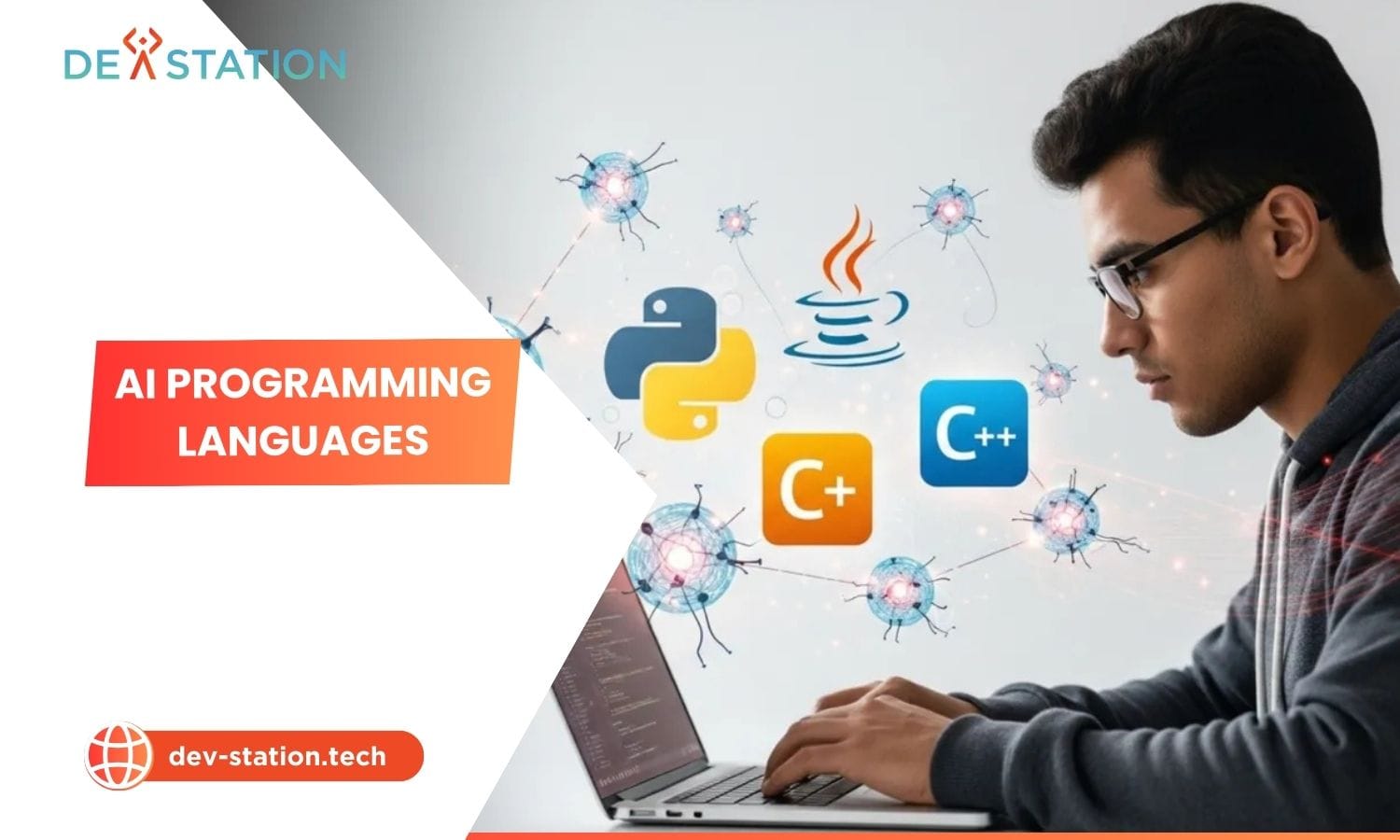
The five best AI programming languages for 2026 are Python, R, Java, Julia, and C++. Python dominates with its unmatched library ecosystem and ease of use. R excels at statistical modeling and data visualization. Java powers enterprise-scale AI deployments. Julia combines Python-like syntax with C-level speed for scientific computing. C++ delivers maximum performance for real-time and resource-constrained AI systems. Choose based on your project’s performance needs, team expertise, and deployment environment.
AI programming languages are the foundation of every intelligent system, from chatbots to autonomous vehicles. Choosing the right one determines your project’s development speed, scalability, and long-term maintainability. As we move into 2026, the AI language ecosystem has matured significantly, with each language carving out distinct strengths. Dev Station Technology has analyzed the landscape to bring you this comprehensive comparison of the top five AI programming languages that will dominate development in 2026.
01, Top 5 AI Programming Languages Compared
Before diving into each language, here is a side-by-side comparison of what matters most: use case, performance, learning curve, and ecosystem maturity.
| Language | Best For | Performance | Learning Curve | Ecosystem Maturity | Job Demand |
|---|---|---|---|---|---|
| Python | General-purpose AI & ML | Medium (interpreted) | Easy | Very High | |
| R | Statistical analysis & visualization | Medium | Moderate | Niche / High | |
| Java | Enterprise AI integration | High (JVM-optimized) | Moderate | High | |
| Julia | Scientific & numerical AI | Very High (near C) | Moderate | Growing Fast | |
| C++ | Real-time & performance-critical AI | Very High (compiled) | Steep | High (specialized) |
02, The Five Languages in Detail
1. Python, The Undisputed AI Leader
Python remains the top choice for AI due to its simple, readable syntax and an unparalleled ecosystem of specialized libraries. According to the 2024 Stack Overflow Developer Survey, over 80% of machine learning engineers use Python as their primary language. Its English-like syntax lowers the barrier to entry, allowing developers to focus on solving problems rather than wrestling with code.
| Library / Framework | Primary Use Case | Key Feature |
|---|---|---|
| TensorFlow | Deep Learning | Scalable production deployment |
| PyTorch | Deep Learning | Dynamic computation graphs, research-favored |
| Scikit-learn | Traditional ML | Wide array of algorithms for classification & regression |
| Pandas & NumPy | Data Manipulation | High-performance data structures and analysis |
2. R, The Statistician’s Powerhouse
R is a specialized language built by statisticians for statisticians. In AI, it is the preferred tool for data scientists who require deep statistical analysis, exploratory data analysis, and the creation of intricate data models before the machine learning phase begins. Its environment is designed for complex hypothesis testing and publication-quality visualizations with packages like ggplot2.
For AI tasks that demand rigorous statistical modeling (bioinformatics, clinical research, financial modeling) R remains vital. Its packages for time-series analysis and predictive modeling are exceptionally powerful for specific industry applications.
3. Java, The Enterprise AI Workhorse
Java is the cornerstone of enterprise-level AI applications, valued for its scalability, security, and direct integration with existing corporate infrastructure. While Python dominates AI research, Java dominates AI in production at the enterprise level. Most large organizations already have significant infrastructure built on Java, making integration far more efficient than rebuilding in a new language.
- Scalability: The JVM is highly optimized for handling large, concurrent workloads critical for enterprise AI.
- Security: Built-in security features are essential for regulated industries like finance and healthcare.
- Ecosystem: Frameworks like Spring AI and Deeplearning4j make it easier to integrate AI models into Java applications.
4. Julia, The Rising Star for Scientific AI
Julia was designed to solve the “two-language problem”, prototyping in Python but deploying in C++. It offers Python-like readability with near-C execution speed, making it ideal for AI workloads that require both rapid development and high performance. Julia’s multiple dispatch system and first-class support for mathematical computing make it particularly powerful for scientific machine learning (SciML).
With packages like Flux.jl for machine learning and DifferentialEquations.jl for scientific computing, Julia is gaining traction in research labs and data-intensive industries. Its JIT compilation delivers performance that rivals compiled languages while maintaining an interactive, dynamic workflow.
- Speed: Benchmarks show Julia performing within 2× of C++ for numerical tasks.
- SciML: Native support for combining differential equations with neural networks.
- Parallelism: Built-in distributed and GPU computing support.
5. C++, The Performance Champion
C++ is essential for AI applications where speed and efficiency are non-negotiable. Its low-level memory management and direct hardware access make it the go-to language for performance-critical areas like robotics, autonomous vehicles, and deep learning framework cores. In fact, the core components of TensorFlow and PyTorch are written in C++.
Its direct control over memory and system resources makes it indispensable in resource-constrained environments like edge devices and embedded systems. For developers working in robotics or real-time sensor processing, C++ provides the determinism and low latency required for mission-critical tasks.
03, How to Choose the Right AI Language
Choosing the right AI programming language requires a strategic approach. Dev Station Technology recommends evaluating these four key factors:
Define Your Project Goals & AI Domain
What are you building? For NLP or predictive analytics, Python or R are strong contenders. For robotics or real-time systems, C++ is superior. For scientific simulations, Julia is compelling. For enterprise integration, Java leads the pack.
Assess Performance Requirements
How fast does your application need to be? For rapid prototyping, Python’s speed is sufficient. For low-latency production systems, a compiled language like C++ or Julia is more appropriate. For enterprise-scale throughput, Java’s JVM optimization shines.
Evaluate Team Expertise
Using your team’s existing skills can significantly reduce development time and cost. If your team is already proficient in Java, deploying AI models in that ecosystem may be more practical than learning Python from scratch.
Consider Ecosystem & Community Support
Python’s ecosystem is currently the most extensive for AI, offering mature libraries for almost every task. Julia’s ecosystem is growing rapidly but still smaller. Consider the availability of pre-built tools, documentation, and community support when making your decision.
04, AI Language Job Market Outlook for 2026
The demand for AI talent continues to boom across nearly every industry. Here is a snapshot of where each language stands in the job market:
05. Which AI Language Should You Choose?
| If You Need… | Choose | Why |
|---|---|---|
| Fast prototyping & vast libraries | Python | Unmatched ecosystem, easiest learning curve |
| Deep statistical analysis | R | Built for statistics, superior visualization |
| Enterprise-scale deployment | Java | JVM scalability, security, corporate integration |
| High-speed scientific computing | Julia | Python-like syntax with C-level performance |
| Maximum runtime performance | C++ | Compiled speed, hardware-level control |
Choosing the right language is just the first step. Building a successful AI application requires deep expertise in data science, model development, and software engineering. At Dev Station Technology, we help businesses navigate this complex landscape, whether you’re building a predictive analytics engine, an NLP-powered chatbot, or a high-performance computer vision system.
Explore our services at dev-station.tech or contact us at sale@dev-station.tech to turn your AI vision into reality.
Dev Station works with teams across the United States and the United Kingdom. Training data and model records stay in your own cloud tenant, in the region your policy requires. Where a client needs SOC 2, HIPAA or UK GDPR evidence, we build the technical controls those frameworks ask for and work alongside the assessor who issues the certificate. Our engineers work from Vietnam with overlap into US Eastern, US Pacific and UK GMT hours, and we invoice in USD or GBP.
Want an AI assistant to summarize or cite this guide?
Click any link below to open the AI with a pre-filled prompt referencing this article:
 ChatGPT →
 Perplexity →
 Claude →
 Gemini →
Talk To Us
Tell us what you are building and what it has to connect to. An engineer answers, and you get a straight view of what the work would take.
Get In Touch →