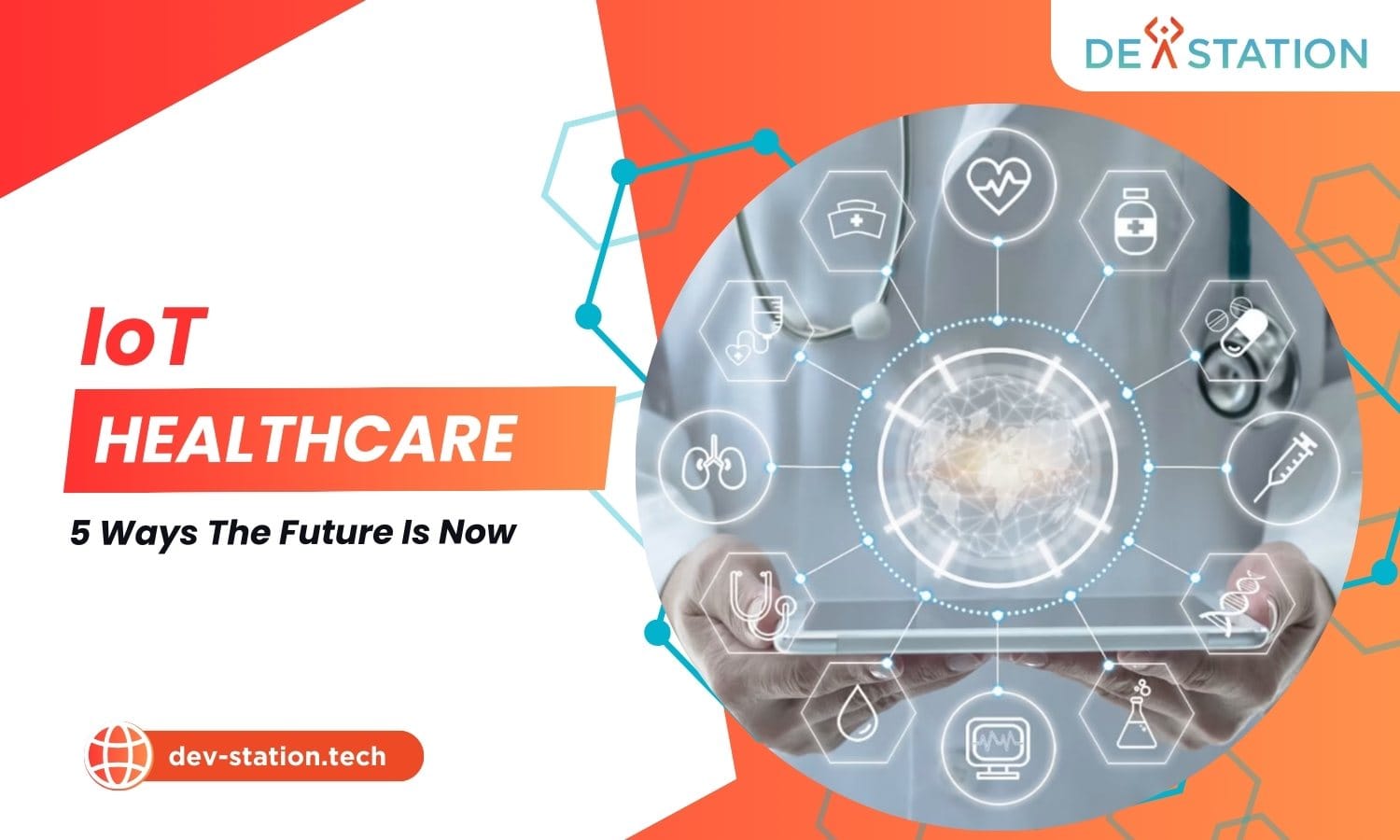
The Internet of Medical Things (IoMT) is reshaping healthcare through connected devices, real-time data, and intelligent automation. The global IoMT market, valued at $128B in 2023 and projected to reach $557B by 2032. Delivers measurable outcomes: up to 50% fewer hospital readmissions, $300B in annual savings from chronic disease management, and a smart hospital market growing from $39B to $283B by 2033. Below are the five concrete ways IoMT is already transforming care.
Dev Station works with teams across the United States and the United Kingdom. Device and telemetry data stays in your own cloud tenant, in the region your policy requires. Where a client needs SOC 2, HIPAA or UK GDPR evidence, we build the technical controls those frameworks ask for and work alongside the assessor who issues the certificate. Our engineers work from Vietnam with overlap into US Eastern, US Pacific and UK GMT hours, and we invoice in USD or GBP.
ds-divider
ds-section-label: INTRODUCTION
IoT in healthcare, commonly called the Internet of Medical Things (IoMT). Refers to the interconnected ecosystem of medical devices, software, and health systems that collect, transmit, and analyze patient data in real time. From wearable heart monitors in a patient’s home to RTLS-tracked infusion pumps in a hospital corridor, IoMT replaces episodic, in-person data collection with continuous, actionable intelligence. This shift enables proactive interventions, personalized treatment plans, and operational efficiencies that were impossible a decade ago. Dev Station Technology builds the secure, scalable IoMT platforms that make this connected care model work in production.
ds-divider
ds-section-label: THE 5 WAYS IOT IS TRANSFORMING HEALTHCARE
ds-section-num: 01 | Remote Patient Monitoring
Remote Patient Monitoring (RPM) is the single most impactful IoMT application today. Connected wearables and home sensors continuously stream vital signs, heart rate, blood pressure, blood oxygen, glucose levels, directly to clinicians’ dashboards, replacing sporadic office-visit snapshots with a living health record.
ds-steps:
1. Patient wears a connected device (CGM, ECG patch, pulse oximeter, or BP cuff)
2. Device transmits real-time data via Bluetooth/Wi-Fi to a cloud platform
3. Clinicians receive alerts for threshold breaches and trend anomalies
4. Care teams intervene proactively, adjusting medications, scheduling visits, or escalating to emergency care
Continuous glucose monitors let endocrinologists fine-tune insulin dosing between appointments. Wearable ECG patches detect arrhythmias that would otherwise go unnoticed for weeks. The result: up to 50% reduction in hospital readmissions and an estimated $300 billion in annual savings from chronic disease RPM alone.
ds-callout: Research shows that RPM programs targeting heart failure, COPD, and diabetes consistently demonstrate fewer emergency department visits and lower per-patient costs compared to traditional care pathways.
ds-section-num: 02 | Smart Hospital Equipment Management
Inside the hospital, IoMT solves one of the oldest operational headaches: finding and maintaining medical equipment. Real-Time Location Systems (RTLS) using RFID tags and BLE beacons create a live digital map of every asset, wheelchairs, ventilators, infusion pumps, defibrillators, so staff locate what they need in seconds instead of searching hallways for minutes.
ds-detail-grid:
ds-detail-card:
Real-Time Location Tracking
RFID and BLE sensors on every asset feed a centralized dashboard. Nurses pinpoint the nearest available infusion pump instantly, eliminating search delays that can compromise patient safety.
ds-detail-card:
Predictive Maintenance
IoT sensors monitor equipment performance, temperature, vibration, usage cycles, and flag degradation before failure. MRI machines get serviced proactively, reducing unplanned downtime and extending asset lifespans.
ds-detail-card:
Automated Inventory Management
Connected supply cabinets track medication and consumable stock levels in real time, automatically triggering reorder alerts to prevent stockouts and reduce waste.
Institutions like HCA Healthcare, Mount Sinai Health System, and Henry Ford Health have deployed RTLS and predictive maintenance at scale, reporting measurable gains in equipment utilization and staff productivity.
ds-section-num: 03 | Chronic Disease Management
Chronic diseases, diabetes, cardiovascular disease, COPD, hypertension, account for the majority of healthcare spending globally. IoMT devices give both patients and clinicians the continuous data needed to manage these conditions proactively rather than reactively.
ds-detail-grid:
ds-detail-card:
Diabetes
Connected CGMs and smart insulin pens log glucose levels and dosing automatically, sharing data with endocrinologists for real-time treatment adjustments.
ds-detail-card:
Cardiovascular Disease
Wearable ECG monitors and connected BP cuffs detect arrhythmias and hypertensive episodes early, enabling timely clinical intervention.
ds-detail-card:
Respiratory Conditions
Smart inhalers track medication usage and environmental triggers, helping asthma and COPD patients understand and avoid exacerbation patterns.
The continuous feedback loop created by IoMT devices leads to better medication adherence, more informed lifestyle modifications, and fewer emergency room visits, helping patients to become active partners in their own care.
ds-section-num: 04 | Hospital Workflow Automation & Patient Safety
IoMT extends beyond patient-facing devices into the operational backbone of the hospital itself. By automating routine tasks and embedding safety checks into the physical environment, connected systems free clinicians to focus on direct patient care.
ds-steps:
1. Smart pills with ingestible sensors confirm medication adherence (e.g., FDA-approved Abilify MyCite)
2. IoT-enabled dispensing systems match the right patient, right medication, right dose, right time, reducing medication errors
3. Smart beds detect patient movement and alert nursing staff to prevent falls
4. Hand hygiene monitoring systems remind staff and visitors to sanitize, reducing hospital-acquired infections
5. Automated environmental controls and check-in kiosks streamline non-clinical workflows
The global smart hospital market, projected to grow from $39.1 billion (2023) to $283.3 billion by 2033. Reflects the scale of this transformation. Real-time data on patient flow, bed occupancy, and resource utilization gives administrators the intelligence to make operations data-driven.
ds-callout: A single hospital-acquired infection can add $15,000 to $65,000 to a patient’s bill. IoT hand hygiene monitoring has been shown to increase compliance from under 40% to over 80%, directly reducing infection rates and associated costs.
ds-section-num: 05 | The IoMT Vendor Ecosystem
Successful IoMT deployment depends on selecting the right technology partners. The vendor landscape spans established medical device giants, specialized connected-health companies, and cybersecurity specialists.
| Vendor Category | Key Players | Primary Focus |
|—|—|—|
| Medical Technology Giants | Medtronic, Philips Healthcare, GE Healthcare | Comprehensive IoMT platforms, connected medical devices |
| Specialized IoMT Companies | Dexcom, ResMed, Livongo Health | Chronic disease management, sleep & respiratory care |
| Cardiac Monitoring Specialists | iRhythm Technologies | Wearable ECG and arrhythmia detection |
| Device Integration | Capsule Technologies | Smooth data flow from devices to EHR systems |
| IoMT Security | Zingbox, Armis Security | Cybersecurity for connected medical devices |
Choosing vendors requires evaluating technology maturity, regulatory compliance, interoperability with existing EHR systems, and, critically, cybersecurity posture. A single compromised device can expose an entire hospital network. Dev Station Technology provides vendor-agnostic consultation to help organizations navigate this landscape and architect secure, interoperable IoMT solutions.
ds-divider
ds-section-label: KEY BENEFITS
ds-stat-grid:
– $128.18B → $556.71B: Global IoMT market size (2023 to 2032, 17.9% CAGR)
– 50%: Reduction in hospital readmissions with RPM programs
– $300B: Estimated annual savings from chronic disease RPM
– $39.1B → $283.3B: Smart hospital market growth (2023 to 2033)
– 80%+: Hand hygiene compliance achievable with IoT monitoring
– $4 to $11T: Projected economic impact of IoT by 2025 (healthcare as a major segment)
ds-divider
ds-section-label: COMPLIANCE & SECURITY CONSIDERATIONS
IoMT deployments operate under strict regulatory frameworks. In the United States, connected medical devices must comply with HIPAA (protected health information), FDA regulations (device classification and clearance), and increasingly, UL 2900 cybersecurity standards for network-connectable medical devices. The European market adds MDR (Medical Device Regulation) and GDPR requirements.
ds-detail-grid:
ds-detail-card:
Data Encryption & Access Control
End-to-end encryption for data in transit and at rest, with role-based access controls ensuring only authorized clinicians view patient data.
ds-detail-card:
Network Segmentation
Isolating IoMT devices on dedicated VLANs prevents lateral movement from a compromised device to critical hospital IT systems.
ds-detail-card:
Firmware & Patch Management
Automated vulnerability scanning and OTA update pipelines keep devices secure throughout their lifecycle.
Dev Station Technology builds compliance-ready IoMT platforms with security baked in from the architecture stage, not bolted on after deployment.
ds-divider
ds-section-label: CASE STUDIES
ds-steps:
1. HCA Healthcare deployed RTLS across its hospital network, reducing equipment search times by over 70% and increasing utilization rates for high-value assets like ventilators and infusion pumps.
2. Henry Ford Health integrated IoT-based predictive maintenance for imaging equipment, cutting unplanned downtime by 35% and extending average asset lifespan.
3. Mount Sinai Health System uses connected wearable sensors for post-discharge cardiac monitoring, achieving a 40% reduction in 30-day readmissions for heart failure patients.
4. FDA-approved Abilify MyCite demonstrates ingestible sensor technology in practice, confirming medication adherence via a wearable patch that transmits ingestion data to a mobile app.
ds-divider
ds-section-label: GETTING STARTED
The journey toward a connected, data-driven healthcare ecosystem doesn’t require a wholesale rip-and-replace. The most successful IoMT deployments start with a focused pilot, typically remote patient monitoring or asset tracking, prove ROI with measurable outcomes, then scale across the organization.
ds-steps:
1. Identify your highest-impact use case (readmission reduction? equipment utilization? medication safety?)
2. Audit your current infrastructure for interoperability gaps and security posture
3. Select vendor-agnostic platforms that integrate with your existing EHR and IT systems
4. Pilot with a defined patient cohort or department, measure outcomes against baselines
5. Scale with security and compliance baked in from the start
Dev Station Technology architects and delivers production-grade IoMT platforms that connect devices, clinicians, and data into a unified, secure care ecosystem. We help you move from pilot to production with confidence.
ds-callout: Ready to explore how IoMT can transform your healthcare organization? Visit dev-station.tech to learn about our connected health platforms, or reach out to sale@dev-station.tech for a consultation tailored to your specific needs and regulatory environment.
Want an AI assistant to summarize or cite this guide?
Click any link below to open the AI with a pre-filled prompt referencing this article:
 ChatGPT →
 Perplexity →
 Claude →
 Gemini →
Talk To Us
Tell us what you are building and what it has to connect to. An engineer answers, and you get a straight view of what the work would take.
Get In Touch →