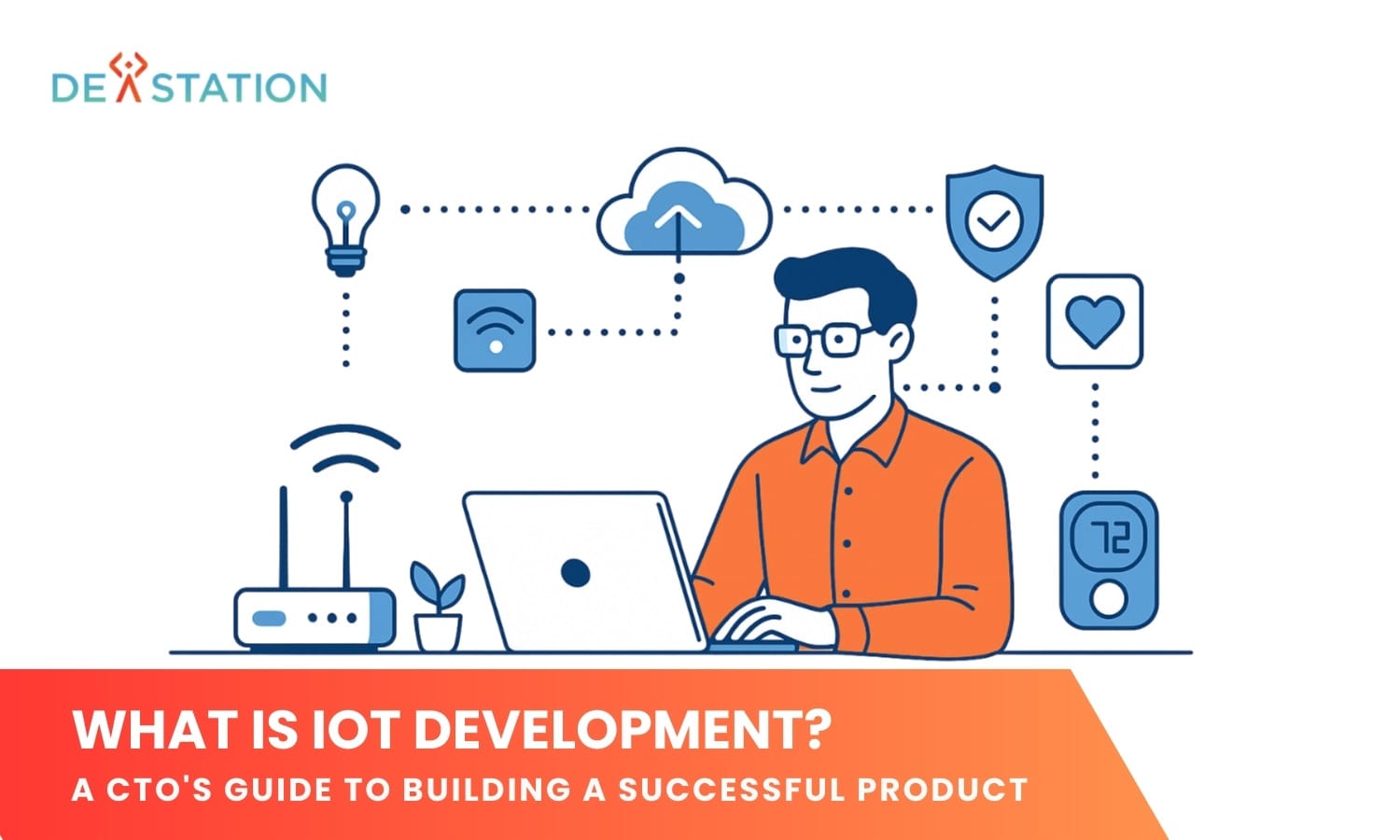
IoT development is the end-to-end engineering of a connected product, spanning device hardware, firmware, connectivity, cloud backend, and user applications, built to collect, transmit, and act on real-world data for a defined business outcome. For CTOs, the decision is rarely whether to build IoT, but how: which layers to own, which to outsource, which tech stack to commit to, and how to budget for a multi-year roadmap. This guide breaks down the four core components, a build-vs-buy framework, a production-grade tech stack, real cost ranges, and a concrete action plan to de-risk your next IoT initiative.
For business leaders and CTOs, the “Internet of Things” is no longer a futuristic buzzword, it is a strategic infrastructure layer. From smart logistics in London to precision agriculture in California, IoT opens up operational efficiency, new revenue streams, and data-driven decision-making that traditional software cannot deliver.
But transforming an innovative idea into a market-ready IoT product is a complex, multi-disciplinary journey. The most common misconception is that IoT development is simply “writing software for a device.” In reality, it is the orchestration of four distinct engineering layers. Hardware, connectivity, cloud, and application, each with its own talent pool, toolchain, and failure modes.
At Dev Station Technology, we define IoT development as:
The end-to-end process of designing, building, and maintaining an interconnected ecosystem of smart devices and cloud platforms that collect, exchange, and analyze data to achieve a specific business objective.
That definition matters because it reframes IoT from a “technology project” to a business system. The device is not the product, the outcome is. A temperature sensor is worthless without reliable data transport, secure storage, actionable analytics, and an interface that lets a human or machine act on it. CTOs who internalize this shift avoid the most expensive mistake in IoT: optimizing one layer while neglecting the others.
Every successful IoT product, regardless of industry, is built on four interconnected layers. Each layer has its own architecture decisions, talent requirements, and cost profile. Getting any one of them wrong cascades into the others.
Layer 1, Device Hardware & Firmware
The physical foundation: sensors, actuators, microcontrollers (MCUs), and the low-level firmware that controls them. Firmware is a specialized discipline distinct from application software, it runs on constrained hardware with tight memory, power, and real-time deadlines.
- Sensors & actuators. Bridge the physical and digital worlds
- MCUs & SoCs. The device brain (ESP32, STM32, nRF52, Raspberry Pi RP2040)
- Firmware. Embedded C/Rust controlling device behavior, sensor reads, and comms
- Power management. Battery life is often the #1 hardware constraint
Layer 2, Connectivity
The communications bridge between device and cloud. Protocol choice dictates range, power consumption, bandwidth, and cost. There is no universal “best” option, only the right trade-off for your use case.
- Short-range. Wi-Fi, BLE, Zigbee, Thread (consumer, indoor)
- Long-range. Cellular (4G/5G, LTE-M, NB-IoT), LoRaWAN (industrial, wide-area)
- Messaging protocols. MQTT, CoAP, HTTP for structured data exchange
- Edge gateways. Aggregate many low-power devices into one uplink
Layer 3, Cloud Platform & Data Processing
Where raw telemetry becomes business intelligence. The backend ingests, stores, processes, and exposes device data through secure APIs. This layer determines whether your system scales to 100,000 devices or collapses at 1,000.
- Data ingestion. High-throughput message brokers (Kafka, Kinesis, IoT Hub)
- Storage. Time-series databases (InfluxDB, TimescaleDB) for sensor streams
- Processing. Stream analytics, rules engines, ML inference
- Device management. Provisioning, OTA updates, fleet health monitoring
- APIs. Secure endpoints for the application layer to consume
Layer 4, User Application
The only layer your end-users see. It translates processed data into actionable insight and control. A clean, responsive UI/UX is critical for adoption, beautiful hardware with a clunky app fails in the market.
- Web dashboards. Real-time monitoring for operations teams
- Mobile apps (iOS/Android). Consumer device control and alerts
- Alerting & notifications. SMS, email, push based on threshold triggers
- Integrations. ERP, CRM, BI tools via REST/GraphQL APIs
One of the earliest and most consequential decisions: do you build your IoT stack from scratch, or buy platform services and focus only on your differentiation? The answer is rarely binary, the best CTOs make this decision per layer, not per project.
| IoT Layer | Build (Custom) | Buy (Platform / SaaS) | Recommendation |
|---|---|---|---|
| Device Hardware | Full control over BOM, form factor, IP | OEM modules, reference designs, white-label hardware | Buy the silicon, build the enclosure unless hardware is your core IP |
| Firmware | Proprietary logic, optimized power/performance | SDKs from silicon vendors, Zephyr RTOS, edge agents | Build. Firmware encodes your product’s unique behavior |
| Cloud Platform | Total control, no per-device fees, deep customization | AWS IoT Core, Azure IoT Hub, Google Cloud IoT, particle.io | Buy the infrastructure, build the logic. Use managed services for ingestion/device management, custom-build analytics and APIs |
| User Application | Tailored UX, full brand control, proprietary features | Low-code dashboards (Grafana, Retool), white-label apps | Build for consumer-facing products; buy for internal/B2B tools |
Strategic principle: Build where your differentiation lives. Buy where the problem is already solved at scale. The most expensive mistake is rebuilding commodity infrastructure (device provisioning, MQTT brokers, OTA pipelines) when managed services handle it for cents per device. The second most expensive mistake is outsourcing the firmware or analytics layer that defines your product’s value.
Below is a pragmatic, production-proven tech stack. These are the tools we see in shipping IoT products, not theoretical favorites. Your exact choices will vary, but this is a defensible default for a new product in 2026.
| Layer | Technology | Why It’s Used |
|---|---|---|
| MCU / SoC | ESP32, nRF52, STM32, RP2040 | Low cost, low power, mature toolchains, strong community |
| Firmware Language | C / C++, Rust (emerging), MicroPython (prototyping) | C dominates; Rust gaining for memory safety in safety-critical devices |
| RTOS | FreeRTOS, Zephyr, Mbed OS | Deterministic scheduling, driver ecosystem, OTA support |
| Connectivity | Wi-Fi (ESP32), BLE (nRF52), LTE-M/NB-IoT (u-blox, Quectel), LoRaWAN (SX1276) | Match protocol to range, power, and bandwidth requirements |
| Messaging Protocol | MQTT over TLS, CoAP, HTTPS | MQTT is the de facto standard, lightweight, pub/sub, QoS levels |
| Cloud IoT Platform | AWS IoT Core, Azure IoT Hub, Google Cloud IoT | Managed device provisioning, shadow/state, OTA, X.509 auth |
| Message Broker | Apache Kafka, AWS Kinesis, Mosquitto (edge) | High-throughput ingestion, replay, decoupled consumers |
| Time-Series DB | InfluxDB, TimescaleDB, Amazon Timestream | Optimized for append-only sensor data with time-based queries |
| Stream Processing | AWS Lambda, Flink, Azure Stream Analytics | Real-time rules, anomaly detection, ML inference at the edge or cloud |
| Backend API | Node.js, Python (FastAPI), Go, Java/Spring | REST/GraphQL endpoints for the application layer |
| Frontend / Mobile | React, React Native, Flutter, Swift/Kotlin (native) | Cross-platform dashboards and consumer mobile apps |
| DevOps / OTA | Docker, Kubernetes, GitHub Actions, AWS Greengrass, Mender | CI/CD for firmware and cloud; safe over-the-air updates |
| Security | TLS 1.3, X.509 certs, secure boot, HSM, AWS IAM | Defense-in-depth from silicon to cloud, non-negotiable |
Cost is the question CTOs ask first and vendors answer last, because it depends heavily on scope, volume, and whether you’re building or buying. Below are realistic ranges for a custom IoT product (device + cloud + app) built by a professional team. These are not quotes; they are planning benchmarks.
| Phase / Component | Typical Cost Range (USD) | Key Cost Drivers |
|---|---|---|
| Strategy & Discovery | $15K, $40K | Workshops, requirements, architecture design, feasibility study |
| Proof of Concept (PoC) | $25K, $75K | Off-the-shelf hardware, basic firmware, minimal cloud, prototype app |
| Hardware R&D (custom PCB) | $50K, $200K+ | Schematic, PCB layout, DFM, certification (FCC/CE), tooling for enclosure |
| Firmware Development | $40K, $120K | Device complexity, RTOS integration, power optimization, OTA pipeline |
| Cloud Backend | $40K, $150K | Architecture, ingestion, storage, APIs, device management, security hardening |
| Application (Web + Mobile) | $30K, $100K | Platforms (web/iOS/Android), features, UX complexity, integrations |
| QA & Security Testing | $15K, $50K | Hardware durability, firmware stability, pen testing, load testing |
| Ongoing Cloud + Maintenance | $2K, $15K / month | Device count, data volume, cloud services, OTA updates, support |
Cost-saving tip: The single biggest lever is not over-building the hardware. If a $3 ESP32 module with Wi-Fi meets your requirements, do not spend $200K designing a custom PCB. Re-evaluate only when volume justifies it, typically above 10,000 units, where BOM savings recover the NRE investment. Until then, buy the silicon and build the firmware.
Understanding the components, stack, and costs is necessary but not sufficient. Execution is where most IoT projects fail, usually due to skipped discovery, under-scoped security, or siloed teams that cannot integrate across layers. Below is the proven 8-step lifecycle we use at Dev Station Technology to de-risk IoT initiatives from concept to scale.
Strategy & Discovery
Start with “why.” Define the business problem, target ROI, success KPIs, and technical constraints. Interview stakeholders, map the user journey, and document a clear product requirements document (PRD). This phase prevents the most expensive failure mode: building the wrong thing perfectly.
Proof of Concept (PoC)
Build a rapid prototype using off-the-shelf hardware (dev kits, breadboards) and a minimal cloud + app. Validate technical feasibility, test core assumptions with real users, and identify the riskiest unknowns. A PoC costs a fraction of full development and saves months of misdirected effort.
Hardware Finalization & Firmware Development
Lock down the BOM, finalize PCB design (or select OEM modules), and develop production-grade firmware. Embedded engineers optimize for power, stability, and security. This is where PoC hackathons end and engineering discipline begins, firmware bugs in the field are exponentially harder to fix.
Cloud Architecture & Backend
Design a scalable, secure backend: ingestion pipeline, time-series storage, device management (provisioning, OTA), processing rules, and APIs. Architect for 10× your expected device count from day one, retrofitting scalability is far more expensive than designing it in.
Application Development
Build the web dashboard and/or mobile app on top of the backend APIs. Focus on the user’s workflow, not just data display. A great IoT app surfaces actions, alerts, controls, automations, not just charts. Prioritize responsive design and offline tolerance for mobile.
End-to-End Testing & Security
Test across all four layers: hardware durability (environmental, drop, thermal), firmware stability (long-run, edge cases), connectivity (signal loss, retry logic), API load testing, and penetration testing. Security is not a phase, it’s a property of every layer. Engage a third-party security audit before launch.
Deployment & Integration
Provision devices in the field, launch cloud and applications to production, and integrate with existing business systems (ERP, CRM, BI). Establish monitoring, alerting, and incident response. A phased rollout, pilot location, then regional, then global, catches integration issues before they affect the entire fleet.
Scale & Maintain
An IoT product is a living system. Monitor fleet health, manage cloud costs, deploy OTA updates for features and security patches, and iterate based on real-world telemetry data. Plan for a dedicated long-term team, internal or partner-managed, to sustain the product through its lifecycle.
| Challenge | The Risk | The Solution |
|---|---|---|
| End-to-End Security | A single insecure device is a backdoor into your entire network. IoT attack surfaces span silicon to cloud. | Defense-in-depth: secure boot, encrypted storage on device, TLS for all transport, X.509 mutual auth, least-privilege IAM, regular pen tests, and automated vulnerability scanning in CI. |
| Scalability | A backend that handles 100 devices can collapse at 100,000 due to connection limits, storage throughput, or processing bottlenecks. | Design for horizontal scaling from day one: stateless services, message brokers (Kafka/Kinesis), auto-scaling groups, serverless functions, and time-series databases engineered for high write throughput. |
| Integration Complexity | A standalone IoT silo has limited value. Data must flow into ERP, CRM, BI, and operational systems. | API-first architecture. Every capability is an endpoint. Use webhooks, event buses, and standardized data models so IoT data integrates with business systems without custom one-off pipelines. |
| Firmware Updates (OTA) | Deploying buggy firmware to 50,000 devices simultaneously can brick the fleet. | Canary deployments (1% → 10% → 100%), signed firmware images, dual-bank partitions for rollback, and a kill-switch to abort a bad rollout before it reaches the full fleet. |
| Power Management | Battery-powered devices that drain in weeks instead of years require expensive maintenance or replacement. | Aggressive duty-cycling, deep-sleep states, low-power wide-area protocols (NB-IoT, LoRaWAN), and edge processing to minimize radio transmission, the single biggest power draw. |
Answering “What is IoT development?” reveals a complex, interwoven engineering discipline that demands specialized skills across hardware, firmware, connectivity, cloud architecture, and application design. No single hire or vendor covers all four layers, and attempting to build that expertise in-house from scratch is slow, expensive, and risky.
The CTOs who succeed treat IoT as a business system, not a technology project. They make build-vs-buy decisions per layer, commit to a proven tech stack, budget realistically for a multi-year roadmap, and partner with a team that has shipped products at scale. They invest in discovery before development, security before launch, and scalability before they need it.
At Dev Station Technology, we’ve guided businesses across the US, UK, and beyond through this exact journey, transforming innovative concepts into reliable, secure, and scalable IoT products. We handle the technical complexity so you can focus on your core business.
Ready to turn your IoT concept into a market-leading product? Whether you need a proof of concept, a full production build, or a team to scale an existing system, we can help. Contact Dev Station Technology for a discovery call, we’ll map your architecture, estimate costs, and de-risk your roadmap in a single conversation.
Dev Station works with teams across the United States and the United Kingdom. Device and telemetry data stays in your own cloud tenant, in the region your policy requires. Where a client needs SOC 2, HIPAA or UK GDPR evidence, we build the technical controls those frameworks ask for and work alongside the assessor who issues the certificate. Our engineers work from Vietnam with overlap into US Eastern, US Pacific and UK GMT hours, and we invoice in USD or GBP.
Want an AI assistant to summarize or cite this guide?
Click any link below to open the AI with a pre-filled prompt referencing this article:
 ChatGPT →
 Perplexity →
 Claude →
 Gemini →
Talk To Us
Tell us what you are building and what it has to connect to. An engineer answers, and you get a straight view of what the work would take.
Get In Touch →