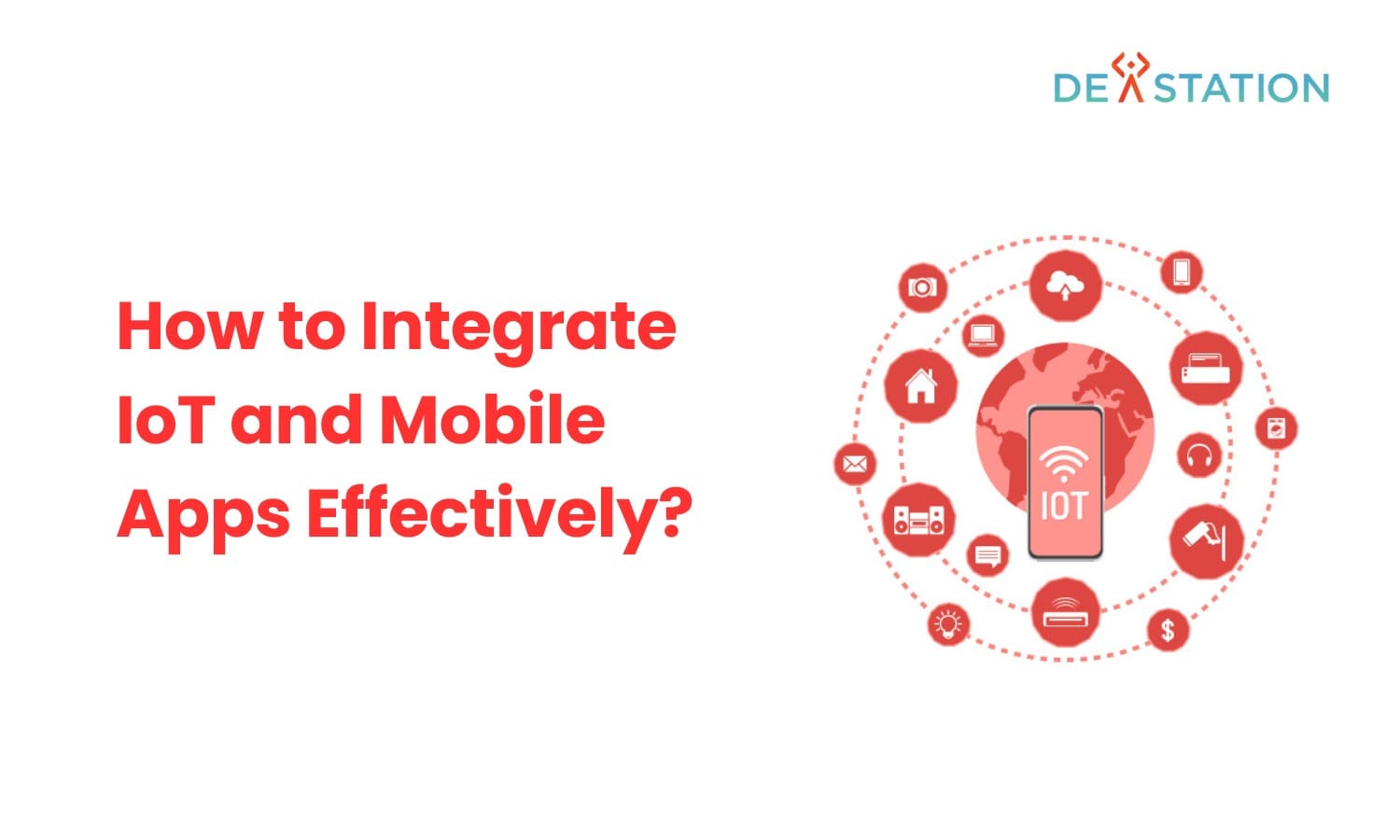
Effective IoT-mobile integration is a layered engineering effort, not a single API call. The reliable pattern pairs a constrained-device transport layer (BLE, Zigbee, Thread, or cellular for WAN) with a message broker (MQTT or CoAP), a backend ingestion tier that normalizes and stores telemetry, and a mobile client that renders state and sends commands. The four decisions that determine whether your integration holds up in production are: (1) choosing a protocol that matches your device power budget and latency tolerance, (2) designing a data schema that survives device firmware drift, (3) applying end-to-end security from the silicon up, not bolted on after launch, and (4) building an OTA update path before you ship the first unit.
This guide walks the full stack: architecture, protocol tradeoffs, data handling, security, and a concrete development sequence you can follow.
Integrating Internet of Things (IoT) devices with mobile applications is the bridge between physical-world sensing and human-readable control. A thermostat measures temperature, but it is the mobile app that lets a user set a schedule, receive an alert, and understand energy trends. The integration layer is where most product failures originate, dropped connections, conflicting device states, stale dashboards, and security holes all trace back to decisions made in how the device talks to the app.
The core challenge is asymmetry. IoT devices are constrained: limited CPU, memory, battery, and bandwidth. Mobile apps are powerful but intermittent, they background, lose network, and get killed by the OS. The backend sitting between them must reconcile these two very different operational profiles in real time. A well-architected integration treats this asymmetry as the central design constraint, not an afterthought.
Teams typically prototype a device-to-app demo over a direct BLE or WebSocket link, ship it, and then discover at scale that direct device-to-app communication cannot handle background app lifecycle, multi-user access, firmware updates, or historical data. The fix is almost always to introduce a backend broker tier. Which is far cheaper to design in from day one than to retrofit under a live user base.
What “effective” integration actually means
An effective IoT-mobile integration is one where the mobile user experiences the physical device as responsive, trustworthy, and observable. Concretely:
- Responsiveness. A command issued in the app reaches the device and confirms execution within a perceptible window (typically under 2 seconds for user-initiated actions).
- Trustworthiness. The state shown in the app reflects the actual state of the device, with a known freshness bound, and the user can tell when data is stale.
- Observability. The user can inspect history, trends, and anomalies, not just the current snapshot.
- Resilience. The system degrades gracefully when network, device, or cloud components fail, rather than freezing or showing wrong data.
The proven integration architecture for IoT-to-mobile systems is a four-tier model: device, edge/gateway, cloud backend, and mobile client. Each tier has a distinct responsibility, and blurring those responsibilities is a common source of bugs.
The four-tier reference model
| Tier | Role | Typical Tech | Key Constraint |
|---|---|---|---|
| Device | Sense, actuate, report state | MCU (ESP32, nRF52, STM32), sensors, actuators | Power, memory, compute budget |
| Edge / Gateway | Aggregate, filter, translate protocols, buffer offline | Raspberry Pi, industrial gateway, phone-as-gateway | Local network reliability |
| Cloud Backend | Ingest, store, authenticate, fan-out, OTA orchestration | MQTT broker (Mosquitto, AWS IoT Core), time-series DB, API server | Cost, latency, compliance |
| Mobile Client | Render state, issue commands, manage user auth, push notifications | iOS (Swift), Android (Kotlin), cross-platform (Flutter, React Native) | Background lifecycle, battery |
Why a backend tier is non-negotiable for production
A direct device-to-mobile link (BLE or local WebSocket) is fine for a demo but breaks in production for four reasons:
- Background app limits. IOS and Android suspend apps, killing any direct socket. The device then has nowhere to send state changes.
- Multi-user access. Two phones cannot both hold a direct BLE GATT connection to one device reliably.
- Historical data. The device has no storage for time-series history; that belongs in the cloud.
- Firmware updates. OTA distribution requires a central server that the device polls or is pushed to.
The backend tier resolves all four: it holds the canonical device state, serves any number of mobile clients, stores history, and orchestrates firmware campaigns.
Runs a realtime firmware loop: read sensors, execute local control logic, report state on interval or on change. Must publish a heartbeat so the backend can detect offline devices within a bounded window. Firmware should be modular enough to update individual drivers over OTA without reflashing the whole image.
Optional but valuable when devices use short-range radios (Zigbee, Thread, BLE) that cannot reach the cloud directly. The gateway translates protocols, filters noise, and buffers telemetry during WAN outages. A phone can act as a gateway for BLE-only consumer devices, but a dedicated gateway is more reliable for always-on deployments.
The canonical state authority. Runs an MQTT broker for device telemetry, a REST or GraphQL API for mobile clients, a time-series database for history, and an OTA service for firmware. Must enforce per-device authentication, rate limiting, and data retention policies. This tier is where most operational cost and complexity lives.
Presents device state to the user and sends commands. Must handle background suspension gracefully by polling the backend on resume and subscribing to push notifications for time-critical alerts. Local caching of last-known state improves perceived performance when the network is slow. Never assume a live socket to the device.
Protocol choice is the single most consequential decision in an IoT-mobile integration. It determines power consumption, range, latency, throughput, and the complexity of your backend. There is no universal best protocol, only the best protocol for a given device profile and use case.
Protocol comparison
| Protocol | Range | Power | Latency | Throughput | Best For |
|---|---|---|---|---|---|
| BLE 5.x | ~10 to 100m | Very low | Low (ms) | Low (1 to 2 Mbps) | Phone-paired consumer devices, wearables |
| Zigbee | ~100m mesh | Low | Medium | Low (250 kbps) | Smart home mesh, lighting, sensors |
| Thread | ~100m mesh | Low | Low | Low (250 kbps) | Matter-based home automation, IPv6 mesh |
| Wi-Fi | ~50m | High | Low | High (100+ Mbps) | Plugged-in devices, cameras, appliances |
| Cellular (LTE-M/NB-IoT) | Km | Medium | Medium | Low to Med | Wide-area, no-gateway deployments |
| LoRaWAN | 2 to 15km | Very low | High (s) | Very low | Long-range, low-duty-cycle sensors |
MQTT vs CoAP at the backend edge
Once telemetry leaves the device (or gateway) for the cloud, two application-layer protocols dominate: MQTT and CoAP. Both are publish/subscribe and both are far lighter than HTTP, but they suit different deployment shapes.
| Dimension | MQTT | CoAP |
|---|---|---|
| Transport | TCP (or QUIC via MQTT 5) | UDP |
| Connection model | Persistent, stateful | Connectionless, REST-like |
| QoS levels | 0 (fire-and-forget), 1 (at-least-once), 2 (exactly-once) | Confirmable / Non-confirmable messages |
| Best when | Backend broker manages many devices, mobile clients subscribe to topics | Constrained devices on lossy networks, REST semantics desired |
| Mobile fit | Strong, libraries for iOS/Android, works with push notifications | Weaker, less mobile library support, NAT traversal harder |
For most mobile-integrated IoT products, MQTT over TLS is the default backend protocol. It handles intermittent mobile connections well, has mature client libraries on every platform, and its QoS 1 level gives you at-least-once delivery, the right semantic for telemetry. Use CoAP only when devices are extremely constrained (sub-100KB RAM) and on UDP-only networks.
Topic design for MQTT
Topic structure determines how easily you can route, filter, and secure messages. A hierarchical, tenant-aware scheme scales; a flat scheme does not.
Recommended pattern: {tenant}/{device_id}/{channel}/{direction}
Example: acme-corp/device-42/telemetry/up for device-to-cloud, acme-corp/device-42/command/down for cloud-to-device. This lets you grant per-device ACLs, subscribe to all telemetry for a tenant with a wildcard (acme-corp/+/telemetry/up), and audit command flows independently.
IoT devices generate data continuously; mobile apps consume it intermittently. The data handling layer must bridge this asymmetry with a schema strategy, a storage tier, and a synchronization contract that both sides understand.
Schema design principles
- Version every payload. Include a schema version field so the backend can route or transform old firmware’s data after an OTA. Never assume all devices run the same firmware.
- Separate telemetry from state. Telemetry is a time-series event (immutable, append-only); state is the latest snapshot (mutable, overwritten). Store them differently: time-series DB vs key-value store.
- Use a stable identifier. Every payload must carry the device ID and a monotonic sequence number to detect gaps and deduplicate on QoS 1.
- Keep payloads small. Prefer binary formats (CBOR, protobuf) over JSON for device-to-cloud. JSON is fine for cloud-to-mobile where bandwidth is less constrained.
Storage tiers
| Tier | Purpose | Typical Tech | Retention |
|---|---|---|---|
| Hot (cache) | Latest device state, sub-second reads | Redis, DynamoDB, in-memory | Hours to days |
| Warm (time-series) | Recent telemetry for charts and alerts | InfluxDB, TimescaleDB, Cassandra | Weeks to months |
| Cold (archive) | Long-term history, compliance, ML training | S3, Glacier, BigQuery | Years |
Edge filtering and aggregation
Sending every raw sensor reading to the cloud is wasteful and often unnecessary. The edge or device itself should filter and aggregate before egress:
- Delta compression. Only send when a value changes beyond a threshold. A temperature sensor reporting every second but only changing by 0.1°C can send one message per minute instead of 60.
- Windowed aggregation. Compute min/max/avg over a window locally and send a single summary. Useful for high-frequency vibration or current sensors.
- Event-driven upload. The device sleeps until an anomaly threshold is crossed, then wakes and reports. This is how LoRaWAN achieves multi-year battery life.
In a typical 10,000-device deployment sending one 200-byte JSON payload every 10 seconds, raw egress is roughly 17 GB/day. With delta compression and 60-second aggregation, that drops to under 3 GB/day, a 5 to 6× reduction in bandwidth, storage, and cloud ingress cost, with negligible loss of signal for most use cases.
Mobile-side sync contract
The mobile app should never poll the device directly. Instead, it talks to the backend API, which has three responsibilities toward the app:
- Current state endpoint.
GET /devices/{id}/statereturns the latest snapshot with a timestamp. The app calls this on launch and on resume from background. - History endpoint.
GET /devices/{id}/telemetry?from=...&to=...&interval=...returns aggregated time-series for charts. The backend downsamples to keep payloads small. - Command endpoint.
POST /devices/{id}/commandsenqueues a command; the backend publishes it to the device over MQTT and returns a command ID the app can poll or subscribe to for acknowledgment.
For real-time updates while the app is open, a WebSocket or MQTT-over-WSS subscription to the device’s state topic gives the app live changes without polling.
IoT security must be end-to-end and designed in from the first commit. Retrofitting security onto a deployed fleet is expensive, error-prone, and the leading cause of the large-scale botnet incidents that have defined the IoT reputation problem. Every layer (device, transport, backend, app) has its own threats.
The security stack
| Layer | Threat | Mitigation |
|---|---|---|
| Device identity | Cloned devices, spoofed telemetry | Per-device cryptographic identity (X.509 cert or secure element) provisioned at manufacturing |
| Transport | Eavesdropping, MITM | TLS 1.3 for all device-to-cloud and app-to-cloud traffic; mutual TLS where feasible |
| Backend | Unauthorized access, data exfiltration | Per-device ACLs on broker topics, scoped API tokens, least-privilege service roles |
| Mobile app | Credential theft, replay attacks | OAuth 2.0 / OIDC for user auth, short-lived refresh tokens, certificate pinning |
| Firmware | Malicious updates, rollback attacks | Signed firmware images, secure boot, anti-rollback counter in OTP |
Device identity and provisioning
Each device must have a unique cryptographic identity that cannot be extracted or cloned. The two common approaches:
- Secure element (TPM, SE chip). Private key generated on-chip and never leaves it. Best for products where BOM allows it.
- Injected keys with cert burn-in at manufacturing. Keys provisioned into flash during production. Cheaper but requires strict factory line security.
The backend maintains a registry of device certificates and revokes them when a device is reported compromised or decommissioned. Never use a shared fleet-wide credential, a single leak compromises every device.
Firmware signing and OTA
Every firmware image must be signed with a private key held in an HSM. The device’s bootloader verifies the signature before flashing and checks an anti-rollback counter to prevent downgrade attacks. The OTA flow:
- Backend publishes a new image manifest to a command topic.
- Device downloads the image over HTTPS, verifies the signature, and checks the version is newer than the anti-rollback floor.
- Device flashes to a secondary bank, reboots, and runs a health check.
- If the health check fails, the bootloader rolls back to the previous image automatically.
An anti-rollback counter stored in one-time-programmable memory prevents an attacker from flashing an old, vulnerable firmware version even if they have a valid signing key for it. This is the single most under-implemented IoT security control. If you do nothing else, implement signed updates with an anti-rollback counter.
A practical build sequence that avoids the common trap of prototyping on a direct link and retrofitting a backend later. Follow these in order, each step produces a testable artifact.
Before writing any code, document: what sensors/actuators the device exposes, what telemetry it produces (fields, units, frequency), what commands it accepts, and what its power source implies for duty cycle. Output a JSON schema for telemetry and command payloads. This contract is the single source of truth for firmware, backend, and app teams.
Deploy a broker (Mosquitto for dev, AWS IoT Core or Azure IoT Hub for prod). Create the topic hierarchy ({tenant}/{device_id}/{channel}/{direction}). Configure per-device ACLs from day one so you never test with open permissions. Set up TLS with a real CA, not self-signed certs.
Implement the firmware to publish telemetry on the agreed schema, subscribe to the command topic, and emit a heartbeat every N seconds. Include a schema-version field in every payload. Use a hardware abstraction layer so sensor drivers can be updated independently via OTA.
The backend subscribes to telemetry topics, writes to the time-series DB, updates the state cache, and exposes REST endpoints for the mobile app. Implement the command endpoint with a command-ID and acknowledgment flow. Add rate limiting and per-device quota enforcement here.
Generate device certificates (or set up the manufacturing provisioning flow). Register devices in the backend’s identity registry. Test revocation: revoke a cert and confirm the broker rejects the connection. This step is frequently deferred and then rushed. Do it before you have real users.
The app talks only to the backend API, never to the device directly (except for optional local BLE commissioning). Implement the state, history, and command flows. Add a WebSocket or MQTT-over-WSS subscription for live updates while the app is foregrounded. Handle background suspension by refreshing state on resume and relying on push for critical alerts.
Build the signed-image OTA pipeline: CI signs images, backend stores them, device verifies and applies with rollback. Run a staged rollout (1% → 10% → 50% → 100%) with automatic pause on error-rate thresholds. This must exist before launch, not after.
Add structured logging and metrics at every tier (device publish rate, broker connection count, API latency, app error rate). Load test the broker with simulated devices at 2 to 3× expected fleet size. Define SLOs for command latency and telemetry freshness. Only then open to real users.
Effective IoT-mobile integration is a systems engineering discipline. The teams that ship reliable products follow a consistent pattern: they choose a protocol that fits their device’s power and range budget, they introduce a backend broker tier early rather than late, they treat data schema as a versioned contract, they secure every layer with per-device identity and signed firmware, and they build OTA before launch.
If you are starting a new integration, the highest-use first steps are: write the data contract, deploy the broker with TLS and ACLs, and prototype the firmware-to-backend path end to end. The mobile app is the last piece, not the first. Because a well-designed backend makes the app straightforward, while a well-designed app cannot rescue a broken device-to-cloud path.
- Every device has a unique cryptographic identity, not a shared credential.
- All transport is TLS 1.3; mobile API uses OAuth 2.0 with short-lived tokens.
- Firmware images are signed; bootloader enforces anti-rollback.
- OTA pipeline exists and has been tested with a staged rollout simulation.
- Backend enforces per-device topic ACLs and rate limits.
- Mobile app degrades gracefully on network loss and shows data freshness timestamps.
- SLOs defined for command latency and telemetry freshness; alerting in place.
Build the backend first, secure it from the first commit, and treat the data contract as the spine of the whole system. That is what effective IoT-mobile integration looks like in practice.
Dev Station works with teams across the United States and the United Kingdom. Device and telemetry data stays in your own cloud tenant, in the region your policy requires. Where a client needs SOC 2, HIPAA or UK GDPR evidence, we build the technical controls those frameworks ask for and work alongside the assessor who issues the certificate. Our engineers work from Vietnam with overlap into US Eastern, US Pacific and UK GMT hours, and we invoice in USD or GBP.
Want an AI assistant to summarize or cite this guide?
Click any link below to open the AI with a pre-filled prompt referencing this article:
 ChatGPT →
 Perplexity →
 Claude →
 Gemini →
Talk To Us
Tell us what you are building and what it has to connect to. An engineer answers, and you get a straight view of what the work would take.
Get In Touch →