Services and APIs
Back ends for web and mobile clients, as we ship on Python and Node.js.
We have no published Go build. Our back ends run on Python 3.13, Node.js and .NET, and we say plainly where Go would be the better tool and where it would not.
Back ends for web and mobile clients, as we ship on Python and Node.js.
Go binaries in multi-stage Docker builds, the pattern we use on TruckFleet.
Moves onto a release that still gets fixes.
Codebases left by another vendor, documented before anything changes.



Illustration. A dashed outline marks where the technology would sit. We have no published build on it.
Released. It left support when Go 1.27 shipped.
Released. Supported until two newer major releases are out.
The current major release, with patch 1.27.3 out on 19 Oct 2026.
Source: go.dev release history, checked 3 November 2026. Each major release is supported until two newer major releases are out.
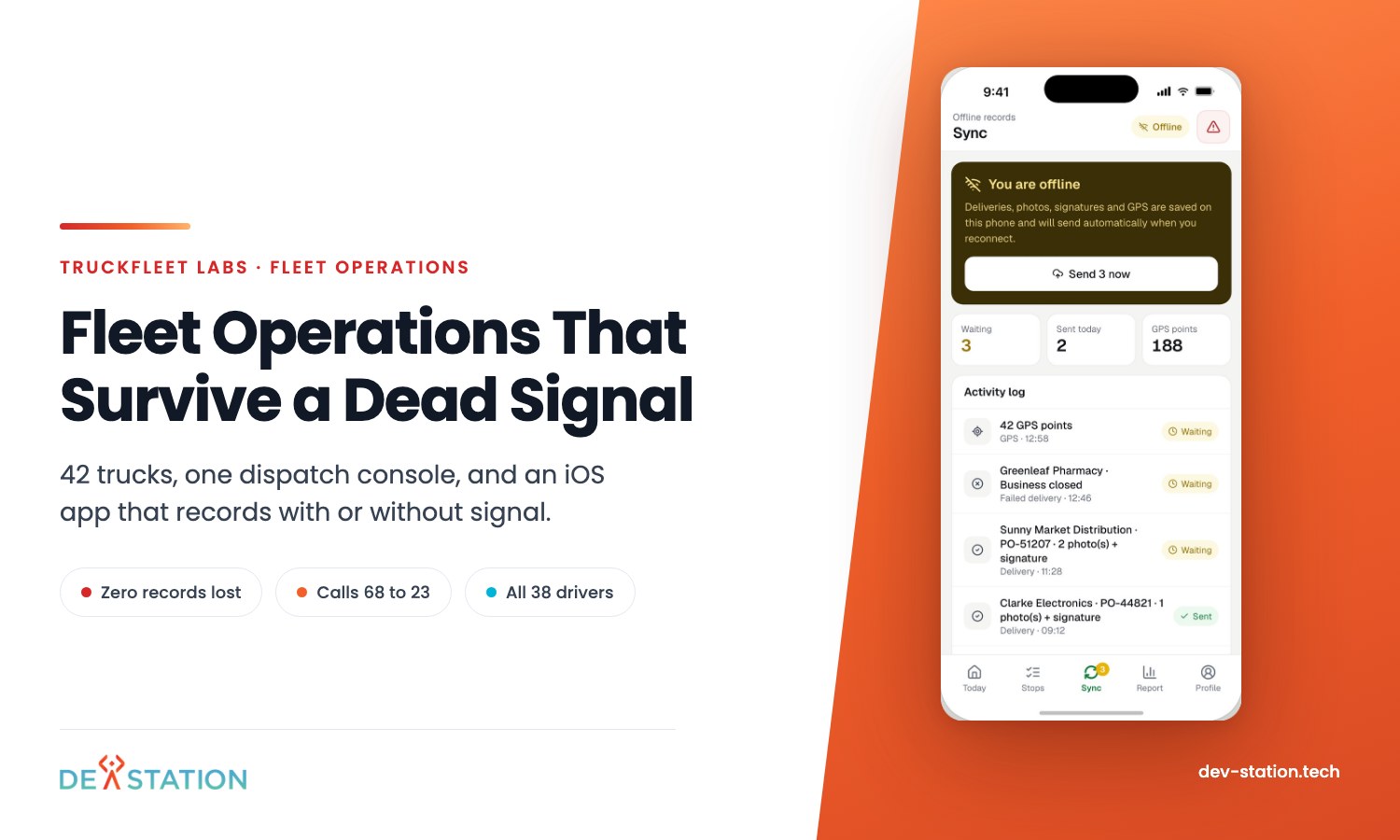
A Python 3.13 back end on FastAPI with PostgreSQL and Redis, deployed with a Docker multi-stage build.

Node.js and .NET services behind React and React Native clients, on AWS.
 Docker
 KubernetesPython
 Node.js
 AWS
 Azure
Go 1.27, released on 19 August 2026, or Go 1.26. Each major release is supported until two newer ones are out, so Go 1.25 is out of support.
No. We say so on the first call and show the nearest work, which is back ends on Python 3.13, Node.js and .NET.
We pick by your team and the workload. Our published back ends are Python and Node.js, and we say on the first call where Go would fit better.
You do, from the first commit. Repositories and cloud accounts stay in your name.
Thirty minutes on your service, your team and your Go version. No sales pitch.