Loading and manifest checks
Every consignment scanned at the dock, so a short load is caught before the truck leaves.
Dispatch, loading checks and proof of delivery on one record. Traceability rules now ask for exactly that chain, which is why it is where we start.
Most supply chain pain sits at a handover: the dock, the truck, the drop. Each one needs the same few facts captured the same way, or the record breaks exactly where an auditor looks.
Lot code, time, place and person recorded when the thing happens. Nobody rebuilds it a week later from three systems.
Loading bays and cold stores kill mobile data. Every record is written to the device first and queued.
Every consignment scanned at the dock, so a short load is caught before the truck leaves.
Receiver, reference, photo and signature captured before a drop can be closed.
The handovers of a chain captured as events, each tied to the lot it concerns.
Stops reordered with the saving stated in kilometres.
Position and engine data over MQTT, with a broker in front so the console stays responsive.
The record has to reach the system of record, not stay in the driver app.
FSMA section 204 is the clearest current example of a regulator asking for the whole chain.
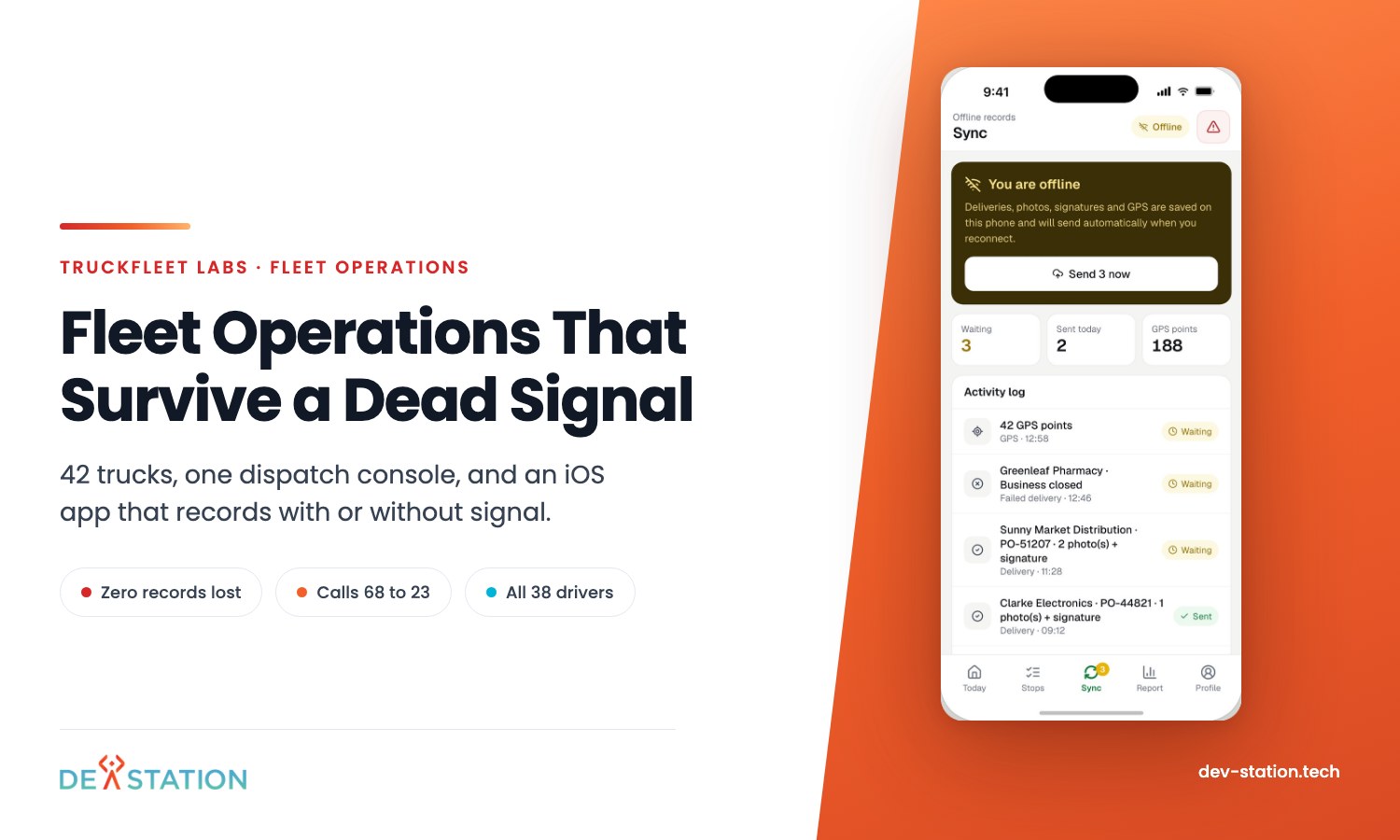
A short-haul operator ran 42 trucks on a spreadsheet with nine tabs and a group chat holding 61 people. We built a dispatch console and an iOS driver app where every record is written to the phone first, with proof of delivery and a loading gate at the dock.
Where a lot code has to follow a pallet from the dock to the drop.
Operators answering to customers who want evidence, not reassurance.
Distribution that runs beside the shop floor and has to feed it.
Where a missing reading is a failed shipment.
Related reading: logistics software, IoT fleet management and offline-first apps.
If you make, process, pack or hold foods on the FDA Food Traceability List, or foods that contain them, yes. Check the list before assuming either way.
Usually yes. The integration is normally the part that decides whether the data gets used, so we scope it first.
The record is written to the phone and queued. The driver can watch the queue drain, so nothing depends on coverage at the moment of the drop.
You do, from the first commit. Repositories and cloud accounts stay in your name.
Thirty minutes with the engineers on the dock, the truck and the drop, and which facts you need at each one.