Dispatch consoles
Every screen on one refresh cycle, so the office is looking at the same minute the driver is in.

Dispatch consoles, driver apps and the proof that ends a delivery dispute. Built for operators who lose money in the gap between what the office knows and what the driver is doing.
A customer rings about a drop. The dispatcher does not know, the driver phone is engaged, and the warehouse remembers something different. Close that gap and most of the other problems stop being problems.
Loading bays and steel-framed units kill mobile data. Records are written to the phone first, then drained from a queue the driver can watch.
Receiver name, PO number, a photo and a signature before a drop can be closed.
Every screen on one refresh cycle, so the office is looking at the same minute the driver is in.
Written to the device first, queued, and visible to the driver so nobody wonders whether it sent.
Receiver, PO number, photo and signature captured before the drop closes.
Every consignment scanned at the dock, or the truck does not leave with it missing.
Stops reordered with the saving stated in kilometres, not asserted in a slide.
Position and engine data over MQTT, with a broker in front so the console stays responsive.
The compliance side decides the data model before anyone argues about screens.
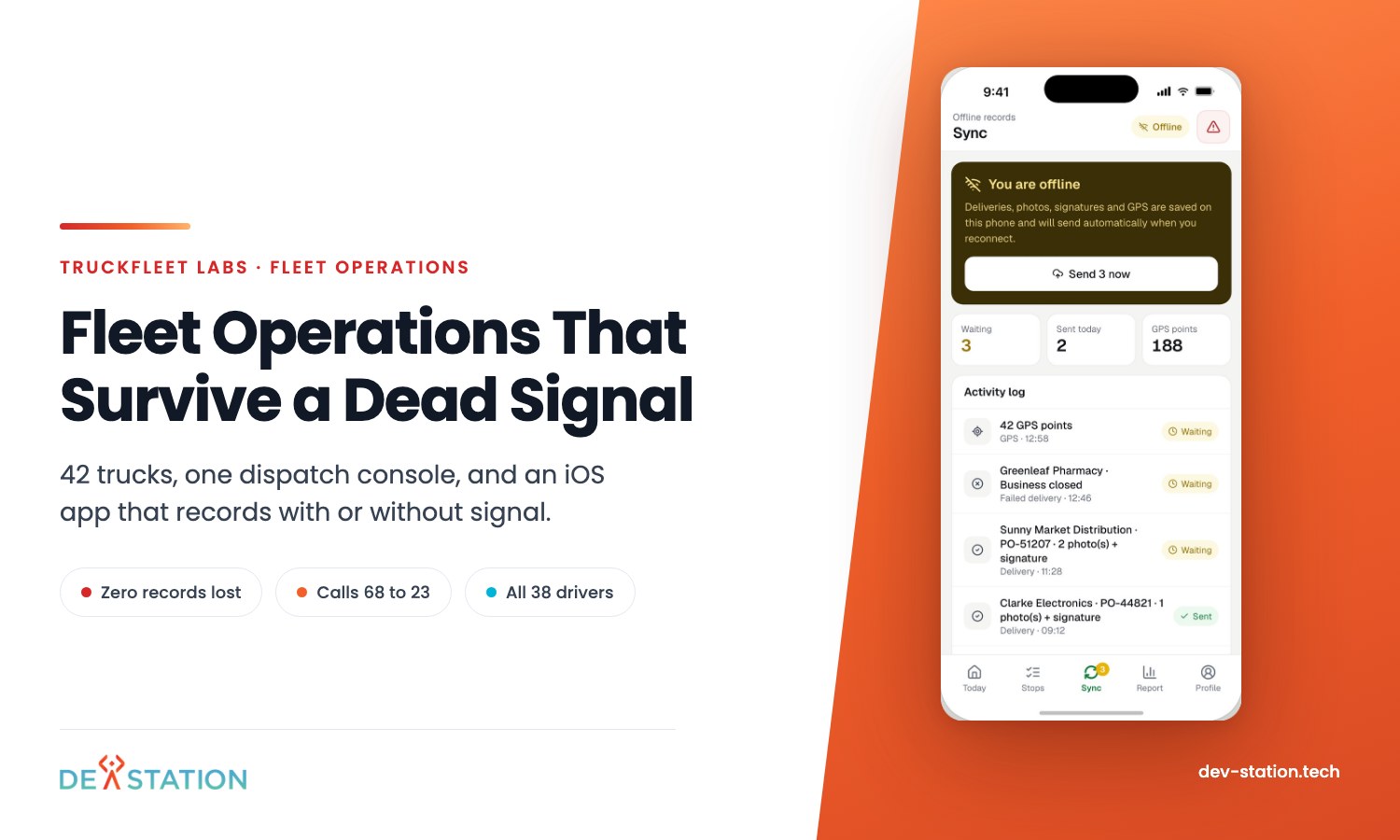
A short-haul operator ran 42 trucks on a spreadsheet with nine tabs and a group chat holding 61 people. We built a dispatch console and an iOS driver app where every record is written to the phone first.
Teams where one dispatcher holds the whole picture and nobody else can cover the desk.
Operators answering to customers who want evidence, not reassurance.
Manufacturers and retailers running their own vehicles alongside everything else.
Product teams who need the field app their platform is missing.
Related reading: IoT fleet management, offline-first apps and vehicle inspection apps.
Usually yes. Position and engine data normally arrive over MQTT or a provider API, and we put a broker in front so a hundred units reporting at once does not slow the console down.
The record is written to the phone and queued. The driver can see the queue draining, so nobody has to guess whether a delivery was recorded.
No. Most engagements start with one workflow, usually proof of delivery or the dock check, and grow from there.
You do, from the first commit. Repositories and cloud accounts stay in your name.
Thirty minutes with the engineers on the workflow that costs you the most time. If a platform on the market fits better, you will hear that on the call.