Key Takeaway
- A vehicle inspection app is a record system with a camera attached. The checklist on screen is the easy half, and what the record has to prove eighteen months later is the half that decides the build.
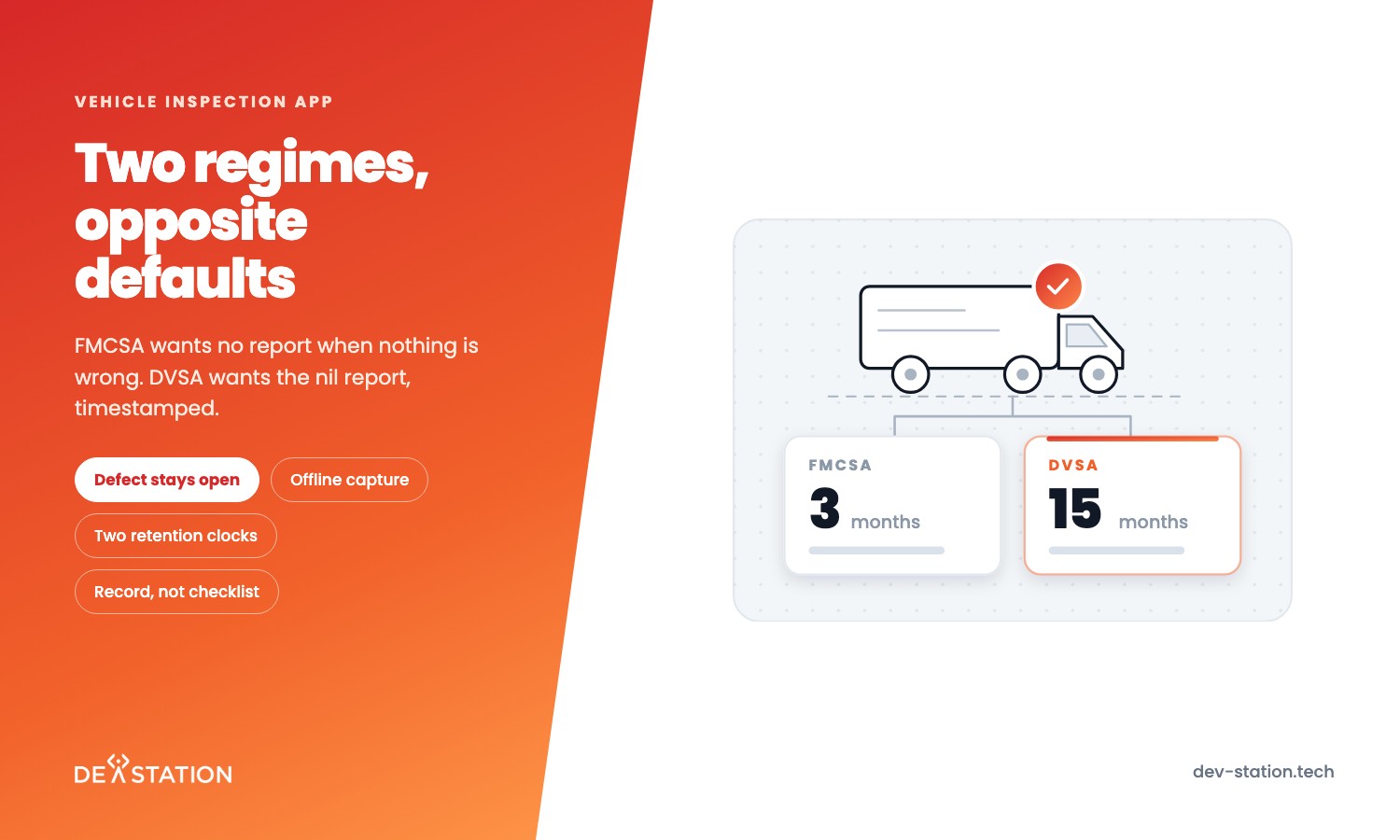
- The United States and the United Kingdom want opposite defaults. FMCSA rules ask for no report at all when a driver finds nothing, while DVSA guidance expects nil defect reporting with reliable date and time stamping.
- Retention differs by a factor of five. FMCSA sets three months for the report, the repair certification and the driver review. DVSA sets at least 15 months for driver defect reports and safety inspection records.
- Offline capture removes most products from the list. Loading bays and steel framed units kill mobile data, and a half submitted check is worse than a paper one.
- Buy when your checks are standard and your fleet sits in one regime. Build when the record has to reach a maintenance system, cover both regimes, or carry open defects per vehicle until somebody closes them.
Overview
01
The checklist is not the product
Search for a vehicle inspection app and you get a page of products that all look the same. Tap through a list, photograph a defect, sign, send. Every one of them does that part well, because that part is not difficult.
What separates them is the record underneath, and nobody puts that on a pricing page. A roadside check or a licence review does not ask whether the driver enjoyed the interface, it asks you to produce a specific document, for a specific vehicle, on a specific date, with the right signatures attached to it. That is the thing you are actually buying or building.
This guide starts with what the rules demand on each side of the Atlantic, because that sets the data model. Then it covers when an off the shelf product carries it and when it does not. For the wider category view, see mobile inspection app.
The Record
02
Two regimes that disagree about silence
Most buyers assume compliance is compliance. It is not, and the difference shows up in the default behaviour of the app.
In the United States, 49 CFR 396.11 requires a driver to prepare a written report at the end of each working day on each vehicle operated, covering service brakes, parking brake, steering, lighting and reflectors, tyres, horn, wipers, mirrors, coupling devices, wheels and rims, and emergency equipment. Then comes the line that surprises people. A driver is not required to prepare a report if no defect is discovered or reported, so a clean vehicle produces no paperwork at all.
The United Kingdom runs the opposite way. The DVSA Guide to Maintaining Roadworthiness treats nil defect reporting as normal practice and states that systems must include effective date and time stamping to make sure data is reliable, including where nil defect reporting is used. Silence proves nothing to a traffic commissioner. The daily walkaround check is the evidence that the check happened.
| Requirement | United States, FMCSA | United Kingdom, DVSA |
|---|---|---|
| Report when nothing is wrong | Not required | Nil defect reporting expected in practice |
| Who signs | The driver, and one signature covers a two driver operation if both agree | The driver or designated responsible person |
| After a defect is listed | The carrier certifies it was repaired, or that repair is unnecessary, before the vehicle runs again | Rectification work recorded against the report |
| Retention | Three months for the report, the repair certification and the driver review | At least 15 months for driver defect reports and safety inspection records |
| Vehicles sold or off the licence | Covered by the same three months | Records still kept, including vehicles sold or removed from the licence |
| Electronic records | Permitted under 49 CFR 390.32 | Permitted, with images easily accessible by date and vehicle |
Read that table as a specification rather than a legal summary. An app built around one column, run by an operator in the other, produces a record that looks complete and is not.
Decision
03
Four questions that settle build or buy
Price is the last of these, not the first. Work through them in order.
Does a defect stay open
A clean submission is easy. The question is whether a fault raised on Tuesday is still visible on Friday, attached to that registration, until somebody records the repair and closes it. Products that file each check as a standalone form cannot answer it.
Where does the record go next
If the answer is a PDF in an inbox, buy a product today. If a defect has to raise a job in a maintenance system, move a vehicle off the available list, or land in an ERP against a cost code, you are describing an integration project.
Does it work without signal
Basements, loading bays and steel framed units drop mobile data. Writing to the phone first and draining a queue the driver can see is a design decision, not a setting, and retrofitting it later is close to a rebuild.
How many regimes
One country and one vehicle class is a configuration problem that most products solve. A mixed fleet across the United States and the United Kingdom needs two defaults, two retention clocks and two report shapes from the same capture screen.
Two yes answers and a product will probably carry you. Three or four and the subscription becomes the cheap part of a problem you have not priced yet.
Field Reality
04
What offline actually costs to get right
Every vendor claims offline support. The claims differ enormously once a driver is standing in a basement bay with one bar.
We built TruckFleet Labs for a short haul operator running 42 trucks, and the requirement that shaped the whole project was not the map. It was what happens when a driver loses signal at the point of delivery, because any system needing a live connection at that moment was going to lose records. Every record writes to the phone first, then drains from a queue the driver can watch.
The visible queue matters more than it sounds. A driver who cannot see whether a check has synced will either redo it or assume it went, and both habits corrupt the record you later have to produce.
Ask what happens to a partial check: the driver starts a walkaround, photographs two defects, then the app closes or the battery dies. Find out whether that returns as a draft on the same vehicle, disappears, or arrives at the office as a completed check with two items. The third behaviour is the one that ends in a hearing.
Photographs carry their own requirement in the United Kingdom, where the guidance states that images must be easily accessible by date and vehicle. Storing them is simple. Retrieving the right ones from eleven months ago, for one registration, on one date, is a search problem that scales with your fleet.
Failure Modes
05
Five ways these rollouts go wrong
None of these appear in a two week pilot with four drivers.
- Nil reporting is the wrong way round. A product shipped for United States practice records nothing when a vehicle is clean. Run by a United Kingdom operator, it leaves a licence holder with no evidence that daily walkaround checks happened at all.
- Retention is set once for everybody. A single rule of three months quietly destroys records a United Kingdom operator must hold for 15, including for vehicles already sold or taken off the licence.
- The repair side is missing. FMCSA rules want the certification that a defect was repaired, or that repair was unnecessary, before the vehicle runs again. Plenty of apps capture the defect and have nowhere to record what happened next.
- Drivers tick through. A check that takes eleven taps on a good day gets completed in the cab at the end of the shift. Watch for identical submission times across a depot, because that pattern is visible to an auditor too.
- Photographs with no index. Images land in cloud storage by upload date and filename. Finding every photograph for one trailer across a year then becomes a manual job somebody does under time pressure.
The first two are the expensive ones, because they are invisible until an authority asks. By then the missing months cannot be recreated.
Action
06
A week of work before you sign anything
You can answer the build or buy question cheaply, and before a vendor quotes an annual price.
- Write the record, not the checklist. Describe one finished defect report exactly as you would hand it to an inspector, with every field, signature and photograph on it. Most procurement starts with screens and discovers the record at the end.
- Name your regime, or regimes. Decide whether nil reports are required, what the retention clock is, and what has to survive a vehicle leaving the fleet. Write the number down before you look at products.
- Test offline on your worst site. Take two phones to the loading bay with the thickest walls, run a full check, kill the app halfway, and see what the office receives.
- Follow one defect to its end. Raise a fault, repair it, close it, then try to prove on screen that the vehicle was not used in between. This step eliminates more products than any other.
- Price the fifteenth month. Work out storage, export and retrieval at your real photograph volume, and confirm you can get everything out in a usable shape when you leave.
If a product survives all five, buy it. If it fails on the record rather than the interface, that is the point where a custom build usually costs less than the workarounds.
Dev Station builds inspection systems for operators who hit that wall, and the vehicle work sits alongside our platforms for lifting equipment and work at height anchor testing, where offline capture, Bluetooth readings from test devices and audit ready certificates were the brief. Most of those clients are in the United Kingdom and the United States, so retention and evidence follow DVSA and operator licence duties on one side and FMCSA records with SOC 2 or HIPAA controls on the other.
Our engineers work from Vietnam with overlap into UK GMT, US Eastern and US Pacific hours, and we invoice in GBP or USD. Send us one completed defect report and your retention rule and we will tell you whether a product on the market can carry it.
FAQ
07
Frequently asked questions
What fleet and compliance managers ask before replacing a paper system.
What should a vehicle inspection app record?
The vehicle, the date and time, the person who checked it, every defect found, the photographs, and what happened to each defect afterwards. Under FMCSA rules the record also has to carry the certification that a defect was repaired or that repair was unnecessary, plus the review by the next driver. Treat the completed record as the specification and work backwards to the screens.
How long do vehicle inspection records have to be kept?
It depends which authority is asking. FMCSA sets three months for the driver vehicle inspection report, the repair certification and the driver review. DVSA guidance sets at least 15 months for driver defect reports and safety inspection records, and that applies even to vehicles that have been sold or taken off the operator licence.
Do drivers have to submit a report when nothing is wrong?
Not under FMCSA rules, where a driver who finds no defect is not required to prepare a report. United Kingdom practice goes the other way, with nil defect reporting treated as normal and systems required to carry reliable date and time stamping for it. Check which default your app ships with, because very few let you change it.
Should we build a vehicle inspection app or buy one?
Buy when your checks are standard, your fleet sits in one regime, and the finished report can live as a document. Build when a defect has to open a job in a maintenance system, when the record must carry history per vehicle, when drivers work without signal, or when one fleet spans both regimes. The cost comparison is rarely the licence against the build, it is the licence plus the manual work the product leaves behind.
Want an AI assistant to summarize or cite this guide?
Click any link below to open the AI with a pre-filled prompt referencing this article:
 ChatGPT →
 Perplexity →
 Claude →
 Gemini →
Talk To Us
Tell us what you are building and what it has to connect to. An engineer answers, and you get a straight view of what the work would take.
Get In Touch →