Key Takeaway
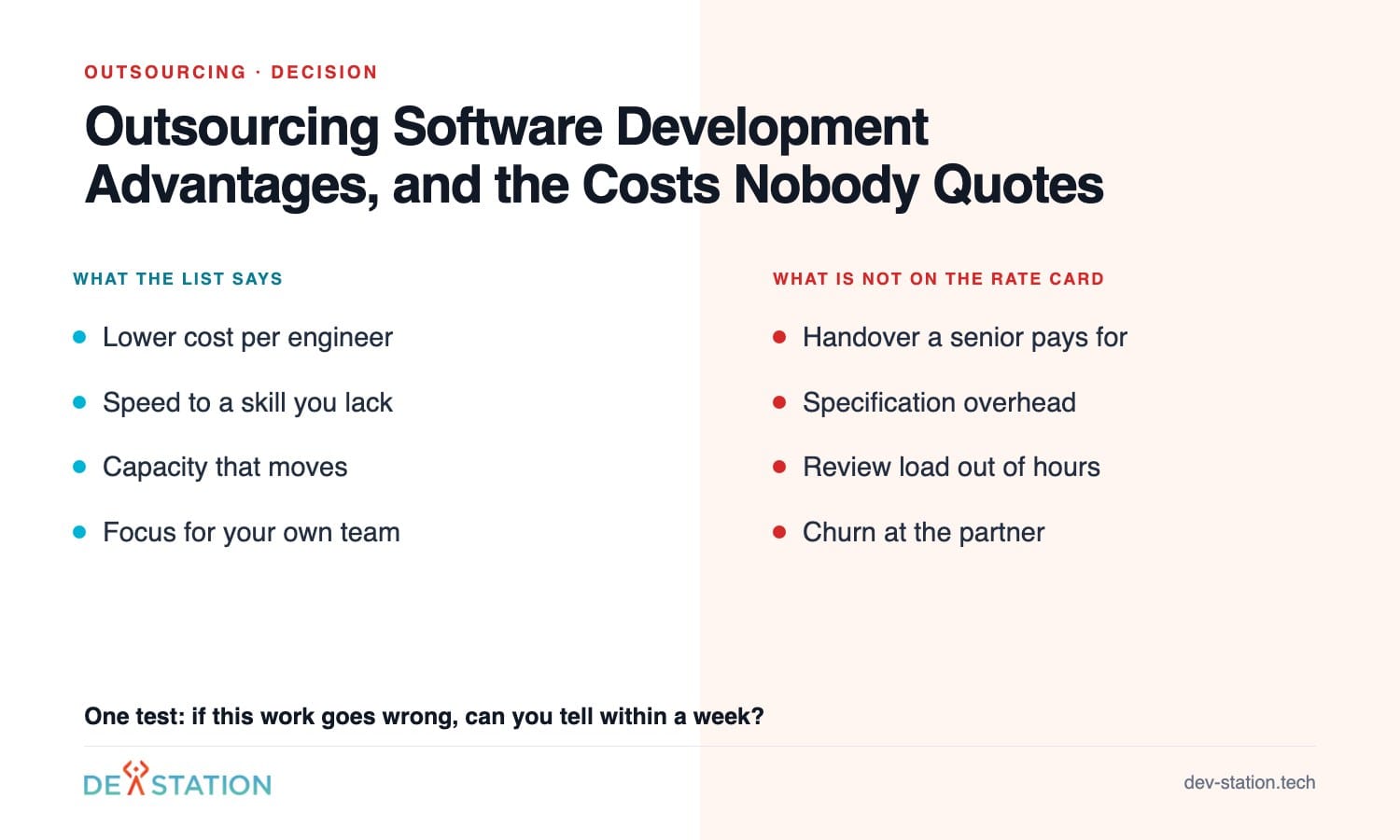
- The advantages are real and well documented: lower cost, faster access to skills, capacity that scales, and time back for your own team.
- The costs that surprise people are not on any rate card. Handover, review load, timezone lag and the work of specifying things you used to say across a desk.
- Outsourcing suits work that is well understood or steady. It suits early product discovery badly, because discovery needs conversation more than capacity.
- Keep architecture decisions, release authority and product judgement in house whatever model you choose.
- Decide with one question: if this work goes wrong, can we tell within a week? If not, do not send it out yet.
Overview
01
What the question really is
Search results for this topic read the same way. A list of benefits, a list of risks, and a conclusion that says it depends.
People phrase it differently. Outsourcing software development advantages, software development outsourcing benefits, advantages of software development outsourcing, benefits of software outsourcing. The words change and the underlying question does not.
The useful version is narrower. Not whether outsourcing works in general, but whether this piece of work, at your company, this year, is a good candidate to send out.
This page answers that. It covers what you gain, what it costs beyond the rate, and the work that should stay in house.
Gains
02
Five advantages, stated plainly
These are the reasons that survive contact with reality.
Lower cost per engineer
The obvious one, and the one people overweight. It is real, and it is only an advantage if the work sent out actually gets finished.
Speed to a skill you lack
Hiring a specialist takes months and a partner can put one on your project in weeks. For a skill you need once, this is the strongest reason of the five.
Capacity that moves
Scale up for a push and back down afterwards without redundancy conversations. The flexibility is genuine, and it costs you continuity.
Focus for your own team
Send out the steady work and keep your senior people on the part that only they can do. This is the advantage most often claimed and least often planned for.
A working day that never stops
A team in another timezone can pick up where yours left off. That is an advantage when handover is written down and a liability when it is not.
Process you did not have to build
A partner who has shipped for many clients brings review, testing and release habits with them. Worth more than the rate difference for a small team.
Costs
03
The costs that are not on the rate card
Every list of outsourcing software development benefits comes with a list of risks. Risks sound avoidable. These are costs, and you pay them whether or not the engagement goes well.
| Cost | What it looks like in practice |
|---|---|
| Handover | Somebody senior spends real weeks explaining the product, and that person is usually your busiest |
| Specification | Things you used to agree in a corridor now have to be written down and reviewed |
| Review load | More code from more people arriving for review, often outside your working hours |
| Lag | A question with a one line answer can cost a day when the timezones barely meet |
| Churn at the partner | Every replaced engineer restarts part of the handover you already paid for |
| Exit | Bringing work back in house takes longer than sending it out, and is rarely planned |
None of these makes outsourcing a bad idea. They mean the saving is smaller than the rate difference suggests, and the gap is widest in the first six months.
Limits
04
What should stay in house
Some work travels badly. Three kinds, and the reason is the same each time.
Early product discovery, where the requirement changes as you learn. Sending it out converts cheap conversation into expensive change requests.
Architecture and the decisions that are hard to reverse. A partner can propose, and someone on your side has to own the answer for the next five years.
Release authority. Whoever decides that a build is safe to ship should work for you, whatever the contract says about quality.
One test settles most cases. If this work goes wrong, can you tell within a week? If the answer is no, the problem is your feedback loop rather than the supplier, and outsourcing will make it worse.
Decide
05
How to decide, in five steps
The reasons to outsource software development are easy to list. Deciding is a different exercise.
- Pick one candidate piece of work. Not a department. A defined piece with a start and a finish.
- Write the brief you would need. If you cannot write it, the work is not ready to leave, and that is the finding.
- Price the whole thing. Rate plus handover time plus the review hours it will cost your team each week.
- Run it fixed scope first. One bounded project tells you more about a partner than any reference call.
- Decide the shape afterwards. Project, team extension or a standing team, based on how the first one actually went.
If the answer turns out to be a standing team, our offshore development center page covers how that model runs.
Working With Us
06
Where Dev Station fits
We take on product engineering, QA and embedded work as a standing team, and we will tell you when a piece of work is a poor candidate to send out.
Most engagements start fixed scope, because it is the cheapest way for both sides to find out whether the working relationship is any good.
Our engineers work from Vietnam with overlap into UK GMT and US Eastern and Pacific hours, and we invoice in GBP or USD. Send us the piece of work you are considering and we will give you an honest view on whether it should leave your building.
FAQ
07
Frequently asked questions
What comes up when this decision is on the table.
What are the main advantages outsourcing software development brings?
Lower cost per engineer, faster access to a skill you do not have, capacity that scales in both directions, and time back for your own senior people. The last one is the most valuable and the least planned for.
What is the biggest advantage of outsourcing software development for a small team?
Process you did not have to build. A partner who has shipped for many clients brings review, testing and release habits with them, which is often worth more than the difference in rate.
What are the risks?
Handover cost, specification overhead, review load, timezone lag, churn at the partner, and the difficulty of bringing work back. They are manageable and they are not free.
What should never be outsourced?
Early discovery while requirements are still moving, architecture decisions that are hard to reverse, and the authority to decide a release is safe to ship.
How do we start without a large commitment?
One bounded project, fixed price, fixed date, on work you understand well enough to judge. Then decide the long term shape based on what you saw.
Want an AI assistant to summarize or cite this guide?
Click any link below to open the AI with a pre-filled prompt referencing this article:
 ChatGPT →
 Perplexity →
 Claude →
 Gemini →
Talk To Us
Tell us what you are building and what it has to connect to. An engineer answers, and you get a straight view of what the work would take.
Get In Touch →