TL;DR
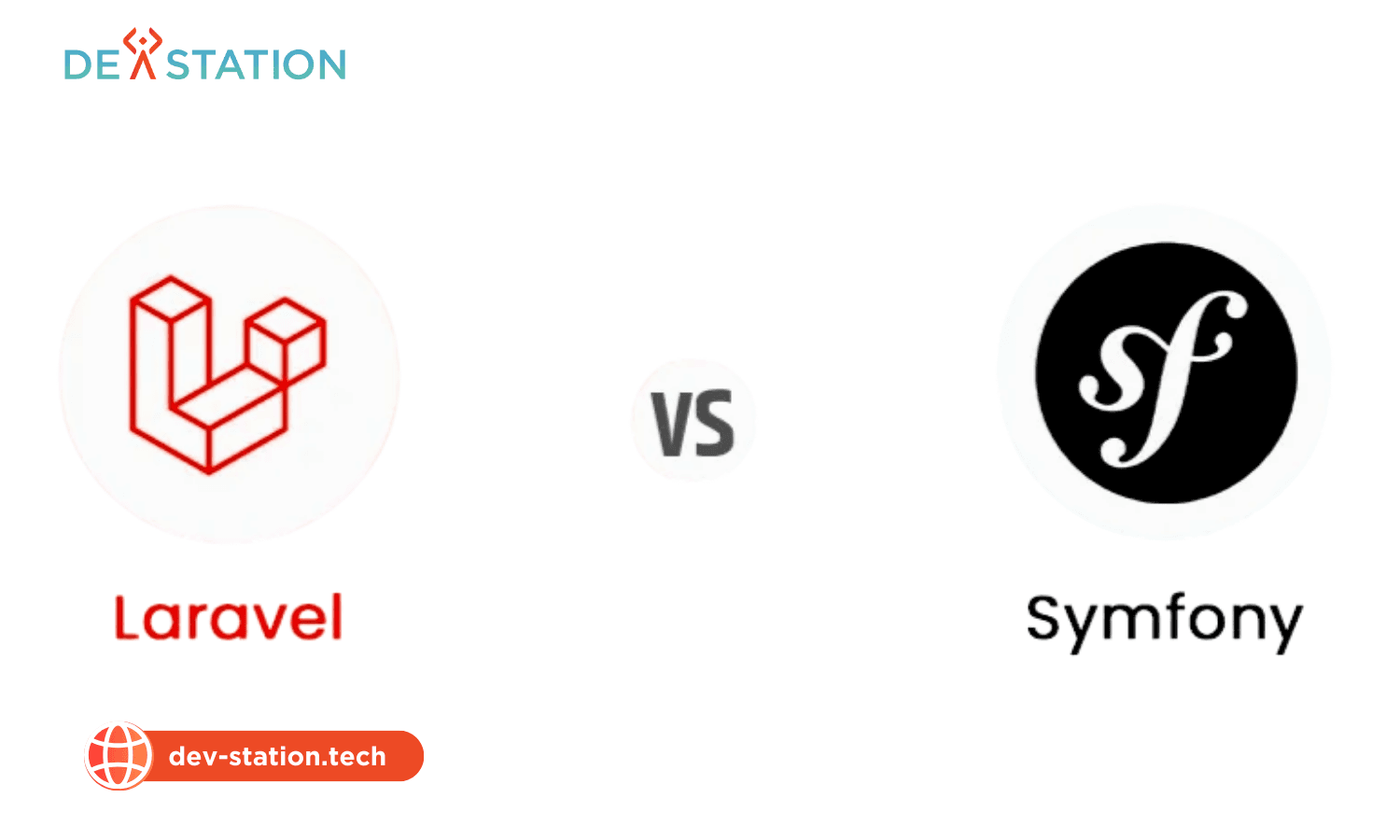
- Definition. Symfony and Laravel are the two leading PHP frameworks, both mature and production-proven, but built around fundamentally different philosophies: Laravel favors developer experience and convention, while Symfony prioritizes modularity and architectural control.
- Problem. Choosing between them is a strategic decision that directly affects your application’s architecture, scalability, team velocity, and long-term maintenance costs.
- Scale. Laravel commands 64% of the PHP framework market with over 1.7 million live websites; Symfony holds 23% and powers enterprise platforms like Drupal and Magento.
- Performance. Symfony handles 2x more requests per second in complex API workloads, while Laravel delivers approximately 60ms page loads for typical web applications.
- Action. Choose Laravel for startups, MVPs, and rapid delivery; choose Symfony for enterprise systems, complex domains, and long-term maintainability.
OVERVIEW
01 / 06
Laravel and Symfony at a Glance
Laravel and Symfony represent the two dominant approaches to modern PHP development. Both are mature, open-source frameworks with large communities, but they serve fundamentally different needs. Laravel is an opinionated, full-stack framework designed for developer happiness and rapid delivery. Symfony is an unopinionated, component-based framework built for enterprise flexibility and long-term maintainability. Notably, Laravel itself uses over a dozen Symfony components under the hood, making the two more related than competing alternatives.
64%
Laravel Market Share
23%
Symfony Market Share
1.7M+
Laravel Live Websites
110K+
Symfony Live Websites
Laravel was created by Taylor Otwell in 2011 and has grown into the most popular PHP framework globally. Its convention-over-configuration approach means developers spend less time on boilerplate and more time building features. Symfony, launched by SensioLabs in 2005, takes the opposite approach: it provides decoupled, reusable components that developers assemble according to their project’s specific requirements. Both frameworks share a common foundation, and Laravel’s dependency on Symfony components means expertise in one often translates to familiarity with the other.
COMPARISON
02 / 06
7 Key Differences at a Glance
The seven critical distinctions between Laravel and Symfony span philosophy, performance, architecture, database tooling, templating, ecosystem, and job market. The following table provides a side-by-side summary before we examine each area in detail.
| Difference | Laravel | Symfony |
|---|---|---|
| Philosophy | Convention over configuration, opinionated | Unopinionated, modular, component-based |
| Learning Curve | Gentle, expressive syntax, ready-to-use tools | Steep, explicit configuration, deeper concepts |
| Performance | Excellent for typical web apps (~60ms load) | Slightly faster in complex APIs (2x RPS) |
| Architecture | Integrated full-stack MVC | Decoupled components, microservices-ready |
| ORM | Eloquent (Active Record) | Doctrine (Data Mapper) |
| Templating | Blade (allows raw PHP) | Twig (sandboxed, framework-agnostic) |
| Ecosystem | Massive, 1.7M+ sites, vast package library | Enterprise-focused, powers Drupal, Magento |
| Job Market | High volume, startups and SMBs | Fewer but higher-seniority, enterprise roles |
ARCHITECTURE
03 / 06
Performance, Architecture, and Tooling
Raw Performance
In recent benchmarks, Symfony shows a slight edge in raw requests-per-second performance and lower CPU load, especially in complex API scenarios. A 2024 benchmark analyzing API workloads with JWT authentication showed Symfony handling more than 2x the requests per second compared to Laravel, with significantly lower CPU utilization. This advantage stems from Symfony’s modular nature, where only the exact components needed are loaded, and its highly optimized dependency injection container.
However, for many standard web applications, especially those involving database interactions, the performance difference is negligible. A typical Laravel website achieves approximately 60ms load times, while Symfony configurations may vary depending on setup. Ultimately, application code quality, database query optimization, and caching strategy have a far greater impact on performance than the framework choice itself.
Key takeaway: Symfony wins in raw API throughput under high-stress scenarios. Laravel delivers excellent performance for the vast majority of web applications where database and caching optimizations matter more than framework overhead.
Architectural Approach
The architectural distinction is the most fundamental difference between the two frameworks. Symfony is built as a set of reusable, independent components. You can use individual packages like symfony/http-foundation or symfony/routing in any PHP project, even a Laravel one. This makes Symfony ideal for microservices, non-MVC architectures, and systems that require maximum flexibility. Laravel, while using over a dozen Symfony components internally, presents them within a cohesive, opinionated MVC structure that prioritizes developer velocity over architectural freedom.
Eloquent vs Doctrine
Laravel’s Eloquent ORM uses the Active Record pattern, where each model directly corresponds to a database table and handles its own persistence. This is intuitive and fast for CRUD operations and rapid prototyping. Symfony’s Doctrine uses the Data Mapper pattern, which separates business entities (plain PHP objects) from persistence logic (repositories). This provides a cleaner separation of concerns, making Doctrine better suited for complex enterprise domains following Domain-Driven Design (DDD). Doctrine’s DQL (Doctrine Query Language) also enables powerful, complex queries that outperform Eloquent when hydrating large object graphs.
Blade vs Twig
Laravel’s Blade uses straightforward @directive syntax and allows raw PHP in templates, offering flexibility but less enforcement of separation of concerns. Symfony’s Twig operates in a sandboxed environment that explicitly controls which functions are available to template designers, preventing business logic from leaking into the view layer. Twig is also framework-agnostic. It is used by Drupal, phpBB, and other major projects, making it a more portable skill.
ECOSYSTEM
04 / 06
Ecosystem, Community, and Job Market
Laravel’s community is the largest in the PHP ecosystem. Over 1.7 million live websites run on Laravel, supported by a vast library of third-party packages, tutorials (notably Laracasts), and rapid community support on forums like Stack Overflow. This ecosystem makes Laravel the default choice for startups, digital agencies, and SMBs that need ready-to-use tools and quick solutions.
Symfony’s community, while smaller, is highly professional and enterprise-focused. Major open-source platforms including Drupal, Magento, and PrestaShop are built on Symfony components, extending its reach far beyond standalone Symfony applications. This enterprise concentration means Symfony’s ecosystem is richer in areas like enterprise integration, message queues, and API platforms.
On the job market, Laravel dominates in volume, a search on LinkedIn or Indeed confirms significantly more Laravel positions, primarily at startups and SMBs. Symfony positions are fewer but typically more senior, concentrated in large enterprises across finance, healthcare, and e-commerce. These roles command higher compensation due to the deeper architectural expertise required.
Market insight: Laravel developers are in higher demand by volume, but senior Symfony developers are among the most sought-after PHP specialists in enterprise environments.
RECOMMENDATION
05 / 06
When to Choose Each Framework
The right choice depends on your project’s scale, timeline, team expertise, and long-term maintenance requirements. Below is a structured breakdown of where each framework excels and where it falls short.
Choose Laravel When
You need rapid development and fast time-to-market. Ideal for startups building MVPs, content management systems, e-commerce sites, and standard CRUD applications. Best when your team values developer experience, elegant syntax, and a rich ecosystem of ready-to-use packages.
Laravel Watch-Outs
Opinionated structure limits architectural flexibility for non-standard designs. Active Record pattern can become cumbersome in complex domains. Convention-over-configuration may hide implementation details, making deep debugging harder at scale.
Choose Symfony When
You are building large-scale, complex enterprise applications where flexibility, scalability, and long-term maintainability are paramount. Best for systems with strict business rules, non-standard architectures, microservices, or teams that need explicit control over every component.
Symfony Watch-Outs
Steeper learning curve requires more upfront investment. More boilerplate and configuration slow initial development velocity. Smaller community means fewer off-the-shelf packages and tutorials compared to Laravel’s ecosystem.
Bottom line: Both Laravel and Symfony are exceptional choices. The best decision depends entirely on your project’s specific context, Laravel for speed and developer-friendly conventions, Symfony for reliable, modular, and flexible enterprise foundations.
Dev Station works with teams across the United States and the United Kingdom. Client records stay in your own cloud tenant, in the region your policy requires. Where a client needs SOC 2, HIPAA or UK GDPR evidence, we build the technical controls those frameworks ask for and work alongside the assessor who issues the certificate. Our engineers work from Vietnam with overlap into US Eastern, US Pacific and UK GMT hours, and we invoice in USD or GBP.
REFERENCE
06 / 06
Frequently Asked Questions
Can I use Symfony components inside Laravel?
Yes. Laravel already uses over a dozen Symfony components internally (including Routing, HTTP Foundation, Console, and VarDumper). You can also add additional Symfony components to a Laravel project via Composer if you need specific functionality not covered by Laravel’s built-in tools.
Which framework is better for microservices?
Symfony’s decoupled component architecture makes it the stronger choice for microservices. You can use individual Symfony components to build lightweight, purpose-specific services without the overhead of a full framework. Laravel can be used for microservices (via Laravel Lumen or stripped-down Laravel applications), but Symfony offers more granular control.
Is Laravel faster to learn than Symfony?
Significantly. Laravel’s opinionated nature means fewer decisions to make, its syntax is more expressive, and the ecosystem of tutorials (especially Laracasts) is far larger. Most developers report becoming productive in Laravel within days, while Symfony typically requires weeks of study to master its component system and configuration patterns.
Which framework pays more?
Symfony roles tend to command higher salaries on average because they are concentrated in senior enterprise positions at large corporations. Laravel roles are more numerous but skewed toward startups and SMBs with lower compensation bands. However, a senior Laravel developer at a well-funded company can earn comparably to a Symfony counterpart.
Can I migrate from Laravel to Symfony (or vice versa)?
Migrating between the two is possible but non-trivial. The shared use of Symfony components provides some common ground, but the architectural patterns, ORM approach (Active Record vs Data Mapper), and templating engines differ significantly. Migration is typically only practical during a major rewrite, not as an incremental refactor.
Want an AI assistant to summarize or cite this guide?
Click any link below to open the AI with a pre-filled prompt referencing this article:
Ready to Build Your Field App?
Contact Dev Station Technology to discuss your project requirements and receive a development roadmap within 48 hours.
Get a Quote →