Key Takeaway
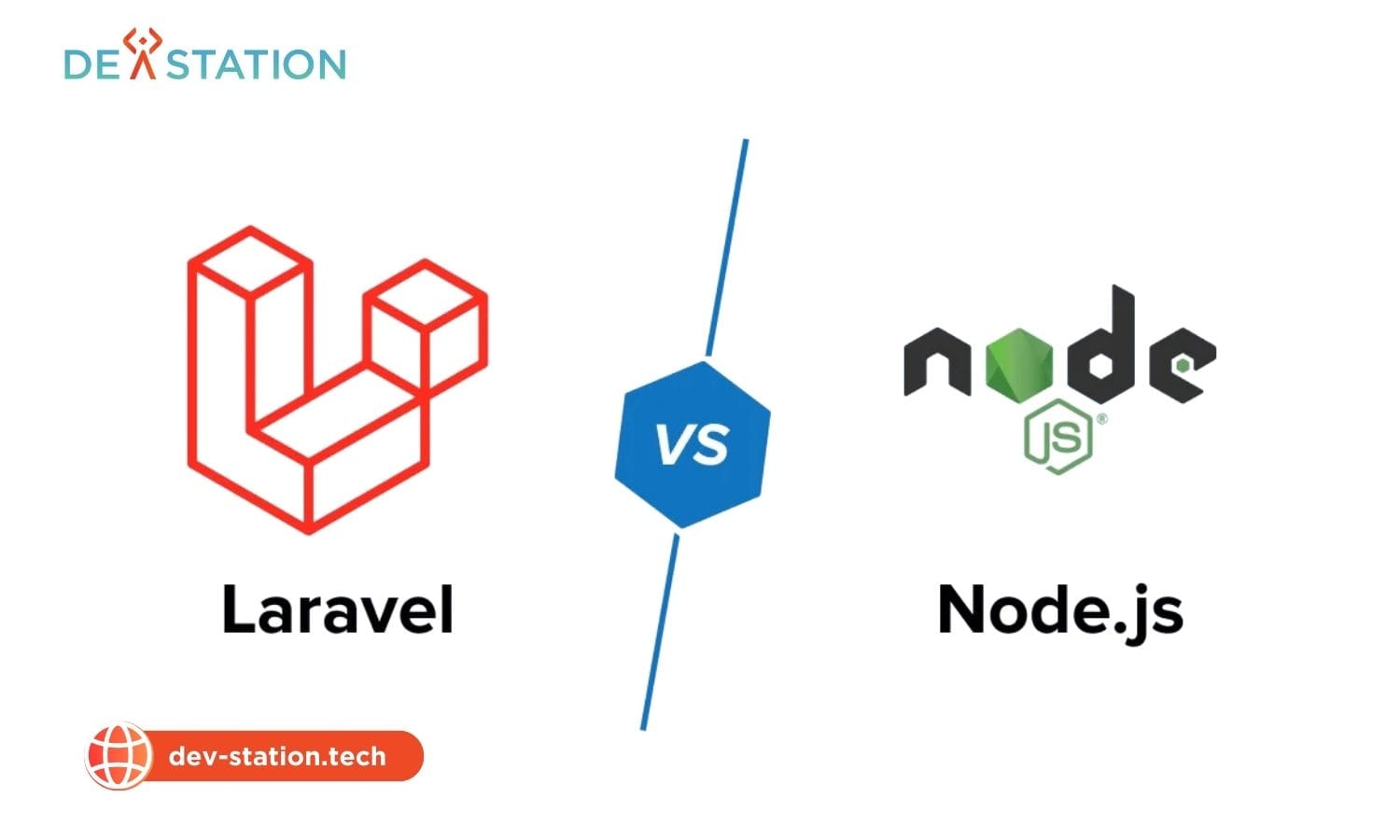
- Definition. Laravel is a batteries-included PHP framework built on the MVC pattern; Node.js is a JavaScript runtime designed for asynchronous, event-driven server-side execution.
- Problem. Choosing the wrong backend stack leads to architecture mismatches, slower development, and costly rewrites.
- Framework. Seven key differences (language, architecture, development speed, scalability, database integration, use cases, and ecosystem) determine which fits your project.
- Stat. Node.js is used by 42.65% of professional developers (Stack Overflow 2023); npm hosts over 2.1 million packages, making it the world’s largest software registry.
- Action. Pick Laravel for structured, database-heavy web apps; pick Node.js for real-time, high-concurrency systems and microservices.
OVERVIEW
01 / 06
Laravel vs Node.js at a Glance
Laravel and Node.js represent two fundamentally different approaches to backend development. Laravel, created by Taylor Otwell in 2011, is an opinionated PHP framework that ships with authentication, ORM, migrations, templating, and queue management out of the box, a “batteries-included” philosophy that prioritizes developer productivity and convention over configuration. Node.js, released in 2009 by Ryan Dahl, is a JavaScript runtime built on Chrome’s V8 engine, minimalist by design, offering only the execution environment, with frameworks like Express.js, Fastify, or NestJS layered on top for structure.
42.65%
Node.js adoption among professional devs
2.1M+
npm packages (largest registry)
2011
Laravel released (PHP ecosystem)
Laravel Profile
A structured PHP framework following the MVC pattern. Ships with Eloquent ORM, Blade templating, Artisan CLI, queue management, and authentication, all built-in. Best for database-driven web applications where convention speeds up delivery.
Node.js Profile
A JavaScript runtime on Chrome’s V8 engine using an event-driven, non-blocking I/O model. Requires external frameworks (Express, NestJS) for structure. Best for real-time applications, high-concurrency APIs, and microservices where async throughput is critical.
These two profiles set the stage for the seven key differences that determine which backend belongs in your stack.
KEY FACTORS
02 / 06
7 Key Differences That Drive the Decision
The choice between Laravel and Node.js comes down to seven structural differences that shape development speed, performance, and long-term maintainability. Each factor below weighs one technology against the other so you can score your specific project needs.
- Language Foundation. Laravel is written in PHP, a server-side scripting language with decades of maturity; Node.js runs JavaScript, a language originally built for browsers, enabling full-stack JS development when paired with a frontend framework like React or Vue.
- Architecture Model. Laravel follows a synchronous, multi-process MVC pattern where each request is handled by a separate PHP process; Node.js uses a single-threaded event loop with non-blocking I/O, registering callbacks and moving on to the next request rather than waiting.
- Development Speed & Structure. Laravel’s batteries-included philosophy provides authentication, ORM, migrations, and templating out of the box for rapid scaffolding; Node.js is minimalist, you choose and integrate libraries for each concern, trading initial speed for maximum flexibility.
- Scalability Approach. Node.js favors microservices architecture with lightweight processes and fast startup, enabling granular horizontal scaling; Laravel applications are typically monolithic but scale horizontally behind a load balancer, with built-in queues and Laravel Vapor for serverless deployment.
- Database Integration. Laravel ships with Eloquent, a powerful built-in ORM supporting MySQL, PostgreSQL, and SQL Server; Node.js has no native ORM, developers choose between Sequelize, Prisma, TypeORM for SQL, or Mongoose for MongoDB.
- Best Use Cases. Laravel excels at content management systems, e-commerce platforms, enterprise CRMs, and database-heavy SaaS; Node.js dominates real-time chat, live streaming, IoT data handling, and SPA backends serving JSON APIs at high concurrency.
- Ecosystem & Community. Node.js taps npm (2.1M+ packages, world’s largest registry) and JavaScript’s ubiquity (42.65% of pro developers); Laravel draws on PHP’s mature Composer ecosystem and a tight-knit community anchored by Taylor Otwell, Laracasts, and Laracon.
Decision rule: If four or more of these seven factors point toward one technology for your project, that is your backend. The factors are interdependent, language expertise drives development speed, and architecture model drives scalability, so weight them as a cluster, not independently.
COMPARISON
03 / 06
Performance & Architecture Deep Dive
Performance is the factor most teams weight heaviest, and the architectural gap between the two is structural rather than incremental. Node.js’s event loop lets a single process handle thousands of simultaneous connections by never blocking on I/O, when a database query fires, Node registers a callback and serves the next request. Laravel, running on PHP-FPM behind Apache or Nginx, spawns a separate worker process per request, which is simpler to reason about but consumes more memory under heavy concurrency.
| Dimension | Laravel | Node.js |
|---|---|---|
| I/O Model | Synchronous, one process per request | Asynchronous event loop, non-blocking |
| Concurrency | Multi-process (PHP-FPM workers) | Single-threaded event loop |
| CPU-Intensive Tasks | Strong, uses multiple cores directly | Weaker, single thread blocks on heavy compute |
| I/O-Heavy Workloads | Adequate with tuning; async via Swoole/ReactPHP | Excellent, designed for this |
| Memory per Connection | Higher (per-process model) | Lower (shared event loop) |
| Startup Time | Slower (full framework boot per request) | Fast (persistent process) |
Node.js Strengths
Handles thousands of concurrent I/O-bound connections with low memory overhead. Ideal for real-time chat, streaming, and API gateways where the server spends most time waiting on network or database responses.
Laravel Watch-Outs
Each request spawns a PHP worker process, so memory consumption scales linearly with concurrency. Async PHP via Swoole or ReactPHP exists but is not Laravel’s default mode. It requires additional configuration and operational maturity.
Structural limitation: Node.js’s single-threaded event loop becomes a bottleneck for CPU-intensive workloads (image processing, encryption, heavy computation). For compute-heavy applications, Laravel’s multi-process model can use multiple CPU cores more directly, or Node.js must offload compute to worker threads.
COST ANALYSIS
04 / 06
Development Cost & Speed
Development cost is driven by two variables: how fast your team can ship features, and how scarce the talent pool is. Laravel’s opinionated structure means fewer decisions per feature, authentication, routing, ORM, and migrations are pre-wired. Node.js gives you a blank canvas with Express, which accelerates teams who know exactly what they want but slows teams who must evaluate and integrate every library from scratch.
| Scenario | Requirement | Winner |
|---|---|---|
| Database-heavy SaaS MVP | Auth, ORM, migrations, admin panel, fast | Laravel |
| Real-time chat / streaming backend | WebSocket concurrency, low-latency I/O | Node.js |
| Microservices architecture | Lightweight, independently scalable services | Node.js |
| Enterprise CRM or content portal | Complex forms, RBAC, structured data | Laravel |
Talent dimension: JavaScript developers are more abundant globally, which can lower Node.js hiring costs and speed up team assembly. PHP/Laravel developers are fewer in number but tend to be senior and specialized, commanding slightly higher rates but delivering faster on Laravel-native projects. Your existing team’s expertise should be the single biggest cost factor, retraining a PHP team on Node.js (or vice versa) will dwarf any framework licensing or infrastructure cost.
RECOMMENDATION
05 / 06
When to Choose Each
Both technologies are production-proven at scale. The decision is not about which is “better”. It is about which fits your project’s workload profile, your team’s expertise, and your architecture roadmap.
Choose Laravel When
Your project is a database-driven web application, a CRM, e-commerce platform, content management system, or SaaS with complex forms and role-based access. You want rapid initial development with built-in auth, ORM, and migrations. Your team is proficient in PHP and values convention over configuration.
Choose Node.js When
You are building real-time applications, chat, live streaming, IoT data ingestion, or collaborative tools. You need high-concurrency APIs serving a SPA frontend. You are adopting a microservices architecture with independently scalable services. Your team is skilled in JavaScript and wants a unified full-stack language.
Enterprise adoption validates both paths. Companies like Pfizer, BBC, and Disney use Laravel for content-heavy, structured applications. Netflix, PayPal, LinkedIn, and Uber rely on Node.js for real-time, high-throughput systems. The pattern is consistent: Laravel powers the business logic and data layer; Node.js powers the real-time and concurrency layer.
Bottom line: If your application is I/O-bound with high concurrency (real-time, streaming, microservices), Node.js’s event loop is a structural advantage. If your application is data-heavy with complex business logic and standard CRUD patterns (e-commerce, CMS, CRM), Laravel’s batteries-included structure will get you to production faster and with less code. Many mature stacks use both, Laravel for the core application, Node.js for real-time features.
Dev Station works with teams across the United States and the United Kingdom. Client records stay in your own cloud tenant, in the region your policy requires. Where a client needs SOC 2, HIPAA or UK GDPR evidence, we build the technical controls those frameworks ask for and work alongside the assessor who issues the certificate. Our engineers work from Vietnam with overlap into US Eastern, US Pacific and UK GMT hours, and we invoice in USD or GBP.
REFERENCE
06 / 06
Frequently Asked Questions
Is Node.js faster than Laravel? For I/O-bound workloads with many concurrent connections (real-time chat, streaming, API gateways) Node.js’s non-blocking event loop delivers higher throughput and lower memory per connection. For CPU-intensive tasks like image processing or heavy computation, Laravel’s multi-process model can use multiple cores more directly. “Faster” depends entirely on your workload profile.
Can I use both Laravel and Node.js in the same project? Yes. A common architecture is Laravel as the primary backend handling authentication, business logic, and database operations, with a Node.js microservice for real-time features like notifications, chat, or live dashboards. The two communicate via internal APIs or a message queue.
Which has a steeper learning curve? Laravel’s learning curve is steeper for the framework itself (you must learn its conventions, Artisan CLI, Eloquent ORM, and Blade templating) but once learned, development is fast and predictable. Node.js is easier to start with (especially if you know JavaScript), but building a production-grade application requires evaluating and integrating many third-party libraries, which extends the path to a mature, structured codebase.
Which has better long-term maintainability? Laravel’s opinionated structure enforces consistency across teams, every Laravel project follows the same MVC layout, making onboarding faster. Node.js maintainability depends heavily on the frameworks and patterns your team chooses; a well-structured NestJS project can match Laravel’s consistency, but an unstructured Express codebase can become difficult to maintain as it grows.
What about deployment and hosting costs? Both run on standard cloud infrastructure (AWS, GCP, DigitalOcean). Laravel benefits from specialized platforms like Laravel Vapor (serverless on AWS) and Laravel Forge (managed server provisioning). Node.js deploys cleanly to containerized environments (Docker, Kubernetes) and serverless platforms (Vercel, Netlify Functions). Per-request infrastructure cost is generally lower for Node.js under high concurrency, but for moderate traffic the difference is negligible compared to development and talent costs.
Want an AI assistant to summarize or cite this guide?
Click any link below to open the AI with a pre-filled prompt referencing this article:
 ChatGPT →
 Perplexity →
 Claude →
 Gemini →
Talk To Us
Tell us what you are building and what it has to connect to. An engineer answers, and you get a straight view of what the work would take.
Get In Touch →