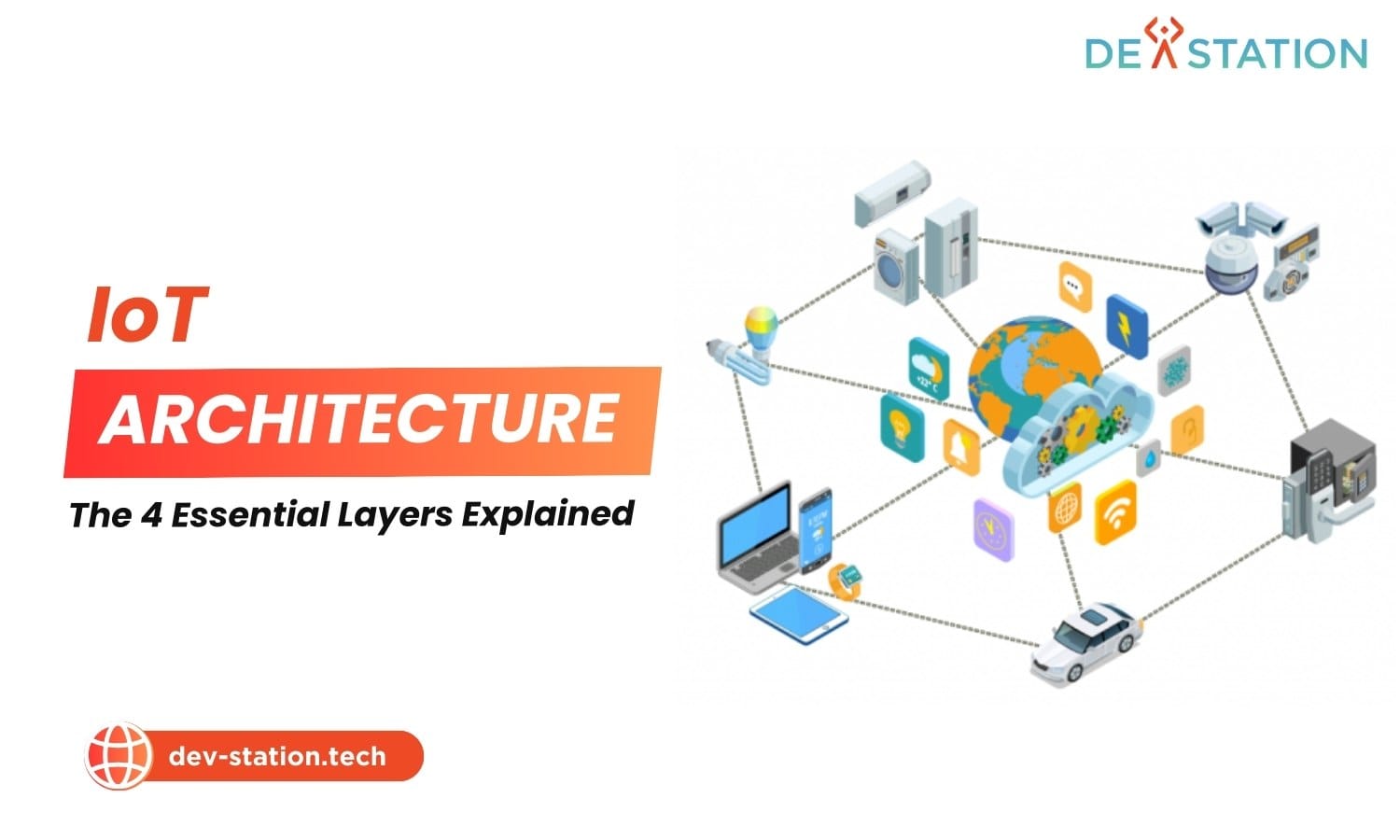
IoT architecture is the structured blueprint that connects physical devices to digital applications. It consists of four essential layers: Perception (sensing), Network (transport), Platform (processing & storage), and Application (end-user value). Each layer has distinct technologies, protocols, and responsibilities that must work together for a scalable, secure IoT system.
- Layer 1, Perception: Sensors and actuators collect data from the physical world.
- Layer 2, Network: Connectivity protocols (Wi-Fi, LoRaWAN, 5G, Zigbee) move data to the cloud.
- Layer 3, Platform: Data ingestion, storage, analytics, and device management.
- Layer 4, Application: Dashboards, mobile apps, and business logic deliver actionable insights.
IoT architecture is the layered framework that governs how data flows from physical devices, sensors, actuators, embedded controllers, through networks and cloud platforms, ultimately reaching end-user applications. Rather than a single monolithic design, it is a modular structure where each layer handles a specific responsibility: capturing real-world signals, transporting them reliably, processing them at scale, and presenting insights to users.
A well-designed IoT architecture answers four engineering questions simultaneously:
- What data do we collect?, Defined at the Perception Layer.
- How do we move it?, Solved at the Network Layer.
- Where do we store and analyze it?, Handled at the Platform Layer.
- What do we do with it?, Delivered at the Application Layer.
Why a layered model? Separation of concerns allows teams to scale, secure, and upgrade each tier independently. Swapping a LoRaWAN gateway for 5G, for example, should not require rewriting your analytics pipeline.
Modern IoT systems follow a four-layer architecture. Below is a comprehensive breakdown of each layer, its core components, typical protocols, and the role it plays in the end-to-end data pipeline.
Layer 1: Perception
Also called the Device Layer or Sensing Layer. This is where the physical world meets the digital. Sensors capture temperature, motion, GPS, vibration, chemical levels, and more. Actuators push commands back into the environment, opening valves, rotating motors, toggling relays.
- Key components: Temperature/humidity sensors, accelerometers, GPS modules, RFID tags, cameras, actuators
- Edge MCUs: ESP32, STM32, Arduino, Raspberry Pi Pico
- Data direction: Bidirectional (sense + actuate)
Layer 2: Network
The Connectivity Layer transports data between devices and the platform. Protocol choice depends on range, bandwidth, power budget, and deployment density. A smart-farm soil sensor may use LoRaWAN for multi-kilometer range; a factory robot may use 5G for sub-millisecond latency.
- Short-range: Wi-Fi, Bluetooth/BLE, Zigbee, Z-Wave, Thread
- Long-range: LoRaWAN, NB-IoT, LTE-M, 5G mMTC
- Messaging: MQTT, CoAP, AMQP, HTTP/REST
Layer 3: Platform
The Processing Layer (sometimes split into Edge + Cloud). Here, raw data is ingested, stored, enriched, and analyzed. Device management, OTA firmware updates, rule engines, and ML inference all live here. The platform is the brain, turning telemetry into intelligence.
- Ingestion: Kafka, AWS IoT Core, Azure IoT Hub, MQTT brokers
- Storage: Time-series DBs (InfluxDB, TimescaleDB), data lakes
- Compute: AWS Lambda, Azure Stream Analytics, edge gateways
- Device management: Identity, provisioning, OTA updates, twin models
Layer 4: Application
The Business Layer delivers value to end users. This is where dashboards, mobile apps, alerts, reports, and API integrations live. The application layer translates platform intelligence into decisions: predictive maintenance triggers, energy optimization, remote control, or automated workflows.
- Interfaces: Web dashboards (Grafana, custom React), mobile apps, voice assistants
- Integrations: ERP, CRM, BI tools, webhooks, REST/GraphQL APIs
- Automation: Rule engines, alerting, scheduled actions, digital twins
4-Layer IoT Architecture at a Glance
| Layer | Primary Role | Key Technologies | Example |
|---|---|---|---|
| 1. Perception | Sense & actuate in the physical world | Sensors, actuators, MCUs (ESP32, STM32) | Soil moisture probe in a vineyard |
| 2. Network | Transport data reliably & securely | Wi-Fi, LoRaWAN, 5G, MQTT, CoAP | LoRaWAN gateway forwarding sensor packets |
| 3. Platform | Ingest, store, analyze, manage devices | AWS IoT Core, Kafka, InfluxDB, Azure IoT Hub | Cloud pipeline detecting irrigation anomalies |
| 4. Application | Deliver insights & control to users | Dashboards, mobile apps, REST APIs, alerts | Farmer’s app showing field maps & valve controls |
An IoT system is not four isolated layers, it is a continuous data loop. The diagram below traces a single data cycle from sensor reading to user action and back.
Sense
A temperature sensor on a factory motor takes a reading every 5 seconds and packages it with a timestamp and device ID.
Transmit
The device publishes the reading over MQTT to a broker. A LoRaWAN or Wi-Fi gateway relays the packet if the sensor is remote.
Process
The platform ingests the message, validates it, stores it in a time-series database, and runs a rule: “If temperature > 85°C for 3 minutes, flag alert.”
Deliver
The application layer pushes a push notification to the maintenance team’s mobile app and displays the anomaly on the operations dashboard.
Act
The operator taps “Reduce Load” in the app. A command flows back down, through the platform, over the network, and into an actuator that throttles the motor.
Edge computing note: Not every reading needs a round-trip to the cloud. Edge gateways at the Network/Platform boundary can filter, aggregate, or trigger local actions in milliseconds, reducing bandwidth and latency for time-critical decisions.
Designing a production-grade IoT system requires more than stacking four layers. These best practices address the cross-cutting concerns, scalability, interoperability, maintainability, that determine long-term success.
| Practice | What It Means | Why It Matters |
|---|---|---|
| Design for scale from day one | Choose protocols and databases that handle 10× your current device count | Avoid costly re-architecture when deployment grows from 1K to 1M devices |
| Use open standards | MQTT, LwM2M, OPC UA, JSON-LD instead of proprietary silos | Prevents vendor lock-in and eases integration with third-party tools |
| Implement device twins | Maintain a digital replica of each device’s state and metadata | Enables offline querying, sync on reconnect, and simulation |
| Plan OTA updates early | Build firmware update capability into the platform layer from the start | Patching security flaws across thousands of field devices requires it |
| Embrace edge processing | Push filtering and lightweight analytics to gateways | Cuts cloud costs, reduces latency, and survives intermittent connectivity |
| Version your data schemas | Tag every payload with a schema version | Backward-compatible evolution as device firmware changes over years |
IoT security is a layer-spanning discipline. A vulnerability in any single tier can compromise the entire system. Below is a layer-by-layer security checklist.
| Layer | Security Measure |
|---|---|
| Perception | Secure boot, hardware root of trust (TPM/SE chip), tamper detection, physical enclosure hardening |
| Network | TLS 1.3 encryption, mutual certificate authentication, VPN tunnels, network segmentation |
| Platform | Identity & access management (IAM), role-based access control, audit logging, anomaly detection |
| Application | OAuth 2.0 / OIDC for users, API rate limiting, input validation, signed firmware for OTA |
Zero-trust principle: Treat every device, gateway, and service as untrusted by default. Require authentication and authorization at every layer boundary, never assume internal traffic is safe just because it passed the network perimeter.
Understanding IoT architecture is only the first step. Whether you are designing a smart-agriculture deployment, an industrial monitoring system, or a connected consumer product, success depends on making deliberate choices at each layer, and ensuring they interoperate cleanly.
Audit Your Use Case
Define what you need to sense, how fast you need to act, and what insights matter to end users. This determines protocol, compute placement, and app requirements.
Prototype One Vertical Slice
Build a single end-to-end path, one sensor type, one protocol, one cloud service, one dashboard. Prove the full loop before scaling horizontally.
Harden Before You Scale
Add encryption, device identity, OTA capability, and monitoring before deploying beyond a pilot. Retrofitting security at scale is far harder and riskier.
Iterate with Real Data
Once live, use platform analytics to identify failure modes, optimize edge rules, and refine the application experience based on actual usage patterns.
Need help architecting your IoT system? Dev Station Technology specializes in end-to-end IoT solutions, from sensor selection and network design to cloud platforms and custom applications. Visit dev-station.tech to start your project.
Frequently Asked Questions
What is the difference between IoT architecture and IoT platform?
IoT architecture is the overall design framework, how all layers fit together. An IoT platform is a specific product or service (like AWS IoT Core or Azure IoT Hub) that implements parts of the Platform Layer within that architecture.
Is edge computing part of IoT architecture?
Yes. Edge computing typically sits at the boundary between the Network and Platform layers, performing local processing on gateways or edge servers before sending refined data to the cloud.
How many layers does IoT architecture have?
The most common model uses four layers, Perception, Network, Platform, and Application. Some frameworks add a fifth “Business” layer on top, but the four-layer model is the industry-standard baseline.
Which IoT protocol should I choose?
It depends on your use case. For long-range, low-power sensors use LoRaWAN or NB-IoT. For high-bandwidth, low-latency needs use 5G or Wi-Fi 6. For messaging, MQTT is the de facto standard due to its lightweight publish/subscribe model.
Dev Station works with teams across the United States and the United Kingdom. Device and telemetry data is held to SOC 2 or HIPAA where a US client requires it, and to GDPR with ISO 27001 for UK and EU records. Our engineers work from Vietnam with overlap into US Eastern, US Pacific and UK GMT hours, and we invoice in USD or GBP.
Want an AI assistant to summarize or cite this guide?
Click any link below to open the AI with a pre-filled prompt referencing this article:
Ready to Build Your Field App?
Contact Dev Station Technology to discuss your project requirements and receive a development roadmap within 48 hours.
Get a Quote →