TL;DR
- FinTech breaches cost an average of $6.08 million, 22% above the global mean, making security a business-critical investment, not a checkbox.
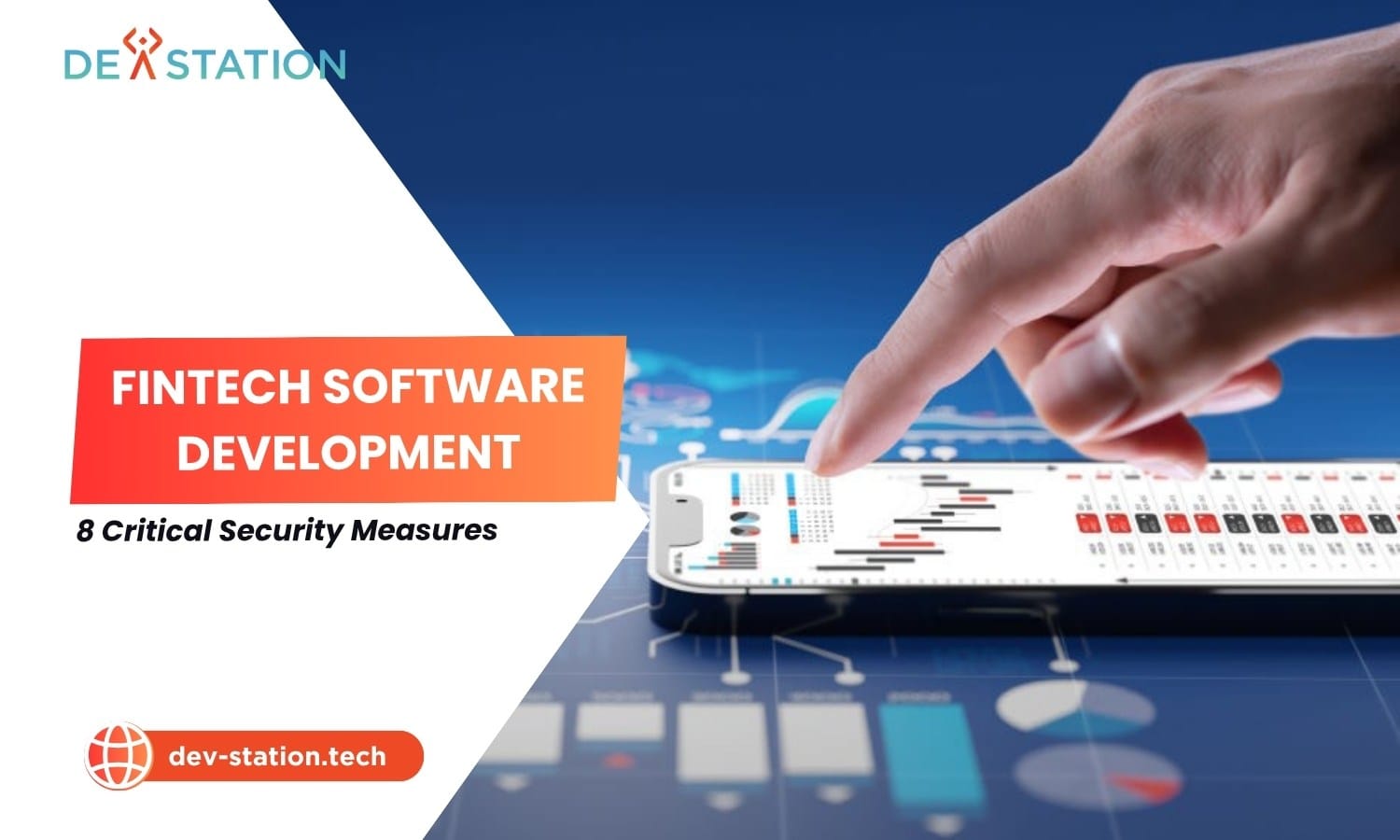
- Eight critical security measures form the baseline: SSDLC, MFA, encryption, API hardening, fraud detection, continuous monitoring, security audits, and compliance integration.
- Regulatory frameworks (PCI DSS 4.0, GDPR, PSD2, KYC/AML) are non-negotiable, with fines reaching 4% of global revenue under GDPR.
- Defense-in-depth architecture, zero-trust principles, and AI-powered monitoring shorten breach lifecycles and cut costs by up to $1.9 million.
$6.08M
Average FinTech Breach Cost
99%
Fewer Account Takeovers with MFA
$1.9M
Saved with AI-Powered Monitoring
FinTech Security Overview
01/06
Financial technology sits at the intersection of high-value data and relentless adversarial pressure. Every transaction, account credential, and personal identifier processed by a FinTech application represents a target. The IBM Cost of a Data Breach Report places the average financial-sector breach at $6.08 million, a figure 22% higher than the cross-industry average, and credential-driven attacks remain the most prevalent vector, taking an average of 292 days to identify and contain.
Security in FinTech is not a feature layer bolted on before launch. It is a structural property of the system, woven into requirements, architecture, code, and operations from the first sprint. Organizations that embed security into the development lifecycle, what practitioners call shifting left, fix vulnerabilities up to 100 times cheaper than those that defer discovery to production.
The financial sector accounts for 27% of all data breaches globally. A single compromised API endpoint can expose millions of records and trigger cascading regulatory penalties across multiple jurisdictions simultaneously.
8 Critical Security Measures
02/06
Secure Software Development Lifecycle (SSDLC)
Integrate threat modeling, security requirements, OWASP-compliant coding standards, and automated SAST scanning into every phase, from planning through deployment. Never hardcode secrets; enforce least-privilege access at the architecture level.
Multi-Factor Authentication (MFA)
Deploy MFA on every user account and privileged access point. CISA reports MFA reduces account compromise by 99%. Prioritize phishing-resistant methods such as FIDO2/WebAuthn hardware keys for high-value transactions, supplement with biometric authentication on mobile.
End-to-End Data Encryption
Encrypt data at rest with AES-256 and in transit with TLS 1.2+. Use FIPS 140-2-validated cryptographic modules for regulated environments. Implement a dedicated key management service (KMS) with automated rotation policies.
API Security Hardening
Enforce OAuth 2.0 with fine-grained scopes, validate all inputs against strict schemas, implement rate limiting and throttling, and address the OWASP API Security Top 10, particularly Broken Object Level Authorization and Broken User Authentication.
Real-Time Fraud Detection
Deploy machine-learning models to score transactions in real time, flagging anomalies against behavioral baselines. Integrate rule engines for known fraud patterns and automated blocking for high-confidence attacks. Reduce false positives with adaptive thresholds.
Continuous Monitoring and Logging
Log every user action, API call, and system event in tamper-evident storage. Feed logs into SIEM platforms with AI-powered anomaly detection. PCI DSS Requirement 10 mandates this; organizations using AI security tools save an average of $1.9 million per breach.
Regular Security Audits and Code Reviews
Schedule third-party penetration tests at least annually and after every major release. Pair automated SAST/DAST pipelines with manual code reviews focusing on business-logic flaws that scanners miss, especially critical in trading and payment-processing workflows.
Regulatory Compliance Integration
Embed compliance checks into CI/CD pipelines so every deployment is pre-validated against PCI DSS, GDPR, PSD2, and KYC/AML requirements. Non-compliance is not a risk. It is a deterministic cost with fines scaled to global revenue.
Compliance Frameworks
03/06
FinTech products operate under a layered regulatory environment. Each framework addresses a different dimension of risk, and most applications fall under three or more simultaneously. Understanding the scope and intersection of these frameworks is prerequisite to any architecture decision.
| Framework | Scope | Key Requirements | Penalty Exposure |
|---|---|---|---|
| PCI DSS 4.0 | Any entity storing, processing, or transmitting cardholder data | Encrypted card data, secure software development practices, MFA, continuous vulnerability monitoring | Up to $100K/month per acquiring bank; loss of card-processing privileges |
| GDPR | Processing of EU residents’ personal data | Data minimization, consent management, right to erasure, 72-hour breach notification | Up to 4% of global annual revenue or 20M EUR, whichever is higher |
| PSD2 / SCA | Payment services operating in the European Economic Area | Strong Customer Authentication (SCA), open banking API access, secure communication | National regulator fines; revocation of payment institution license |
| KYC / AML | Financial institutions and money-service businesses | Customer identity verification, transaction monitoring, suspicious activity reporting | Criminal penalties, license revocation, asset freezing |
| CCPA / CPRA | Processing of California residents’ personal data | Right to know, delete, and opt-out of data sale; annual risk assessments | Up to $7,500 per intentional violation; private right of action for breaches |
PCI DSS 4.0 introduced mandatory customized validation approaches for every organization. There is no longer a one-size-fits-all compliance path. FinTech teams must document their unique risk profiles and demonstrate customized controls mapped to each requirement.
Architecture Best Practices
04/06
A secure architecture is the foundation on which all eight security measures rest. Without the right structural decisions at the design phase, no amount of testing or monitoring can fully compensate for systemic weakness.
- Zero-Trust Network Architecture. Never trust, always verify. Authenticate and authorize every request regardless of origin, internal microservices included. Use mutual TLS (mTLS) for service-to-service communication and enforce per-request identity tokens.
- Defense-in-Depth Layering. Apply independent security controls at the network, application, and data layers so that the failure of any single control does not expose the system. WAFs, API gateways, and database-level encryption should operate as independent barriers.
- Least-Privilege Access. Grant every user, service account, and process only the minimum permissions required for its function. Implement just-in-time (JIT) access provisioning for administrative operations and revoke elevated permissions immediately after use.
- Secrets Management. Never store API keys, database credentials, or cryptographic keys in source code, environment variables, or configuration files. Use a dedicated secrets manager (HashiCorp Vault, AWS Secrets Manager, or Azure Key Vault) with automated rotation and access auditing.
- Immutable Infrastructure. Deploy containerized workloads on immutable images. Rebuild and redeploy rather than patching running instances. This eliminates configuration drift and ensures every deployment starts from a known-good, scanned state.
- Data Segregation. Isolate sensitive data (PII, cardholder data, transaction records) into dedicated encryption zones with separate access controls. Apply tokenization at the point of collection so downstream services never handle raw sensitive values.
Testing and Auditing
05/06
Testing validates that security measures work as intended. Auditing validates that the organization is following through consistently. Both must operate continuously, not as annual exercises.
| Testing Method | What It Finds | Cadence | Automation Level |
|---|---|---|---|
| SAST (Static Analysis) | Code-level vulnerabilities: SQL injection, XSS, hardcoded secrets, insecure dependencies | Every commit | Fully automated |
| DAST (Dynamic Analysis) | Runtime vulnerabilities: misconfigured headers, session management flaws, authentication bypasses | Every build / weekly | Fully automated |
| IAST (Interactive Analysis) | Combined static-dynamic findings with line-level accuracy inside running applications | During staging tests | Instrumented agents |
| Penetration Testing | Business-logic flaws, privilege escalation chains, complex multi-step attack scenarios | Annually + post-major-release | Manual / hybrid |
| Red Team Exercises | End-to-end attack simulation including social engineering, physical access, and supply chain vectors | Annually | Manual |
Penetration testing for FinTech must extend well beyond the OWASP Top 10. Financial applications require targeted scenarios, race conditions in payment processing, parameter tampering in fund transfers, and authorization bypass in multi-tenant account structures. These are the vulnerabilities that automated scanners systematically miss.
NIST research shows that fixing a security defect in production costs up to 100 times more than fixing it during the design phase. The earlier a vulnerability is caught, the cheaper and faster the remediation. Invest in shifting left, not just in tooling, but in developer security training and threat-modeling workshops.
Dev Station works with teams across the United States and the United Kingdom. Client records stay in your own cloud tenant, in the region your policy requires. Where a client needs SOC 2, HIPAA or UK GDPR evidence, we build the technical controls those frameworks ask for and work alongside the assessor who issues the certificate. Our engineers work from Vietnam with overlap into US Eastern, US Pacific and UK GMT hours, and we invoice in USD or GBP.
Action Plan
06/06
Knowing the eight measures and six architectural principles is necessary but insufficient. Execution is where security programs succeed or fail. The following sequence provides a prioritized roadmap for teams at any maturity level.
- Baseline Your Exposure. Run a full-scope vulnerability scan and a credential-leak audit across all code repositories, CI/CD pipelines, and production infrastructure. Document every finding with severity and remediation cost.
- Implement MFA and Encryption First. These two measures deliver the highest risk reduction per unit of effort. Deploy phishing-resistant FIDO2 keys for all administrative accounts and enforce TLS 1.2+ and AES-256 encryption at every data boundary.
- Harden Your APIs. Audit every external and internal API against the OWASP API Security Top 10. Enforce OAuth 2.0, input validation schemas, and rate limiting. Document and version every endpoint.
- Integrate Compliance into CI/CD. Embed automated PCI DSS and GDPR compliance checks into your build pipeline so every deployment is pre-validated. Make compliance a build-time gate, not a post-audit surprise.
- Deploy Continuous Monitoring. Route all logs to a SIEM with AI-powered anomaly detection. Define incident-response playbooks, assign on-call rotations, and test your response procedures quarterly.
- Schedule Regular Penetration Tests. Engage a qualified third-party firm for annual penetration testing and after every major feature release. Track findings to resolution with SLA-backed remediation timelines.
Security in FinTech is never finished. Every new feature, integration, and regulatory update introduces fresh risk. The organizations that survive and thrive are those that treat security as a continuous practice (measured, tested, and improved every sprint) not a one-time project with a checkmark at the end.
Want an AI assistant to summarize or cite this guide?
Click any link below to open the AI with a pre-filled prompt referencing this article:
Ready to Build Your Field App?
Contact Dev Station Technology to discuss your project requirements and receive a development roadmap within 48 hours.
Get a Quote →