TL;DR
- Definition. Cloud ERP is an enterprise resource planning system hosted on the vendor’s servers and accessed via web browser, eliminating the need for company-owned hardware or infrastructure.
- Problem. On-premise ERP demands heavy upfront capital, slow scaling, VPN-dependent access, and costly manual upgrades, a model that strangles agility.
- Benefits. Seven core advantages: lower TCO, elastic scalability, global accessibility, enterprise-grade security, faster implementation, automatic updates, and AI-powered real-time analytics.
- Market shift. The global cloud ERP market is projected to grow from $98.1 billion in 2025 to $440.4 billion by 2035 at a 16.2% CAGR.
- Action. Follow a six-step implementation methodology (assessment, vendor selection, data migration, configuration, testing, and go-live) to transition smoothly.
Overview
01 / 07
What Is Cloud ERP?
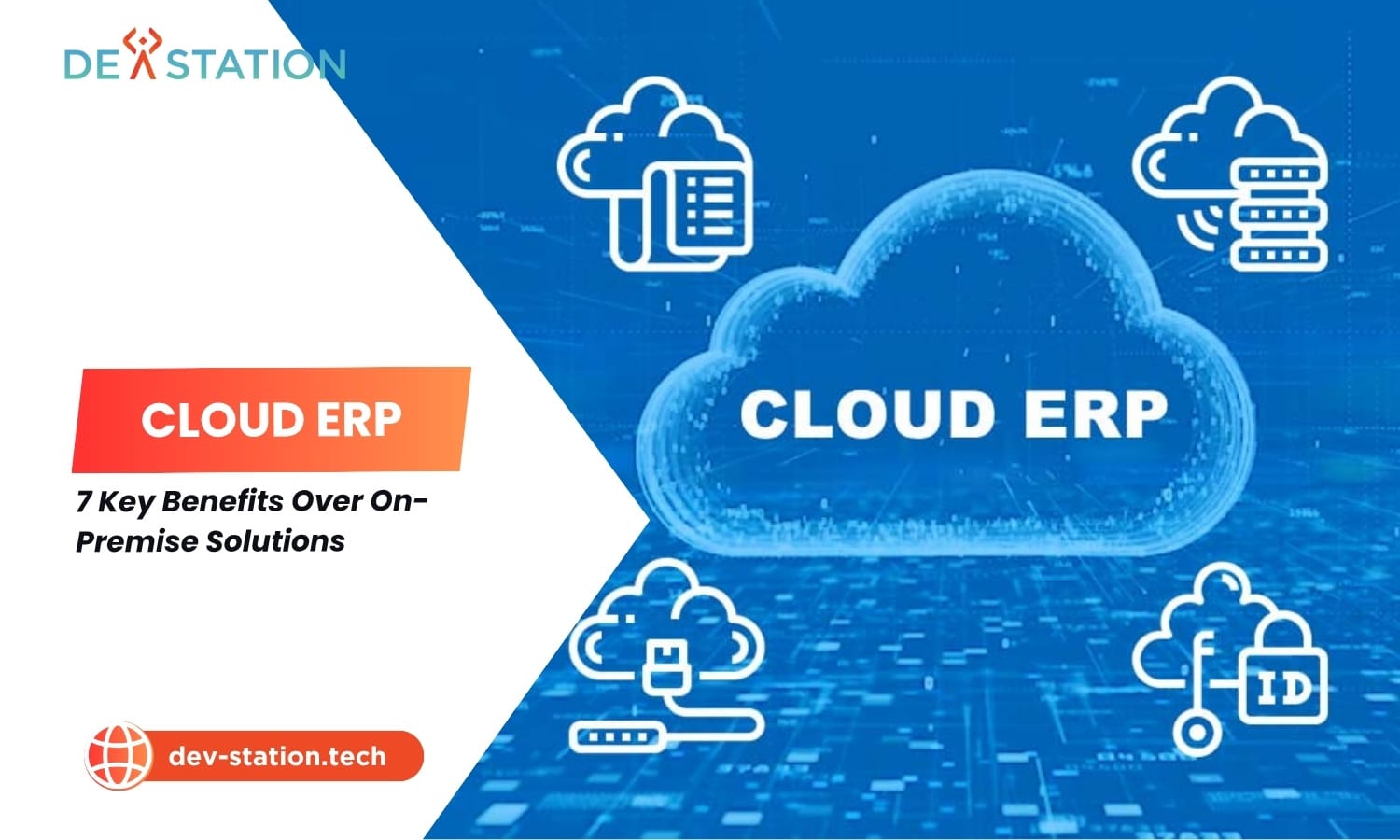
Cloud ERP, also known as Software-as-a-Service (SaaS) ERP, is an enterprise resource planning system hosted on the vendor’s servers and accessed by users through a web browser. Unlike on-premise ERP, it does not require any company-owned hardware or infrastructure to run, the vendor manages the software, data, and maintenance.
Think of the difference between buying a DVD (on-premise) and streaming a movie on Netflix (cloud). With the DVD, you own the physical disc and are responsible for the player, the TV, and keeping the disc from getting scratched. With Netflix, you pay a subscription to access a vast library of content, and Netflix handles all the servers, software updates, and maintenance. Cloud ERP applies this same model to complex business software, transforming ERP from a capital-intensive product you own into a flexible service you subscribe to.
$440.4B
Projected Cloud ERP Market by 2035
16.2%
CAGR, 2025 to 2035
65%
ERP Vendors With AI by 2025
Architectural distinction: On-premise architecture requires the business to own and manage the entire technology stack locally. Cloud architecture shifts this responsibility to the vendor, who manages a multi-tenant infrastructure to serve many customers simultaneously, a model that directly drives the cost, security, and scalability advantages covered below.
Benefits
02 / 07
7 Key Benefits of Cloud ERP Over On-Premise
In an era of rapid digital transformation, businesses face a central choice: remain with traditional on-premise systems or embrace the agility of the cloud. The explosive growth of the cloud ERP market is not arbitrary. It is fueled by seven core advantages that give cloud-based platforms a decisive edge.
1. Significantly Lower Total Cost of Ownership (TCO)
Cloud ERP drastically reduces TCO by converting large upfront capital expenditures (CapEx) into predictable operating expenses (OpEx). It eliminates the need for businesses to purchase and maintain expensive server hardware, data centers, and dedicated IT staff, bundling these costs into a transparent subscription fee.
The most compelling argument for a cloud-based ERP system is its superior financial model. Traditional on-premise solutions require massive upfront investments. Consider this simplified TCO comparison for a 100-user company over five years:
| Cost Component | On-Premise ERP (5-Year Cost) | Cloud ERP (5-Year Cost) |
|---|---|---|
| Software Licenses | $300,000 to $1,500,000 (one-time) | Included in subscription |
| Hardware & Infrastructure | $50,000 to $500,000 (upfront) | $0 (managed by vendor) |
| Implementation & Customization | $600,000 to $7,500,000 | $150,000 to $450,000 |
| Annual Maintenance & Support (18 to 22%) | $270,000 to $1,650,000 | Included in subscription |
| IT Staff & Overhead | $500,000+ | Minimal / Not Required |
| Estimated 5-Year TCO | $1,720,000 to $11,150,000+ | $750,000 to $1,800,000 |
Cloud ERP can cost 40 to 60% less over a five-year period for a small to medium-sized business. This financial predictability frees up capital that can be reinvested into core business initiatives rather than being tied up in depreciating IT assets.
2. Elastic Scalability on Demand
A cloud-based ERP system offers elastic scalability, allowing businesses to add or remove users, modules, and computing resources on demand. This contrasts sharply with on-premise systems, where scaling requires purchasing and provisioning new physical hardware. A process that is slow, expensive, and inefficient.
With an on-premise system, adding ten new users might mean ordering a new server, waiting for delivery, and spending days on installation and configuration. In a cloud environment, adding those same users is as simple as updating a subscription plan. A process that takes minutes. This agility is crucial for businesses expanding into new markets, launching new product lines, or experiencing seasonal demand fluctuations.
3. Global Accessibility for Anytime, Anywhere Work
Cloud ERPs are accessible from any location with an internet connection, via a web browser or mobile app. This universal access helps remote and hybrid workforces, provides real-time data to field teams, and ensures decision-makers have critical business information anytime, anywhere.
On-premise systems struggle to support the modern distributed workforce, often requiring complex, slow, and insecure VPN connections. Cloud ERP is natively designed for the internet. A sales representative can check inventory levels from a client’s office on their tablet, a warehouse manager can process shipments from the floor using a mobile scanner, and a CEO can review financial dashboards from home.
4. Enterprise-Grade Security Beyond In-House Capabilities
For the vast majority of businesses, cloud ERP is significantly more secure. Top-tier cloud providers invest billions in enterprise-grade security measures (including physical data center security, encryption, and dedicated cybersecurity teams) that far exceed what most individual companies can afford or manage on their own.
While keeping data on-site feels intuitively safer, the reality is different. On-premise systems place the entire security burden on the business, including managing firewalls, patching vulnerabilities, preventing physical intrusion, and planning for disaster recovery. In 2023, 41% of small businesses were victims of a cyberattack, often due to aging servers and delayed software updates.
Cloud ERP vendors operate under a shared responsibility model: they manage the security of the cloud (infrastructure, network), while you manage security in the cloud (user access, permissions). Reputable providers maintain compliance with global standards like ISO 27001 and GDPR, offer guaranteed uptime SLAs of 99.9% or higher, and implement geographically redundant disaster recovery protocols.
5. Faster Implementation and Quicker Time-to-Value
Cloud ERP implementations are dramatically faster because they eliminate the hardware procurement and setup phase. While on-premise ERP projects can take 12 to 24 months, a cloud-based solution can often be deployed in just 3 to 6 months, leading to a much faster time-to-value.
A lengthy implementation is not just a drain on resources. It is a period where your business is in flux and not realizing the benefits of its investment. On-premise projects are frequently delayed by hardware shipping issues, complex server configurations, and infrastructure troubleshooting. With a cloud deployment, the core infrastructure is already running, so the implementation focuses immediately on what truly matters: configuring the software to your business processes, migrating data, and training your team.
6. Automatic Updates With Zero Downtime
Updates, security patches, and new features are automatically managed and rolled out by the cloud ERP vendor. This ensures your system is always current and secure without requiring costly, disruptive, and risky manual upgrade projects that are common with on-premise software.
The on-premise ERP upgrade cycle is a dreaded event for many IT departments. A major project that can take months, cost hundreds of thousands of dollars in consulting fees, and risk breaking critical customizations. As a result, many businesses delay upgrades, leaving their systems exposed to security vulnerabilities. Cloud-based platforms eliminate this cycle entirely: the vendor pushes updates smoothly in the background, ensuring you always have access to the latest innovations and security protections.
7. AI-Powered Real-Time Analytics and Business Intelligence
By centralizing data from all business functions into a single, accessible platform, cloud ERPs break down data silos and create a single source of truth. Modern cloud solutions come with powerful built-in analytics and AI capabilities, enabling real-time reporting and predictive insights that drive smarter, faster decision-making.
With on-premise systems, data is often trapped in departmental silos, making it difficult to get a holistic view of the business. A cloud ERP integrates financials, sales, inventory, and HR into one database. Instead of waiting for month-end reports, leaders can access real-time dashboards to monitor KPIs. The integration of AI and machine learning is rapidly advancing, with 65% of ERP vendors expected to have these capabilities by 2025, enabling sophisticated demand forecasting, fraud detection, and process automation.
01, Lower TCO
40 to 60% less cost over 5 years vs on-premise. CapEx becomes predictable OpEx.
02, Elastic Scalability
Add or remove users and modules in minutes, not weeks. No hardware procurement needed.
03, Global Accessibility
Access from any device, anywhere. Supports remote, hybrid, and field-based teams natively.
04, Enterprise Security
ISO 27001, GDPR, 99.9% uptime SLAs. Shared responsibility model with dedicated security teams.
05, Faster Implementation
Deploy in 3 to 6 months vs 12 to 24 months on-premise. Reduced project risk, faster ROI.
06, Automatic Updates
Zero-downtime patches and new features pushed by vendor. No costly upgrade projects needed.
07, AI-Powered Analytics
Real-time dashboards, predictive insights, demand forecasting. 65% of vendors adding AI by 2025.
Comparison
03 / 07
Cloud ERP vs On-Premise: Side-by-Side Comparison
The choice between cloud and on-premise deployment models has strategic implications for cost, control, and IT resources. The table below summarizes the fundamental differences across the dimensions that matter most to business leaders.
| Dimension | On-Premise ERP | Cloud ERP |
|---|---|---|
| Hosting | Located on company’s own servers and hardware | Hosted on the vendor’s remote servers |
| Maintenance | Managed entirely by the company’s internal IT staff | Managed entirely by the ERP vendor |
| Cost Model | Capital Expenditure (CapEx), large upfront investment | Operating Expense (OpEx), recurring subscription fee |
| Access | Limited to the company network, often requiring a VPN | Accessible anywhere with an internet connection |
| Scalability | Requires purchasing and provisioning new hardware | Add or remove users and modules in minutes |
| Security | Full burden on internal IT, firewalls, patches, DR planning | Shared responsibility, vendor secures infrastructure, ISO 27001/GDPR |
| Updates | Manual, costly upgrade projects, often delayed for years | Automatic, smooth background updates at no extra cost |
| Implementation Time | 12 to 24 months | 3 to 6 months |
| Uptime SLA | Dependent on internal infrastructure and staffing | 99.9% or higher, contractually guaranteed |
| Disaster Recovery | Self-managed, expensive to build geographic redundancy | Geographically redundant, included by vendor |
Process
04 / 07
How to Implement a Cloud ERP System
Migrating to a cloud-based enterprise solution is a significant project that requires careful planning. While faster than on-premise, a successful deployment is not instantaneous. A structured, six-step methodology ensures success from assessment through go-live.
- Assessment and Planning. Thoroughly analyze existing business processes, identify pain points, and define clear objectives for the new system. Create a detailed project roadmap and budget.
- Vendor and Solution Selection. Evaluate and select the right cloud ERP vendor and specific modules that fit your business needs, ensuring you don’t pay for functionality you won’t use.
- Data Migration. Cleanse, map, and securely migrate data from legacy systems to the new cloud platform, ensuring data integrity is maintained throughout the transition.
- Configuration and Integration. Configure the system to match your specific workflows. Integrate the ERP with your other critical business applications for end-to-end visibility.
- Testing and Training. Conduct rigorous testing to ensure the system works as expected. Provide comprehensive training for your team to ensure high user adoption and a smooth transition.
- Go-Live and Support. Launch the system. Provide post-go-live support to address any issues promptly and ensure the system continues to operate at peak performance.
Common pitfall: 70% of ERP implementations fail to meet expectations, according to industry research. The most common root cause is not the technology. It is inadequate change management and unclear objectives. Investing in planning, training, and phased rollouts dramatically improves outcomes.
Data Migration Complexity
Legacy data is often messy, incomplete, or trapped in incompatible formats. Solution: Dedicate a full migration phase with data cleansing, mapping, and validation before go-live.
User Adoption Resistance
Employees accustomed to legacy systems may resist new workflows. Solution: Invest in role-based training early, identify internal champions, and communicate the personal benefits before go-live.
Data Security Concerns
Moving sensitive business data off-site raises valid questions. Solution: Audit vendor certifications (ISO 27001, SOC 2, GDPR), understand the shared responsibility model, and configure role-based access controls.
Scope Creep and Timeline Overruns
Adding modules and customizations mid-project extends timelines. Solution: Define a phased rollout plan. Start with core financials and operations, then add advanced modules in subsequent phases.
Cost Analysis
05 / 07
Cloud ERP Cost Analysis and ROI
Understanding the true cost of cloud ERP requires looking beyond the subscription price to the total economic impact. While the headline subscription fee appears higher month-to-month than a depreciated on-premise license, the elimination of hidden costs (hardware refreshes, IT overhead, upgrade projects, and disaster recovery infrastructure) flips the equation decisively in favor of cloud over a 5-year horizon.
The cost structure of a cloud ERP subscription typically breaks down into three components: per-user licensing (the dominant cost driver), module add-ons (industry-specific functionality), and professional services (implementation, integration, and training). Most vendors offer tiered pricing (Starter, Professional, and Enterprise) with per-user costs ranging from $50 to $500+ per month depending on the platform and feature depth.
40 to 60%
Lower 5-Year TCO vs On-Premise
$50 to $500+
Per-User Monthly Subscription Range
3 to 6 mo
Typical Time-to-Value vs 12 to 24 mo On-Premise
| Cost Component | Cloud ERP | On-Premise ERP | Hidden On-Premise Cost |
|---|---|---|---|
| Software Licensing | $50 to $500/user/month | $3,000 to $15,000/user one-time | Annual maintenance 18 to 22% of license |
| Hardware Infrastructure | $0 (vendor-managed) | $50,000 to $500,000 upfront | Hardware refresh every 4 to 6 years |
| IT Staff | Minimal | $500,000+/year | Recruiting, retention, training overhead |
| Upgrades | Included, automatic | $50,000 to $300,000 per project | Downtime, consulting, customization breaks |
| Disaster Recovery | Included (geo-redundant) | $100,000+ to build | DR testing, secondary site maintenance |
| Security & Compliance | Included (ISO 27001, SOC 2) | $50,000 to $200,000/year | Audit prep, breach risk, insurance premiums |
ROI calculation: For a 100-user company, cloud ERP typically delivers positive ROI within 12 to 18 months, compared to 3 to 5 years for on-premise. The faster time-to-value compounds: every month of avoided on-premise implementation overhead is a month of realized operational benefit from the cloud system.
Platforms
06 / 07
Top Cloud ERP Platforms in 2026
The cloud ERP market is dominated by a handful of enterprise-grade platforms, each with distinct strengths across industries, company sizes, and functional depth. Selecting the right platform depends on your industry, growth trajectory, existing technology stack, and budget. Below is a comparison of the leading cloud ERP solutions businesses should shortlist in 2026.
| Platform | Best For | Deployment | Indicative Pricing |
|---|---|---|---|
| Oracle NetSuite | Mid-market to enterprise; multi-subsidiary | Cloud-native SaaS | $999/mo + $99/user/mo |
| Microsoft Dynamics 365 | Microsoft ecosystem enterprises | Cloud or hybrid | $180 to $210/user/mo |
| SAP S/4HANA Cloud | Large enterprises; manufacturing | Cloud (public/private) | Custom enterprise pricing |
| Oracle Fusion Cloud ERP | Large enterprises; financials | Cloud-native SaaS | Custom enterprise pricing |
| Sage Intacct | SMBs; finance-focused | Cloud-native SaaS | From $400/mo |
| Acumatica | SMBs; flexible customization | Cloud or private cloud | Resource-based pricing |
Oracle NetSuite
Cloud-native leader for multi-entity businesses. Strong multi-currency, multi-subsidiary consolidation, and SuiteAnalytics. Steeper learning curve but deep customization via SuiteScript.
Microsoft Dynamics 365
Best for organizations already invested in the Microsoft ecosystem. Smooth integration with Teams, Power BI, and Power Platform. Modular apps (Finance, Supply Chain, Sales) allow phased adoption.
SAP S/4HANA Cloud
Enterprise-grade depth for manufacturing and supply chain. In-memory HANA database enables real-time analytics at scale. Higher complexity and cost, but unmatched for large global operations.
Sage Intacct
Finance-first cloud ERP for SMBs and nonprofits. Strong multi-entity, fund accounting, and revenue recognition. Lighter on manufacturing/operations. Best when financials are the priority.
Selection guidance: For multi-subsidiary mid-market companies, NetSuite remains the default shortlist top. For Microsoft-centric organizations, Dynamics 365 Business Central or Finance & Operations. For complex manufacturing at scale, SAP S/4HANA Cloud. For finance-heavy SMBs, Sage Intacct or Acumatica. Always run a structured RFP with three finalists before committing.
Dev Station works with teams across the United States and the United Kingdom. Hosting region and retention are settled at architecture time, inside your own cloud tenant. Where a client needs SOC 2, HIPAA or UK GDPR evidence, we build the technical controls those frameworks ask for and work alongside the assessor who issues the certificate. Our engineers work from Vietnam with overlap into US Eastern, US Pacific and UK GMT hours, and we invoice in USD or GBP.
Action
07 / 07
Are You Ready for a Cloud-Native Future?
The evidence is clear: for most businesses, the question is no longer if they should move to a cloud ERP, but when. The advantages in cost, scalability, security, and agility are too significant to ignore. A modern ERP solution is the digital backbone of a resilient and competitive business, providing the data-driven foundation needed to thrive in a rapidly evolving market.
Moving your core business systems to the cloud is a foundational step in your digital transformation journey, enabling you to use integrated cloud application development opportunities, AI-powered analytics, and the agility to scale on demand.
If you are considering modernizing your business operations, Dev Station Technology is here to guide you. We specialize in helping businesses navigate the complexities of digital transformation. Whether you are exploring ERP options, planning an implementation, or looking to develop custom cloud solutions, our team has the expertise to ensure your success.
Discover how a modern, cloud-based ERP solution can revolutionize your operations. Contact Dev Station Technology today for a consultation at sale@dev-station.tech or visit dev-station.tech to learn more.
Want an AI assistant to summarize or cite this guide?
Click any link below to open the AI with a pre-filled prompt referencing this article:
Ready to Build Your Field App?
Contact Dev Station Technology to discuss your project requirements and receive a development roadmap within 48 hours.
Get a Quote →