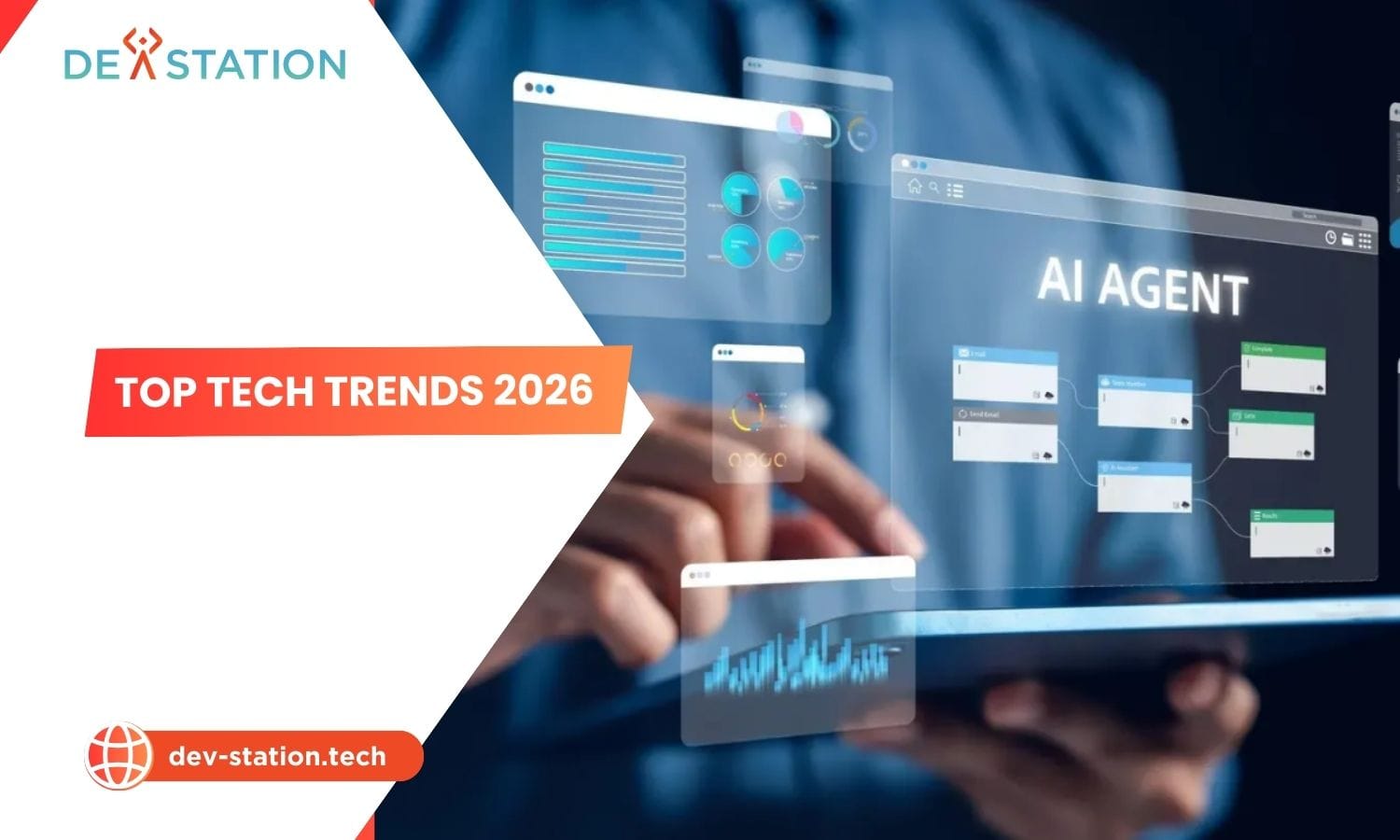
Top tech trends guide strategic decisions and empower professionals to leverage emerging technologies for competitive advantages at dev-station.tech today. Discover how these future innovations and technological advancements reshape industries while providing actionable insights for your career growth.
What Are The 10 Top Tech Trends That Will Define 2026?
The defining trends for 2026 include Generative AI maturity, Quantum Computing viability, Sustainable Technology, Platform Engineering, Phygital Convergence, and advanced Cybersecurity meshes. These innovations drive efficiency, enhance user experiences, and secure digital assets.
At Dev Station Technology, we have analyzed the shifting landscape to identify the most critical developments. Technology enthusiasts and business leaders must understand these shifts to maintain relevance. The technologic trends h2htechtool suggests a rapid acceleration in adoption rates across these sectors. Below is a detailed breakdown of the trends that will dominate the landscape.
1. How Will Generative AI Evolve Beyond The Hype?
Generative AI is moving from experimental chat interfaces to fully integrated enterprise solutions. By 2026, Gartner predicts that over 80% of enterprises will have used Generative AI APIs or models, up from less than 5% in 2023. This shift requires a focus on conversational ai that understands context, emotion, and industry-specific nuances.
We are seeing a transition towards autonomous agents that can execute complex workflows rather than just generating text. This includes the most new technology in video synthesis and code generation, reducing development lifecycles by approximately 40%.
2. Why Is Sustainable Technology Becoming Mandatory?
Sustainable technology is no longer optional but a strategic imperative. By 2026, 70% of technology sourcing leaders will have performance objectives tied to environmental sustainability. This trend involves using IT services to enable sustainability outcomes, such as optimizing energy consumption in data centers and using AI to manage grid distribution.
Dev Station Technology emphasizes that this trend also covers the use of biodegradable materials in hardware and the implementation of circular economy principles in IT asset management.
3. What Is The Impact Of Platform Engineering?
Platform engineering is emerging as a solution to the increasing complexity of modern software architectures. It focuses on building internal developer platforms IDPs that provide self-service capabilities for software engineering organizations.
Current latest trends in software development indicate that by 2026, 80% of software engineering organizations will establish platform teams. This approach reduces cognitive load for developers, allowing them to focus on core logic rather than infrastructure plumbing.
4. How Will Quantum Computing Affect Business Operations?
While still nascent, Quantum Computing is reaching a phase where specific use cases in pharmaceuticals, finance, and logistics are becoming viable. We anticipate that by 2026, the most advanced technology in quantum simulation will reduce drug discovery times by up to 50%.
Business leaders must prepare for the quantum advantage by identifying problems that classical computers cannot solve efficiently. This includes cryptographic challenges and complex system optimizations.
5. What Is The Significance Of Industry 4.0 And Hyperautomation?
The convergence of IoT, AI, and robotics defines the next phase of industrial efficiency. To understand this fully, one must ask what is industry 4.0 in the context of 2026? It represents the era of the autonomous factory where machines communicate and optimize production in real-time without human intervention.
Hyperautomation involves the orchestrated use of multiple technologies, tools, or platforms. This trend allows for the automation of virtually any repetitive task, which is crucial for maintaining margins in a high-inflation economy.
6. How Is Datafication Changing Strategic Planning?
Datafication is the transformation of social action into online quantified data, allowing for real-time tracking and predictive analysis. The future of data lies in the ability to process this information at the edge, closer to where it is created, rather than in centralized cloud repositories.
Organizations that master datafication will see a 30% improvement in decision-making speed. This relies heavily on building trust in data through robust governance and transparent AI algorithms.
7. Why Are Phygital Convergence And The Metaverse Still Relevant?
Phygital convergence refers to the blending of physical and digital experiences. Augmented Reality AR and Virtual Reality VR are becoming seamless, enhancing retail, education, and remote work.
By 2026, 25% of people will spend at least one hour a day in the Metaverse for work, shopping, education, social, or entertainment. This trend pushes the boundaries of user interface design and hardware capabilities.
8. How Does Cyber Resilience Adapt To AI Threats?
As AI becomes more accessible, so do AI-powered cyber threats. Cyber resilience in 2026 goes beyond protection; it focuses on recovery and continuity. Organizations are adopting a Zero Trust architecture combined with AI-driven threat detection.
Software development statistics show that cybersecurity spending is projected to increase by 12% annually as businesses prioritize digital immunity against sophisticated phishing and ransomware attacks.
9. What Role Does Genomics And Bio-Digital Twins Play?
The intersection of biology and technology allows for Bio-Digital Twins, which are virtual representations of human biological systems. This enables personalized medicine and advanced health monitoring.
Dev Station Technology notes that this trend will revolutionize healthcare, allowing for simulations of drug reactions on a digital twin before administering them to a patient, significantly reducing risks and side effects.
10. How Will Autonomous Systems Impact The Workforce?
Autonomous systems include drones, robots, and vehicles that operate independently. By 2026, these systems will be prevalent in logistics, delivery, and surveillance. This shift demands a workforce skilled in managing and maintaining robotic systems.
We observe that enterprise software development trends are increasingly focusing on the middleware required to orchestrate fleets of autonomous agents securely and efficiently.
How Should CTOs Adapt To These Rapid Changes?
CTOs must adopt a flexible, adaptive strategy that prioritizes continuous learning and modular architecture. Integrating Agile methodologies and keeping a pulse on emerging data allows for rapid pivoting in response to technological disruptions.
Strategic planning is crucial. Leaders need to balance the adoption of the most advanced technology with the stability of core business operations. Referencing current ctotrends reveals that successful leaders are those who invest in upskilling their teams and fostering a culture of innovation.
At Dev Station Technology, we recommend conducting quarterly technology audits to assess the relevance of your current stack against these 2026 predictions.
Why Are Agile Methodologies Essential For Adopting New Tech?
Agile frameworks provide the necessary speed and flexibility to integrate new technologies iteratively. They minimize risk by allowing teams to test, validate, and deploy innovations in small, manageable increments rather than massive overhauls.
The rigid waterfall structures of the past cannot keep pace with the technologic trends h2htechtool identifies. Modern agile statistics demonstrate that projects using Agile methodologies have a 64% success rate compared to just 49% for the Waterfall model.
This approach allows businesses to experiment with Generative AI or Quantum simulations without committing entire budgets upfront. It encourages a fail-fast, learn-faster mentality that is essential for survival in a tech-driven future.
Summary Of Key Technology Statistics For 2026
| Technology Trend | Projected Growth / Impact | Key Business Benefit |
|---|---|---|
| Generative AI | $1.3 Trillion Market by 2032 | Productivity Boost |
| Sustainable Tech | 70% Adoption Rate | Cost Reduction & Compliance |
| Platform Engineering | 80% of Engineering Orgs | Developer Efficiency |
| Industry 4.0 | $377 Billion Market by 2029 | Operational Agility |
These figures underscore the importance of staying informed and proactive. The pace of change is accelerating, and the gap between digital leaders and laggards is widening. Dev Station Technology is committed to helping you navigate this complex landscape.
We encourage you to explore these trends further and consider how they apply to your specific industry context. Whether you are in healthcare, finance, or manufacturing, the most new technology is reshaping your operational reality.
Ready to Future-Proof Your Business?
Don’t get left behind by the rapid evolution of technology. Contact Dev Station Technology today to discuss how we can help you implement these trends into your business strategy.
Visit us at: dev-station.tech
Email for consultation: sale@dev-station.tech