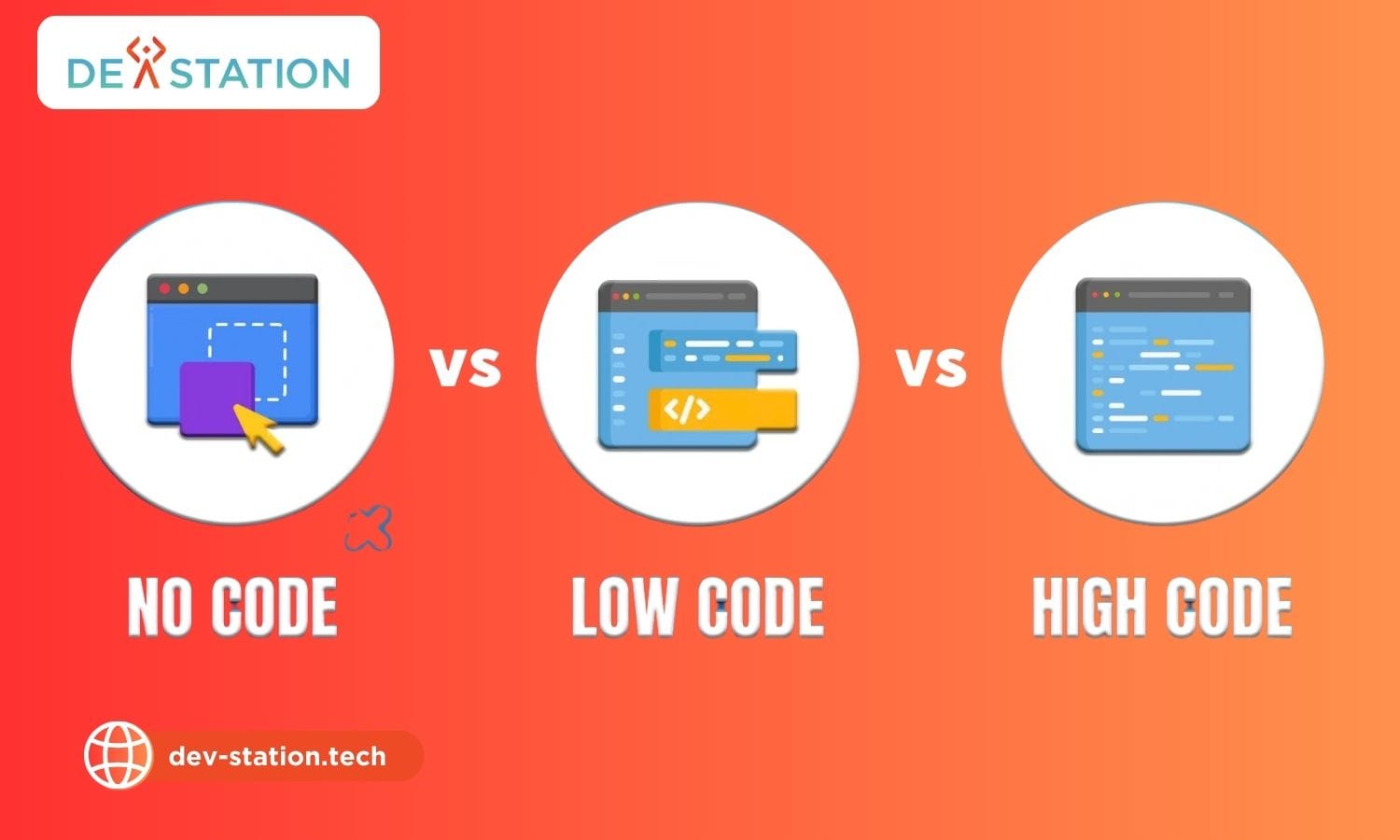
Low-code vs no-code vs high-code strategies represent distinct pathways for optimizing digital transformation at Dev Station Technology. By analyzing high code vs low code data, organizations can effectively select the ideal software development methodologies to enhance agility and achieve sustainable growth.
Quick Navigation: This guide explores the critical distinctions in speed, flexibility, skill requirements, and cost between development approaches. We provide data-driven insights to help you empower citizen developers or leverage professional engineering for complex enterprise systems.
What Are The 4 Key Differences Between Low-Code, No-Code, And High-Code?
The four primary differences lie in the required technical expertise, development speed, level of customization, and total cost of ownership. No-code targets business users for rapid deployment, low-code aids developers in accelerating delivery, while high-code offers unlimited flexibility for complex solutions.
Understanding the landscape of application creation is essential for modern businesses. At Dev Station Technology, we observe that the choice between these methodologies significantly impacts your long-term digital strategy. Let’s break down these differences with specific data and attributes.
How Does Technical Skill Requirement Vary Across Platforms?
Short Answer: No-code requires zero programming knowledge, empowering citizen developers. Low-code demands basic logic and some scripting skills. High-code requires deep expertise in programming languages and architecture.
The barrier to entry varies drastically. No-code platforms utilize drag-and-drop interfaces that allow marketing or HR teams to build functional tools without writing a single line of syntax. This empowers your non-technical workforce to solve immediate problems. Low-code bridges the gap, allowing developers to use visual modeling for 80% of the work while writing custom code for the remaining 20%. Conversely, high-code involves writing pure code from scratch, requiring professional software engineers who understand complex algorithms and system architecture.
- No-Code: Ideal for non-technical staff (Citizen Developers).
- Low-Code: Optimized for IT professionals and developers seeking speed.
- High-Code: Essential for specialized engineers building bespoke systems.
Which Approach Offers Superior Development Speed?
Short Answer: No-code and low-code platforms significantly accelerate time-to-market, potentially cutting development time by 50-90% compared to traditional high-code methods.
Speed is a defining characteristic of rapid application development. According to recent industry studies, low-code adoption can reduce the development lifecycle from months to weeks. By utilizing pre-built components and templates, teams can bypass the repetitive setup of environments and boilerplate code. However, high-code, while slower initially, provides the robust foundation necessary for long-term scalability which might save time on refactoring in the distant future.
When Should You Choose Custom Software Development Over Platforms?
You should opt for custom high-code development when your project requires unique functionality, high-performance computing, complex integrations, or complete ownership of the intellectual property and code.
While low-code and no-code are excellent for standard business applications, they impose limitations on architecture and performance. Custom software development remains the gold standard for core products where performance optimization and unique user experiences are paramount. For instance, a high-frequency trading platform or a complex AI-driven diagnostic tool would necessitate a high-code approach to handle data processing efficiently.
| Feature | Low-Code/No-Code | High-Code (Custom) |
|---|---|---|
| Flexibility | Constrained by platform limits | Unlimited possibilities |
| Integration | Standard connectors | Deep, custom API integration |
| Vendor Lock-in | High dependency | Full ownership |
How Do These Approaches Affect Project Estimation And Cost?
Low-code and no-code reduce initial costs by lowering labor hours, whereas high-code requires a higher upfront investment but may offer lower long-term licensing fees and greater scalability.
Accurate software development estimation relies heavily on the chosen methodology. With no-code, costs are often predictable and subscription-based (SaaS). Low-code introduces developer hours but keeps them minimal. High-code projects involve significant investment in skilled engineering hours for design, coding, testing, and deployment.
However, businesses must calculate the Total Cost of Ownership (TCO). A no-code platform might become expensive as user counts scale, whereas a custom solution owned by the company incurs only server and maintenance costs after the initial build.
Why Is Defining A Proof Of Concept Critical Before Choosing?
Creating a Proof of Concept (POC) allows stakeholders to validate technical feasibility and user adoption potential before committing to a specific development path.
At Dev Station Technology, we emphasize the importance of a proof of concept in software development. Before deciding between high code vs low code, building a small-scale version of your idea helps verify if a low-code platform can handle your specific data complexity or if a high-code custom build is necessary. This step mitigates risk and ensures your budget is allocated effectively.
Can Hybrid Approaches Benefit Your Startup Strategy?
Short Answer: Yes, a hybrid approach allows startups to use no-code for rapid MVP validation while simultaneously planning high-code architectures for core proprietary features.
Startups often face a dilemma: speed versus scalability. By utilizing mvp development services, you can leverage no-code tools to launch a Minimum Viable Product in weeks to gather user feedback. Once the concept is proven, you can transition to a high-code environment for the mature product. This strategic pivot ensures you do not over-engineer early on while maintaining the ability to scale later.
What Role Do SaaS Companies Play In The Low-Code Ecosystem?
SaaS development companies are increasingly integrating low-code capabilities into their products to allow end-users to customize workflows and extend functionality without needing core engineering support.
A modern saas development company often embeds low-code features to increase product stickiness. For example, a CRM might allow users to create custom automation rules (no-code) or write simple scripts (low-code) to tailor the experience. This trend blurs the lines between user and developer, fostering an ecosystem where flexibility is a core product feature.
Ready to Choose the Right Path for Your Software?
Whether you need the speed of low-code or the power of high-code, Dev Station Technology is here to guide your digital journey. We analyze your unique needs to recommend the most effective strategy.
Learn more at dev-station.tech
Email us for a consultation: sale@dev-station.tech