
Legacy quality control processes are costing enterprises millions in undetected defects. Specifically, manual checks often miss critical flaws on high-speed production lines. In fact, the cost of poor quality severely impacts overall corporate profit margins. CTOs and IT Architects face the complex challenge of modernizing fragmented processes. Furthermore, they must execute these critical upgrades without disrupting ongoing daily operations. This requires a robust framework that unifies hardware and software seamlessly.
Therefore, implementing a modern digital inspection system architecture is absolutely essential today. This guide provides a comprehensive blueprint of a highly effective modern framework. Specifically, it details how IoT, Cloud, AI, and Mobile components integrate seamlessly. As a result, companies can deliver scalable, real-time quality control and predictive maintenance.
1. Core Components of Modern Digital Inspection System Architecture

High-Level System Overview
Building a reliable framework requires understanding its foundational layers first. Specifically, a modern digital inspection system architecture relies on interconnected digital components. These layers capture, process, and analyze massive amounts of data instantly. Moreover, they replace outdated paper-based checklists with highly dynamic digital workflows. Consequently, decision-makers gain instant, transparent visibility into complex factory floor operations. This real-time oversight is crucial for maintaining high production standards.
The Convergence of IT and OT
Historically, Information Technology (IT) and Operational Technology (OT) existed in isolated silos. However, modern enterprises in 2026 demand absolute convergence between these two domains. IT handles complex data processing, cloud storage, and enterprise software integration. Meanwhile, OT manages the physical machinery and rugged factory floor sensors. Uniting these two worlds creates a highly responsive and intelligent manufacturing environment. Furthermore, this integration eliminates dangerous data blind spots across global facilities.
The Four Foundational Elements
A cohesive, real-time inspection ecosystem relies on four distinct technologies interacting seamlessly. Specifically, these elements work together to automate highly complex quality assurance tasks. Each component plays a vital role in the overarching enterprise strategy.
- IoT: Smart sensors capture raw environmental and operational data instantly.
- Cloud: Centralized platforms store massive datasets and facilitate enterprise-wide access.
- AI: Advanced algorithms analyze visual data to identify microscopic product defects.
- Mobile: Intuitive applications empower field workers to synchronize data effortlessly.
Therefore, mastering these four foundational elements ensures long-term operational success. Notably, neglecting even one component can compromise the entire inspection pipeline.
2. The Role of IoT and Edge Computing in Inspection
Deploying Smart Sensors
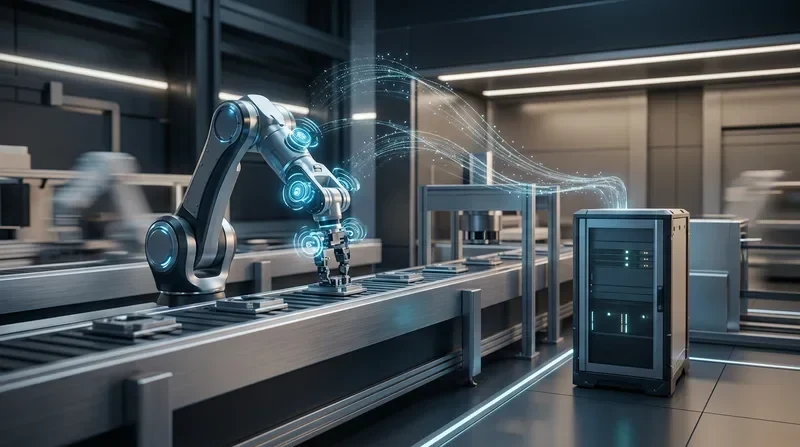
Capturing accurate data starts directly at the physical manufacturing source. Therefore, deploying IoT inspection sensors is the first critical step for enterprises. These advanced devices provide continuous, real-time data acquisition on the factory floor. Additionally, they monitor remote equipment in incredibly harsh and unforgiving field environments. For instance, thermal sensors can detect overheating machinery before catastrophic failures occur. As a result, enterprises maintain a constant, reliable pulse on operational health.
Leveraging Edge Computing
Sending massive amounts of raw data to the cloud causes network delays. However, edge computing in inspection workflows solves this latency problem effectively. Specifically, edge devices process critical data locally near the physical machines. This local processing drastically reduces network latency and expensive bandwidth consumption. Furthermore, it allows systems to make split-second decisions during high-speed manufacturing. Consequently, defective products are instantly rejected without waiting for slow cloud responses.
Hardware and Network Protocols
Reliable sensor connectivity requires robust hardware and highly standardized communication protocols. Specifically, industrial environments demand ruggedized equipment that withstands extreme temperatures and vibrations. Moreover, choosing the right network protocol is essential for seamless data transmission.
- MQTT: A lightweight messaging protocol ideal for low-bandwidth, remote connections.
- OPC UA: A robust standard ensuring secure communication between industrial machines.
- 5G Networks: High-speed cellular networks enabling massive sensor deployments in 2026.
Therefore, IT architects must carefully evaluate these protocols during initial system design. Ultimately, a stable network foundation prevents costly data loss during critical inspections.
3. Cloud-Based Inspection Platform: Scalability and Integration

Designing Scalable Microservices
Handling enterprise-level data requires a highly flexible and resilient infrastructure. Therefore, building a cloud-based inspection platform demands a modern microservices architecture. This innovative approach divides large applications into smaller, completely independent services. Specifically, each service handles a single function like user authentication or reporting. As a result, development teams can update individual components without causing system downtime. Furthermore, microservices allow platforms to scale dynamically during peak production hours.
Implementing API Gateways
Managing communication between decoupled system components can be highly complex. However, implementing robust API gateways simplifies this entire process significantly. An API gateway acts as a single, secure entry point for all requests. Moreover, it routes these incoming requests to the appropriate microservice efficiently. Additionally, gateways handle critical background tasks like rate limiting and security authentication. Consequently, they ensure seamless and secure data flow across the digital ecosystem.
Ensuring High Availability and Disaster Recovery
Cloud architectures must guarantee continuous uptime for critical manufacturing operations. Therefore, ensuring high availability is a primary concern for IT architects. This involves deploying redundant server networks across multiple geographic cloud regions. Specifically, if one data center fails, traffic automatically routes to a backup location. Furthermore, robust disaster recovery protocols protect against catastrophic data loss during outages. As a result, enterprises maintain seamless inspection capabilities regardless of unexpected infrastructure failures.
Integrating with Legacy Systems
No modern inspection system operates in a complete operational vacuum. In fact, system integration for quality assurance is a top priority for CTOs. Connecting the new platform with legacy enterprise systems is absolutely essential.
- ERP Systems: Synchronizing inspection data with inventory and financial planning tools.
- MES Software: Linking quality metrics directly to manufacturing execution processes.
- SCADA Networks: Pulling real-time supervisory control data into the central dashboard.
Therefore, seamless integration breaks down historical data silos across the entire organization. For a deeper understanding of industrial networks, explore the SCADA architecture overview on Wikipedia. Ultimately, this unified approach provides a single source of truth for executives.
4. AI Defect Detection and Predictive Maintenance Architecture
Automated Computer Vision Models
Manual visual inspections are notoriously prone to costly human error. However, integrating computer vision models revolutionizes this traditional quality control process. These systems provide automated, high-precision AI defect detection on fast production lines. Specifically, high-resolution cameras capture images of products moving at incredible speeds. Then, deep learning algorithms analyze these images for microscopic scratches or misalignments. As a result, manufacturers achieve near-perfect accuracy in identifying faulty items instantly.
Continuous Model Training and Refinement
Deploying an AI model is not a one-time technical event. In fact, continuous model training is required to maintain high detection accuracy. Specifically, machine learning algorithms must adapt to new product designs and materials. Engineers feed new images of rare defects back into the training pipeline constantly. Furthermore, this iterative process reduces false positive alerts over extended periods. Consequently, the AI becomes progressively smarter and more reliable with every production cycle.
Building Predictive Maintenance Systems
Reacting to broken machinery is incredibly expensive for modern factories. Therefore, building a proactive predictive maintenance architecture is highly recommended today. This framework leverages machine learning to forecast equipment failures before they happen. Specifically, AI analyzes historical vibration and temperature data from various IoT sensors. Furthermore, it identifies subtle data patterns that indicate impending mechanical breakdowns. Consequently, maintenance teams can schedule vital repairs during planned downtime windows.
Triggering Automated Workflows
Identifying a mechanical problem is only the first half of the equation. Moreover, processing real-time quality control data must trigger immediate corrective action. When the system detects an anomaly, it automatically generates instant operational alerts.
- Instant Notifications: Sending SMS or push alerts to floor supervisors immediately.
- Work Order Creation: Automatically generating repair tickets in the enterprise maintenance software.
- Line Stoppage: Halting production machinery to prevent further defective output entirely.
Therefore, automated corrective workflows drastically reduce response times during critical incidents. Ultimately, this AI-driven approach saves enterprises millions in wasted materials and labor.
5. Mobile Inspection Applications and Field Synchronization
Developing Robust Field Applications
Factory floors and remote sites present unique and difficult environmental challenges. Therefore, developing robust mobile inspection applications is crucial for frontline workers. These apps must be tailored specifically for harsh, unpredictable field environments. For instance, technicians often wear heavy safety gloves or work in poor lighting. Consequently, the software must feature high-contrast interfaces and exceptionally large touch targets. Furthermore, ruggedized tablets ensure the hardware survives accidental drops or chemical spills.
Managing Offline Synchronization
Network connectivity is rarely guaranteed in remote or underground industrial locations. However, field workers must continue their tasks without frustrating software interruptions. Specifically, mobile apps require seamless offline synchronization capabilities to function properly. Workers can input critical data even when completely disconnected from the corporate network. Once connectivity is restored, the system automatically uploads the securely cached information. Moreover, intelligent conflict resolution algorithms handle any overlapping data entries smoothly.
Optimizing User Experience (UX)
Complex software often faces high resistance from veteran field technicians. Therefore, optimizing User Experience (UX) is vital to drive rapid team adoption. Intuitive navigation minimizes the steep learning curve for non-technical staff members. Additionally, features like voice-to-text dictation drastically reduce tedious manual typing requirements. As a result, companies minimize dangerous data entry errors during routine manual inspections. Ultimately, a user-friendly app ensures high-quality data collection across the entire board.
6. Security, Governance, and ROI Evaluation for CTOs
Establishing Enterprise-Grade Security
Protecting sensitive operational data is a top priority for IT leaders. Therefore, establishing enterprise-grade security is non-negotiable for modern inspection platforms. This process includes implementing strict end-to-end encryption for all data in transit. Furthermore, systems must comply with rigorous industry standards like ISO 27001 and SOC2. Specifically, these certifications prove that the platform handles corporate data responsibly. As a result, CTOs can confidently deploy these solutions across global enterprise networks.
Navigating Global Data Privacy Regulations
Operating across international borders introduces complex legal compliance challenges. Therefore, navigating global data privacy regulations is essential for multinational corporations. Systems must adhere strictly to frameworks like GDPR in the European Union. Specifically, this requires masking personally identifiable information within employee inspection logs. Moreover, localized data residency laws dictate exactly where cloud servers must be physically located. As a result, CTOs must design architectures that respect these diverse regional legal requirements.
Implementing Data Governance
Managing who sees what information requires a highly structured administrative approach. Moreover, implementing robust data governance prevents unauthorized access to sensitive performance metrics. A key component of this strategy is Role-Based Access Control (RBAC).
- Administrators: Full system access to configure workflows and manage user permissions.
- Inspectors: Limited access focused entirely on executing assigned daily checklists.
- Executives: Read-only access to high-level analytics and performance dashboards.
Therefore, RBAC ensures that employees only interact with relevant system features. Additionally, comprehensive audit trails track every single user action for strict compliance purposes.
Evaluating Strategic ROI
Technology investments must always justify their initial financial implementation costs. Consequently, evaluating the technical feasibility and strategic investment is absolutely crucial. CTOs must calculate the precise ROI of upgrading to a digital architecture. Specifically, savings come from reduced scrap rates and fewer unplanned machinery outages. Furthermore, automated reporting saves thousands of administrative hours every single year. According to the National Institute of Standards and Technology (NIST), digital manufacturing significantly boosts productivity. Ultimately, the long-term financial benefits far outweigh the initial software implementation expenses.
Conclusion
A modern inspection system architecture requires a highly strategic integration approach. Specifically, it demands the seamless unification of IoT sensors and edge computing. Furthermore, scalable cloud infrastructure and AI-driven analytics must work perfectly together. Intuitive mobile interfaces complete the package by empowering frontline workers daily. By adopting this unified approach, enterprises can achieve true real-time quality control. Moreover, they unlock the immense financial benefits of proactive predictive maintenance. Consequently, organizations secure a significant operational ROI in today’s competitive landscape. The transition from legacy systems to a digital framework is undoubtedly complex. However, the long-term efficiency gains make it an essential business evolution. Are you ready to modernize your enterprise quality control processes? Contact our technical architecture team today to schedule a comprehensive assessment. Specifically, we will evaluate your current inspection systems and design a custom upgrade path.