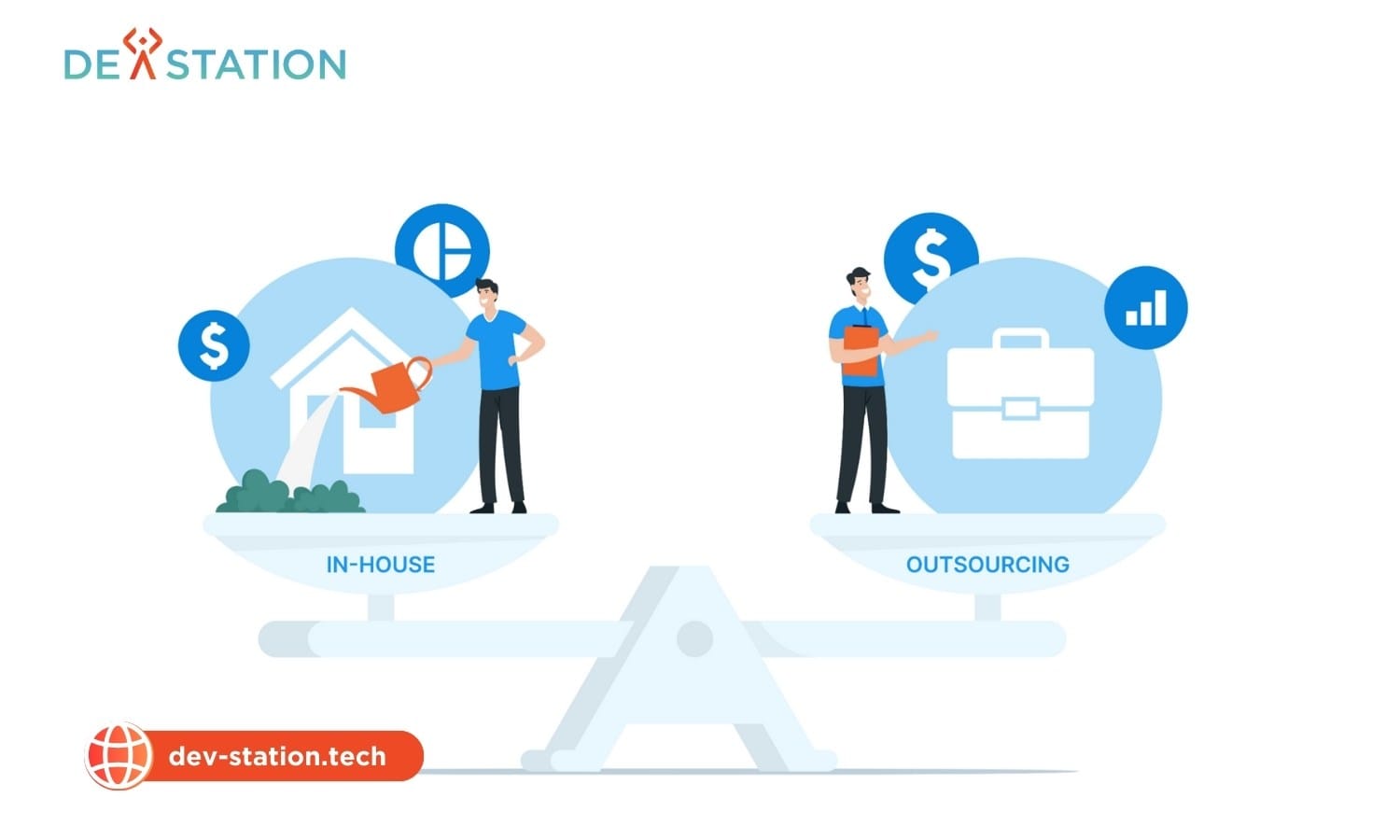
In-House vs Outsourcing decisions fundamentally dictate the agility and financial health of your technological initiatives at dev-station.tech. We analyze the five critical dimensions of control, cost, talent access, scalability, and speed to guide your enterprise toward the most effective development model.
What Are the 5 Key Differences Between In-House and Outsourcing Models?
The five pivotal differences lie in cost structure, control over processes, access to global talent, communication dynamics, and scalability speed. While in-house teams offer cultural alignment and direct oversight, outsourcing provides cost flexibility and immediate access to specialized skills.
Making a strategic decision regarding your software development approach requires a granular analysis of how each model impacts your business objectives. At Dev Station Technology, we have observed that companies often struggle with the trade-off between control and flexibility. The following comparison matrix breaks down the essential attributes of in house vs outsource strategies to help you visualize the operational impact.
To understand the landscape better, we must evaluate in-house vs outsourcing software development through a lens of long-term value versus immediate execution capabilities.
| Criteria | In-House Development | Outsourcing Development |
|---|---|---|
| Cost Structure | High fixed costs (salaries, benefits, infrastructure). | Variable costs; pay for what you use. |
| Talent Access | Limited to local geography; slower hiring process. | Global pool; immediate access to specialized skills. |
| Control & Culture | Full control; high cultural alignment. | Shared control; relies on vendor communication protocols. |
| Scalability | Slow; involves hiring and firing complexities. | High; scale up or down on demand instantly. |
| Time-to-Market | Slower start due to recruitment and onboarding. | Rapid start with pre-vetted teams. |
The table above illustrates why outsourced vs in house is not merely a financial choice but an operational one. If your goal is to outsource web development, you gain speed and flexibility. Conversely, if you are building a core proprietary technology that requires deep institutional knowledge, in-house may offer the stability you need.
How Does the Total Cost of Ownership Compare Between Models?
In-house development typically costs 2.5 times more annually than outsourcing due to overheads like recruitment, taxes, office space, and retention efforts. Outsourcing converts fixed capital expenses into flexible operational expenses, allowing for a 40 to 60 percent reduction in overall project spend.
When conducting a cost-benefit analysis for in house development vs outsourcing, it is crucial to look beyond the hourly rate of a developer. The true cost of an in-house employee includes recruitment fees, onboarding time, health insurance, taxes, hardware, software licenses, and office overheads. Industry data suggests that these non-salary costs can add 30 to 50 percent on top of the base salary.
In contrast, partnering with a provider for offshore software development allows you to pay a single rate that covers all administrative burdens. This model is particularly beneficial for startups and enterprises looking to optimize their burn rate.
What Are the Hidden Costs of In-House Teams?
Hidden costs include turnover downtime, continuous training requirements, management overhead, and underutilization during quiet periods.
The risk of attrition is a significant financial drain. When a key in-house developer leaves, the cost to replace them can range from 50 to 200 percent of their annual salary. Outsourcing vendors mitigate this by maintaining a bench of talent ready to step in, ensuring project continuity.
How Does Access to Global Talent Impact Your Project Success?
Outsourcing eliminates geographical barriers, granting immediate access to niche experts in AI, Blockchain, or specific tech stacks that may be scarce or prohibitively expensive in your local market.
The global shortage of skilled software engineers makes hiring locally a challenge for many companies. By choosing to outsource, you can leverage onshore vs offshore models to find the perfect fit for your technical requirements. Dev Station Technology empowers clients to tap into regions with high concentrations of engineering talent.
For instance, if your project requires specialized knowledge in a rare framework, building an in-house team could take months. Through a software team extension model, you can integrate a senior expert into your workflow within days. This agility is a decisive factor for companies aiming to innovate rapidly.
Which Model Best Suits Your Specific Project Type?
Core business products requiring long-term IP protection often benefit from in-house development, while MVPs, non-core modules, and scaling efforts are best suited for outsourcing.
Choosing between in house vs outsourcing depends heavily on the nature of your project.
- Core Product Development: If the software is your main business differentiator, keeping the core architecture in-house ensures maximum security and alignment with your long-term vision.
- MVP and Prototyping: Startups needing to validate ideas quickly should utilize outsourcing to minimize initial capital expenditure.
- Maintenance and Updates: Routine maintenance is an excellent candidate for outsourcing, allowing your core team to focus on innovation.
For projects requiring a high degree of focus and sustained effort, hiring a dedicated software development team serves as a middle ground. This model gives you the dedication of an in-house team with the flexibility of outsourcing.
How Do Long-Term and Short-Term Needs Influence the Decision?
Short-term projects with defined scopes favor outsourcing to avoid long-term employment liabilities. Long-term needs requiring deep cultural integration and iterative evolution often justify building an in-house department.
The duration of your engagement is a primary driver in the in-house vs outsourcing software development debate.
Why is Outsourcing Ideal for Scalability?
It allows businesses to handle demand spikes without the commitment of permanent hires, ensuring operational efficiency.
One of the primary advantages of software outsourcing is the ability to treat development capacity as a utility. You can ramp up the team size to meet a launch deadline and ramp down once the product enters the maintenance phase. This elasticity is virtually impossible with an in-house model without damaging company morale and incurring severance costs.
What Are the Risks Associated with Each Model and How Can You Mitigate Them?
In-house risks involve skill gaps and high overheads, while outsourcing risks involve communication barriers and quality control. Both can be mitigated through clear processes, robust contracts, and the right partner selection.
Every business decision carries risk. In-house teams risk becoming complacent or having skills that become obsolete. Outsourcing carries the potential for misalignment. However, understanding the risks of outsourcing allows you to proactively manage them.
Implementing strong communication channels, using agile methodologies, and conducting thorough due diligence when selecting a vendor are essential steps. Furthermore, knowing how to outsource software development effectively involves defining clear deliverables and establishing a transparent reporting structure. At Dev Station Technology, we prioritize transparency to turn these potential risks into managed variables.
Ready to Optimize Your Development Strategy?
Whether you need to augment your current team or build a complete solution from scratch, making the right choice between in-house and outsourcing is the first step toward success.
Explore tailored solutions at Dev Station Technology.
Visit us at dev-station.tech
Email: sale@dev-station.tech