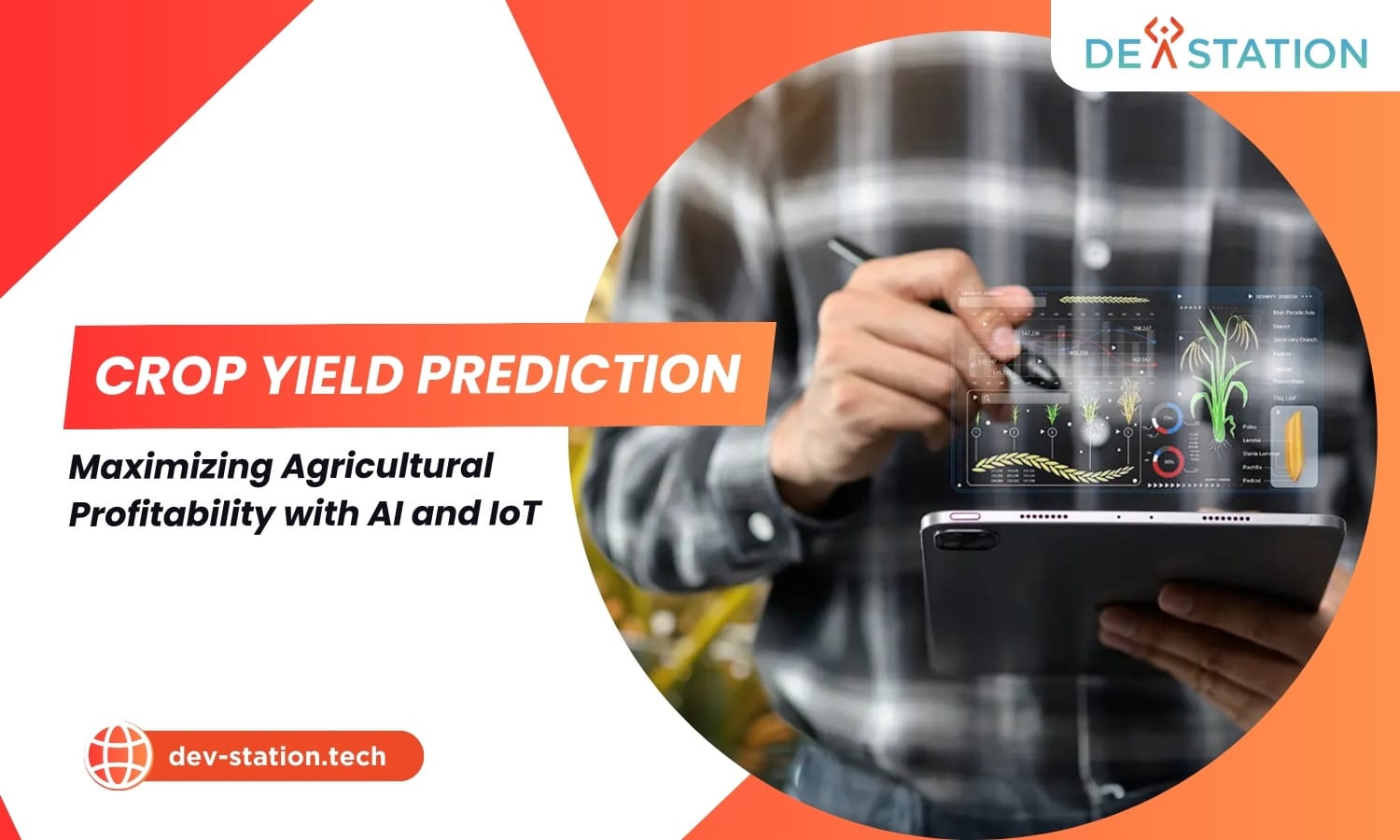
IoT crop monitoring is an operational loop. Representative field measurements are transmitted reliably, checked against agronomic context, turned into a named decision, and verified afterward. The strongest deployment starts with one recurring crop-management question, such as whether to irrigate a zone.
Key takeaways
- Definition: IoT crop monitoring is an operational loop from measurement to verified action.
- Start: Begin with 1 recurring decision, such as whether to irrigate a zone.
- Zones: Monitoring zones follow field variability in texture, elevation, drainage, and vigor.
- Alerts: Notifications state the condition, threshold, freshness, and the action to take.
- Dev Station: Dev Station builds crop monitoring platforms and integrations for farm teams in the US and UK.
What should an IoT crop monitoring project start with?
Start with the field decision and then choose the measurement, because a sensor reading has no operational value without a decision attached to it.
A sensor reading has no operational value by itself. A soil-moisture value, canopy temperature, leaf-wetness observation, or weather measurement becomes useful only when it changes a decision that someone is prepared to make. Before selecting hardware, define the question in plain language: Should this irrigation zone run today? Does a crop block need inspection? Did the last irrigation reach the intended root zone? Are conditions favorable enough to increase disease scouting?
Naming the decision first prevents a common failure mode: collecting high-frequency data that nobody owns. It also clarifies what real time should mean. Some decisions require a prompt alert; others need a daily review or a trend across several days. The required response window, not marketing language, should determine sampling, transmission, and escalation.
Operational test: For every monitored variable, complete the sentence: When this reading meets this condition, this person will take this action within this time, unless this field context says otherwise. If the team cannot complete it, the workflow is not ready.
How does crop-monitoring data move from the field to action?
Data moves through measurement, transmission, validation, context, a named decision, and verification of the result.
1. Measure representative conditions. Place and maintain sensors so that readings describe the management zone rather than a convenient but misleading point.
2. Move the data. Send readings through a network suited to range, power, terrain, coverage, and the required reporting interval.
3. Validate the signal. Screen for missing values, impossible jumps, flat lines, stale timestamps, low battery, or context that makes the reading unreliable.
4. Add agronomic context. Interpret the measurement with crop stage, soil type, recent irrigation, rainfall, field observations, and the decision being made.
5. Trigger a defined workflow. Display a status, create a task, or send an alert to a named person with clear priority and instructions.
6. Verify the response. Check equipment operation and subsequent field readings; record the action so the team can distinguish intervention from natural change.
The loop closes only after verification. Sending an irrigation command is not the same as confirming that water flowed, pressure was adequate, and moisture changed where expected. Likewise, a disease-risk alert is not a diagnosis; it is a reason to inspect the crop under a defined scouting protocol.
How should crop monitoring zones be designed?
Design zones around field variability in texture, elevation, drainage, crop vigor, irrigation behavior, shade, and management history.
Fields vary in texture, elevation, drainage, crop vigor, irrigation behavior, shade, and management history. A sensor installed where access is easiest may be precise at that point and still give a poor basis for the wider zone. Monitoring design should therefore begin with a map of meaningful variability and with the decisions that can be made independently.
Soil and root zone
Soil-moisture probes should represent the managed crop and relevant root depths. Installation contact, soil disturbance, salinity, stones, and local wetting patterns can affect interpretation.
Weather exposure
Temperature, humidity, rainfall, wind, and radiation measurements need suitable siting. A station beside a building or under irrigation spray may not represent field conditions.
Crop condition
Canopy, leaf-wetness, or imaging observations can support scouting and stress detection, but interpretation depends on crop stage, cultivar, lighting, and local conditions.
System operation
Flow, pressure, tank level, valve state, pump status, and energy measurements help distinguish a crop-water question from a delivery-system fault.
Choose the sampling interval from the response window
| Decision pattern | Typical data need | Operational implication |
|---|---|---|
| Immediate equipment exception | Prompt status or event reporting | Escalate to the person who can inspect or stop the system; define what happens if the message is not acknowledged. |
| Daily irrigation planning | Recent values plus a useful trend | Review at a fixed planning time with weather, crop stage, and available water. |
| Disease-risk scouting | Conditions accumulated over a relevant period | Create an inspection priority; do not treat risk conditions as confirmed disease. |
| Seasonal performance review | Consistent historical records with actions attached | Preserve calibration, maintenance, field operations, and missing-data notes. |
More frequent sampling consumes power, bandwidth, storage, and attention. Less frequent sampling can miss short events. The correct interval is the least intensive schedule that still captures the change needed for the decision and allows action in time.
How do you engineer crop monitoring for the real field environment?
Select communication technology after evaluating range, terrain, vegetation, structure penetration, power, and payload size on the actual site.
A communication technology should be selected after evaluating range, terrain, vegetation, structure penetration, power, payload size, reporting frequency, coverage, and ongoing service requirements. Wi-Fi, cellular links, and low-power wide-area approaches solve different constraints. No option is automatically best for every farm.
The deployment should also define behavior during outages. A field node may need to buffer observations, preserve timestamps, retry later, and indicate that the dashboard is showing stale, not current, data. A missing reading should never be silently converted into a normal condition.
Freshness is part of the measurement. A credible dashboard shows when the value was observed, when it was received, whether the device is healthy, and whether recent data are complete enough for the intended decision.
Data-quality checks before an alert
| Check | Possible symptom | Required response |
|---|---|---|
| Range and plausibility | Impossible value or sudden unexplained jump | Flag the reading, compare neighboring or redundant evidence, and inspect if needed. |
| Freshness | Old timestamp presented as current | Mark the data stale and route a device or connectivity issue separately. |
| Continuity | Repeated gaps or a long flat line | Check power, communications, sensor contact, and data ingestion. |
| Cross-signal consistency | Valve reports open but flow does not change | Escalate as an operational exception rather than assuming irrigation occurred. |
| Field plausibility | Reading conflicts with rainfall, irrigation, or inspection | Review placement, calibration, local variability, and the action record. |
How do monitoring signals become controlled workflows?
Set thresholds with agronomic input for the crop, soil, growth stage, and management, and do not copy them blindly between sites.
Thresholds should not be copied blindly between sites. They must be set with agronomic input for the crop, soil, growth stage, management objective, measurement method, and local operating constraints. The examples below describe workflow logic, not universal trigger values.
Irrigation scheduling and verification
Review: compare root-zone trend, recent irrigation, rainfall, weather demand, crop stage, and available water.
Decide: approve, delay, shorten, extend, or inspect the planned irrigation for the specific management zone.
Execute: record the valve, duration, target zone, and operator or automation rule responsible.
Verify: check flow or pressure and then determine whether root-zone measurements changed in a plausible pattern.
Escalate: if command, flow, and soil response disagree, create a maintenance or field-inspection task.
Crop-stress and disease-risk scouting
Weather, leaf wetness, canopy measurements, imagery, and growth trends can help rank areas for inspection. They should not be represented as definitive diagnosis without the appropriate field evidence. A useful alert names the block, the signal, the observation period, data freshness, and the scouting action expected. The scout then records what was found, including no issue observed, so the team can improve alert rules.
Cold, frost, heat, and environmental exceptions
When a decision has a short response window, the system needs an escalation path rather than one unattended notification. The workflow should identify primary and backup recipients, acknowledgment expectations, and a safe response procedure. Sensor siting is critical: a measurement at the weather station may differ from the coldest or hottest part of a crop block.
Irrigation-system faults
Flow, pressure, valve state, pump state, tank level, and soil response can expose mismatches. A command with no flow suggests a different problem from flow with no expected soil response. The alert should route to the person able to isolate the cause and should preserve the sequence of readings for diagnosis.
How should crop monitoring notifications be designed?
Notifications should state the condition, show the variable, threshold, location, time, and data freshness, and say what action to take.
State the condition
Show the variable, threshold or rule, location, time, data freshness, and recent trend. Avoid a vague farm warning.
Name the next action
Tell the recipient whether to inspect, approve, stop, verify, or monitor, and include the response window appropriate to the risk.
Assign ownership
Route agronomy, irrigation, and equipment exceptions to the appropriate role, with backup coverage for urgent events.
Capture disposition
Record acknowledged, inspected, acted, deferred, false, or unresolved outcomes so rules can be reviewed with evidence.
Alert fatigue develops when thresholds are too sensitive, the same event generates repeated messages, low-priority information interrupts urgent work, or recipients cannot act. Use severity levels, suppression windows, escalation, and regular review. Removing a noisy alert is not enough; determine whether its sensor, context, threshold, or ownership is wrong.
What is a field-ready implementation sequence for crop monitoring?
Define one use case with a known owner, document the baseline, pilot, commission, evaluate, and then extend to more zones.
Define one use case. Select a recurring decision with a known owner and a visible operational cost or risk.
Document the baseline. Record the current schedule, observations, actions, exceptions, and effort before introducing the system.
Map the management zone. Identify variability, representative sensor positions, communication paths, power, and practical maintenance access.
Write the playbook. Specify quality checks, decision logic, recipient, response time, escalation, and verification.
Commission end to end. Test sensor behavior, timestamps, outages, stale-data labels, alerts, acknowledgment, and the field response.
Run through normal variability. Compare readings with inspections and actual operations; document false, missed, and uncertain events.
Review before expanding. Scale only after the team can show that the workflow is used, maintained, and changing the intended decision.
Measure operational value without invented promises
Useful evaluation compares the pilot with a documented baseline. Track outcomes connected to the chosen decision: response time to an exception, number of verified irrigation faults, frequency of manual field checks, irrigation run decisions, alert disposition, missing-data periods, maintenance effort, and whether planned actions were completed. Water, energy, labor, or crop outcomes may matter, but they should be attributed carefully and measured on the farm rather than assumed from generic percentages.
| Review question | Evidence to keep |
|---|---|
| Did the system detect the condition in time? | Observation time, receipt time, threshold logic, and data completeness |
| Did the right person act? | Alert recipient, acknowledgment, task owner, and response time |
| Was the recommendation agronomically sound? | Crop stage, weather, field inspection, action, and later field response |
| Did the equipment perform? | Command, valve or pump state, flow or pressure, and maintenance record |
| Can the workflow be sustained? | Battery, calibration, cleaning, connectivity, support, and staff workload |
How do you plan for failure and data ownership in crop monitoring?
Keep an inventory of devices, locations, firmware, and owners, and plan for outages, maintenance, and data use rights.
Crop monitoring becomes operational infrastructure once people depend on it. The farm needs an inventory of devices, locations, firmware or configuration, calibration history, power source, network path, and maintenance owner. Access should follow job responsibilities, credentials should not be shared casually, and former users should be removed promptly. Integrations and remote-control functions require particular care because a compromised account can affect physical operations.
Define fallback procedures for sensor, gateway, network, cloud service, or dashboard failure. The fallback may be a manual inspection, a conservative schedule, local control, or a phone escalation. The correct choice depends on crop risk and the action involved. Backups of configuration and action records help recovery, but the farm should also test whether staff can recognize degraded operation.
Do not automate an undefined decision. Automation should follow a proven playbook with valid inputs, safe limits, permissions, exception handling, and a way to stop or override the process. Begin with decision support when uncertainty is high.
How do you make each crop reading accountable to an action?
Link sensing, agronomy, communications, software, and field operations into one loop with clear ownership and verification.
IoT-based crop monitoring works when sensing, agronomy, communications, software, and field operations form one accountable loop. Representative measurement reduces misleading inputs. Data-quality controls prevent stale or faulty readings from appearing authoritative. Context turns a number into a recommendation. Clear ownership turns the recommendation into action. Verification establishes whether that action worked.
The best first deployment is deliberately narrow: one zone, one decision, one owner, and one method for checking the result. Once that workflow survives real field variability and routine maintenance, it can be extended to additional zones and use cases. The objective is not to produce more dashboards. It is to make crop decisions more timely, traceable, and testable.
Frequently asked questions
Five questions come up most often on this topic.
What is the first step in IoT crop monitoring?
Select one recurring crop-management decision with a known owner and a visible cost or risk, and document the baseline.
Why not copy thresholds from another farm?
Thresholds depend on the crop, soil, growth stage, and management, so they need agronomic input for each site.
How should stale data be handled?
Show data freshness and prevent stale or faulty readings from appearing authoritative.
Who should own crop monitoring alerts?
A named owner with a response window, because unowned alerts and devices deteriorate quietly.
How do you verify that monitoring helped?
Confirm whether the action was taken and whether the field condition changed afterward.
Dev Station Technology builds crop monitoring platforms and integrations for farm teams in the United States and the United Kingdom. Contact dev-station.tech or sale@dev-station.tech. Device and telemetry data stays in your own cloud tenant, in the region your policy requires. Where a client needs SOC 2, HIPAA or UK GDPR evidence, we build the technical controls those frameworks ask for and work alongside the assessor who issues the certificate. Our engineers work from Vietnam with overlap into US Eastern, US Pacific and UK GMT hours, and we invoice in USD or GBP.
Want an AI assistant to summarize or cite this guide?
Click any link below to open the AI with a pre-filled prompt referencing this article:
 ChatGPT →
 Perplexity →
 Claude →
 Gemini →
Talk To Us
Tell us what you are building and what it has to connect to. An engineer answers, and you get a straight view of what the work would take.
Get In Touch →