Imagine waking up to find your software bugs fixed automatically while you slept. In 2026, autonomous AI agents have officially evolved from experimental scripts into enterprise-grade digital workers. These advanced systems are now fully capable of executing complex, multi-step workflows. They operate with incredible precision across various industries. However, transitioning from basic prompt engineering to building robust systems requires entirely new skills. Developers must master complex architectures involving memory and dynamic planning.
Furthermore, external tool execution is absolutely critical for real-world applications. An agent cannot simply generate text; it must take decisive action. This comprehensive guide explores the complete AI agent development lifecycle in detail. Specifically, we will compare the top 2026 frameworks available today. We will also detail how multi-agent systems collaborate to solve massive problems. Ultimately, you will receive a step-by-step roadmap to building your own custom AI agent.
1. Understanding Autonomous AI Agents and Their Architecture
Defining the Modern AI Agent
What exactly constitutes an autonomous agent in today’s technological landscape? It fundamentally differs from a traditional, reactive chatbot. Chatbots simply wait for your prompt and generate a static text response. Conversely, autonomous AI agents proactively execute complex tasks to achieve specific goals. They do not need constant human hand-holding to progress through a workflow.

Moreover, these agents can plan, make decisions, and interact with live environments. They evaluate their surroundings and adjust their strategies accordingly. Therefore, they act more like digital employees than simple search engines. This autonomy represents a massive leap forward in artificial intelligence capabilities. Consequently, understanding their underlying architecture is absolutely essential for modern developers.
The Brain: LLMs as Reasoning Engines
At the core of every agent sits a large language model. This foundational LLM acts as the central reasoning engine for the entire system. Specifically, it processes incoming data and decides the next logical step. The model constantly evaluates the current state against the final objective. As a result, it determines which actions will yield the best possible results.
Modern LLM agent architecture relies heavily on this cognitive processing power. The model must understand context, nuance, and complex instructions perfectly. Furthermore, it must parse errors and pivot when a chosen strategy fails. Therefore, selecting a highly capable model is the most critical architectural decision. A weak reasoning engine will inevitably lead to a failing agent.
Memory Systems for Context
Agents need reliable memory to function effectively over extended periods. Short-term memory acts as the immediate context window during a task. It tracks the current conversation, recent actions, and immediate variables. Meanwhile, long-term memory stores historical data for future recall and learning. Developers typically implement this using advanced vector databases.
For instance, tools like Pinecone or Milvus store semantic embeddings efficiently. These databases convert text into mathematical vectors for rapid similarity searches. As a result, the agent remembers past interactions and learns from previous mistakes. Additionally, it can pull relevant company data instantly when needed. Ultimately, robust memory prevents the agent from repeating tasks endlessly.
Planning and Reasoning Frameworks
Complex tasks require highly structured thinking methodologies to succeed. Therefore, developers utilize techniques like Chain-of-Thought (CoT) prompting. This specific technique forces the agent to break down problems into smaller steps. It prevents the model from rushing to an incorrect conclusion. Additionally, the ReAct framework combines deep reasoning with immediate action.
Using ReAct, the agent thinks, acts, and then observes the result. Furthermore, Tree of Thoughts allows the model to explore multiple parallel solutions simultaneously. It evaluates different pathways before committing to a final action. Consequently, these frameworks prevent logical dead ends during complex workflows. They ensure the agent remains focused on the ultimate goal.
Tool Use and Action Execution
An agent without tools is essentially just a philosopher. To be truly useful, it needs the ability to take physical or digital action. Therefore, developers equip agents with various external tools and integrations. These include REST APIs, web search capabilities, and secure code execution environments. Specifically, the agent can fetch live data or modify external systems autonomously.
For example, it might query a customer database or send an automated email. It could also scrape a competitor’s website for pricing data. Consequently, tool integration bridges the gap between digital thought and real-world impact. The agent transforms from a conversationalist into a highly productive worker. Most importantly, it executes these actions exactly when the workflow demands it.
2. Top AI Agent Frameworks in 2026
LangChain and LangGraph Dominance
Choosing the right framework is absolutely crucial for your project’s success. In 2026, LangChain remains a foundational tool for serious AI developers. Specifically, LangChain agent development offers unparalleled flexibility for custom enterprise builds. It provides pre-built components that drastically speed up the engineering process. Moreover, LangGraph has become the undisputed industry standard for agentic workflows.
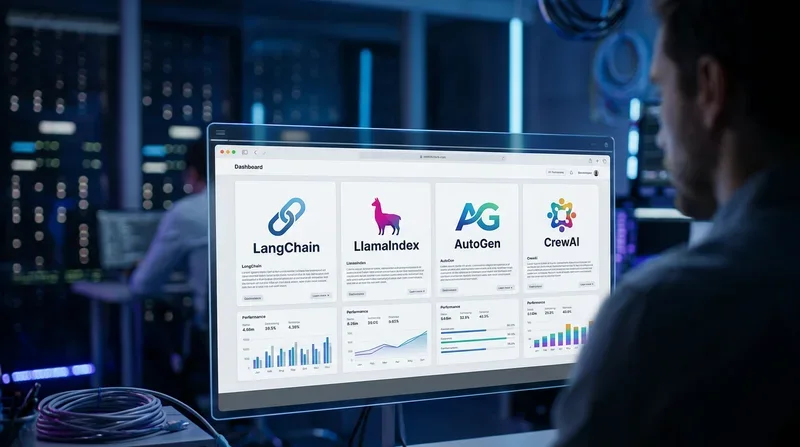
LangGraph handles complex state management using cyclical, graph-based architectures. This allows agents to loop back and retry failed actions seamlessly. Therefore, developers can build highly reliable, fault-tolerant systems with ease. It prevents the agent from crashing when an API call randomly fails. Ultimately, these two tools form the backbone of modern AI engineering.
LlamaIndex for Data-Driven Agents
Many agents need deep, secure access to proprietary enterprise data. In these specific cases, LlamaIndex stands out as the best-in-class framework. It excels at building highly accurate, RAG-enabled autonomous agents. Furthermore, it seamlessly connects massive document repositories directly to your reasoning engine. It handles data ingestion, chunking, and vectorization automatically.
As a result, your agent can synthesize information from thousands of PDFs instantly. Notably, LlamaIndex optimizes the retrieval process for maximum factual accuracy. It ensures the model only uses verified company data to make decisions. Therefore, it drastically reduces the risk of corporate data hallucinations. This makes it perfect for legal, financial, and medical applications.
Leading Multi-Agent Orchestrators
Single agents often struggle with highly complex, multi-disciplinary workflows. Therefore, multi-agent systems have gained massive popularity across the tech sector. Frameworks like AutoGen and CrewAI currently lead this collaborative revolution. CrewAI tutorial highlights often showcase incredibly complex role-playing AI teams. Specifically, you can assign distinct, specialized personas to different agents.
One agent might write software code, while another reviews it for security flaws. A third agent could then deploy the code to a testing environment. Consequently, this orchestration perfectly mimics a real human engineering department. It divides labor efficiently and ensures higher quality outputs. Furthermore, these frameworks manage the complex communication between the different personas.
Emerging Lightweight Python Libraries
Heavyweight enterprise frameworks are not always necessary for every project. In fact, many developers now prefer lightweight alternatives for simpler tasks. Emerging Python libraries dominate the 2026 landscape for rapid prototyping. These streamlined tools offer faster deployment times and significantly lower overhead. Additionally, they provide a cleaner alternative to older, clunky AutoGPT setups.
Developers appreciate the minimal boilerplate code required to launch an agent. They can spin up a functional prototype in mere minutes. However, these libraries might lack advanced state management features. Ultimately, choosing the right AI agent frameworks 2026 depends entirely on your specific needs. You must balance speed, complexity, and long-term scalability.
3. Step-by-Step Guide: Building Custom AI Agents with Python
Phase 1: Planning and Setup
Building a successful agent always starts with a clear, detailed blueprint. First, you must define the agent’s specific persona and core identity. What is its primary goal and its strict operational scope? Furthermore, crafting a robust system prompt is absolutely essential for success. This prompt dictates the rules of engagement and behavioral boundaries.

Without strict guidelines, the agent might wander off-task or hallucinate. Therefore, spend ample time refining these initial parameters before writing any code. You should outline exactly what the agent should and should not do. Additionally, define the specific metrics that will determine a successful task completion. Proper planning prevents massive headaches during the later coding phases.
Phase 2: Choosing the Right Model
The foundational LLM dictates your agent’s overall intelligence and reasoning capacity. In 2026, developers have incredible model options at their disposal. You might choose GPT-4.5 for complex, highly nuanced reasoning tasks. Alternatively, Claude 3.5 offers exceptional coding and deep analytical capabilities. Both are fantastic choices for enterprise-grade autonomous systems.
On the other hand, open-source models like Llama 3 provide cost-effective alternatives. Specifically, fine-tuned open-source models often match proprietary performance for specific niches. They also offer better data privacy since they run locally. Ultimately, select a model that perfectly balances cost, capability, and security requirements. Your choice will heavily impact the agent’s final performance.
Phase 3: Implementing Robust Memory
A forgetful agent is a deeply frustrating and inefficient agent. Therefore, integrating robust memory systems is a critical development phase. You should connect a vector database like Pinecone, Weaviate, or Qdrant immediately. These databases enable semantic search and rapid, accurate information recall. Specifically, they convert text into mathematical vectors for highly efficient storage.
When the agent needs historical context, it queries this database directly. As a result, the system maintains perfect continuity across long-running tasks. It remembers user preferences, past errors, and previously gathered data. Furthermore, you must implement a system to prune outdated memory periodically. This keeps the database fast and prevents context window overload.
Phase 4: Equipping External Tools
Next, you must give your agent digital hands to work with. This phase involves connecting external APIs and custom Python functions. For instance, you might integrate a web scraping tool for research. Additionally, you could provide read and write access to your CRM system. The agent needs crystal clear instructions on how to use each tool.
Therefore, you must define strict input and output schemas using JSON. Consequently, the LLM knows exactly when and how to trigger specific actions. It understands what data it needs to provide to the API. Moreover, you must implement robust error handling for these tools. If an API fails, the agent must know how to recover gracefully.
Phase 5: The Execution Loop
The execution loop is the absolute heartbeat of your custom agent. This core logic dictates how the system observes, thinks, and acts continuously. Typically, it follows a strict cycle of reasoning and execution. First, the agent evaluates the current state against its final goal. Then, it selects an appropriate tool and executes the action.
Afterward, it observes the result of that specific action carefully. If the result is unsatisfactory, it pivots and tries a different approach. Furthermore, you must implement strict safeguards to prevent infinite execution loops. You should set a maximum number of steps or a timeout limit. Ultimately, a well-coded loop ensures reliable, autonomous operation without human intervention.
4. Designing Multi-Agent Systems and Workflows
The Shift to Specialized AI Teams
The tech industry has rapidly moved beyond single-agent architectures. Today, specialized AI teams consistently outperform generalist agents in almost every metric. A single model often struggles to maintain context across vastly different tasks. It might excel at writing text but fail miserably at debugging code. However, a multi-agent system divides the labor efficiently among experts.
Each agent focuses entirely on a narrow, highly specific domain. One agent researches, one writes, and one reviews the final output. As a result, the overall output quality improves dramatically across the board. Furthermore, this approach reduces the cognitive load on any single model. Therefore, multi-agent systems represent the future of complex enterprise automation.
Architecting Collaborative Workflows
Designing these advanced systems requires careful, deliberate architectural planning. You can structure these collaborative workflows in several different ways. Hierarchical structures feature a manager agent that delegates tasks to various subordinates. The manager reviews their work and compiles the final deliverable. Alternatively, sequential workflows pass data down a strict, linear pipeline.
Meanwhile, decentralized structures allow agents to interact freely based on immediate needs. They communicate peer-to-peer without a central manager dictating every move. Choosing the right architecture depends entirely on your specific business process. A creative task might require decentralization, while data processing needs sequential pipelines. Ultimately, the architecture dictates how efficiently the team operates.
Managing Communication and State
Agents must communicate effectively to collaborate on complex projects. Therefore, managing inter-agent communication is a primary technical challenge for developers. They need a shared state to understand the project’s current status accurately. This shared memory ensures no two agents duplicate the exact same work. Furthermore, you must implement strict conflict resolution protocols.
What happens when two agents disagree on a specific technical approach? A robust system uses a consensus mechanism or a manager override function. Consequently, the workflow continues smoothly without requiring human intervention. Additionally, you must log all inter-agent communication for debugging purposes. This transparency is vital for refining the system over time.
Real-World Multi-Agent Orchestration
Let us look at practical applications of this incredible technology. Real-world examples often utilize advanced frameworks like CrewAI and AutoGen. For instance, a marketing team might deploy three distinct, specialized agents. One researches market trends, another writes copy, and the third optimizes formatting. They pass drafts back and forth seamlessly.
They critique each other’s work until the content is absolutely perfect. Ultimately, this orchestration drastically reduces project turnaround times for the company. Another example involves a cybersecurity team of agents monitoring network traffic. One detects anomalies, while another isolates the compromised server immediately. Therefore, multi-agent systems provide unparalleled speed and efficiency.
5. Real-World Use Cases for Generative AI Agents
Autonomous Software Engineering
AI agents are completely transforming the modern software development lifecycle. They now handle autonomous coding and incredibly complex debugging tasks daily. Developers simply provide a feature request, and the agent writes the code. Furthermore, agents conduct automated pull request reviews with incredible accuracy. They scan for security vulnerabilities and enforce strict coding standards.
They even write comprehensive unit tests for the newly generated code. As a result, human developers can focus entirely on high-level system architecture. They spend less time hunting for missing semicolons and more time innovating. Therefore, engineering teams are shipping products faster than ever before.
Advanced Customer Support Resolution
Traditional chatbots simply deflect customer inquiries to human agents. However, modern autonomous agents actually resolve complex, multi-step user issues. They can access billing systems, issue refunds, and update account details securely. Moreover, they do this entirely without any human intervention or oversight. They understand user frustration and adjust their tone accordingly.
This capability drastically reduces support ticket backlogs for large enterprises. Customers no longer wait on hold for hours to fix simple problems. Consequently, customer satisfaction scores typically see massive, immediate improvements. Businesses save millions in operational costs while providing superior service.
Research and Data Synthesis
Deep data analysis is another prime use case for autonomous agents. They perform autonomous web scraping to gather vital market intelligence continuously. Then, they synthesize this massive amount of raw data into actionable insights. Additionally, agents can generate comprehensive, fully formatted reports in seconds. They cross-reference multiple sources to ensure absolute factual accuracy.
If two sources conflict, the agent notes the discrepancy in the report. Ultimately, this saves financial analysts hundreds of hours of tedious manual labor. They can review the synthesized insights instead of reading raw data feeds. Therefore, strategic decision-making becomes significantly faster and more data-driven.
Financial and Operational Automation
Enterprise operations benefit massively from highly capable agentic automation. Agents seamlessly handle tedious administrative tasks like complex invoice processing. They extract data, verify totals, and update accounting software without errors. Furthermore, they monitor global supply chains for potential disruptions in real-time. They track weather patterns, port delays, and supplier inventory levels.
By utilizing predictive analytics, they can even suggest proactive inventory adjustments. If a storm threatens a shipping route, the agent reroutes the cargo automatically. Therefore, companies achieve unprecedented levels of operational efficiency and resilience. They mitigate risks before they impact the bottom line.
6. Challenges, Limitations, and AI Agent Development Costs
Overcoming Technical Hurdles
Building autonomous agents is certainly not without significant technical challenges. Mitigating AI hallucinations remains a primary concern for developers in 2026. Agents sometimes invent facts or misuse their provided tools entirely. Additionally, preventing infinite execution loops requires strict, foolproof programmatic safeguards. If an agent gets stuck, it can drain your API budget rapidly.
Managing latency is also crucial for real-time, user-facing applications. Users will not wait five minutes for an agent to formulate a plan. Therefore, developers must implement robust error handling and strict timeout protocols. They must optimize the reasoning loop to execute as quickly as possible. Overcoming these hurdles separates toy projects from enterprise-grade solutions.
Mitigating Security Risks
Security is absolutely paramount when agents access external company systems. Defending against malicious prompt injection attacks is a critical priority. Bad actors might try to hijack the agent’s instructions to steal data. Furthermore, securing unauthorized API access prevents catastrophic corporate data breaches. You must use strict permission boundaries and isolated execution environments.
Consequently, the agent can only access explicitly approved resources and databases. It should never have root access to your entire infrastructure. Additionally, implement strict logging for every single action the agent takes. This audit trail is vital for identifying and neutralizing security threats quickly.
Breaking Down Financial Costs
Developing and running agents incurs various ongoing financial expenses. Understanding these development costs is vital for accurate project planning. API token usage often represents the absolute largest ongoing expense. Every thought, observation, and action consumes valuable tokens from your provider. Complex multi-agent workflows can burn through budgets surprisingly fast.
Additionally, you must factor in infrastructure expenses for hosting vector databases. High-performance memory systems require dedicated servers and significant compute power. Hosting containerized applications also adds to the monthly cloud computing bill. Therefore, you must forecast these costs accurately before deploying to production.
Strategies for Token Optimization
Strict cost control requires highly proactive management strategies and oversight. Optimizing token consumption is essential for sustainable operations in 2026. You can use smaller, specialized models for simple routing and formatting tasks. Meanwhile, reserve expensive models like GPT-4.5 exclusively for complex reasoning. This hybrid approach drastically reduces your overall token expenditure.
Furthermore, implementing semantic caching prevents redundant, expensive API calls. If an agent asks a similar question twice, it retrieves the cached answer. Additionally, you should truncate conversation history to the minimum required context. Ultimately, these strategies significantly reduce your operational overhead without sacrificing performance.
7. Best Practices for Testing, Deploying, and Monitoring
Establishing Robust Testing Environments
You absolutely cannot deploy an autonomous agent without rigorous testing. Establishing robust testing environments ensures reliable performance under heavy stress. You must simulate edge cases, API failures, and malicious user inputs. Furthermore, implementing Human-in-the-Loop (HITL) safety protocols is highly recommended initially. This allows a human to approve high-stakes actions before execution.
For example, an agent should never execute a financial trade autonomously at first. A human supervisor must review the logic and authorize the transaction. Therefore, HITL provides a crucial safety net during early deployment phases. Once the agent proves its reliability, you can gradually increase its autonomy.
Containerization and Cloud Deployment
Proper deployment architecture guarantees long-term system stability and scalability. Developers typically containerize AI agents using tools like Docker. This ensures consistent performance across vastly different computing environments. It eliminates the dreaded “it works on my machine” problem entirely. Subsequently, they deploy these containers to scalable cloud infrastructure.
Platforms like AWS or Google Cloud handle dynamic workload fluctuations automatically. If your agent goes viral, the cloud spins up additional instances instantly. As a result, your agent remains highly responsive during massive traffic spikes. Proper deployment architecture is just as important as the agent’s code.
Real-Time Monitoring and Analytics
Deployment is truly only the beginning of the software lifecycle. Real-time monitoring is absolutely essential for maintaining agent health and efficiency. You must track agent behavior, success rates, and overall token usage continuously. Additionally, analyzing decision-making pathways helps identify logical flaws in the system. You need to know exactly why an agent failed a task.
Specialized observability tools provide beautiful visual dashboards for these critical metrics. They alert you instantly if the agent starts throwing continuous errors. Consequently, you can spot and resolve issues before they escalate into disasters. Proactive monitoring ensures your digital workforce remains highly productive.
Continuous Iteration and Improvement
AI agents require ongoing maintenance, refinement, and continuous updates. Continuous iteration is the absolute key to long-term operational success. You should regularly analyze agent logs to identify frequent failure points. Then, use this valuable data to refine your core system prompts. Sometimes, a simple prompt tweak fixes a massive behavioral issue.
Moreover, you can improve tool execution by updating API schemas regularly. As new models release, you should benchmark them against your current setup. Ultimately, an agent should grow smarter and more efficient over time. It is a living system that requires constant nurturing and optimization.
Conclusion
Building autonomous AI agents in 2026 requires deep, specialized technical knowledge. You need a solid understanding of LLM architecture and advanced memory management. Furthermore, seamless tool integration is vital for practical, real-world functionality. By leveraging modern frameworks like LangChain and CrewAI, you unlock massive potential. Developers can create highly capable multi-agent systems today with relative ease.
These advanced systems effectively automate incredibly complex business workflows across all industries. They reduce costs, increase efficiency, and eliminate tedious manual labor entirely. The transition from reactive chatbots to proactive digital workers is fully underway. Ready to build your first autonomous agent? Start exploring our recommended 2026 AI frameworks immediately, or contact our AI engineering team for a custom development consultation.